What Makes Your Elbow Bend?
Root Concept
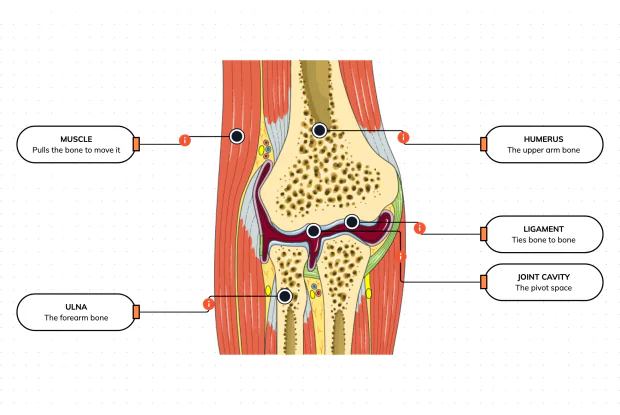
A joint does not move itself: a muscle crossing it pulls the two bones toward each other, ligaments tie bone to bone so the joint stays together, and the fluid-filled joint cavity is the low-friction space where the bones pivot.
CodePLU Goal
Upgrading Human Mental Models
Learn how to think in Workflows
Concept Development By codeplu.com
Each part that turns the elbow into movement, joined to the job it does — pull, anchor, hold or pivot
If Bones and Joints Are Just Hardware, What Actually Moves Them?
You have already seen what a bone is made of and what a joint is made of — but a skeleton, on its own, cannot move a muscle. Left to itself it would just collapse in a heap. Bones are levers and joints are hinges, yet a lever does not swing and a hinge does not open until something pulls on it. That something is muscle, and this tutorial is about the parts that turn the elbow from a static hinge into real movement.
A muscle is a band of tissue that can do exactly one thing: shorten, and by shortening, pull. At the elbow, a muscle runs down from the upper arm, crosses the joint, and attaches to a forearm bone. When it shortens it pulls that forearm bone up toward the upper arm — and that pull is what bending your elbow actually is. The bones are the levers; the muscle is the engine; the joint is the pivot they turn around.
Two more parts make it work safely. Ligaments — tough bands tying bone directly to bone — hold the joint together so the muscle's pull bends it rather than pulls it apart. And the fluid-filled joint cavity between the bones lets them pivot with almost no friction. In the playground above you will label the muscle, the two bones it links, the ligament and the joint cavity — and the label on each connection tells you the job that part does.
What Turns a Joint Into Movement?
Why can't a joint move on its own?
Because bones and joints are passive — they are hardware with no engine of their own. A bone is a rigid lever and a joint is a low-friction hinge, but a lever only swings when a force is applied to it, and nothing inside the joint itself supplies that force. Take away the muscles and the whole skeleton simply falls into a pile: the parts that let it move are still all there, but there is nothing left to move them. Movement is never something the joint does by itself; it is always something a muscle does to the joint.
How does a muscle actually move the bone?
A muscle works by shortening — its fibres contract and the whole muscle gets shorter and fatter — and because both of its ends are anchored to bone, shortening drags those two anchor points toward each other. At the elbow, the muscle is fixed to the upper arm bone at the top and to a forearm bone at the bottom, crossing the joint in between. When it shortens, the upper anchor barely moves but the forearm swings up toward it, and the elbow bends. That is the whole mechanism: a muscle spans a joint and pulls its two bones together.
Why does a muscle need two different bones?
A muscle can only pull its two ends together, so it must be attached to two separate bones with a joint between them — otherwise there would be nothing to move. One bone acts as the fixed anchor (here the humerus of the upper arm, which stays roughly still) and the other is the one that actually swings (the forearm bone). If a muscle attached to only one bone, or spanned no joint, its pull would do nothing useful. Crossing from one bone to another, over a joint, is exactly what lets a muscle turn its pull into movement.
What stops the joint from pulling apart?
The same pull that bends the joint could, in principle, wrench the bones apart — so ligaments hold them together. A ligament is a strong, slightly stretchy band running straight from one bone to the other, across the joint, and it lets the bones swing in the direction they are meant to while stopping them separating or bending sideways. Muscles move the joint; ligaments make sure it only moves the right way. This is why a torn ligament leaves a joint feeling loose and unstable even when the muscles are fine.
Where does the actual bending happen?
At the joint cavity — the narrow, fluid-filled gap where the ends of the two bones meet. This is the pivot: as the muscle pulls, the forearm bone rotates around this space, its smooth end gliding against the upper arm bone almost without friction because of the slippery fluid there. The muscle supplies the force, the bones are the levers, the ligaments hold it all in line, and the joint cavity is the frictionless point they all turn around. Take any one of them away and the movement fails.
Real World Example
Why Do the Muscles at a Joint Come in Pairs?
Feel the front of your upper arm as you bend your elbow, then the back of it as you straighten your arm: two different muscles bulge, one for each direction. Almost every joint is worked by a matched pair like this, and the reason comes straight from how a muscle moves a bone:
A muscle can only pull
Never push
A muscle has exactly one move: it shortens, and by shortening it pulls its two ends together. It cannot lengthen itself to push, any more than a piece of rope can push a load — it can only haul. So the muscle on the front of your upper arm, the biceps, can pull your forearm up and bend the elbow, but once the arm is bent that same muscle has no way to shove it back down again. Pulling is the whole of what a muscle does, and that single limitation shapes how every joint in your body has to be wired.
So each joint needs a pulling partner
One muscle per direction
If a muscle can only pull one way, then a joint that has to move both ways needs a second muscle pulling the opposite way. At the elbow, the biceps on the front pulls the forearm up to bend the arm; the triceps on the back pulls it down to straighten the arm. They sit on opposite sides of the same joint and pull in opposite directions, so between them they can drive the movement either way. When one shortens to do its job, the other relaxes and is stretched, ready to haul the bone back when its turn comes. Neither is a backup — each is the only thing that can undo the other's pull.
What this tells you
Movement is a tug of war
Every movement you make is really a controlled tug of war between opposing muscles pulling across a joint. This is why muscles almost always come in antagonistic pairs — biceps and triceps at the elbow, and the same arrangement at the knee, the wrist, the jaw and beyond. It also explains why you can hold a position perfectly still: both muscles pull at once, balancing each other, and the joint stops wherever their pulls are equal. Understanding that a muscle can only pull, never push, is the key that makes the whole design of the moving body suddenly make sense.
FAQs
Final Words
A skeleton is a set of levers and hinges with no engine — it takes muscle to bring it to life. At the elbow a muscle crosses the joint and pulls one bone toward the other, ligaments tie the bones together so the pull bends the joint instead of wrenching it apart, and the fluid-filled joint cavity gives the bones a frictionless place to pivot. Force, levers, stabilisers and a pivot: movement needs all four working together.
Label the muscle, the humerus, the ulna, the ligament and the joint cavity, and you will see why muscles come in pulling pairs and why a joint is useless without them. With what a bone is, what a joint is, and what moves a joint all in place, the named bones of the skeleton become pieces you can picture fitting, holding and moving together.
Continue This Track
This concept is part 3 of The Human Body, Head to Toe.
What Is a Bone Made Of?
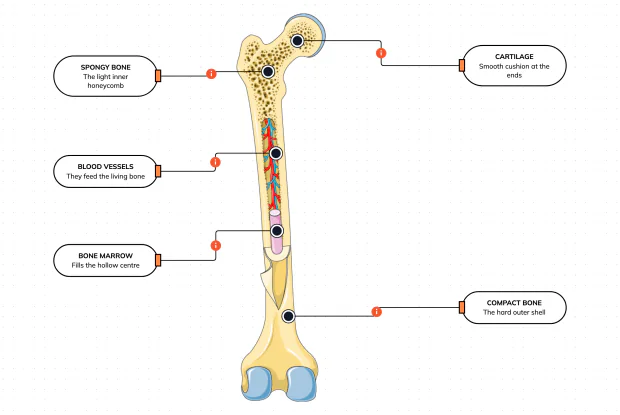
Cut a bone open and it is nowhere near solid: a hard outer shell, a light honeycomb inside, a hollow centre full of marrow, blood vessels threading through, and a smooth cushion at each end. Learn what each part does — then label them yourself in an interactive playground.
What Is Inside Your Elbow Joint?
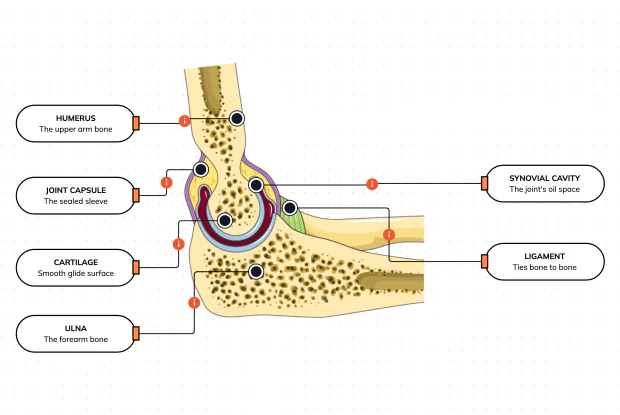
A joint is where two bones meet and move — and it is far more than just the bones. Cut open the elbow and you find smooth cartilage caps, a sealed capsule of slippery fluid, and tough ligaments holding it all together. Learn what each part does, then label them yourself in an interactive playground.
What Makes Your Elbow Bend?
Bones and joints are just the hardware; nothing moves until a muscle pulls. Label the elbow to see the parts that turn a joint into movement — the muscle that pulls, the ligament that holds bone to bone, the two bones it links, and the space they pivot in — then build it yourself in an interactive playground.
What Holds Your Elbow Together?
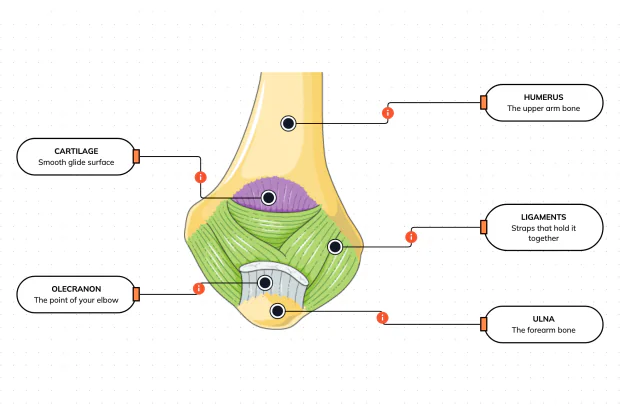
Your elbow is pulled on all day — by gravity, by every bag you carry, by every time you hang or push. So what stops the two bones from simply coming apart? Look at the back of the elbow and label the ligaments, the bony point, the cartilage and the two bones — and learn what holds the whole joint together.
What Are the Main Bones of the Skull?
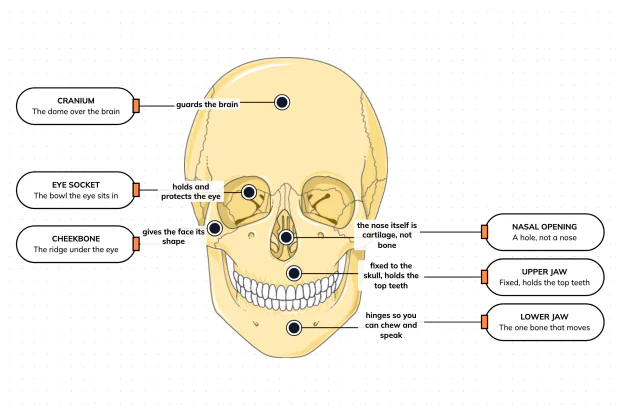
The skull looks like a single bone, but it is really about twenty-two locked together — with just one left free to move. Learn what each main part does, then label a skull yourself in an interactive playground.
What Are the Parts of Your Ear?
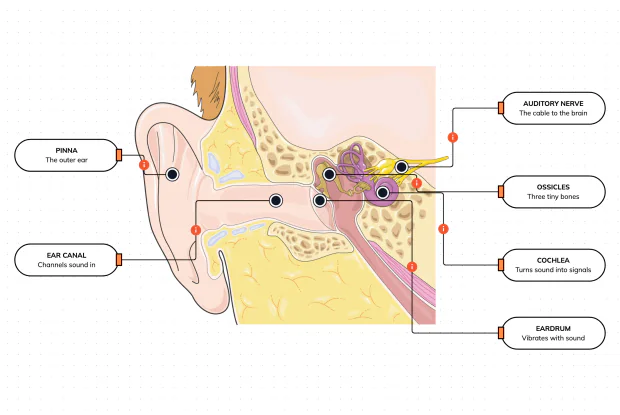
Hearing is a chain of parts passing a sound along, each handing it to the next. Label the pinna, ear canal, eardrum, ossicles, cochlea and auditory nerve, and follow a sound all the way from the air outside to a signal your brain can read — in an interactive playground.
How Does Your Ear Keep You Balanced?
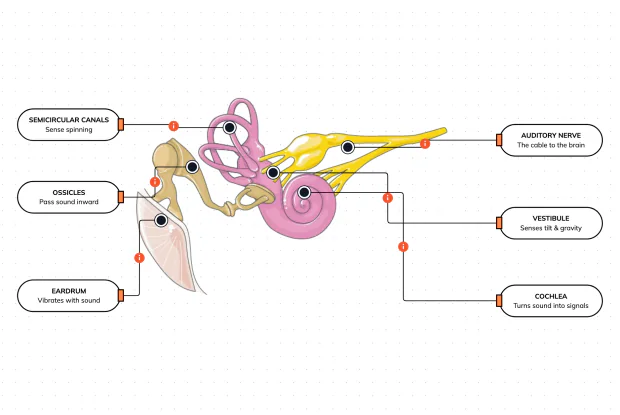
Your ear does a second, hidden job: balance. Inside it sit fluid-filled loops that sense spinning and a chamber that senses tilt and gravity. Label the semicircular canals, vestibule, cochlea, ossicles, eardrum and nerve, and learn how one organ both hears and keeps you upright — in an interactive playground.
What Are the Parts of the Eye You Can See?
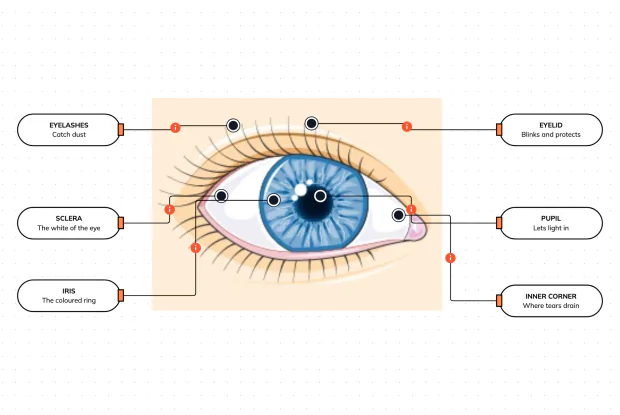
Before you look inside the eye, learn the parts you can already see in a mirror. Label the pupil, iris, sclera, eyelid, eyelashes and the tear-duct corner, and learn what each visible part does to let in light and protect the eye — in an interactive playground.
Where Do Your Tears Come From and Go?
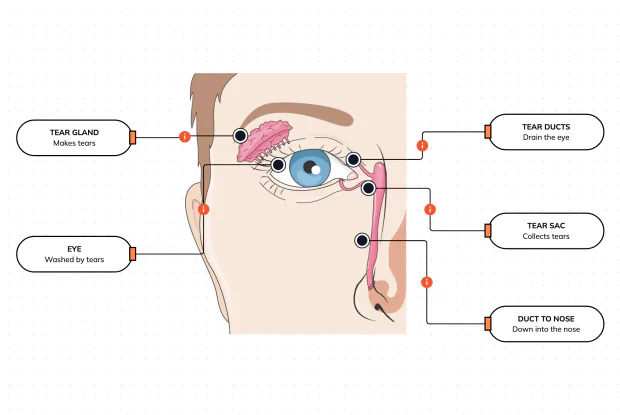
Your eyes make and drain tears all day to stay clean and wet. Label the tear gland, the eye, the tear ducts, the tear sac and the duct to the nose, and follow a tear from where it is made to where it drains — in an interactive playground.
How Does Your Eye Turn Light Into a Picture?
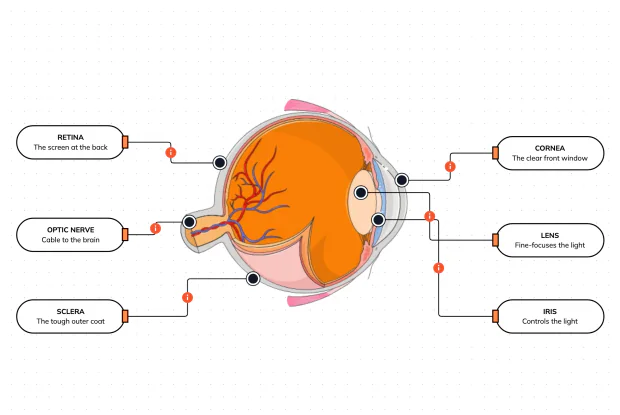
Your eye works like a living camera. Cut it open and label the cornea, lens, iris, retina, optic nerve and sclera, and follow light as it is focused onto a screen at the back of the eye and sent to the brain — in an interactive playground.