Where Do Your Tears Come From and Go?
Root Concept
Tears are made by the lacrimal (tear) gland above the outer eye, spread across the eye by blinking to keep it clean and wet, then drain through tiny openings at the inner corner into the tear ducts, collect in the lacrimal sac, and flow down the nasolacrimal duct into the nose.
CodePLU Goal
Upgrading Human Mental Models
Learn how to think in Workflows

Concept Development By codeplu.com
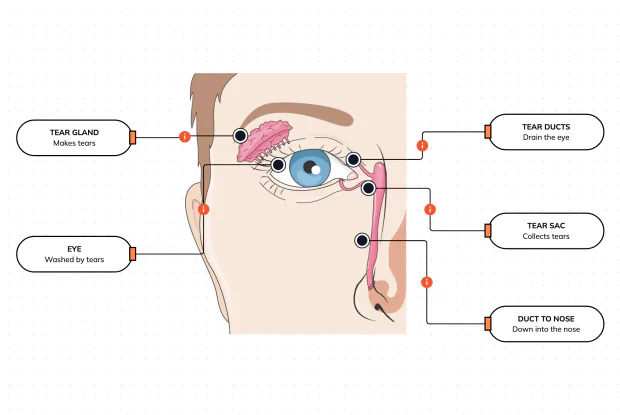
The tear system, each part joined to the job it does — making tears, washing the eye, and draining them away into the nose
Where Do Tears Come From — and Where Do They Go?
You only think about tears when you cry, but your eyes are being bathed in them every waking second. A thin film of tears covers the front of each eye all the time, and it has to — without it the surface would dry out, sting and scratch within minutes. So your eye runs a constant, quiet plumbing system: a tap that makes fresh tears, a wiper that spreads them, and a drain that carries the used ones away. This figure shows that whole system on one face, and once you see it, several everyday mysteries — like why crying makes your nose run — suddenly make sense.
The tap is the tear gland (the lacrimal gland), a small gland tucked above the outer corner of the eye. It steadily makes tears and releases them onto the eye, and it can open right up to flood the eye when you cry or when something irritates it. Each blink then acts as the wiper, sweeping that fresh fluid across the whole front of the eye — cleaning off dust, keeping the surface moist and smooth, and even helping to kill germs.
Then the used tears have to go somewhere, and they drain toward the inner corner of the eye, nearest the nose. There, tiny openings called the tear ducts suck the tears off the eye into a small tear sac, which empties down a tube — the duct to the nose — into the nose itself. So tears do not simply evaporate; they are piped away internally. In the playground above you will label the gland that makes tears, the eye they wash, and the ducts, sac and tube that drain them — and the label on each connection tells you the job that part does.
How Does the Tear System Work — Part by Part?
What makes your tears?
Tears are made by the lacrimal gland — the tear gland — a small gland sitting just above and to the outer side of each eye. It works quietly all day, producing a small, steady trickle of tears that keeps the eye's surface wet; this is the 'basal' flow you are never aware of. But it can also crank up dramatically: when you cry, or when your eye is irritated by smoke, onions or a speck of grit, the gland pours out a flood of tears to wash the trouble away or express emotion. Because it sits at the top-outer corner, the tears it releases spread down and across the eye toward the inner corner, which is exactly where the drainage is — so the whole eye gets bathed on the way.
What do tears do for the eye?
Tears are not just salty water — they are the eye's cleaning, protection and comfort system, and the eye genuinely cannot work without them. Every blink sweeps a fresh layer of tears across the front of the eye, and that film does several jobs at once: it washes away dust and grit, it keeps the surface moist so it does not dry out and sting, it contains substances that kill bacteria, and it fills in tiny irregularities to give the eye a smooth, clear optical surface to see through. This is why a dry eye is not just uncomfortable but actually sees less clearly, and why you blink far more than you need to just for wetting — the tears are doing constant maintenance on the window you look through.
How do tears drain away?
If tears were only ever made and never drained, your eyes would permanently overflow — so there is a drainage system, and it starts at the inner corner of the eye, nearest the nose. Here there are tiny openings called the tear ducts (or puncta and canaliculi): little holes on the edges of the upper and lower lids that act like plugholes, drawing the used tears off the surface of the eye. Every blink helps pump tears toward these openings. You can actually see the drainage side of the system as the little pink structures crowded at the inner corner in the figure. Normally the tap and the drain are balanced, so a steady film stays on the eye and the surplus is quietly carried away.
What are the tear sac and the duct to the nose?
Once the tear ducts have drawn tears off the eye, the tears collect in a small pouch called the tear sac (the lacrimal sac), tucked at the inner corner beside the nose. From the sac, a longer tube — the nasolacrimal duct, the 'duct to the nose' — runs downward and empties the tears into the inside of your nose. So the drainage is a little pipeline: openings, then sac, then duct, then nose. This is the part most people never realise exists: your eyes and your nose are directly connected by this tube. It is why the whole tear system is sometimes summed up as 'the eyes drain into the nose', and it explains one of the most familiar experiences of all.
Why does crying make your nose run?
Because your eyes drain into your nose. Normally the tear gland makes just a little fluid and the drainage carries it quietly away, so you notice nothing. But when you cry, the gland floods the eye with far more tears than the little drainage pipes can cope with — so some spill over your eyelids as the tears you can see, and the rest pour down the nasolacrimal duct into your nose all at once. That sudden rush of watery fluid into the nose is what makes it run when you cry. The very same plumbing explains why eye drops can leave a strange taste in your throat, and why a cold, which swells the lining of the nose and blocks the duct's opening, can make your eyes water.
Real World Example
Why Does Crying Make Your Nose Run?
The tear system is easy to ignore until it does something obvious. Three everyday experiences show each part of it in action:
Why crying makes your nose run
The drainage into the nose
It feels strange that sadness makes your nose run, but the plumbing explains it completely. Your eyes drain into your nose through the nasolacrimal duct, all day, unnoticed, because normally only a tiny trickle of tears is being carried away. When you cry, the tear gland floods the eyes with far more fluid than usual — more than the drainage can handle. Some of it brims over your lower lids as visible tears, and the rest gushes down the ducts into your nose, mixing with mucus and pouring out as a runny nose. So a runny nose while crying is simply the overflow of tears taking their normal exit route, just in a sudden flood. The same connection is why, after using eye drops, you can sometimes taste them at the back of your throat.
Why your eyes water in cold wind
The tear gland's reflex
Step out into a cold, blustery day and your eyes stream, even though you are not upset. This is the tear gland's reflex response. Cold air and wind dry and irritate the surface of the eye, and the gland reacts the way it does to any irritation — by making extra tears to protect and soothe the surface. It over-produces, and again the little drainage system cannot keep up with the sudden surplus, so tears well up and spill down your cheeks. It is the same reflex that floods your eyes when you chop onions or get a speck of dust in your eye: the gland's job is to wash trouble away, so its answer to almost any irritation is simply 'more tears', and the overflow is what you feel running down your face.
Why some babies have a constantly watery eye
A blocked tear duct
Quite a few newborn babies have one eye that constantly wells up and weeps, even when they are perfectly content. Usually this is a blocked tear duct: the nasolacrimal duct that should carry tears down into the nose has not fully opened yet, a very common and harmless situation at birth. Because the drain is blocked while the gland keeps making its normal tears, the fluid has nowhere to go and simply overflows the eye all the time. It is the tear system with a working tap but a plugged drain. Most clear up on their own within the first year as the duct opens, which is why doctors usually just advise gentle massage and patience — a neat, everyday demonstration that tears really do need somewhere to drain.
FAQs
Final Words
Your eyes run a constant plumbing system you never think about. The tear gland above the outer eye makes tears; blinking spreads them across the eye to keep it clean, wet and clear; and the used tears drain at the inner corner through the tear ducts into the tear sac, then down the nasolacrimal duct into the nose. A tap, a wiper and a drain, working all day so the window you see through stays clean and comfortable.
Once you can see the drain running into the nose, everyday puzzles solve themselves — why crying makes your nose run, why cold wind and onions make your eyes stream, and why a baby's blocked duct leaves an eye weeping. This is the last piece of the eye: you have now met it from the outside and inside, followed the light to the retina and on to the brain, seen the muscles that aim it, and the tears that keep it clean. From here the head-to-toe tour of the body moves on down the neck.
Continue This Track
This concept is part 9 of The Human Body, Head to Toe.
What Is a Bone Made Of?
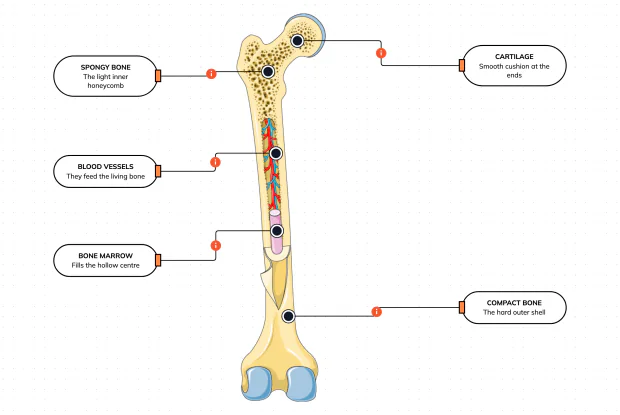
Cut a bone open and it is nowhere near solid: a hard outer shell, a light honeycomb inside, a hollow centre full of marrow, blood vessels threading through, and a smooth cushion at each end. Learn what each part does — then label them yourself in an interactive playground.
What Is Inside Your Elbow Joint?
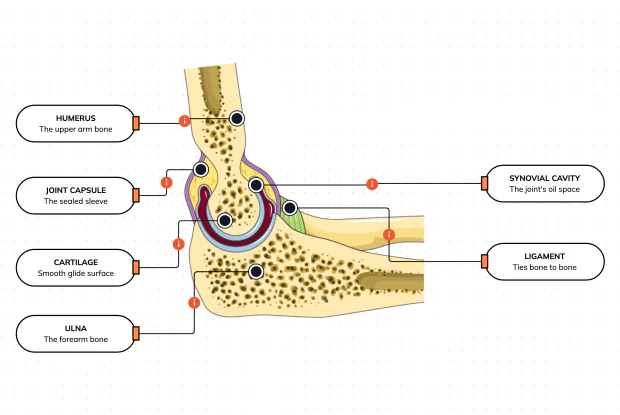
A joint is where two bones meet and move — and it is far more than just the bones. Cut open the elbow and you find smooth cartilage caps, a sealed capsule of slippery fluid, and tough ligaments holding it all together. Learn what each part does, then label them yourself in an interactive playground.
What Makes Your Elbow Bend?
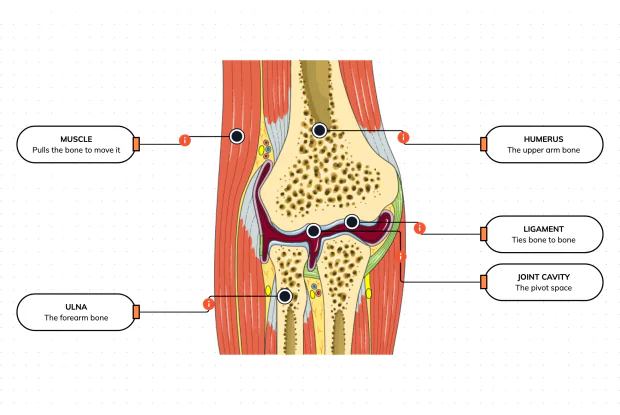
Bones and joints are just the hardware; nothing moves until a muscle pulls. Label the elbow to see the parts that turn a joint into movement — the muscle that pulls, the ligament that holds bone to bone, the two bones it links, and the space they pivot in — then build it yourself in an interactive playground.
What Holds Your Elbow Together?
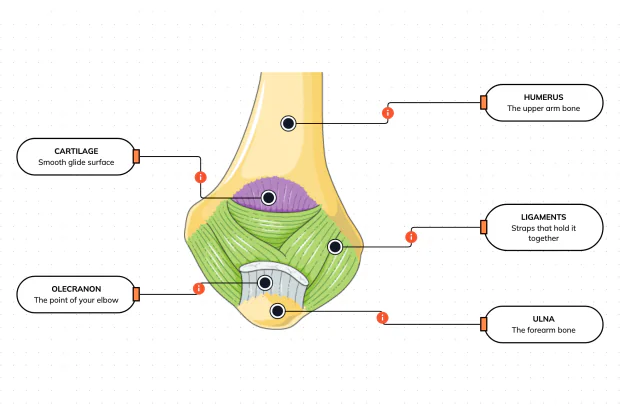
Your elbow is pulled on all day — by gravity, by every bag you carry, by every time you hang or push. So what stops the two bones from simply coming apart? Look at the back of the elbow and label the ligaments, the bony point, the cartilage and the two bones — and learn what holds the whole joint together.
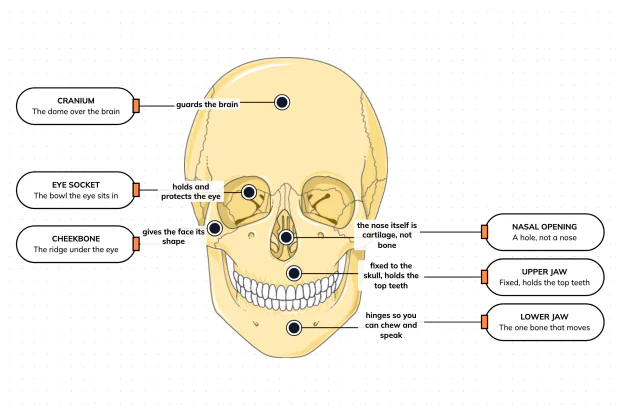
What Are the Main Bones of the Skull?
The skull looks like a single bone, but it is really about twenty-two locked together — with just one left free to move. Learn what each main part does, then label a skull yourself in an interactive playground.
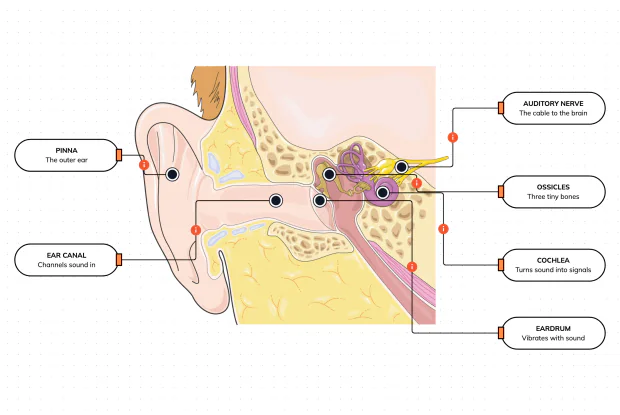
What Are the Parts of Your Ear?
Hearing is a chain of parts passing a sound along, each handing it to the next. Label the pinna, ear canal, eardrum, ossicles, cochlea and auditory nerve, and follow a sound all the way from the air outside to a signal your brain can read — in an interactive playground.
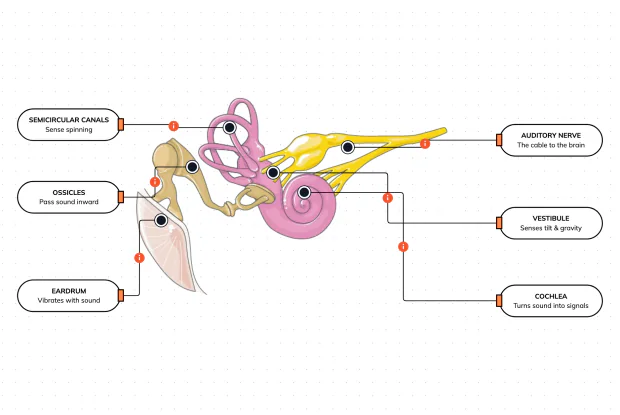
How Does Your Ear Keep You Balanced?
Your ear does a second, hidden job: balance. Inside it sit fluid-filled loops that sense spinning and a chamber that senses tilt and gravity. Label the semicircular canals, vestibule, cochlea, ossicles, eardrum and nerve, and learn how one organ both hears and keeps you upright — in an interactive playground.
What Are the Parts of the Eye You Can See?
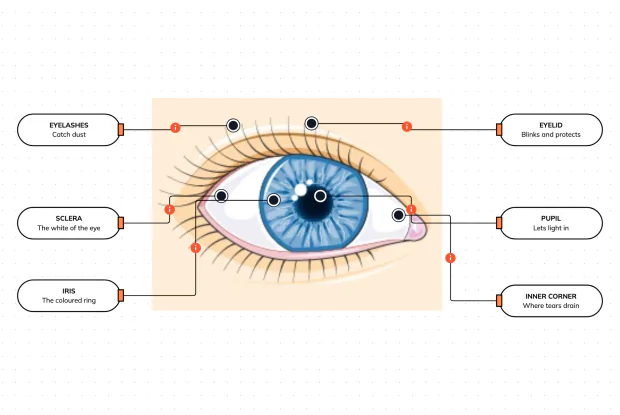
Before you look inside the eye, learn the parts you can already see in a mirror. Label the pupil, iris, sclera, eyelid, eyelashes and the tear-duct corner, and learn what each visible part does to let in light and protect the eye — in an interactive playground.
Where Do Your Tears Come From and Go?
Your eyes make and drain tears all day to stay clean and wet. Label the tear gland, the eye, the tear ducts, the tear sac and the duct to the nose, and follow a tear from where it is made to where it drains — in an interactive playground.
How Does Your Eye Turn Light Into a Picture?
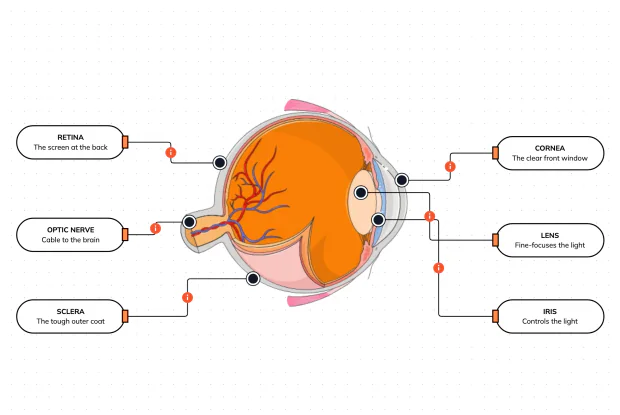
Your eye works like a living camera. Cut it open and label the cornea, lens, iris, retina, optic nerve and sclera, and follow light as it is focused onto a screen at the back of the eye and sent to the brain — in an interactive playground.