What Is Inside Your Elbow Joint?
Root Concept
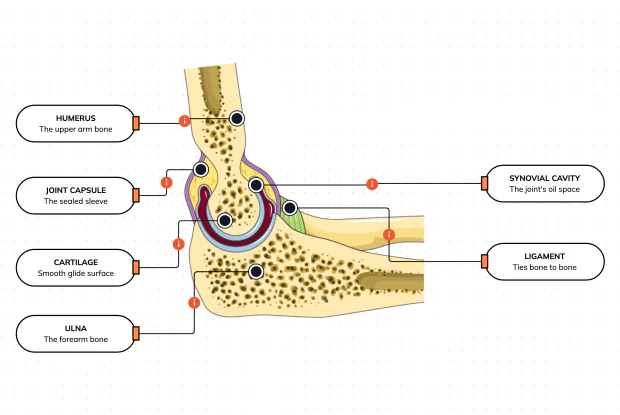
A joint is where two bones meet and move: at the elbow the humerus and ulna meet, their ends capped with smooth cartilage, sealed inside a fluid-filled capsule that lubricates every movement, and lashed together by ligaments that keep it stable while it bends.
CodePLU Goal
Upgrading Human Mental Models
Learn how to think in Workflows

Concept Development By codeplu.com
Each part of a synovial joint, joined to the job it does — glide, seal, lubricate or hold together
What Actually Lets Your Elbow Bend Without Wearing Out?
Bend and straighten your arm a few times. That smooth, silent, effortless movement is happening at a joint — the place where two bones meet and are built to move against each other. You will do it hundreds of thousands of times a year, for decades, and it never rusts, squeaks or seizes up. No machine hinge comes close. The secret is that a joint is not just two bones touching; it is a small, sealed, self-oiling system, and the elbow is a perfect one to open up and look inside.
At the elbow, the upper arm bone (the humerus) meets a forearm bone (the ulna). But their bare ends never actually touch. Each end is capped with a smooth, slippery layer of cartilage, and the whole meeting point is wrapped in a sealed bag called the joint capsule. Inside that capsule is a thin film of fluid — the synovial fluid — that lubricates the surfaces so they glide almost without friction, the way a drop of oil frees a stiff hinge.
Holding the whole thing together are ligaments: tough bands that tie bone directly to bone, so the joint can move freely in the direction it is meant to while staying stable and not falling apart. In the playground above you will label the two bones, the cartilage, the capsule, the fluid-filled cavity and a ligament — and the label on each connection tells you the job that part does.
What Is Each Part of a Joint For?
What is a joint, exactly?
A joint is simply the place where two bones meet — but the interesting joints are the ones built to move, called synovial joints, and the elbow is one of them. Here the humerus of the upper arm meets the ulna of the forearm, and the joint is engineered so the ulna can swing toward and away from the humerus: that is what bending and straightening your arm actually is. The elbow is a hinge joint, meaning it moves cleanly on one axis — open and shut like a door — rather than twisting or swivelling. Every part inside it exists to make that one movement smooth, stable and long-lasting.
Why don't the two bones grind against each other?
Because their ends never actually touch bare bone on bare bone. Each bone end is capped with articular cartilage — a smooth, glassy, slightly rubbery layer that is far slipperier than bone. It lets the surfaces glide over one another with almost no friction, and it cushions the impact every time you lean on your elbow or take a knock. Bare bone grinding on bare bone would wear away fast and hurt badly; that is exactly what happens in arthritis, when the cartilage is lost. Healthy cartilage is what keeps the movement silent and painless.
What is the joint capsule and the fluid inside it?
The whole joint is wrapped in a joint capsule — a tough, sealed sleeve of tissue that encloses the meeting point of the bones like a bag. Its job is partly to hold the bones together, but mostly to seal in a small amount of slippery liquid called synovial fluid. That fluid fills the space inside the capsule (the synovial cavity) and works exactly like oil in a machine: it coats the cartilage surfaces so they slide freely, and it feeds the cartilage, which has no blood supply of its own. Seal plus fluid is what makes the joint self-lubricating.
What holds the joint together?
Ligaments do. A ligament is a strong, slightly stretchy band that ties one bone directly to another, right across the joint. At the elbow, ligaments run along the sides linking the humerus to the forearm bones, and they are what stop the joint pulling apart or bending sideways in a way it should not. They allow the movement the joint is designed for — the clean hinge swing — while blocking the movements that would damage it. When people 'tear a ligament', this is the tissue they mean, and it is why the joint then feels loose and unstable.
Why is the elbow a hinge and not a ball-and-socket?
Because of the shape where the bones meet. The end of the humerus has a spool-shaped surface that fits into a matching notch on the ulna, and that interlocking shape only permits movement along one axis — bend and straighten. It cannot swivel like the shoulder, which is a ball sitting in a socket. That is a deliberate trade: the hinge shape gives up the freedom to rotate in exchange for strength and stability in the one direction that matters, so you can lift and push hard through your forearm without the joint wobbling.
Real World Example
Why Don't Your Joints Wear Out Like the Hinges on a Door?
Think of a door hinge, or the pivot on a pair of scissors: metal rubbing on metal, needing oil, slowly wearing loose and starting to squeak. Your elbow does the same job millions more times and outlasts them all. Opening the joint shows exactly why:
The surfaces are capped, not bare
Articular cartilage
A door hinge is bare metal grinding on bare metal, so every swing scrapes a tiny bit of material away and the surfaces slowly roughen and wear loose. Your elbow never lets the hard surfaces touch: each bone end is capped with a layer of smooth articular cartilage, slicker and more giving than bone or metal. The two cartilage caps glide over each other with a fraction of the friction, and the layer also squashes slightly to absorb shocks that would dent a rigid hinge. Nothing hard ever rubs directly on anything hard, which is the first reason the joint does not grind itself away.
It oils itself, in a sealed bag
Capsule + synovial fluid
A hinge only stays smooth if someone remembers to oil it, and the oil drips away and collects grit. Your elbow carries its own oil and never loses it: the joint capsule is a sealed sleeve that traps a film of slippery synovial fluid permanently around the cartilage. Every time the joint moves it spreads that fluid across the surfaces and even presses fresh fluid into the cartilage, so the lubrication renews itself with use instead of wearing out. It is also why gentle movement keeps a joint healthier than holding it dead still — moving is what circulates the fluid and works it into the cartilage. A self-contained, self-refreshing oil system in a sealed bag is something no ordinary hinge has.
What this tells you
A joint is a system, not a pivot
The reason your elbow beats any machine hinge is that it is not just a pivot point — it is a complete little system where every part protects the movement. Cartilage stops the hard surfaces touching, synovial fluid keeps them slippery, the sealed capsule keeps that fluid in and clean, and ligaments hold the whole thing in line so nothing rubs where it shouldn't. Remove any one of them and the joint would fail the way a hinge does. Understanding a joint means seeing it as that cooperating set of parts, which is also why joint problems like arthritis are really the failure of one part — usually the cartilage — rather than the bones themselves wearing out.
FAQs
Final Words
A joint is a small, self-oiling system, not just a place where two bones touch. At the elbow the humerus and ulna meet, but their ends are capped with smooth cartilage, sealed inside a capsule of slippery synovial fluid, and lashed together by ligaments — so the joint bends freely, silently and painlessly, and holds firm while it does. Every part has one job, and the movement depends on all of them working together.
Label the two bones, the cartilage, the capsule, the synovial cavity and the ligament, and you will understand not just the elbow but every movable joint in your body — the knee, the hip, the knuckles all follow the same design. Now that you know what a bone is made of and what a joint is made of, the named bones of the skeleton are pieces you can see fitting and moving together.
Continue This Track
This concept is part 2 of The Human Body, Head to Toe.
What Is a Bone Made Of?
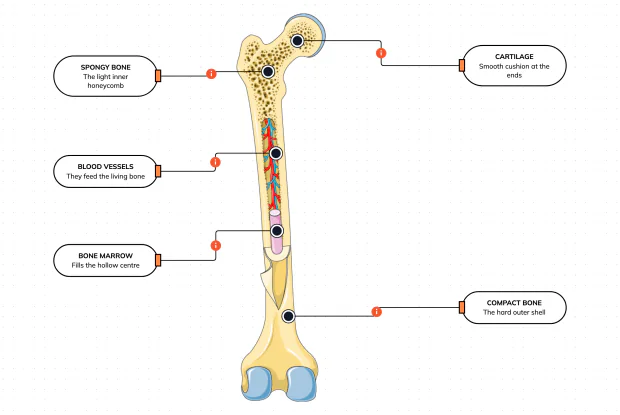
Cut a bone open and it is nowhere near solid: a hard outer shell, a light honeycomb inside, a hollow centre full of marrow, blood vessels threading through, and a smooth cushion at each end. Learn what each part does — then label them yourself in an interactive playground.
What Is Inside Your Elbow Joint?
A joint is where two bones meet and move — and it is far more than just the bones. Cut open the elbow and you find smooth cartilage caps, a sealed capsule of slippery fluid, and tough ligaments holding it all together. Learn what each part does, then label them yourself in an interactive playground.
What Makes Your Elbow Bend?
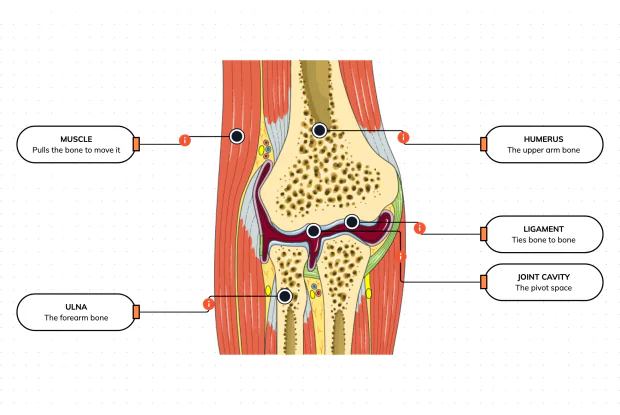
Bones and joints are just the hardware; nothing moves until a muscle pulls. Label the elbow to see the parts that turn a joint into movement — the muscle that pulls, the ligament that holds bone to bone, the two bones it links, and the space they pivot in — then build it yourself in an interactive playground.
What Holds Your Elbow Together?
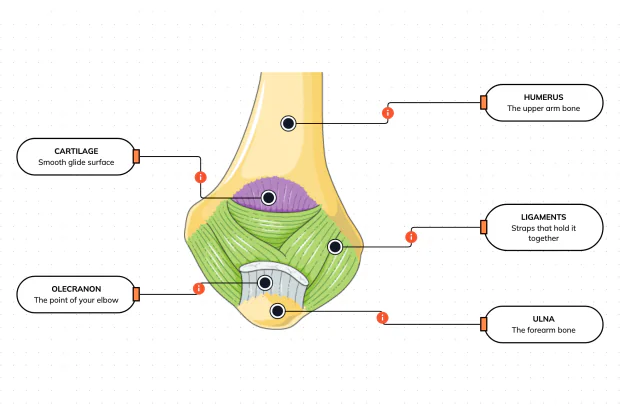
Your elbow is pulled on all day — by gravity, by every bag you carry, by every time you hang or push. So what stops the two bones from simply coming apart? Look at the back of the elbow and label the ligaments, the bony point, the cartilage and the two bones — and learn what holds the whole joint together.
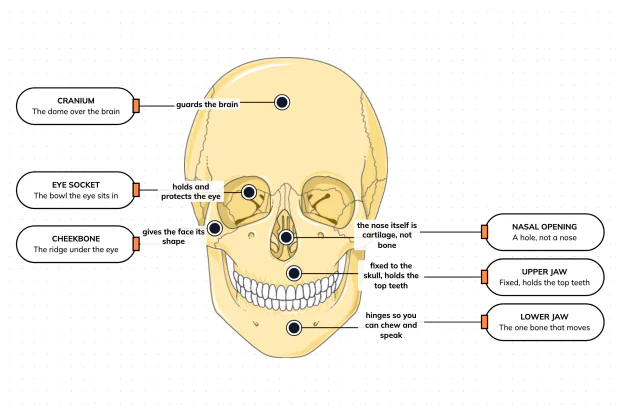
What Are the Main Bones of the Skull?
The skull looks like a single bone, but it is really about twenty-two locked together — with just one left free to move. Learn what each main part does, then label a skull yourself in an interactive playground.
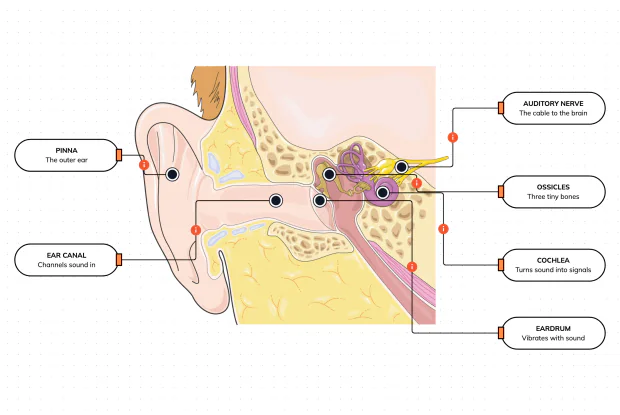
What Are the Parts of Your Ear?
Hearing is a chain of parts passing a sound along, each handing it to the next. Label the pinna, ear canal, eardrum, ossicles, cochlea and auditory nerve, and follow a sound all the way from the air outside to a signal your brain can read — in an interactive playground.
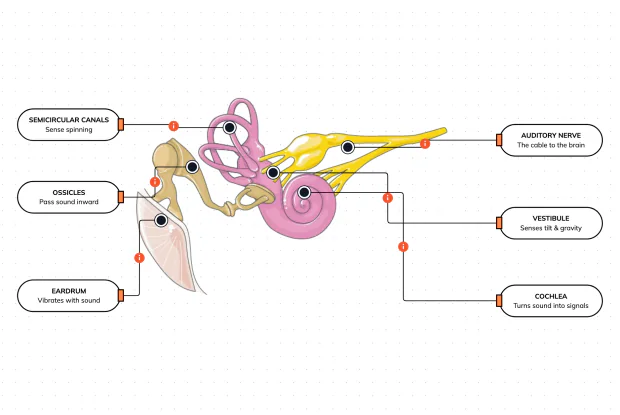
How Does Your Ear Keep You Balanced?
Your ear does a second, hidden job: balance. Inside it sit fluid-filled loops that sense spinning and a chamber that senses tilt and gravity. Label the semicircular canals, vestibule, cochlea, ossicles, eardrum and nerve, and learn how one organ both hears and keeps you upright — in an interactive playground.
What Are the Parts of the Eye You Can See?
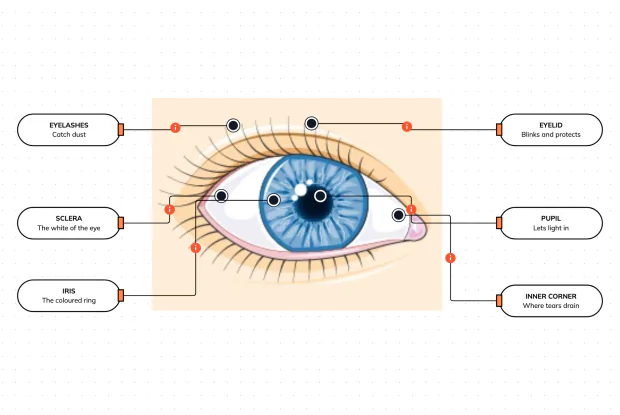
Before you look inside the eye, learn the parts you can already see in a mirror. Label the pupil, iris, sclera, eyelid, eyelashes and the tear-duct corner, and learn what each visible part does to let in light and protect the eye — in an interactive playground.
Where Do Your Tears Come From and Go?
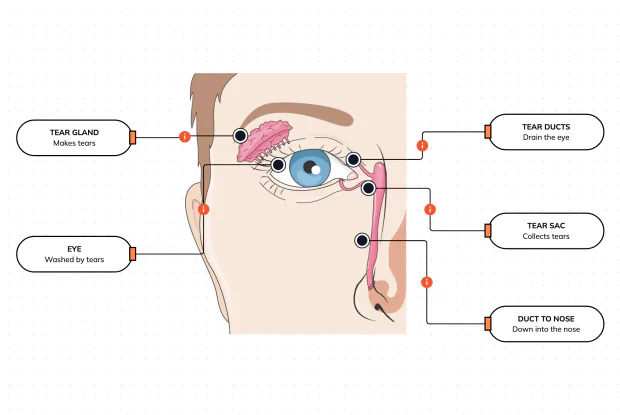
Your eyes make and drain tears all day to stay clean and wet. Label the tear gland, the eye, the tear ducts, the tear sac and the duct to the nose, and follow a tear from where it is made to where it drains — in an interactive playground.
How Does Your Eye Turn Light Into a Picture?
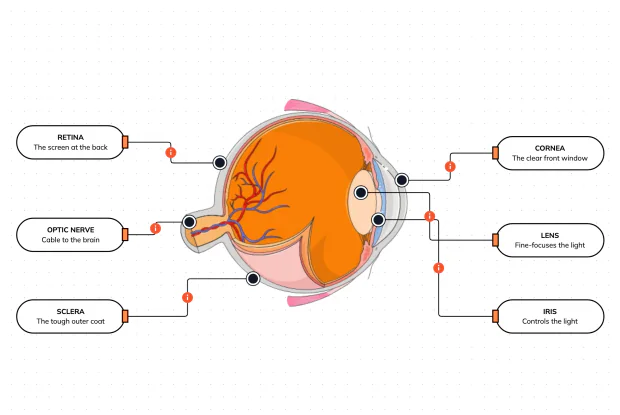
Your eye works like a living camera. Cut it open and label the cornea, lens, iris, retina, optic nerve and sclera, and follow light as it is focused onto a screen at the back of the eye and sent to the brain — in an interactive playground.