What Are the Parts of the Eye You Can See?
Root Concept
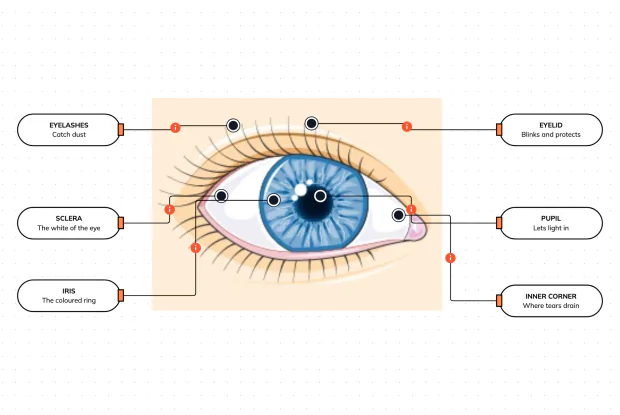
Looking at an eye from the front you can see: the pupil, the black opening that lets light in; the iris, the coloured ring that changes the pupil's size; the sclera, the tough white outer coat; and around them the eyelids and eyelashes that protect the eye, with the inner corner where tears drain away.
CodePLU Goal
Upgrading Human Mental Models
Learn how to think in Workflows

Concept Development By codeplu.com
The visible parts of the eye, each joined to the job it does — letting light in, and guarding the eye that receives it
What Are You Actually Looking At When You Look Someone in the Eye?
You look at eyes all day — in the mirror, in photos, in the faces of people you talk to — but have you ever named the parts you are seeing? Before you open the eye up and explore the lens and retina inside, it is worth learning the eye from the outside, because everything you can see in a mirror already has a clear job. The visible eye is really two things at once: an opening that carefully lets light in, and a set of guards that protect that delicate opening from the world.
The light-handling parts are the ones in the centre. The pupil is the black circle in the middle — and it is not a black dot but a hole, the opening through which all light enters the eye. Around it is the iris, the coloured ring that gives your eyes their colour (blue, brown, green) and, more importantly, works like a muscle to make the pupil bigger or smaller, controlling how much light gets in. Surrounding both is the sclera, the white of the eye — the tough outer coat that wraps almost the whole eyeball and keeps its firm, round shape.
The rest of what you see is protection. The eyelids are movable covers that blink down to shield the eye, block out light for sleep, and sweep tears across the surface to keep it clean and wet. The eyelashes are the short hairs that catch dust and trigger an automatic blink when anything comes too close. And at the inner corner sits a small pink fleshy bump beside the opening where tears drain away into the nose. In the playground above you will label all six — three for letting light in, three for protection — and the label on each connection tells you the job that part does.
What Does Each Visible Part of the Eye Do?
What is the pupil — the black circle?
The pupil is the black circle in the very centre of the eye, and the surprising thing is that it is not a thing at all — it is a hole. It looks black for the same reason a window looks dark from outside on a bright day: you are looking into a dark space, the inside of the eye, and almost no light comes back out. The pupil is the doorway through which every bit of light you see must pass on its way to the back of the eye. Its most important trick is that it changes size: it shrinks to a tiny dot in bright light to protect the eye and sharpen the image, and it opens wide in the dark to gather as much light as possible. It never stays still for long, quietly adjusting to the light around you all day.
What is the iris, the coloured part?
The iris is the coloured ring surrounding the pupil — blue, brown, green, grey or hazel — and it is what people mean when they talk about your 'eye colour'. But the iris is not just decoration: it is really a ring of muscle, and its job is to control the pupil. When it is bright, the iris tightens and squeezes the pupil small; when it is dim, it relaxes and lets the pupil open wide. In other words, the iris is the eye's automatic aperture, exactly like the adjustable opening in a camera lens that lets in more or less light. Everyone's iris pattern is slightly different, unique enough that it can be used to identify a person — which is how iris scanners at airports work.
What is the white of the eye (sclera)?
The white part around the iris is the sclera, and it is the tough, protective outer wall of the eyeball. Most of the eye is a fluid-filled ball, and it needs a strong, slightly stretchy coat to hold that round shape and protect the delicate parts inside — that coat is the sclera, and it wraps almost the entire eyeball; the white you can see is just the front of it. It is strong enough to guard the eye from knocks and to give the muscles that move the eye something firm to pull on. Healthy sclera is white, which is why a doctor looks at it for clues to your health: it can turn red when the eye is irritated, or yellowish when something is wrong with the liver.
What do the eyelids do?
The eyelids are the movable flaps of skin that cover the eye, and they are its main bodyguards. They snap shut in a fraction of a second to shield the eye from a fast-moving object, a bright flash or a puff of air — a reflex so quick you cannot stop it. They close to block light out when you sleep. And every time you blink — around fifteen to twenty times a minute without noticing — the eyelids wipe a fresh film of tears across the front of the eye, exactly like a windscreen wiper, keeping it clean, wet and clear. An eye left open and unblinking dries out and stings within minutes, which is why blinking, though it feels like nothing, is doing constant essential work.
What are eyelashes for?
The eyelashes are the row of short, curved hairs along the edge of each eyelid, and they are more than a decorative frame — they are the eye's first line of defence. Their main job is to keep things out: they catch drifting dust, sand and grit before it can reach the surface of the eye, and they help shade it from bright overhead light, a bit like a tiny sun-visor. They are also touch-sensitive tripwires: if something brushes the lashes or comes close to the eye, they trigger the blink reflex instantly, snapping the lid shut to protect the eye before you have even thought about it. It is the same reason animals like camels have such long lashes — to keep sand and dust out of their eyes.
What is the pink corner of the eye?
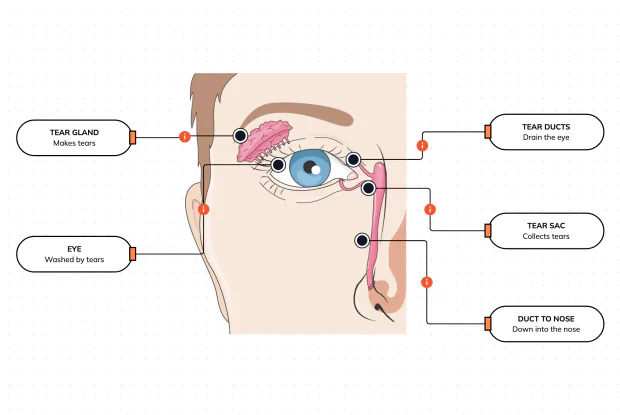
At the inner corner of the eye — the side nearest your nose — there is a small pink fleshy bump and the beginning of a drainage system for your tears. Tears are made constantly by glands above the eye and spread across it by blinking to keep it clean and moist; they then flow toward this inner corner and drain away through tiny openings into a passage that leads down into your nose. This is why crying makes your nose run — the overflow of tears is pouring down that same channel. It is also where a little dried mucus and dust collect overnight, forming the 'sleep' you find in the corner of your eye in the morning. So the inner corner is really the eye's plughole, quietly draining away the tears that keep it clean.
Real World Example
Why Does the Black Dot in Your Eye Keep Changing Size?
The parts of the eye you can see are not still or fixed — they are working all the time, adjusting and protecting. A few everyday moments show each of them in action:
Why the black dot changes size
The pupil and iris
Walk from a bright room into a dark one, or shine a light near someone's eyes, and you can watch the black pupil change size within a second. This is the iris at work. In bright light the iris tightens and squeezes the pupil small, so only a little light gets in and the eye is not dazzled or damaged; in the dark it relaxes and opens the pupil wide to gather every scrap of light so you can see. It happens automatically, without any thought, and it happens in both eyes together — shine a light in one eye and the other's pupil shrinks too. It is the same job a camera does when it adjusts its aperture, and it is why your eyes take a minute to 'adjust' when the lights suddenly go out: the pupils are still opening up.
Why you blink without thinking
The eyelids and eyelashes
You blink fifteen to twenty times a minute and almost never notice, and you cannot keep your eyes open if something flies toward your face — the lids slam shut on their own. This is the eyelids and eyelashes working as a protection team. The lashes act as tripwires: the instant something touches them or comes close, they fire off the blink reflex, and the eyelid snaps down faster than you could ever move it deliberately, shielding the eye. Even when nothing is threatening it, the steady rhythm of blinking sweeps tears across the eye to keep it wet and wipe away dust, like a windscreen wiper on a slow setting. It is why staring at a screen, which makes you blink less, leaves your eyes feeling dry and tired.
Why crying makes your nose run
Tears and the inner corner
Cry, or get something in your eye, and your nose starts to run at the same time — a strange link that the inner corner of the eye explains perfectly. Your eyes are always making a small amount of tears to stay clean and moist, and those tears drain away through tiny openings at the inner corner into a passage that leads straight down into your nose. Normally you never notice, but when you cry or your eye waters heavily, far more tears are produced than usual, they overflow down that same drainage channel in a flood, and the result comes out of your nose. The same corner is where dust and dried mucus gather overnight to form the crusty 'sleep' you rub away in the morning. It is simply the eye's drain, doing its quiet job of clearing away used tears.
FAQs
Final Words
Every part of the eye you can see in a mirror has a clear job, and they split neatly into two groups. Three let light in and set up vision: the pupil is the opening light passes through, the iris is the muscular ring that sizes that opening, and the sclera is the tough white coat holding the whole eyeball together. Three protect it: the eyelids blink to shield the eye and spread tears, the eyelashes catch dust and trigger the blink, and the inner corner drains the used tears away.
Notice that everything visible from the front is either the opening for light or the guard around it — the real machinery of seeing is deeper in. That is the natural next step: now that you can name the outside of the eye, you can open it up and follow the light inward, through the lens that focuses it to the retina that finally turns it into what you see.
Continue This Track
This concept is part 8 of The Human Body, Head to Toe.
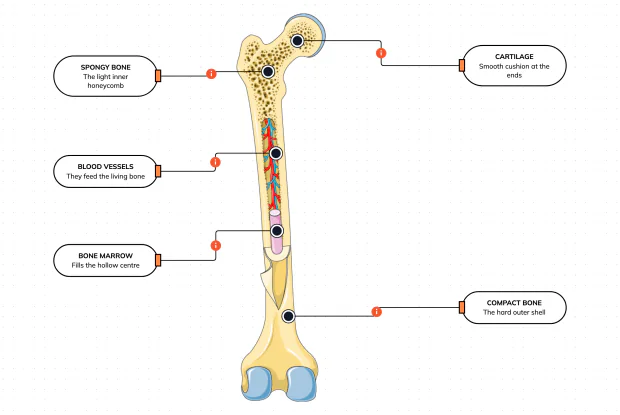
What Is a Bone Made Of?
Cut a bone open and it is nowhere near solid: a hard outer shell, a light honeycomb inside, a hollow centre full of marrow, blood vessels threading through, and a smooth cushion at each end. Learn what each part does — then label them yourself in an interactive playground.
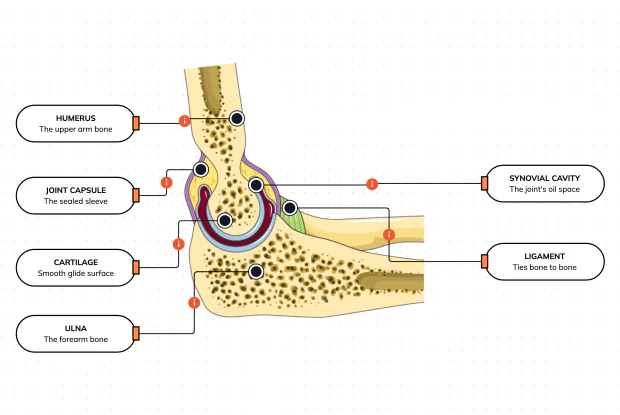
What Is Inside Your Elbow Joint?
A joint is where two bones meet and move — and it is far more than just the bones. Cut open the elbow and you find smooth cartilage caps, a sealed capsule of slippery fluid, and tough ligaments holding it all together. Learn what each part does, then label them yourself in an interactive playground.
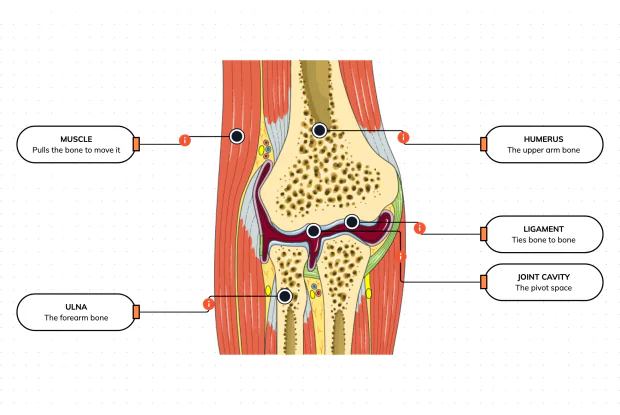
What Makes Your Elbow Bend?
Bones and joints are just the hardware; nothing moves until a muscle pulls. Label the elbow to see the parts that turn a joint into movement — the muscle that pulls, the ligament that holds bone to bone, the two bones it links, and the space they pivot in — then build it yourself in an interactive playground.
What Holds Your Elbow Together?
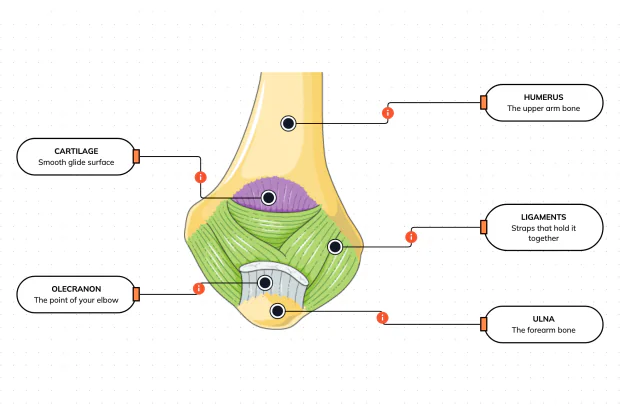
Your elbow is pulled on all day — by gravity, by every bag you carry, by every time you hang or push. So what stops the two bones from simply coming apart? Look at the back of the elbow and label the ligaments, the bony point, the cartilage and the two bones — and learn what holds the whole joint together.
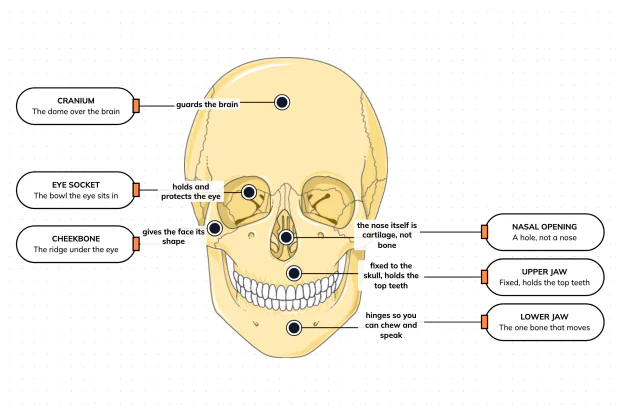
What Are the Main Bones of the Skull?
The skull looks like a single bone, but it is really about twenty-two locked together — with just one left free to move. Learn what each main part does, then label a skull yourself in an interactive playground.
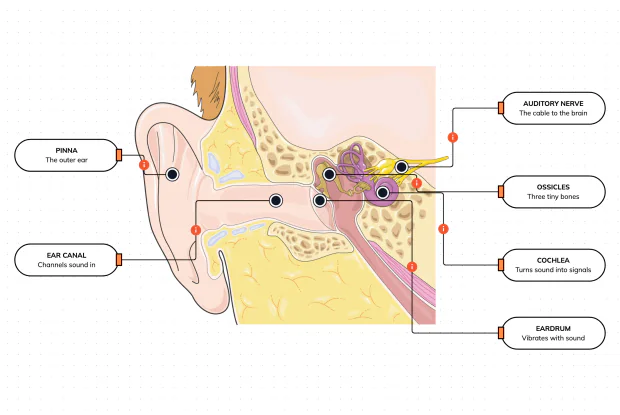
What Are the Parts of Your Ear?
Hearing is a chain of parts passing a sound along, each handing it to the next. Label the pinna, ear canal, eardrum, ossicles, cochlea and auditory nerve, and follow a sound all the way from the air outside to a signal your brain can read — in an interactive playground.
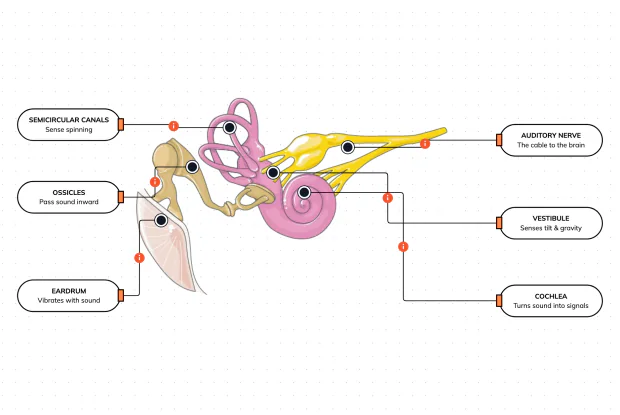
How Does Your Ear Keep You Balanced?
Your ear does a second, hidden job: balance. Inside it sit fluid-filled loops that sense spinning and a chamber that senses tilt and gravity. Label the semicircular canals, vestibule, cochlea, ossicles, eardrum and nerve, and learn how one organ both hears and keeps you upright — in an interactive playground.
What Are the Parts of the Eye You Can See?
Before you look inside the eye, learn the parts you can already see in a mirror. Label the pupil, iris, sclera, eyelid, eyelashes and the tear-duct corner, and learn what each visible part does to let in light and protect the eye — in an interactive playground.
Where Do Your Tears Come From and Go?
Your eyes make and drain tears all day to stay clean and wet. Label the tear gland, the eye, the tear ducts, the tear sac and the duct to the nose, and follow a tear from where it is made to where it drains — in an interactive playground.
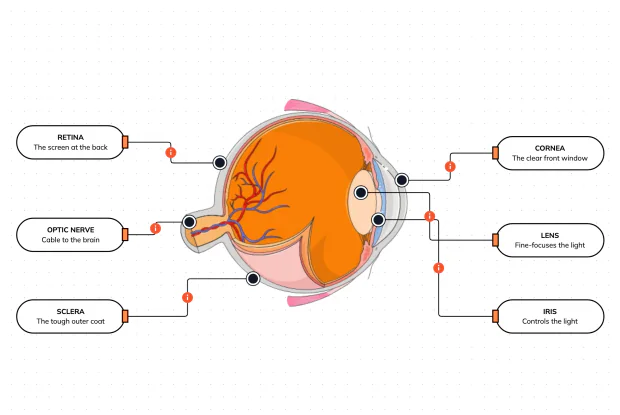
How Does Your Eye Turn Light Into a Picture?
Your eye works like a living camera. Cut it open and label the cornea, lens, iris, retina, optic nerve and sclera, and follow light as it is focused onto a screen at the back of the eye and sent to the brain — in an interactive playground.