What Is a Bone Made Of?
Root Concept
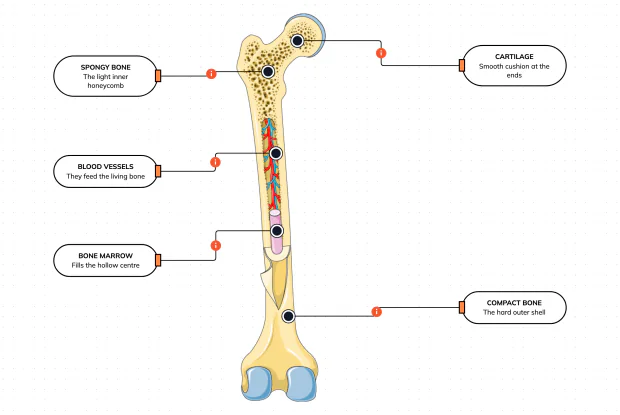
A bone is a living, layered structure — a hard compact-bone shell around a light spongy-bone core, a hollow centre filled with marrow that makes blood cells, blood vessels feeding it, and cartilage cushioning the ends — built to be strong and light at once.
CodePLU Goal
Upgrading Human Mental Models
Learn how to think in Workflows

Concept Development By codeplu.com
Each part of a bone's structure, joined to the job it does — shell, core, cushion, supply or store
Is a Bone Just a Dead, Solid Rock?
Most people picture a bone as a solid, dry, dead thing — like a stick or a stone in the shape of a leg. Cut one open, though, and almost none of that is true. A bone is layered, mostly hollow, full of soft living tissue, laced with blood vessels, and busy making new blood cells every second. It is one of the most alive parts of your body, not one of the deadest.
The outside is a shell of hard, dense material called compact bone — that is the smooth, ivory-white part you picture. But it is only a shell. Towards the ends the bone is filled with spongy bone, a light honeycomb that gives strength without adding much weight, and down the middle of the shaft runs a hollow tube, the marrow cavity, packed with soft marrow. Threading through all of it are blood vessels, because living tissue has to be fed.
And because the ends of a bone meet other bones at joints, each end is capped with a smooth layer of cartilage that cushions the contact so bone never grinds directly on bone. In the playground above you will label the compact shell, the spongy core, the marrow, the blood vessels and the cartilage — and the label on each connection tells you what that part is for.
What Is Each Part of a Bone For?
Is a bone solid all the way through?
No — and that is the biggest surprise about bones. A bone is built in layers: a hard, dense shell of compact bone on the outside, a light honeycomb of spongy bone filling the widened ends, and a hollow cavity running down the centre of the shaft. If a bone were solid all the way through it would be far heavier than it needs to be, and you could barely lift your own legs. The layering is the whole point — solid only where strength is needed, light and hollow everywhere else.
What is compact bone?
Compact bone is the dense, hard outer layer — the smooth ivory part you picture when you think of a bone. It forms the wall of the shaft and the thin surface over every bone, and it is where a bone's strength lives: it resists bending, twisting and the load of your body weight. It is not truly solid either, but packed with microscopic tubes carrying blood vessels, which is how the living cells buried in the hard material stay fed. Think of it as the bone's strong outer casing.
What is spongy bone?
Spongy bone is the light, honeycomb-like tissue that fills the widened ends of a bone, under the compact shell. Its tiny struts are not arranged randomly — they line up along the exact directions that force travels through the bone, so it braces the ends against pressure using as little material as possible. That is how a bone can be strong at the joints, where loads are highest, without becoming heavy. It is the same trick engineers use with a honeycomb or a lattice: strength where it is needed, empty space everywhere else.
What is inside the hollow centre?
The hollow cavity down the middle of the shaft is filled with bone marrow, a soft tissue that does a job most people never associate with bones: it makes blood. Red marrow produces new red and white blood cells and platelets, churning out billions a day, while fattier yellow marrow stores energy. So your bones are not just a frame to hang muscles on — they are a factory, quietly manufacturing the blood that keeps the rest of you alive.
Is a bone actually alive?
Yes — very much so. Living bone cells are woven all through the hard material, and they are fed by blood vessels that thread into the bone through tiny channels, which is exactly why a broken bone can heal itself and why bones slowly thicken where they are used and thin where they are not. At each end, a smooth layer of cartilage caps the bone where it meets another at a joint, cushioning the contact so the surfaces glide instead of grinding. A bone grows, repairs, remodels and feeds itself — the opposite of a dead stick.
Real World Example
Why Are Your Bones Stronger Than Concrete but Light Enough to Sprint With?
Weight for weight, bone rivals steel and beats concrete for strength, yet your whole skeleton is light enough to carry at a run. That is not a lucky accident — it is the same strength-to-weight engineering humans use for bridges and bike frames, and you can read it straight off the layers of a bone:
The hard shell does the heavy lifting
Compact bone
The outer wall of the shaft is compact bone, a dense, hard casing arranged as a hollow tube down the length of the bone. A hollow tube is a deliberate engineering choice, not a shortcut: for a given amount of material, a tube resists bending and twisting far better than a solid rod of the same weight, because the material sits out at the edges where the stress is highest. It is exactly why bicycle frames, scaffolding poles and aircraft parts are tubes rather than solid bars. The compact shell gives the bone almost all of its strength while the empty centre saves enormous weight — strength on the outside, nothing wasted in the middle.
The honeycomb fills the ends
Spongy bone
At the widened ends, where the bone meets a joint and the load spreads out in many directions, a hollow tube would not be enough. So those ends are packed with spongy bone — a lattice of tiny struts that look random but are precisely aligned along the paths that force actually travels through the joint. Material goes only where the stress goes, and the gaps stay empty. The result braces the end against pressure from any angle while weighing a fraction of what solid bone would. It is the same principle as the honeycomb core inside a lightweight door or an aircraft panel: maximum stiffness, minimum mass.
What this tells you
Strength by design, not bulk
Put the two together and the lesson is clear: a bone is strong because of how it is shaped, not because it is a solid lump. A hard tube where it needs to resist bending, a honeycomb where loads fan out, and hollow space everywhere strength is not required — that is how evolution solved the same problem an engineer faces, getting the most strength from the least weight. A solid bone would be stronger in the crude sense, but so heavy you could barely move; a light bone that snapped would be useless. The layered structure is the compromise that lets you be both sturdy and quick, and it is why understanding a bone means understanding its design, not just its shape.
FAQs
Final Words
A bone is a masterpiece of living engineering, not a dead stick. A hard compact-bone shell carries the load, a light spongy-bone honeycomb braces the ends, a hollow centre stores marrow that manufactures your blood, blood vessels keep the whole thing alive, and cartilage cushions every joint. Strong and light at once, and able to grow, feed and heal itself — everything about a bone follows from doing several demanding jobs without weighing you down.
Label the compact shell, the spongy core, the marrow, the blood vessels and the cartilage, and you will never picture a bone as a solid rock again. Once you know what a bone is made of, the named bones of the skeleton — skull, spine, arm, leg and the rest — are all built from exactly this living, layered structure.
Continue This Track
This concept is part 1 of The Human Body, Head to Toe.
What Is a Bone Made Of?
Cut a bone open and it is nowhere near solid: a hard outer shell, a light honeycomb inside, a hollow centre full of marrow, blood vessels threading through, and a smooth cushion at each end. Learn what each part does — then label them yourself in an interactive playground.
What Is Inside Your Elbow Joint?
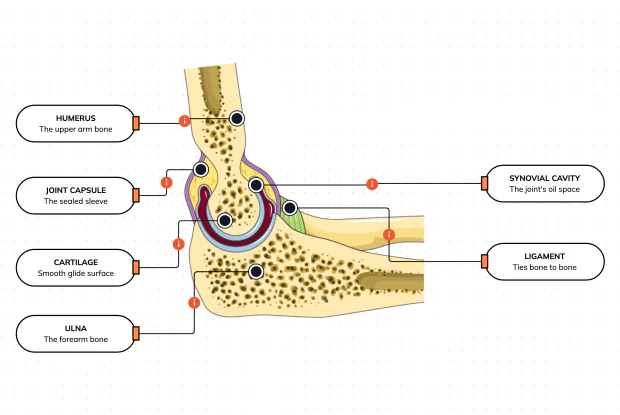
A joint is where two bones meet and move — and it is far more than just the bones. Cut open the elbow and you find smooth cartilage caps, a sealed capsule of slippery fluid, and tough ligaments holding it all together. Learn what each part does, then label them yourself in an interactive playground.
What Makes Your Elbow Bend?
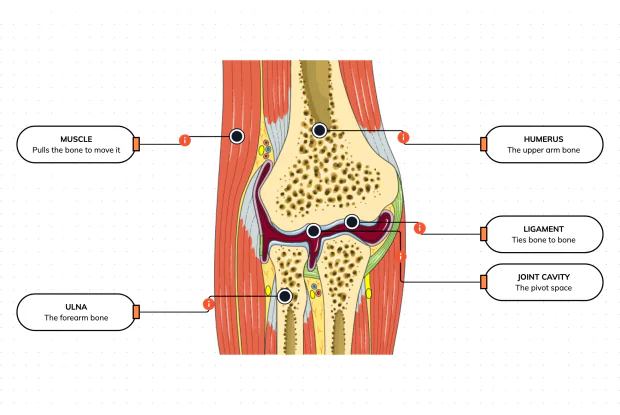
Bones and joints are just the hardware; nothing moves until a muscle pulls. Label the elbow to see the parts that turn a joint into movement — the muscle that pulls, the ligament that holds bone to bone, the two bones it links, and the space they pivot in — then build it yourself in an interactive playground.
What Holds Your Elbow Together?
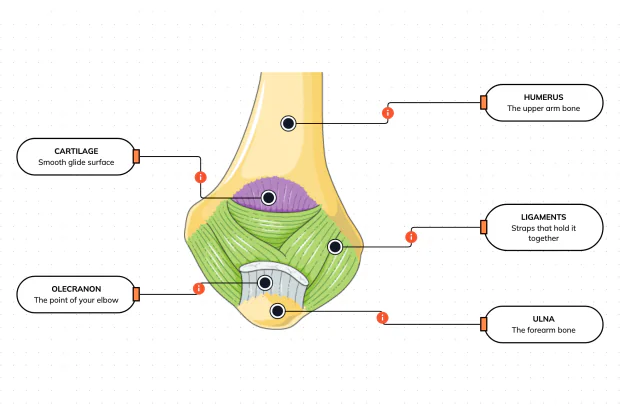
Your elbow is pulled on all day — by gravity, by every bag you carry, by every time you hang or push. So what stops the two bones from simply coming apart? Look at the back of the elbow and label the ligaments, the bony point, the cartilage and the two bones — and learn what holds the whole joint together.
What Are the Main Bones of the Skull?
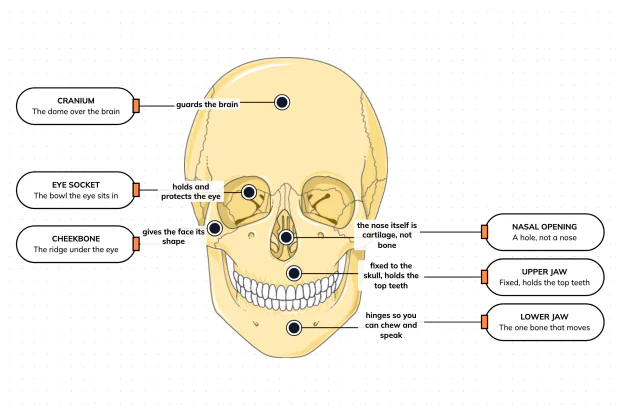
The skull looks like a single bone, but it is really about twenty-two locked together — with just one left free to move. Learn what each main part does, then label a skull yourself in an interactive playground.
What Are the Parts of Your Ear?
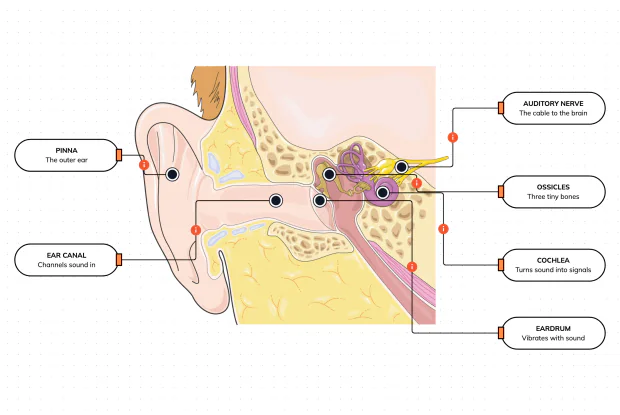
Hearing is a chain of parts passing a sound along, each handing it to the next. Label the pinna, ear canal, eardrum, ossicles, cochlea and auditory nerve, and follow a sound all the way from the air outside to a signal your brain can read — in an interactive playground.
How Does Your Ear Keep You Balanced?
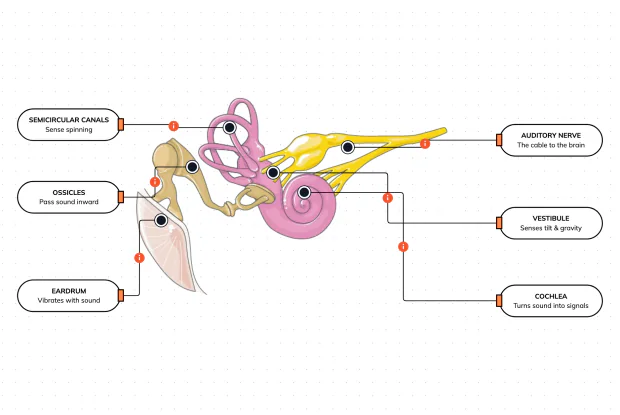
Your ear does a second, hidden job: balance. Inside it sit fluid-filled loops that sense spinning and a chamber that senses tilt and gravity. Label the semicircular canals, vestibule, cochlea, ossicles, eardrum and nerve, and learn how one organ both hears and keeps you upright — in an interactive playground.
What Are the Parts of the Eye You Can See?
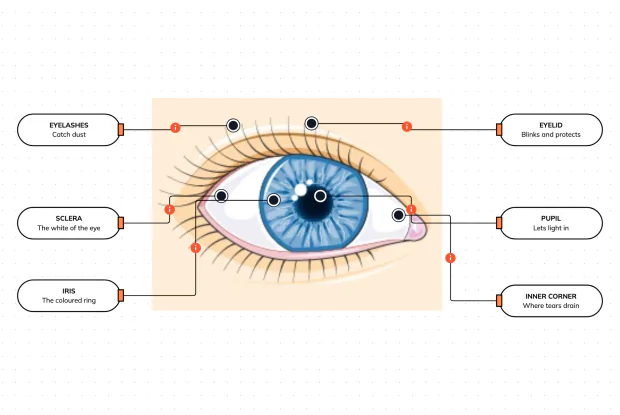
Before you look inside the eye, learn the parts you can already see in a mirror. Label the pupil, iris, sclera, eyelid, eyelashes and the tear-duct corner, and learn what each visible part does to let in light and protect the eye — in an interactive playground.
Where Do Your Tears Come From and Go?
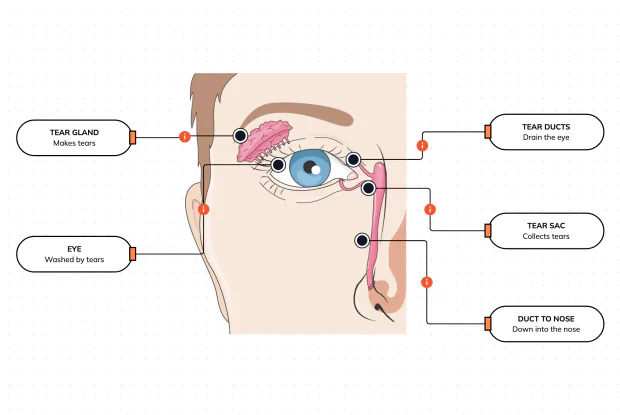
Your eyes make and drain tears all day to stay clean and wet. Label the tear gland, the eye, the tear ducts, the tear sac and the duct to the nose, and follow a tear from where it is made to where it drains — in an interactive playground.
How Does Your Eye Turn Light Into a Picture?
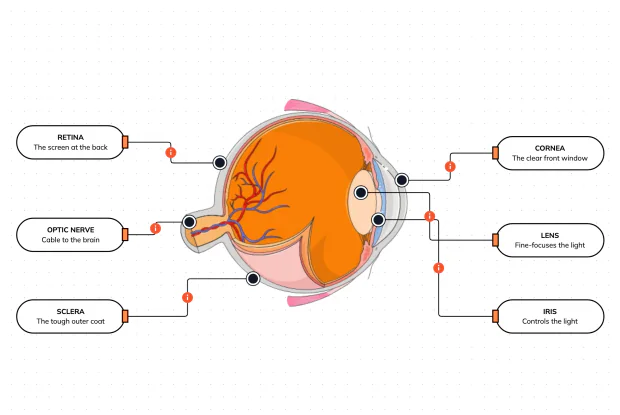
Your eye works like a living camera. Cut it open and label the cornea, lens, iris, retina, optic nerve and sclera, and follow light as it is focused onto a screen at the back of the eye and sent to the brain — in an interactive playground.