How Does Your Ear Keep You Balanced?
Root Concept
The inner ear does two jobs. The cochlea turns sound into hearing signals; the balance organs beside it — three semicircular canals that sense the head spinning and a vestibule that senses tilt and gravity — keep you upright. The auditory nerve carries both the hearing and balance signals to the brain, and the eardrum and ossicles deliver sound in.
CodePLU Goal
Upgrading Human Mental Models
Learn how to think in Workflows

Concept Development By codeplu.com
The inner ear's two jobs, each part joined to what it does — the loops and chamber that keep you balanced, and the spiral that lets you hear
How Does Your Body Always Know Which Way Is Up?
Close your eyes and tilt your head. You still know, instantly and without looking, that your head is tilted — and if someone spun you round, you would feel that too. That sense of balance feels obvious, but it comes from a part of your body you would never guess: your ear. Tucked into the same tiny space that lets you hear is a second, hidden set of sensors whose only job is to tell your brain how your head is moving and which way is up. It is why a problem deep in the ear can leave you dizzy, and why balance and hearing so often go wrong together.
The balance sensors are two things working as a team. First are the semicircular canals — three little loops of fluid-filled tubing, set at different angles like the three faces of a corner. When you turn your head, the fluid inside them lags behind and sloshes, and tiny sensors feel that sloshing, so each loop reports a different direction of spin. Second is the vestibule, a chamber sitting between the loops that senses steady tilt and the pull of gravity, telling you when your head is upright, leaning or upside down.
Right beside these balance organs sits the cochlea, the snail-shaped spiral that does the hearing — turning sound into signals, fed by the eardrum and the tiny ossicles. All of it, hearing and balance alike, is wired to the brain by a single nerve. In the playground above you will label the balance loops and chamber, the hearing spiral, the nerve, and the parts that bring sound in — and see how one small organ quietly does two very different jobs.
What Does Each Part Do?
Wait — the ear controls balance?
Yes. We think of the ear as the organ for hearing, but the inner ear is really two sense organs packed into one space. Alongside the cochlea, which handles sound, sits a set of balance sensors called the vestibular system. They constantly measure how your head is tilted and how it is moving, and send that information to the brain, which uses it — together with your eyes and the feeling in your feet — to keep you upright and steady. You never think about it because it works silently, but the moment it goes wrong you notice at once: the world seems to tip or spin, and you feel dizzy. That is your ear, not your eyes, sounding the alarm.
What do the semicircular canals do?
The semicircular canals are three small loops of fluid-filled tube, and they sense rotation — your head turning or spinning. They are set at three different angles, roughly like the three edges that meet at the corner of a box, so between them they can detect a turn in any direction: nodding, shaking your head, or tilting it to your shoulder. Here is the trick: when your head starts to turn, the fluid inside the loops lags behind for a moment (just as tea in a cup swirls a beat after you twist the cup), and tiny hair sensors feel the fluid move against them. That tells the brain exactly how you are turning. When you spin round and round and then stop, the fluid keeps sloshing for a few seconds — which is precisely why you still feel like you are spinning after you have stopped, and stagger about dizzy.
What is the vestibule for?
The semicircular canals sense turning, but they cannot feel steady tilt or gravity — for that there is the vestibule, the chamber sitting between the loops and the cochlea. Inside it are sensors weighted with tiny crystals, so that gravity pulls on them: when your head tips, the weights shift and the sensors report which way is down. The vestibule also feels straight-line movement, like the surge when a lift starts to rise or a car pulls away. Together the two systems cover everything: the canals report spinning and turning, and the vestibule reports tilt, gravity and straight-line motion. That is how, even with your eyes shut, you always know whether your head is upright, leaning, or lying down.
So what does the cochlea do?
The cochlea is the ear's hearing organ, and it sits right next to the balance sensors — the snail-shaped spiral you can see coiled below the loops. It works on the same basic idea as the balance organs: it is filled with fluid and lined with tiny hair sensors, but instead of sensing head movement, it senses the vibrations of sound. When sound reaches it, the fluid ripples, the hairs bend, and they fire off nerve signals that the brain reads as sound. So the inner ear reuses one clever design — fluid moving tiny hair sensors — for two completely different purposes: the canals and vestibule use it to feel movement, and the cochlea uses it to feel sound.
What does the nerve carry?
The auditory nerve is the single cable that connects the whole inner ear to the brain, and it actually carries two kinds of message bundled together: the hearing signals from the cochlea, and the balance signals from the canals and vestibule. (For this reason its full name is the vestibulocochlear nerve — 'vestibular' for balance, 'cochlear' for hearing.) Everything the inner ear senses travels up this one nerve to the brain, which then does the real work of understanding it — turning the signals into the sounds you recognise and the constant, automatic adjustments that keep you balanced. Because both messages share the same nerve and the same small space, a problem there can affect hearing and balance at the same time.
How do the eardrum and ossicles fit in?
The eardrum and the ossicles are the sound-delivery service for the cochlea, shown here on the left where sound arrives. The eardrum is the tight membrane that vibrates when sound waves hit it, and the ossicles are the three tiny bones that carry that vibration inward and press it against the cochlea. They belong to the outer and middle ear rather than the inner ear, but they are drawn here because without them the cochlea would receive no sound. Notice that they feed only the hearing side — the balance organs need no such delivery system, because they respond to your own head's movement directly, not to anything coming in from outside.
Real World Example
Why Do You Feel Dizzy When You Spin Around?
You do not usually notice your balance sense until it misfires. When it does, the strange feelings it produces are a perfect window onto how the inner ear works, because each one comes from a specific part being tricked:
Why spinning makes you dizzy
The semicircular canals
Spin around several times and then stop, and the room seems to keep turning while you stagger. That happens inside the semicircular canals. They sense turning by the fluid in their loops lagging behind your head's movement — but fluid, once it is moving, does not stop the instant you do; it keeps sloshing for a few seconds, like water still swirling in a glass after you stop stirring. So even though your head has stopped, the canals are still reporting a spin, and they send that message to the brain. Your eyes say 'we have stopped' while your ears say 'we are still turning', and the disagreement is felt as dizziness. It fades in a few seconds — exactly the time the fluid takes to settle.
Why you feel sick in a car or boat
The vestibule and canals
Travel sickness is the opposite kind of trick: your balance organs and your eyes disagree, but the other way round. Reading a book in a moving car, your eyes are fixed on a still page and tell the brain 'we are not moving' — but the vestibule and canals of your inner ear feel every sway, turn and bump of the car and shout 'we are moving a lot'. The brain gets two flatly contradictory reports at once and cannot reconcile them, and that confusion is what produces the queasy, unwell feeling of motion sickness. It is why looking out at the horizon helps: it lets your eyes see the movement your inner ear is already feeling, so the two senses agree again.
Why an ear infection makes the room spin
Vertigo from the inner ear
Sometimes the balance organs go wrong all by themselves, with no spinning and no travelling involved — and this is often what people mean by 'vertigo'. If an infection, inflammation, or a loose crystal disturbs the fluid or sensors of the inner ear, the canals and vestibule start sending false movement signals to the brain even while you are sitting perfectly still. The brain believes them, and the room appears to lurch or spin, sometimes badly enough to cause nausea and falling. Because the balance sensors sit right next to the cochlea and share its nerve, the same illness can affect hearing too. It is a powerful reminder that the calm sense of a steady world around you is being generated, every second, deep inside your ear.
FAQs
Final Words
Your ear is really two sense organs sharing one small space. The cochlea turns sound into hearing signals, while right beside it the balance organs keep you upright: the three semicircular canals sense your head spinning and turning, and the vestibule senses tilt and gravity. A single nerve carries both the hearing and the balance messages to the brain, and the eardrum and ossicles feed sound to the cochlea. One clever design — fluid moving tiny hair sensors — is reused for two completely different jobs.
Once you can see the balance organs, everyday feelings finally make sense: the dizziness after spinning, the queasiness of a car journey, the spinning room of an ear infection are all your inner ear's balance sensors being fooled. You have now met the ear as both a hearing organ and a balance organ — the second is a sense most people never realise they have. Next in the head-to-toe tour, the same 'trace the pathway' approach will open up the eye.
Continue This Track
This concept is part 7 of The Human Body, Head to Toe.
What Is a Bone Made Of?
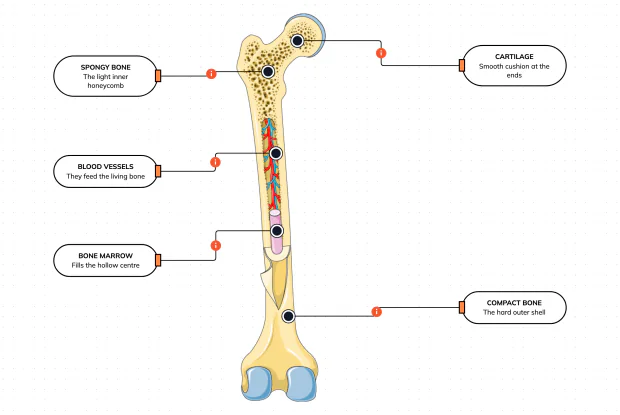
Cut a bone open and it is nowhere near solid: a hard outer shell, a light honeycomb inside, a hollow centre full of marrow, blood vessels threading through, and a smooth cushion at each end. Learn what each part does — then label them yourself in an interactive playground.
What Is Inside Your Elbow Joint?
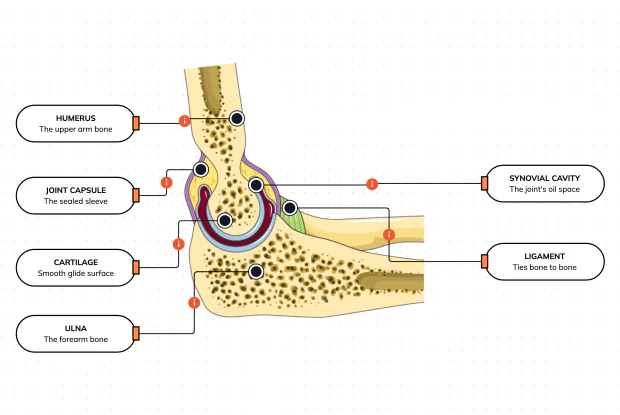
A joint is where two bones meet and move — and it is far more than just the bones. Cut open the elbow and you find smooth cartilage caps, a sealed capsule of slippery fluid, and tough ligaments holding it all together. Learn what each part does, then label them yourself in an interactive playground.
What Makes Your Elbow Bend?
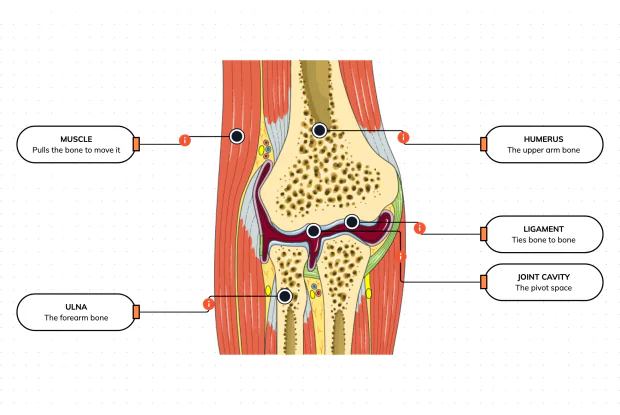
Bones and joints are just the hardware; nothing moves until a muscle pulls. Label the elbow to see the parts that turn a joint into movement — the muscle that pulls, the ligament that holds bone to bone, the two bones it links, and the space they pivot in — then build it yourself in an interactive playground.
What Holds Your Elbow Together?
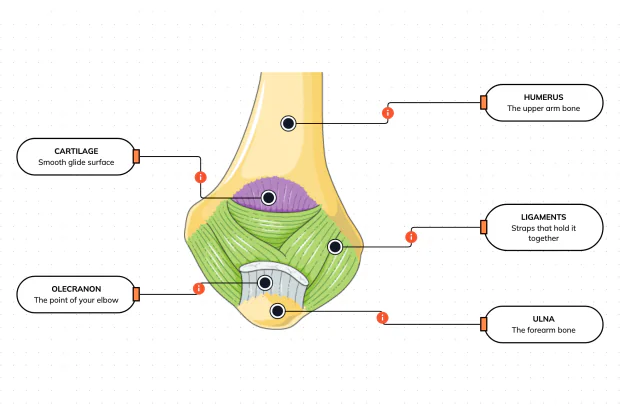
Your elbow is pulled on all day — by gravity, by every bag you carry, by every time you hang or push. So what stops the two bones from simply coming apart? Look at the back of the elbow and label the ligaments, the bony point, the cartilage and the two bones — and learn what holds the whole joint together.
What Are the Main Bones of the Skull?
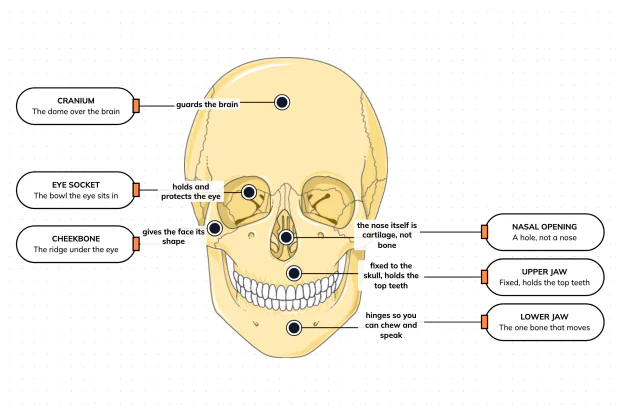
The skull looks like a single bone, but it is really about twenty-two locked together — with just one left free to move. Learn what each main part does, then label a skull yourself in an interactive playground.
What Are the Parts of Your Ear?
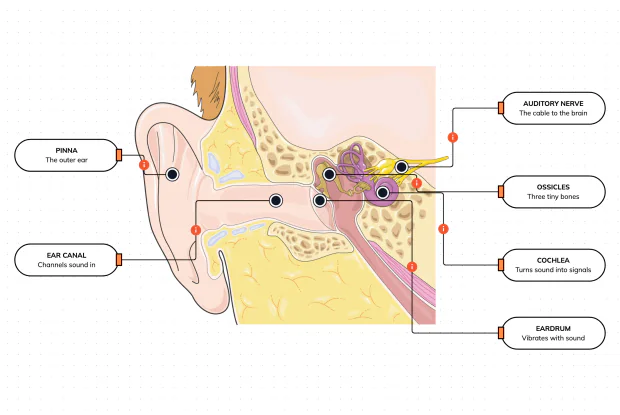
Hearing is a chain of parts passing a sound along, each handing it to the next. Label the pinna, ear canal, eardrum, ossicles, cochlea and auditory nerve, and follow a sound all the way from the air outside to a signal your brain can read — in an interactive playground.
How Does Your Ear Keep You Balanced?
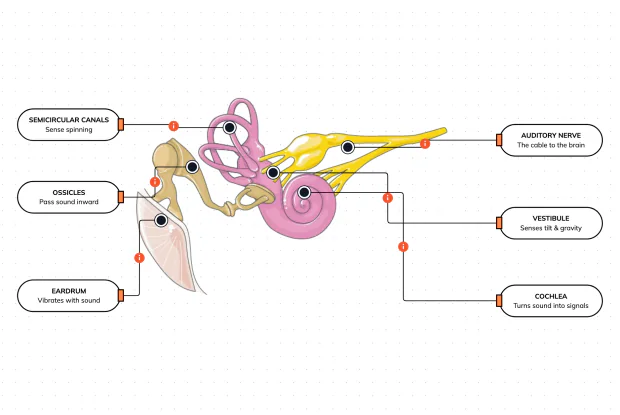
Your ear does a second, hidden job: balance. Inside it sit fluid-filled loops that sense spinning and a chamber that senses tilt and gravity. Label the semicircular canals, vestibule, cochlea, ossicles, eardrum and nerve, and learn how one organ both hears and keeps you upright — in an interactive playground.
What Are the Parts of the Eye You Can See?
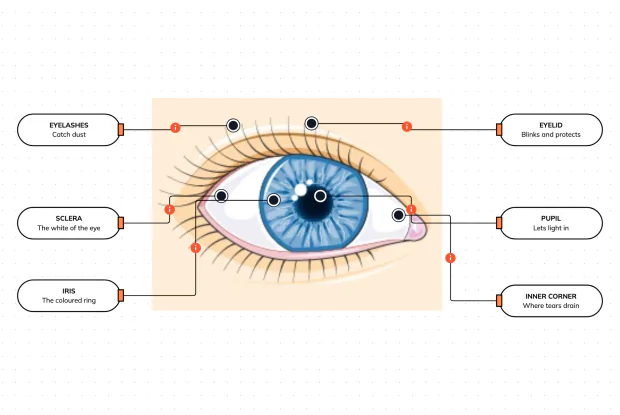
Before you look inside the eye, learn the parts you can already see in a mirror. Label the pupil, iris, sclera, eyelid, eyelashes and the tear-duct corner, and learn what each visible part does to let in light and protect the eye — in an interactive playground.
Where Do Your Tears Come From and Go?
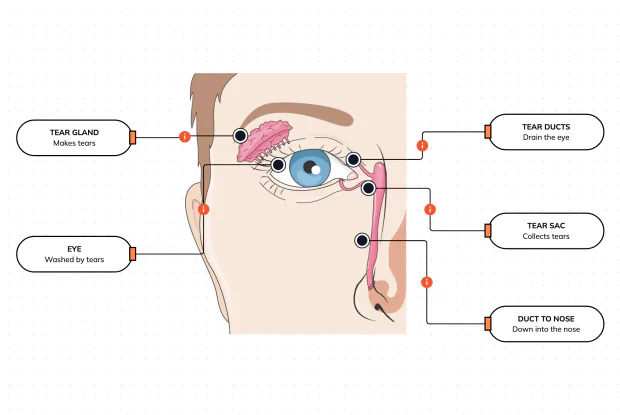
Your eyes make and drain tears all day to stay clean and wet. Label the tear gland, the eye, the tear ducts, the tear sac and the duct to the nose, and follow a tear from where it is made to where it drains — in an interactive playground.
How Does Your Eye Turn Light Into a Picture?
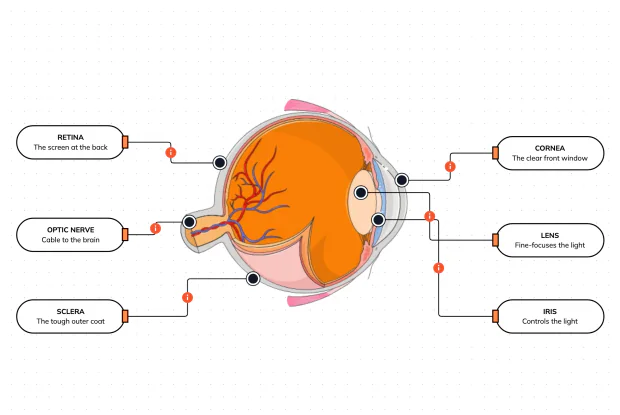
Your eye works like a living camera. Cut it open and label the cornea, lens, iris, retina, optic nerve and sclera, and follow light as it is focused onto a screen at the back of the eye and sent to the brain — in an interactive playground.