What Are the Parts of Your Ear?
Root Concept
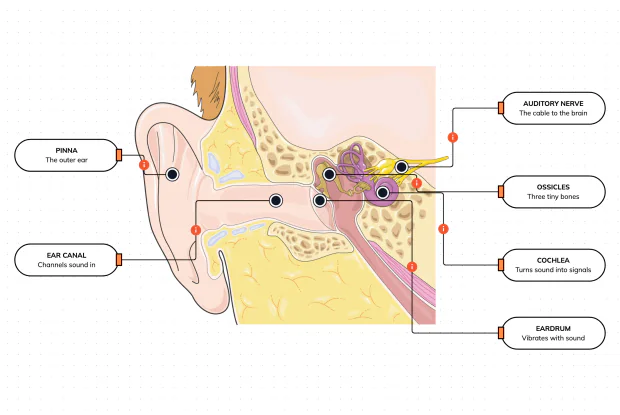
The ear turns sound in the air into signals for the brain in a chain: the pinna funnels sound into the ear canal, which carries it to the eardrum; the eardrum vibrates and shakes three tiny bones (the ossicles), which pass the vibration to the cochlea; the cochlea turns it into nerve signals that the auditory nerve carries to the brain.
CodePLU Goal
Upgrading Human Mental Models
Learn how to think in Workflows

Concept Development By codeplu.com
The parts of the ear, each joined to the job it does as a sound travels from the air outside to a signal in the brain
How Does a Sound in the Air Become Something You Hear?
A sound starts out as nothing but a tiny wave of moving air — the air pushed by a voice, a guitar string or a slamming door. Somehow your ear catches that faint ripple and turns it into something your brain can understand. It does this not in one step but as a relay: a chain of parts, each catching the sound from the part before it and handing it on in a new form. Follow the chain and the whole ear suddenly makes sense — each piece is there to pass the sound one stage further along.
It begins with the parts you can see and reach. The pinna — the flap on the side of your head that most people just call 'the ear' — is a funnel that catches sound waves and steers them into the ear canal, the short tube that carries them inward. At the end of the canal the sound meets the eardrum, a tight little skin stretched across the tube. Just as a drum skin trembles when sound hits it, the eardrum vibrates — and that is the moment a wave of air becomes a physical movement.
From there the sound goes deeper, into places you will never see. The vibrating eardrum shakes three of the smallest bones in your body, the ossicles, which pass the movement along and make it stronger. They deliver it to the cochlea, a fluid-filled spiral shaped like a snail's shell, where the vibration is finally turned into electrical nerve signals. The auditory nerve then carries those signals to the brain, which reads them as sound. In the playground above you will label all six parts and trace that journey for yourself.
What Does Each Part of the Ear Do?
What does the outer ear (pinna) do?
The pinna is the part everyone thinks of as 'the ear' — the curved flap of skin-covered cartilage on the side of your head. Its job is to be a funnel. Sound waves spreading through the air are faint and travelling in all directions, and the pinna's cupped shape catches them over a wide area and channels them into the narrow opening of the ear canal, a little like cupping your hand behind your ear to hear better. Its folds and ridges also subtly change the sound depending on whether it came from in front, behind, above or below — which is one of the ways your brain works out where a sound is coming from. Everything the pinna does is about collecting sound and pointing it inward; it does not yet 'hear' anything.
What is the ear canal for?
The ear canal is the short tube leading from the pinna inward to the eardrum — the passage you (carefully) clean and the one a doctor shines a light down. Its main job is simply to carry the sound the pinna has collected deeper into the head and deliver it to the eardrum, while also protecting that delicate drum by keeping it tucked safely inside the skull rather than exposed on the surface. The canal makes its own wax, which traps dust and dirt and keeps the tube from drying out, slowly carrying debris back out toward the opening. If the canal gets blocked — by too much wax or by swelling from an infection — sound cannot reach the eardrum properly, and everything suddenly sounds muffled.
What is the eardrum, and why does it vibrate?
The eardrum is a thin, tightly-stretched membrane sealing the far end of the ear canal — a real, tiny drum skin. It is the boundary between the outer ear and the middle ear, and it is where sound changes form. A sound wave is just air being pushed back and forth, and when that moving air hits the taut eardrum it makes it flex in and out at exactly the same rhythm — it vibrates. That is the crucial moment in hearing: the invisible wave in the air becomes a real, physical movement of a solid object. A louder sound pushes the eardrum further; a higher-pitched sound makes it flutter faster. Because it is so thin and stretched, a very loud blast or a poke can tear it, which is why it must stay protected deep in the canal.
What are the ossicles, the three tiny bones?
Pressed up against the inner side of the eardrum are the ossicles — three little bones that are the smallest in the whole body, small enough to sit together on a fingernail. They form a linked chain across the air-filled middle ear: when the eardrum vibrates, the first bone catches the movement, the second passes it to the third, and the third pushes it into the inner ear. They are not just messengers, though — arranged like a set of levers, they concentrate the eardrum's gentle, spread-out vibration into a stronger, sharper push. This matters because the inner ear is full of fluid, and it takes more force to make a movement in fluid than in air. The ossicles are the ear's built-in amplifier, boosting the signal so it is strong enough to carry on.
What is the cochlea, and how does it create hearing?
The cochlea is the spiral in the inner ear shaped exactly like a snail's shell — and it is where sound finally becomes a nerve signal. It is a coiled tube filled with fluid and lined with thousands of microscopic hair cells. When the ossicles push on it, they set the fluid inside rippling, and those ripples bend the tiny hairs. Each hair cell, when bent, fires off a little electrical signal — and different parts of the coiled tube respond to different pitches, so high and low sounds trigger different cells. In other words, the cochlea translates the pattern of a vibration into a pattern of nerve signals: this is the actual act of hearing, the point where a physical movement becomes information. Damage these delicate hair cells — with age or very loud noise — and they do not grow back, which is the most common cause of permanent hearing loss.
What does the auditory nerve do — and what about balance?
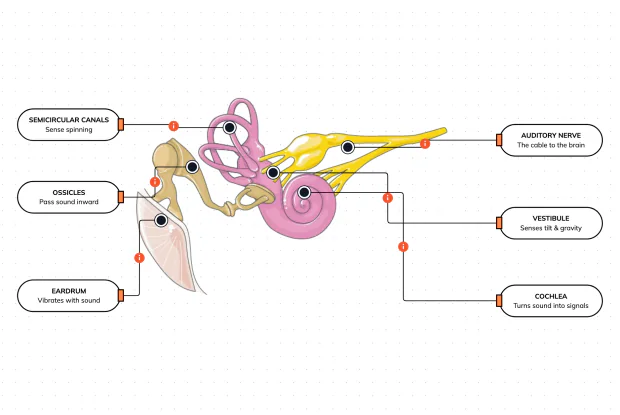
The auditory nerve is the cable that carries the cochlea's signals to the brain, where they are finally understood as speech, music or noise. Until the brain receives and reads them, no 'hearing' has really happened — the ear only prepares the signal; the brain does the listening. It is worth knowing that the inner ear does a second job too: right next to the cochlea sit the looping semicircular canals, also fluid-filled, which sense the movements of your head and keep you balanced. That is why an inner-ear problem can make you dizzy as well as affect your hearing, and why a bad ear infection can leave the room feeling like it is spinning. Hearing and balance share the same tiny, fluid-filled corner of your inner ear.
Real World Example
Why Are There So Many Different Reasons People Lose Their Hearing?
Because a sound has to be passed along from part to part, hearing can fail wherever the chain is interrupted. Doctors group hearing problems by which part is affected, and tracing the journey of sound explains each one:
A blocked channel
The ear canal
The simplest hearing problems happen right at the start, in the outer ear, before the sound has even reached the eardrum. If the ear canal gets plugged — most often by a build-up of wax, but also by swelling and fluid from an infection, or a small object a child has pushed in — then the sound the pinna collected simply cannot get through to the drum. Everything goes muffled, as though you had a finger in your ear, which in effect you do. The good news is that this kind of loss is usually completely reversible: clear the blockage and the sound reaches the eardrum again and hearing returns to normal. It is a blocked pipe, not a broken machine, and it is why a doctor's first move is often just to look down the canal.
A torn drum or stuck bones
The eardrum and ossicles
The next set of problems is in the middle ear, where the sound is being converted and amplified. If the eardrum is torn — by a very loud blast, a sudden pressure change, or a poke — it can no longer vibrate cleanly, so less of the sound gets passed on. If the tiny ossicles are damaged, or stiffened by disease so they can no longer move freely, the ear's amplifier fails and the signal reaching the inner ear is too weak. This is called conductive hearing loss, because the problem is in conducting the sound inward rather than in sensing it. Often it can be helped: a torn eardrum can heal or be repaired, and stuck or broken ossicles can sometimes be treated or replaced surgically.
Worn-out sensors
The cochlea
The hardest hearing loss to fix happens deepest in, at the cochlea, where sound is turned into nerve signals. The cochlea senses sound using thousands of microscopic hair cells, and these are fragile: years of ageing, or exposure to very loud noise like concerts, machinery or headphones turned up too high, gradually wear them out — and unlike skin or bone, they do not grow back. When enough are gone, the ear can catch and amplify a sound perfectly but no longer turn it fully into signals, so the sound is lost at the last step. This is the most common permanent hearing loss, and it is why protecting your ears from loud noise matters so much: the outer and middle ear can often be repaired, but the sensors in the cochlea cannot be replaced.
FAQs
Final Words
The ear makes sense the moment you stop seeing it as one organ and see it as a relay. A sound is caught by the pinna, carried down the ear canal, and turned into movement when it vibrates the eardrum. The three tiny ossicles pass that movement on and strengthen it, the snail-shaped cochlea turns it into nerve signals, and the auditory nerve delivers those signals to the brain, which finally hears. Each part simply hands the sound to the next in a new form — air, then movement, then signal.
Seeing the chain also explains real life: why a plug of wax makes everything muffled, why an ear infection can throw off your balance, and why loud music can cause a hearing loss that never fully heals. This is your first sense organ in the head-to-toe tour of the body; the same idea — trace the pathway, part by part — is how you will understand the eye and every other sense that follows.
Continue This Track
This concept is part 6 of The Human Body, Head to Toe.
What Is a Bone Made Of?
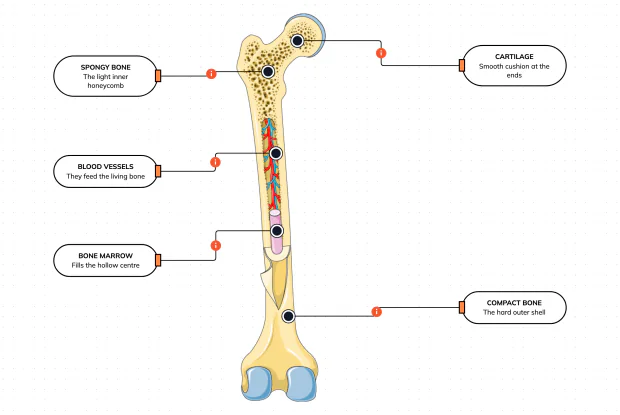
Cut a bone open and it is nowhere near solid: a hard outer shell, a light honeycomb inside, a hollow centre full of marrow, blood vessels threading through, and a smooth cushion at each end. Learn what each part does — then label them yourself in an interactive playground.
What Is Inside Your Elbow Joint?
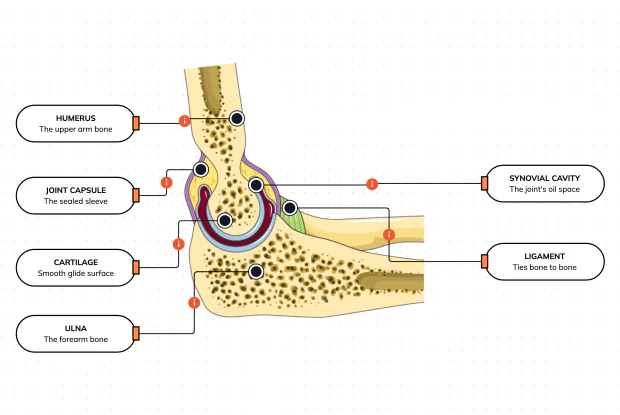
A joint is where two bones meet and move — and it is far more than just the bones. Cut open the elbow and you find smooth cartilage caps, a sealed capsule of slippery fluid, and tough ligaments holding it all together. Learn what each part does, then label them yourself in an interactive playground.
What Makes Your Elbow Bend?
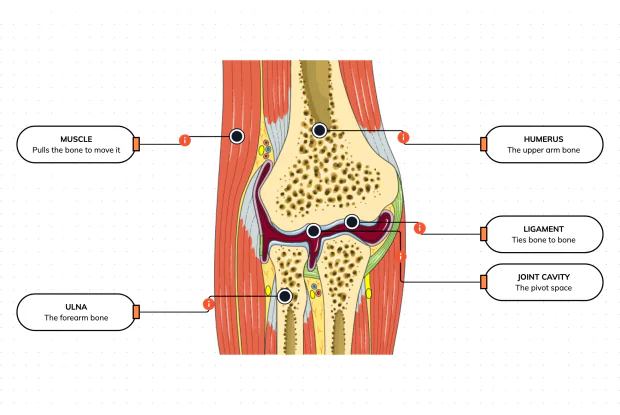
Bones and joints are just the hardware; nothing moves until a muscle pulls. Label the elbow to see the parts that turn a joint into movement — the muscle that pulls, the ligament that holds bone to bone, the two bones it links, and the space they pivot in — then build it yourself in an interactive playground.
What Holds Your Elbow Together?
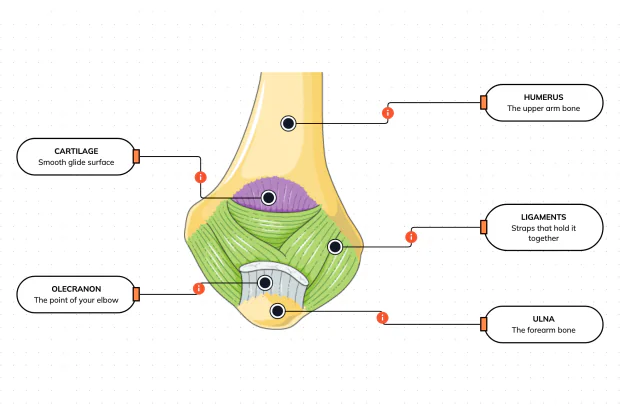
Your elbow is pulled on all day — by gravity, by every bag you carry, by every time you hang or push. So what stops the two bones from simply coming apart? Look at the back of the elbow and label the ligaments, the bony point, the cartilage and the two bones — and learn what holds the whole joint together.
What Are the Main Bones of the Skull?
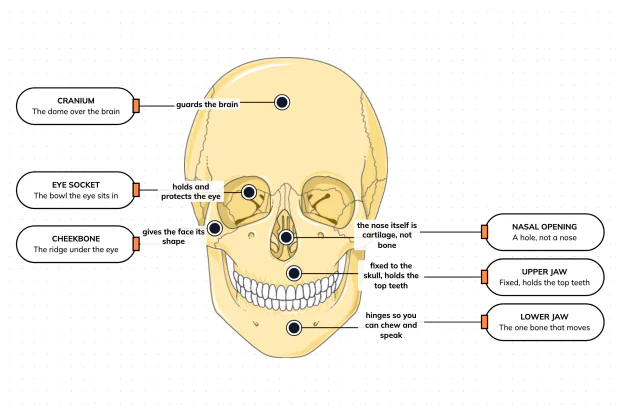
The skull looks like a single bone, but it is really about twenty-two locked together — with just one left free to move. Learn what each main part does, then label a skull yourself in an interactive playground.
What Are the Parts of Your Ear?
Hearing is a chain of parts passing a sound along, each handing it to the next. Label the pinna, ear canal, eardrum, ossicles, cochlea and auditory nerve, and follow a sound all the way from the air outside to a signal your brain can read — in an interactive playground.
How Does Your Ear Keep You Balanced?
Your ear does a second, hidden job: balance. Inside it sit fluid-filled loops that sense spinning and a chamber that senses tilt and gravity. Label the semicircular canals, vestibule, cochlea, ossicles, eardrum and nerve, and learn how one organ both hears and keeps you upright — in an interactive playground.
What Are the Parts of the Eye You Can See?
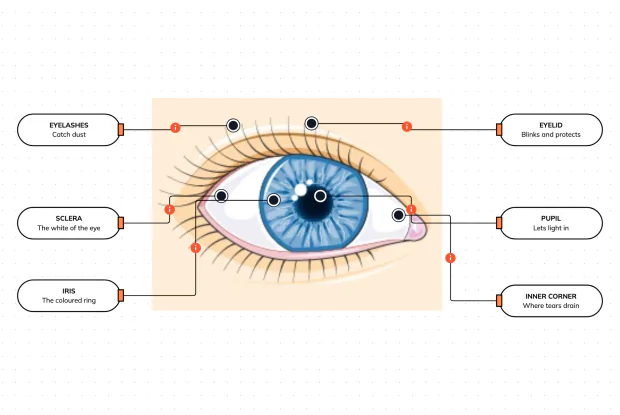
Before you look inside the eye, learn the parts you can already see in a mirror. Label the pupil, iris, sclera, eyelid, eyelashes and the tear-duct corner, and learn what each visible part does to let in light and protect the eye — in an interactive playground.
Where Do Your Tears Come From and Go?
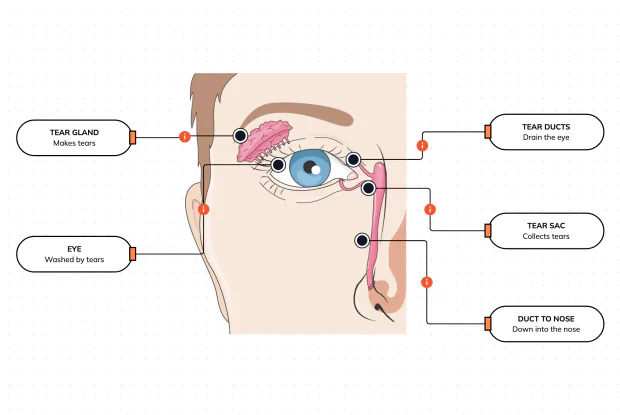
Your eyes make and drain tears all day to stay clean and wet. Label the tear gland, the eye, the tear ducts, the tear sac and the duct to the nose, and follow a tear from where it is made to where it drains — in an interactive playground.
How Does Your Eye Turn Light Into a Picture?
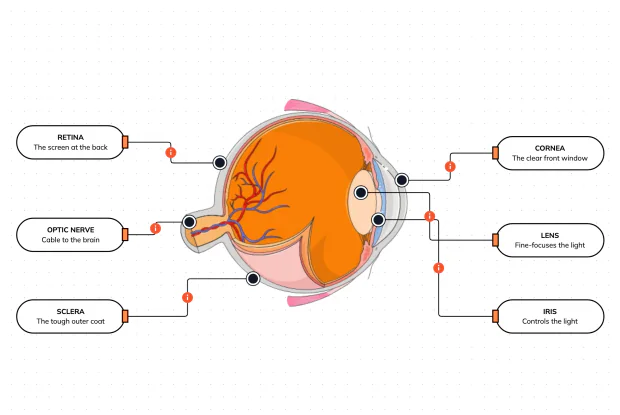
Your eye works like a living camera. Cut it open and label the cornea, lens, iris, retina, optic nerve and sclera, and follow light as it is focused onto a screen at the back of the eye and sent to the brain — in an interactive playground.