What Are the Main Bones of the Skull?
Root Concept
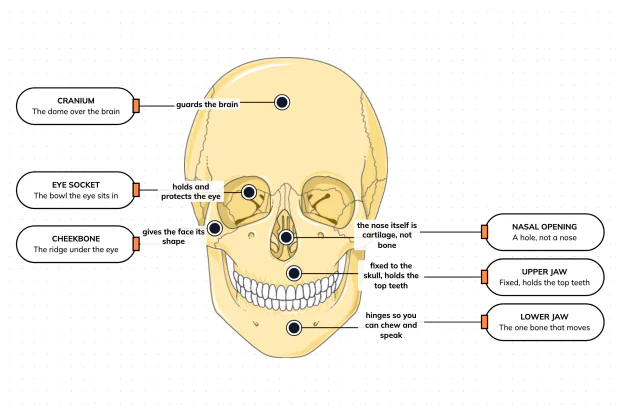
The skull is many bones fused into one protective case for the brain and the sense organs, with only the lower jaw left free to move for chewing and speaking.
CodePLU Goal
Upgrading Human Mental Models
Learn how to think in Workflows

Concept Development By codeplu.com
Each part of the skull, joined to the place it protects — or, for the jaw, the place it moves
Why Do We Call the Skull One Thing When It Is Really Many Bones?
Pick up a skull and it feels like one solid object, so it is a surprise to learn that it is built from about twenty-two separate bones. They are locked together so tightly that the joins look like cracks — wiggly lines called sutures — and once you are grown they do not move at all. That is deliberate. The skull's first job is to protect the brain, and a rigid box protects far better than a bag of loose pieces.
But there is one exception, and it is the exception that makes the whole design work. A single bone, the lower jaw, is left free to swing on a hinge near your ears. Everything else is fused for protection; the lower jaw is released for movement, because you have to open your mouth to eat and speak. Almost everything interesting about the skull comes from this one split: most of it is a fixed shield, and one piece of it is a moving tool.
The rest of the skull is shaped around the things it has to guard and carry. There are two deep bowls for the eyes, a central gap where the nose sits, ridges of cheekbone that give the face its shape, and the upper jaw that holds your top teeth as part of the skull itself. In the playground above you will label each of these, and the label on every connection tells you what that part is actually for.
What Is Each Part of the Skull For?
Is the skull really just one bone?
No — it only looks that way. The skull is roughly twenty-two bones that have grown together, and you can still see the joins as faint jagged lines. In a newborn they are not joined at all: a baby's skull is left in soft, separate plates so the head can squeeze through birth and then keep growing as the brain does. That is why babies have a 'soft spot' on top. Over the first couple of years the plates knit into the single hard case you think of as a skull, with only the lower jaw kept free.
Why does a skull have no nose?
Look at any skull and there is no nose, just a gap in the middle of the face shaped a little like an upside-down heart. That gap is the nasal opening. The nose you see on a living face is made of cartilage — the same bendy material as the tip of your ear — and cartilage is not bone, so it is not part of the skeleton. This is the reason a skeleton in a museum has a hole where the nose should be but keeps every tooth: teeth are anchored in bone, the nose was never bone at all.
What are the eye sockets for?
Each eye sits in a deep bony cup called the eye socket, or orbit. It is not carved out of one bone but formed where several skull bones meet, and it wraps around the eye on almost every side. The point is protection: a soft, precious eyeball is set back inside a rim of bone you can feel with your fingers, so a knock tends to land on the bony edge rather than the eye itself. The socket is also a little bigger than the eye, leaving room for the muscles that swivel it.
Why can the lower jaw move when nothing else can?
The lower jaw is the only bone in your whole head that moves, and it moves a lot — every bite and every word depends on it. It hangs from a hinge just in front of each ear, so it can drop open and swing side to side. The upper jaw, by contrast, is fixed: it is part of the skull and never moves on its own. So when you 'open your mouth', only the bottom half actually goes anywhere. You can feel this by resting a finger near your ear and opening wide — the moving lump under your finger is that hinge at work.
Why are cheekbones so easy to feel?
Run a finger from the outer corner of your eye toward your ear and you cross a hard ridge — that is your cheekbone. It sits close to the surface with little padding over it, which is why it stands out on the face and why a knock there is felt as bone. Its job is partly shape, giving the face its width and contour, and partly protection, forming the strong outer wall of the eye socket. Cheekbones are one of the clearest places to feel your skull without a mirror.
Real World Example
Why Does a Museum Skull Have No Nose but a Full Set of Teeth?
A skull on display is missing some things you would expect and keeps others you might not — and the difference comes down to what each part is made of:
The missing nose and ears
Cartilage, not bone
When you look at a museum skull, the first thing that seems wrong is the face: there is no nose and no outer ears, just a triangular hole in the middle and an opening on each side. That is because the nose and the outer ears were never bone to begin with — they are made of cartilage, a firmer, rubbery tissue that gives the living face its shape but is far softer than bone. Cartilage is not built to last; after death it dries out and breaks down long before the hard bony skull does. So what the skeleton keeps is only the bony frame around those features — the pear-shaped nasal opening where the nose sat, and the ear canals where the ears once curled.
The full set of teeth
Anchored in bone
The next surprise is that the teeth are almost always still there, often a complete set, and looking remarkably intact. Teeth survive because of where and how they are held: each one is rooted deep into a socket in the upper jaw (the maxilla) or the lower jaw (the mandible), both of which are solid bone. Locked into bone, the teeth are anchored and protected as firmly as the skull itself. They are also capped with enamel, the hardest substance the body makes, so they resist wear and decay even after everything soft around them has gone. This is exactly why teeth are so prized by archaeologists and forensic scientists — they can outlast the rest of a body by centuries and still reveal age, diet and identity.
What this tells you
Bone lasts, cartilage does not
Put the two together and the museum skull teaches a rule that runs through the whole skeleton: bone endures, and the soft tissues attached to it do not. Reading a skull well means picturing the parts that have vanished — filling the central gap with the nose that once sat there, and imagining the outer ears curling beside the openings on each side. Everything you label on the bony skull is only half the living head; the rest was cartilage, muscle and skin wrapped over this frame. Keeping that in mind turns a bare skull from a spooky object into a clear map of where each living feature was anchored — and it explains why some parts made it into the display case while the softer ones never could.
FAQs
Final Words
The skull makes sense the moment you see it as one idea with a single exception. Almost all of it is a rigid case — about twenty-two bones fused into a shield around the brain, with deep sockets for the eyes and a bony wall of cheek around each one. Then one bone, the lower jaw, is set free on a hinge, because a shield that never opens could not eat or speak.
Remember what each part is made of and the strange details stop being strange. The nose and outer ears are cartilage, so they vanish and leave only gaps; the teeth are set in bone, so they last. Label the cranium, the sockets, the cheekbones, the nasal opening and the two jaws, and you can read any skull you meet — and everything above the neck that we look at next hangs on this frame.
Continue This Track
This concept is part 5 of The Human Body, Head to Toe.
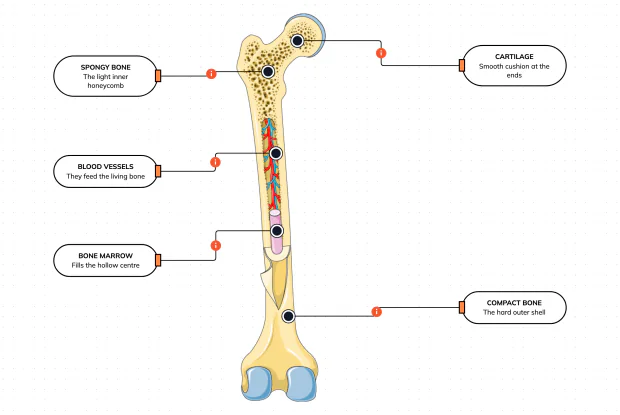
What Is a Bone Made Of?
Cut a bone open and it is nowhere near solid: a hard outer shell, a light honeycomb inside, a hollow centre full of marrow, blood vessels threading through, and a smooth cushion at each end. Learn what each part does — then label them yourself in an interactive playground.
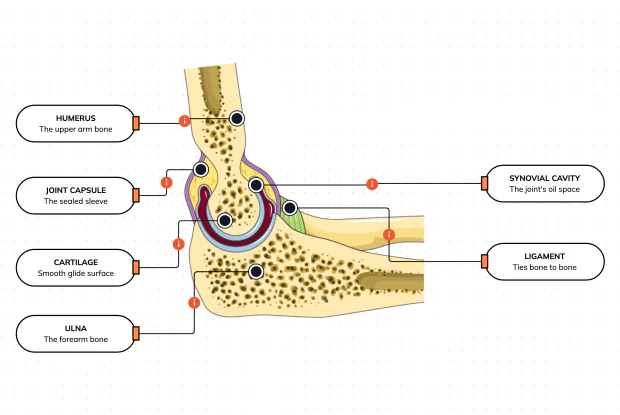
What Is Inside Your Elbow Joint?
A joint is where two bones meet and move — and it is far more than just the bones. Cut open the elbow and you find smooth cartilage caps, a sealed capsule of slippery fluid, and tough ligaments holding it all together. Learn what each part does, then label them yourself in an interactive playground.
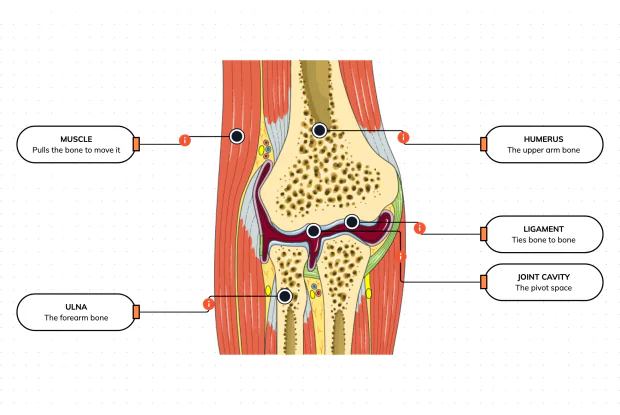
What Makes Your Elbow Bend?
Bones and joints are just the hardware; nothing moves until a muscle pulls. Label the elbow to see the parts that turn a joint into movement — the muscle that pulls, the ligament that holds bone to bone, the two bones it links, and the space they pivot in — then build it yourself in an interactive playground.
What Holds Your Elbow Together?
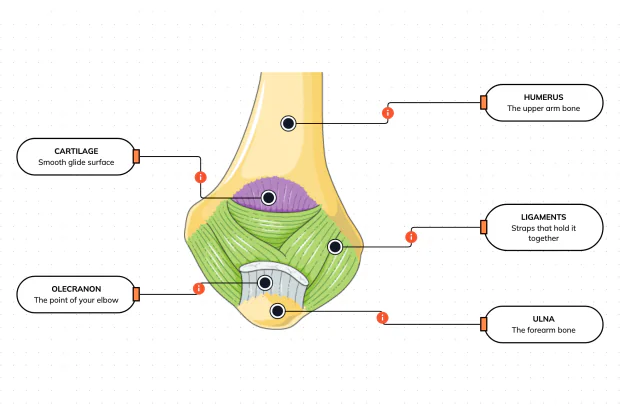
Your elbow is pulled on all day — by gravity, by every bag you carry, by every time you hang or push. So what stops the two bones from simply coming apart? Look at the back of the elbow and label the ligaments, the bony point, the cartilage and the two bones — and learn what holds the whole joint together.
What Are the Main Bones of the Skull?
The skull looks like a single bone, but it is really about twenty-two locked together — with just one left free to move. Learn what each main part does, then label a skull yourself in an interactive playground.
What Are the Parts of Your Ear?
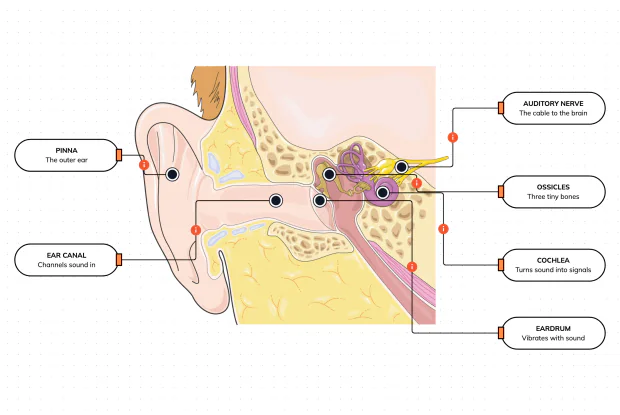
Hearing is a chain of parts passing a sound along, each handing it to the next. Label the pinna, ear canal, eardrum, ossicles, cochlea and auditory nerve, and follow a sound all the way from the air outside to a signal your brain can read — in an interactive playground.
How Does Your Ear Keep You Balanced?
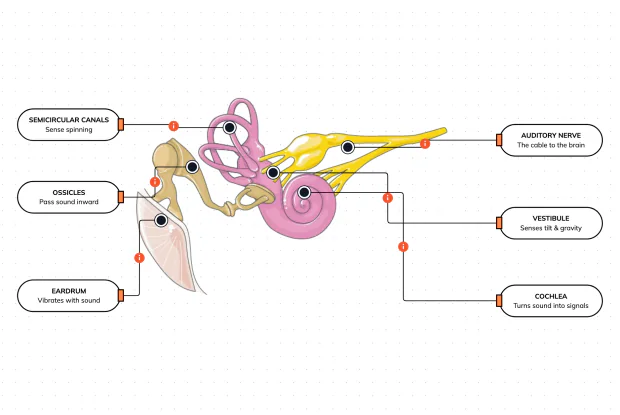
Your ear does a second, hidden job: balance. Inside it sit fluid-filled loops that sense spinning and a chamber that senses tilt and gravity. Label the semicircular canals, vestibule, cochlea, ossicles, eardrum and nerve, and learn how one organ both hears and keeps you upright — in an interactive playground.
What Are the Parts of the Eye You Can See?
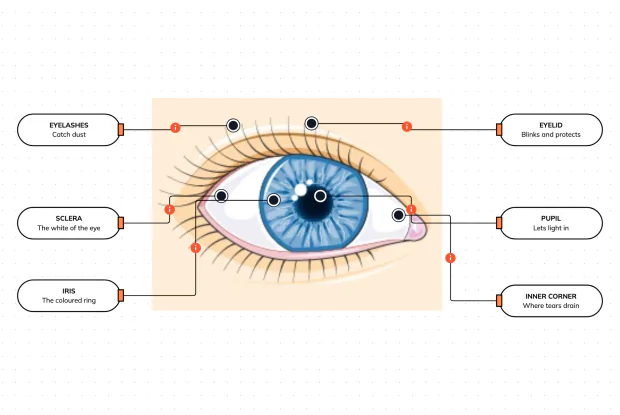
Before you look inside the eye, learn the parts you can already see in a mirror. Label the pupil, iris, sclera, eyelid, eyelashes and the tear-duct corner, and learn what each visible part does to let in light and protect the eye — in an interactive playground.
Where Do Your Tears Come From and Go?
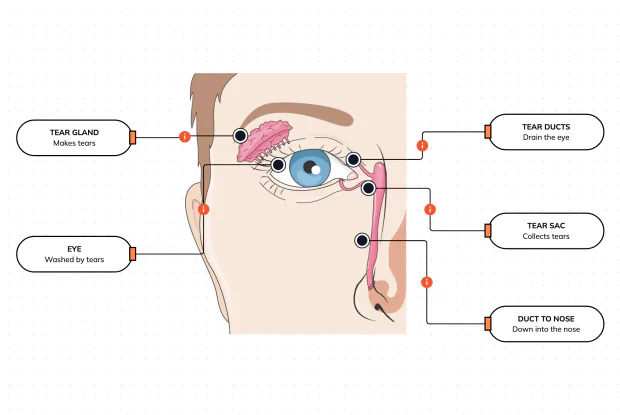
Your eyes make and drain tears all day to stay clean and wet. Label the tear gland, the eye, the tear ducts, the tear sac and the duct to the nose, and follow a tear from where it is made to where it drains — in an interactive playground.
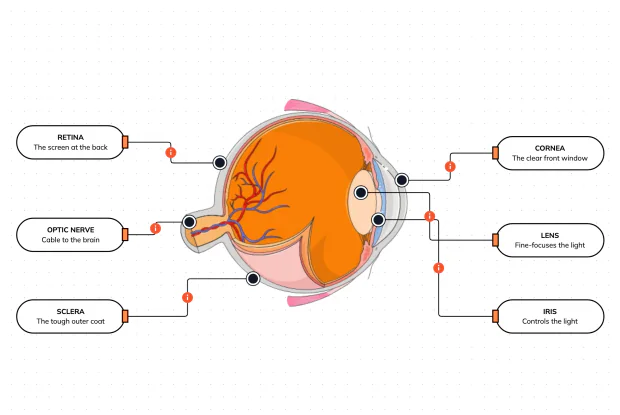
How Does Your Eye Turn Light Into a Picture?
Your eye works like a living camera. Cut it open and label the cornea, lens, iris, retina, optic nerve and sclera, and follow light as it is focused onto a screen at the back of the eye and sent to the brain — in an interactive playground.