What Holds Your Elbow Together?
Root Concept
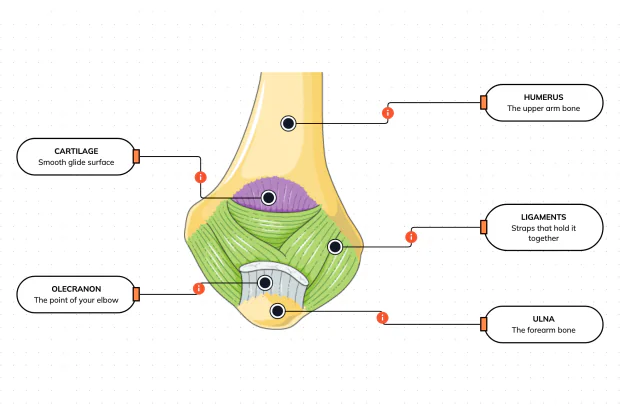
The elbow stays together because tough ligaments lash the humerus of the upper arm to the ulna of the forearm: the ulna's bony point (the olecranon) hooks against the humerus, smooth cartilage lets the surfaces glide, and the woven ligaments hold it all firmly so the joint bends without ever pulling apart.
CodePLU Goal
Upgrading Human Mental Models
Learn how to think in Workflows
Concept Development By codeplu.com
The parts you see at the back of the elbow, each joined to the job it does in holding the joint together
What Stops Your Elbow From Pulling Apart?
Hang from a bar, carry a heavy bag, or just let your arm dangle, and something is quietly trying to pull your forearm away from your upper arm. Every joint in your body is under this kind of steady tug — gravity and the weight of whatever you hold are always working to separate the bones. Yet your elbow never comes apart. Something is holding the two bones firmly together while still letting them swing freely, and the back of the elbow is the perfect place to see exactly what.
At the elbow the upper arm bone (the humerus) meets the forearm bone (the ulna). Looking from behind, the most obvious landmark is the olecranon — the bony point you can feel when you rest your elbow on a table. But the real stars of this view are the ligaments: tough, woven bands that cross the joint and lash the two bones directly to each other. They are what turn two loose bones into one stable, working hinge.
In the playground above you will label the two bones, the smooth cartilage that caps them, the bony point of the elbow, and the ligaments that hold it all together — and the label on each connection tells you the job that part does. By the end you will understand not just what the back of the elbow looks like, but why it stays together no matter how hard you pull on it.
What Holds the Elbow Together — Part by Part?
Why does a joint need holding together at all?
Because a joint is a place where two separate bones meet, and nothing about the bones themselves keeps them attached. If bones were the only thing at a joint, your forearm would simply drop off the moment you lifted anything or hung your arm down. Every movable joint is under constant pull — from gravity, from the weight of what you carry, and from the muscles yanking the bones about. So a joint has to solve two opposite problems at once: it must let the bones move freely in the direction they are meant to, and at the same time stop them from ever separating. At the elbow, the parts that solve the second problem are the ligaments.
What are ligaments, and how do they hold bone to bone?
A ligament is a tough, slightly stretchy band of tissue that ties one bone directly to another, right across the joint. In this back view of the elbow you can see them as the green woven fibres wrapping over and around the joint like strapping tape. At the elbow they run mainly down the two sides, linking the humerus above to the ulna and radius below, so the bones are lashed firmly together yet can still swing open and shut. Ligaments are strong enough to take a hard pull without tearing, but they are not rigid — they allow the exact hinge movement the elbow is built for while blocking the sideways or pulling-apart movements that would damage it. They are the seatbelts of the joint: mostly you never notice them, but they are the reason it stays safely together.
What is the olecranon — the point of your elbow?
The olecranon is the bony point at the very back of your elbow, the part you feel dig into a table when you lean on it. It is not a separate bone — it is the top end of the ulna, shaped into a hook. That hook wraps up and around the end of the humerus, so the two bones interlock rather than just touching. This shape does two important jobs: it makes the elbow a stable hinge that can only bend and straighten (not swivel), and it gives the powerful arm muscles a solid lever to pull on when you straighten your arm. Because the olecranon sits right under the skin with no muscle over it, it is easy to feel — and, unfortunately, easy to knock, which is exactly what you do when you hit your 'funny bone'.
What stops the bones grinding while they are held so tight?
Holding two bones firmly together would be useless if their hard ends simply ground against each other every time the joint moved. That is where cartilage comes in — the smooth, slightly rubbery cap you can see (shown here in purple) covering the bone end where it meets its partner. Cartilage is far slipperier than bone, so the surfaces glide over one another with almost no friction, and it cushions the impact each time you lean on or knock the joint. This is the clever balance of the elbow: the ligaments pull the bones tightly together for stability, while the cartilage makes sure that tight contact still slides smoothly and silently. Lose the cartilage — as happens in arthritis — and the held-together surfaces start to grind, which is what makes the joint stiff and painful.
What is the difference between a ligament and a tendon?
This is one of the most common mix-ups, and the back of the elbow is a good place to sort it out. A ligament ties bone to bone and holds a joint together — that is what you are labelling here. A tendon ties muscle to bone and passes on the muscle's pull so the joint can move. So ligaments are about stability (keeping the joint from coming apart) and tendons are about movement (making the joint go). At the elbow you have both: ligaments strapping the humerus to the ulna, and, out of sight in this view, the big triceps tendon attaching to the olecranon to straighten the arm. Same tough, rope-like material — completely different job depending on what each end is tied to.
Real World Example
Why Doesn't Your Arm Come Apart When You Hang From a Bar?
Hanging from a bar is about the hardest pulling test you can give a joint: everything below your hands is dead weight trying to separate the bones. The elbow passes it without a thought. Looking at the back of the joint shows exactly how the pull is handled and why nothing gives way:
The force trying to rip the joint open
The pull of your body weight
The moment your feet leave the floor, gravity turns your whole lower body into a load hanging off your arms, and that load pulls straight down on the forearm bones. Nothing about the bones themselves resists this — the humerus and the ulna are just two separate bones meeting at the elbow, and a downward pull is exactly the direction that would drag them apart. This is the same force at work, more gently, every single day: when you carry a full shopping bag, lift a suitcase, or simply let your arm hang, that weight is always trying to open the joint. A joint that relied on bone shape alone would come apart under it, so something else has to take the strain.
The straps that refuse to let go
The elbow ligaments
Taking that strain is the whole job of the ligaments — the tough woven bands you can see wrapping the back and sides of the joint. They are tied firmly to the humerus at one end and to the forearm bones at the other, so when your body weight tries to pull the bones apart, the ligaments go taut and simply refuse to lengthen. Think of them as heavy-duty strapping holding two poles end to end: the poles can still hinge where they meet, but they cannot be pulled off each other. Ligaments are built for exactly this — extremely strong against a straight pull, yet flexible enough to let the elbow bend and straighten freely. That combination is why you can hang your entire weight from your arms and feel completely secure, with the bones staying locked together the whole time.
What happens when a strap is stretched too far
A sprained ligament
You find out how much the ligaments were doing the instant one is overloaded. If the joint is forced past its limit — an awkward fall, a wrench, a sudden yank in the wrong direction — a ligament can be stretched or partly torn, and that injury is called a sprain. Suddenly the joint feels loose, wobbly and painful, and it no longer holds firm when you pull on it, because the very band that kept the bones together has been damaged. That is the clearest proof of what ligaments quietly do: you only notice them once they stop working. It is also why a sprained elbow, knee or ankle takes weeks to settle — ligaments have a poor blood supply and mend slowly, so the strap has to knit itself back to full strength before the joint feels solid again.
FAQs
Final Words
Your elbow is under a steady pull all day long, yet it never comes apart — because it is not just two bones touching, but two bones lashed firmly together. At the back of the joint the ligaments strap the humerus to the ulna, the olecranon hooks the bones into a stable hinge, and the smooth cartilage lets those tightly-held surfaces still glide without grinding. Stability and free movement at the same time: that is what the ligaments and the shape of the bones achieve together.
Label the two bones, the cartilage, the bony point and the ligaments, and you will understand not just the elbow but why every movable joint in your body — the knee, the shoulder, the knuckles — stays together while it moves. Now that you know what a bone is made of, what is inside a joint, and what holds a joint together, the named bones of the skeleton are pieces you can see fitting, moving and holding firm as one working frame.
Continue This Track
This concept is part 4 of The Human Body, Head to Toe.
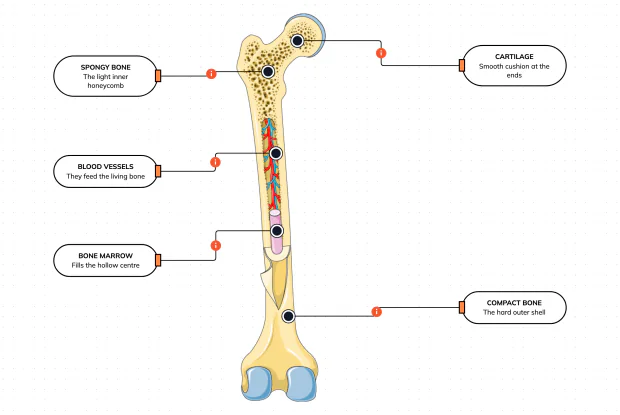
What Is a Bone Made Of?
Cut a bone open and it is nowhere near solid: a hard outer shell, a light honeycomb inside, a hollow centre full of marrow, blood vessels threading through, and a smooth cushion at each end. Learn what each part does — then label them yourself in an interactive playground.
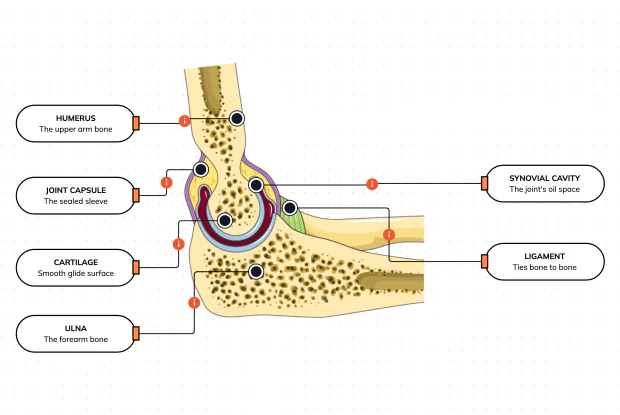
What Is Inside Your Elbow Joint?
A joint is where two bones meet and move — and it is far more than just the bones. Cut open the elbow and you find smooth cartilage caps, a sealed capsule of slippery fluid, and tough ligaments holding it all together. Learn what each part does, then label them yourself in an interactive playground.
What Makes Your Elbow Bend?
Bones and joints are just the hardware; nothing moves until a muscle pulls. Label the elbow to see the parts that turn a joint into movement — the muscle that pulls, the ligament that holds bone to bone, the two bones it links, and the space they pivot in — then build it yourself in an interactive playground.
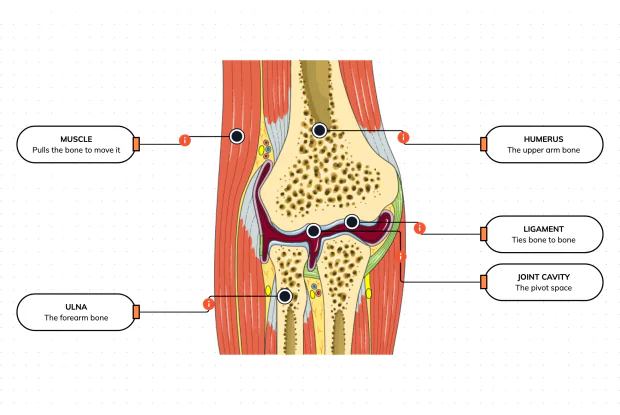
What Holds Your Elbow Together?
Your elbow is pulled on all day — by gravity, by every bag you carry, by every time you hang or push. So what stops the two bones from simply coming apart? Look at the back of the elbow and label the ligaments, the bony point, the cartilage and the two bones — and learn what holds the whole joint together.
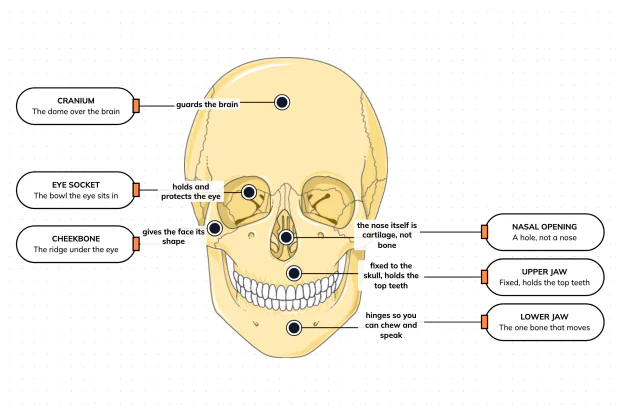
What Are the Main Bones of the Skull?
The skull looks like a single bone, but it is really about twenty-two locked together — with just one left free to move. Learn what each main part does, then label a skull yourself in an interactive playground.
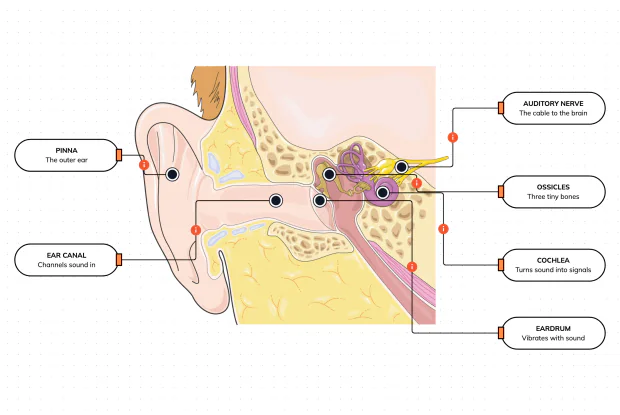
What Are the Parts of Your Ear?
Hearing is a chain of parts passing a sound along, each handing it to the next. Label the pinna, ear canal, eardrum, ossicles, cochlea and auditory nerve, and follow a sound all the way from the air outside to a signal your brain can read — in an interactive playground.
How Does Your Ear Keep You Balanced?
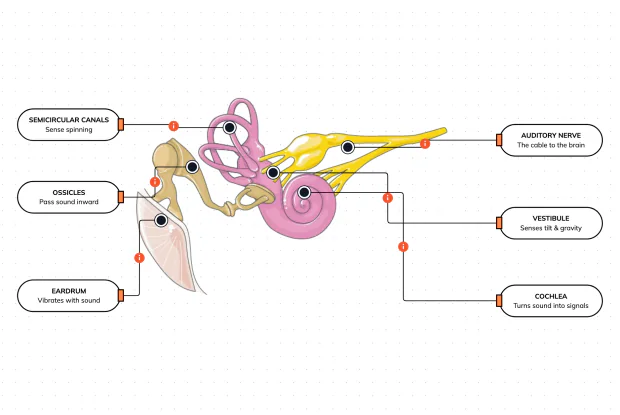
Your ear does a second, hidden job: balance. Inside it sit fluid-filled loops that sense spinning and a chamber that senses tilt and gravity. Label the semicircular canals, vestibule, cochlea, ossicles, eardrum and nerve, and learn how one organ both hears and keeps you upright — in an interactive playground.
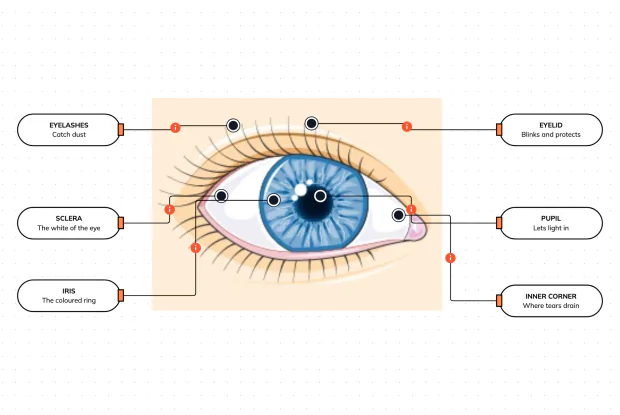
What Are the Parts of the Eye You Can See?
Before you look inside the eye, learn the parts you can already see in a mirror. Label the pupil, iris, sclera, eyelid, eyelashes and the tear-duct corner, and learn what each visible part does to let in light and protect the eye — in an interactive playground.
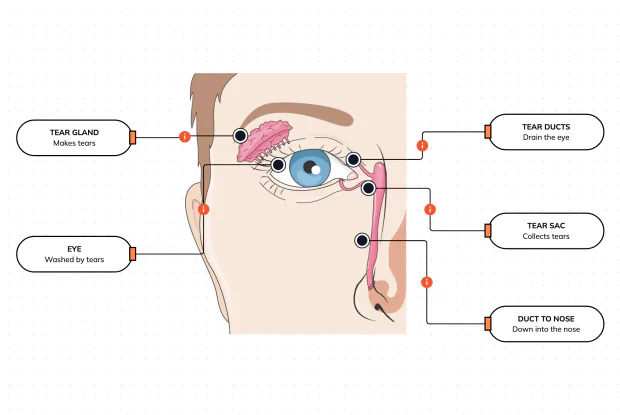
Where Do Your Tears Come From and Go?
Your eyes make and drain tears all day to stay clean and wet. Label the tear gland, the eye, the tear ducts, the tear sac and the duct to the nose, and follow a tear from where it is made to where it drains — in an interactive playground.
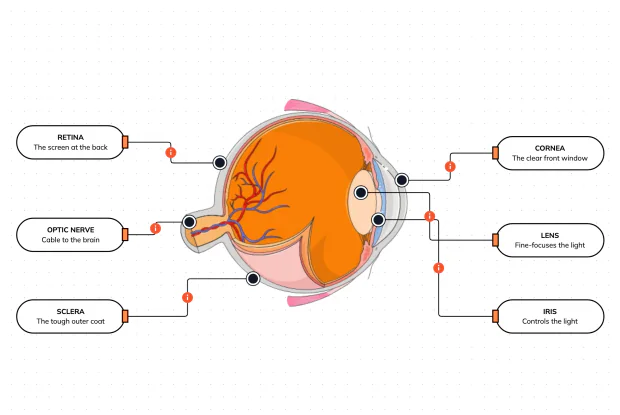
How Does Your Eye Turn Light Into a Picture?
Your eye works like a living camera. Cut it open and label the cornea, lens, iris, retina, optic nerve and sclera, and follow light as it is focused onto a screen at the back of the eye and sent to the brain — in an interactive playground.