How Is the Male Urinary Tract Different?
Root Concept
The male urinary tract has the same first three parts as everyone's — kidneys, ureters and bladder — but its urethra is much longer, running from the bladder down through the prostate gland and along the penis to the outside, and it carries reproductive fluid as well as urine.
CodePLU Goal
Upgrading Human Mental Models
Learn how to think in Workflows

Concept Development By codeplu.com
The male urinary tract — the familiar kidney, ureter and bladder, plus the prostate gland and the long urethra unique to the male path
Why Is the Bottom of the Male Urinary Tract Different?
Everyone's urinary system starts the same way: two kidneys make urine, two ureters carry it down, and a bladder stores it. That top part of the path is identical in every body. The difference between the male and female urinary tract is only at the very bottom — in the last tube, the urethra, and what sits around it.
In males, the urethra is much longer. Instead of a short tube straight to the outside, it leaves the bladder, passes through a gland called the prostate, and then runs all the way along the penis before it reaches the outside. So a male has the same kidney → ureter → bladder path as anyone, but a longer final stretch.
There is one more twist: in males, this same urethra is shared with the reproductive system, carrying not only urine but also reproductive fluid (at different times). In the playground you will label the familiar kidney, ureter and bladder, plus the two parts that make the male tract different — the prostate gland and the long urethra.
What Makes the Male Urinary Tract Special?
The same start: kidneys, ureters, bladder
It is worth saying clearly: most of the male urinary tract is exactly the same as everyone's. Two kidneys sit near the middle of the back and filter the blood to make urine. Two ureters carry that urine down, gently squeezing it along, and empty it into the bladder. The bladder is the same stretchy muscular bag that stores urine until you are ready to go. None of this differs between males and females — the making, the carrying and the storing of urine work identically. So if you already understand the urinary system, you already understand three-quarters of the male tract. The only differences come after the bladder, in how the urine finally leaves the body.
The prostate: a gland in the path
Just below the bladder, wrapped around the very start of the urethra, sits a gland about the size of a walnut called the prostate. Only males have one. Its main job belongs to the reproductive system — it makes part of the fluid that carries sperm — but it matters for the urinary tract because the urethra runs straight through the middle of it. That means anything that changes the size of the prostate also squeezes the tube that urine must pass through. Most of the time this causes no trouble at all. But the prostate's position, hugging the urethra right where it leaves the bladder, is the key fact that links this reproductive gland to how urine flows out in males.
The long urethra, shared with reproduction
After passing through the prostate, the male urethra keeps going — down and along the whole length of the penis — before it finally opens to the outside. This makes it far longer than the female urethra, which is short and leads almost straight out. Two consequences follow. First, because germs have a much longer tube to travel up, simple bladder infections are less common in males than in females. Second, this one long tube does double duty: at different times it carries urine out (its urinary job) and reproductive fluid out (its reproductive job), though never both at once. So the male urethra is a shared exit — the same tube serving two systems — which is the biggest way the male urinary tract differs from the general plan.
Real World Example
Why the Male Tract's Shape Matters
The male tract's differences are not just anatomy trivia — they show up in everyday health. Here are three:
Why older men may need the toilet more
An enlarging prostate can squeeze the urethra
As men get older, the prostate very often slowly grows larger. Because the urethra runs right through the middle of the prostate, a bigger prostate can gently squeeze that tube where it leaves the bladder, making the urine stream weaker and the bladder harder to empty fully. That is why many older men find they need the toilet more often, especially at night, or that the flow is slower than it used to be. It is extremely common and usually not dangerous, and doctors can treat it. It is a direct, everyday consequence of one anatomical fact from this tutorial: in males, the urine tube passes straight through a gland that tends to grow with age.
Fewer bladder infections in males
A longer urethra is a longer journey for germs
Urinary infections, where germs travel up the urethra into the bladder, are much more common in females than in males, and the male tract's shape is a big reason why. The male urethra is long, running through the prostate and all the way along the penis, so germs from outside have a far longer, harder journey to reach the bladder. The short female urethra gives germs a much quicker route in. This is a neat example of how a simple difference in the length of one tube changes real health outcomes — the same organ (the urethra) doing the same job, but its length alone making infections rarer in one body plan than the other.
One tube, two jobs
The male urethra serves urine and reproduction
In males, the urethra is shared between the urinary system and the reproductive system: it is the exit route for urine and, at other times, for reproductive fluid. The body keeps these separate in time — never both together — using muscles that switch which one can pass. This sharing is unique to the male plan; in females the two systems have separate openings. It is why the male urethra is described as belonging to both systems, and why a single tutorial on 'the male urinary tract' naturally brushes up against reproduction. For the urinary story, the key point is simply that this long, shared tube is the final path urine takes to leave the body.
FAQs
Final Words
The male urinary tract is mostly the familiar path: kidneys make urine, ureters carry it down, and the bladder stores it, exactly as in everyone. The differences are all at the end — a urethra that is much longer, that passes through the walnut-sized prostate gland just below the bladder, and that is shared with the reproductive system, carrying both urine and reproductive fluid at different times.
Those differences have real effects: an enlarging prostate can squeeze the urethra and slow the urine stream in older men, while the long urethra makes bladder infections less common than in females. Same first three parts, a longer and busier last one — that is the male urinary tract in a nutshell.
Continue This Track
This concept is part 51 of The Human Body, Head to Toe.
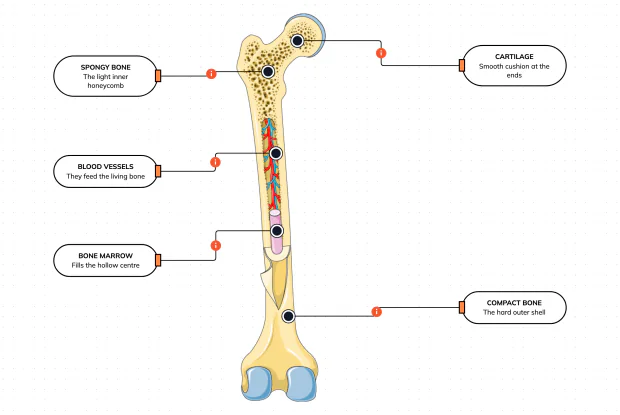
What Is a Bone Made Of?
Cut a bone open and it is nowhere near solid: a hard outer shell, a light honeycomb inside, a hollow centre full of marrow, blood vessels threading through, and a smooth cushion at each end. Learn what each part does — then label them yourself in an interactive playground.
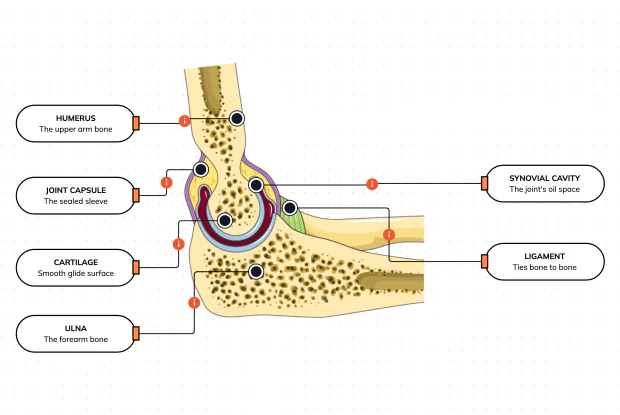
What Is Inside Your Elbow Joint?
A joint is where two bones meet and move — and it is far more than just the bones. Cut open the elbow and you find smooth cartilage caps, a sealed capsule of slippery fluid, and tough ligaments holding it all together. Learn what each part does, then label them yourself in an interactive playground.
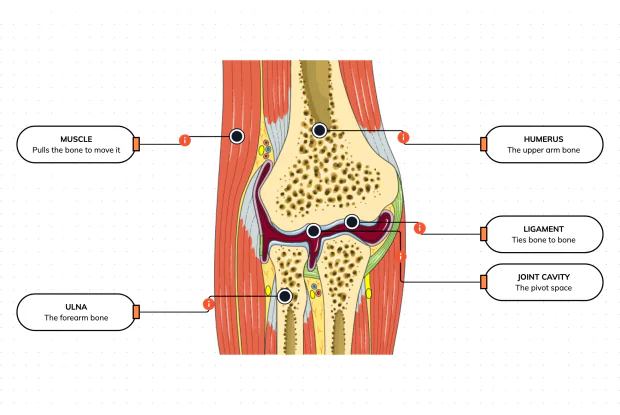
What Makes Your Elbow Bend?
Bones and joints are just the hardware; nothing moves until a muscle pulls. Label the elbow to see the parts that turn a joint into movement — the muscle that pulls, the ligament that holds bone to bone, the two bones it links, and the space they pivot in — then build it yourself in an interactive playground.
What Holds Your Elbow Together?
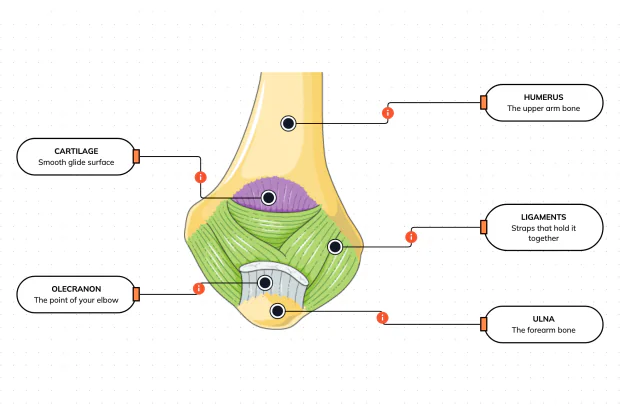
Your elbow is pulled on all day — by gravity, by every bag you carry, by every time you hang or push. So what stops the two bones from simply coming apart? Look at the back of the elbow and label the ligaments, the bony point, the cartilage and the two bones — and learn what holds the whole joint together.
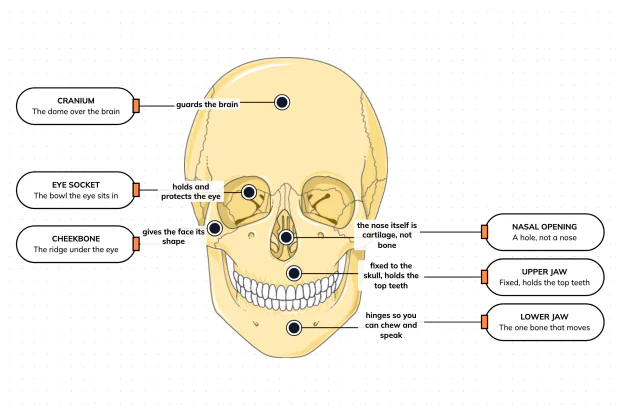
What Are the Main Bones of the Skull?
The skull looks like a single bone, but it is really about twenty-two locked together — with just one left free to move. Learn what each main part does, then label a skull yourself in an interactive playground.
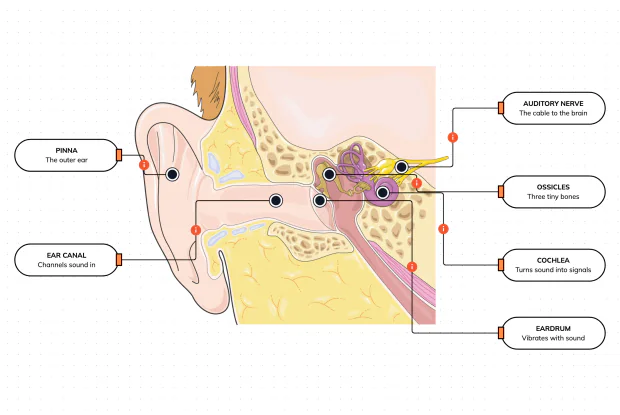
What Are the Parts of Your Ear?
Hearing is a chain of parts passing a sound along, each handing it to the next. Label the pinna, ear canal, eardrum, ossicles, cochlea and auditory nerve, and follow a sound all the way from the air outside to a signal your brain can read — in an interactive playground.
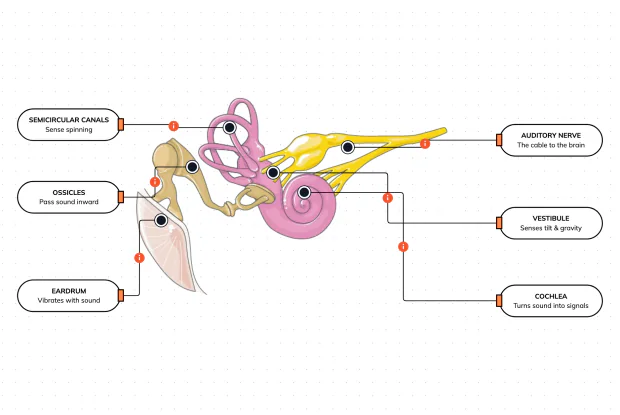
How Does Your Ear Keep You Balanced?
Your ear does a second, hidden job: balance. Inside it sit fluid-filled loops that sense spinning and a chamber that senses tilt and gravity. Label the semicircular canals, vestibule, cochlea, ossicles, eardrum and nerve, and learn how one organ both hears and keeps you upright — in an interactive playground.
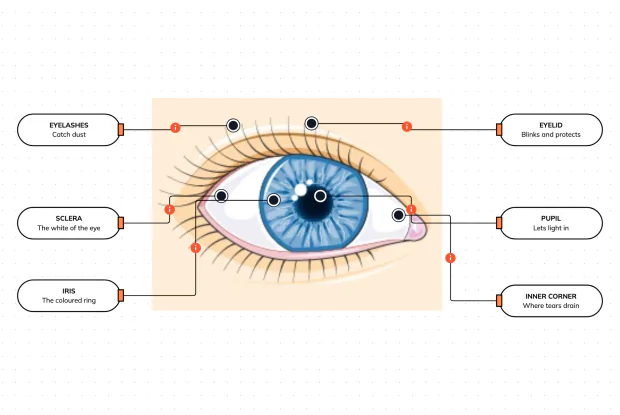
What Are the Parts of the Eye You Can See?
Before you look inside the eye, learn the parts you can already see in a mirror. Label the pupil, iris, sclera, eyelid, eyelashes and the tear-duct corner, and learn what each visible part does to let in light and protect the eye — in an interactive playground.
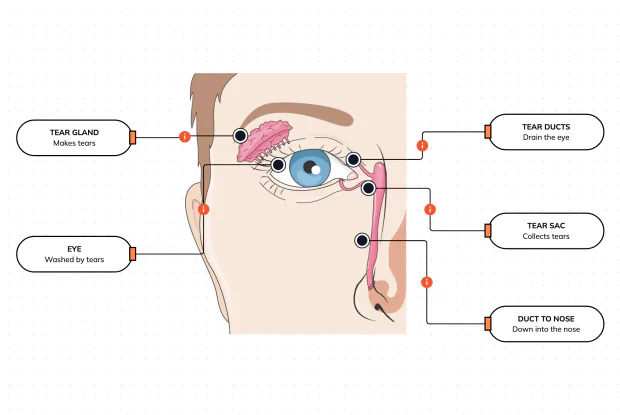
Where Do Your Tears Come From and Go?
Your eyes make and drain tears all day to stay clean and wet. Label the tear gland, the eye, the tear ducts, the tear sac and the duct to the nose, and follow a tear from where it is made to where it drains — in an interactive playground.
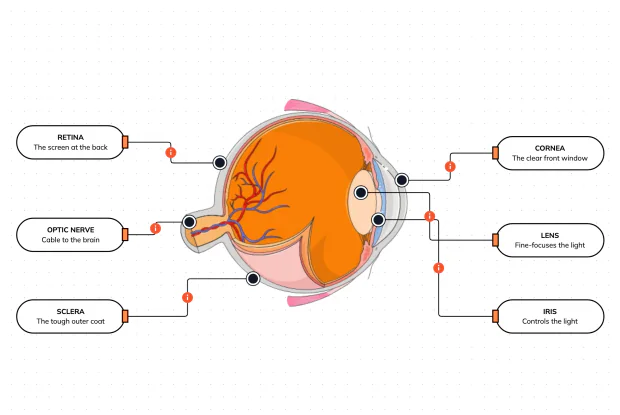
How Does Your Eye Turn Light Into a Picture?
Your eye works like a living camera. Cut it open and label the cornea, lens, iris, retina, optic nerve and sclera, and follow light as it is focused onto a screen at the back of the eye and sent to the brain — in an interactive playground.