What Is the Urinary System?
Root Concept
The urinary system is the set of organs that make and remove urine, arranged as a one-way path: the two kidneys filter the blood and make urine, the two ureters carry it down to the bladder, the bladder stores it, and the urethra carries it out of the body.
CodePLU Goal
Upgrading Human Mental Models
Learn how to think in Workflows

Concept Development By codeplu.com
The urinary system as one path — kidney makes urine, ureter carries it down, bladder stores it, urethra lets it out
What Happens to Urine From Start to Finish?
Your body is always making waste, and one of the main ways it gets rid of it is in your urine. But urine does not just appear where it leaves — it is made in one place, carried to another, stored, and only then let out. The organs that do all this, working together as a team, are called the urinary system.
There are four parts, and they form a simple one-way path from top to bottom. At the top are the two kidneys, which filter your blood and make the urine. From each kidney, a long tube called a ureter carries the urine downward. Both ureters empty into the bladder, a stretchy bag low in your tummy that stores the urine until you are ready. When you go to the toilet, the urine leaves the bladder through one last tube, the urethra, and out of the body.
So the whole journey is: kidney → ureter → bladder → urethra. Each part has one clear job, and urine only ever travels one way along the chain. In the playground you will label all four parts and follow the path of a drop of urine from where it is made to where it leaves.
How Do the Parts of the Urinary System Work Together?
Making the urine: the kidneys
The journey starts with the two kidneys, bean-shaped organs near the middle of your back. Their job is to filter your blood: as blood passes through them, they pull out waste and extra water and turn it into urine, while sending the cleaned blood back into the body. The kidneys never stop, making urine in a slow steady trickle all day and all night. This is the only place in the whole system where urine is actually made — every other part just moves it, stores it, or lets it out. So the kidneys are the source, and everything downstream is about handling what they produce. (If you want the inside story of how a kidney is built, that is its own tutorial; here it is simply the start of the path.)
Carrying and storing: ureters and bladder
Urine made in the kidneys has to get down to where it can be stored, and that is the job of the ureters — two thin tubes, one from each kidney, that run down to the bladder. They do not just let urine dribble down; they gently squeeze it along, so it keeps moving even when you are lying down or upside down. Both ureters empty into the bladder, a stretchy muscular bag that is the storage tank of the system. As urine arrives, the bladder swells to hold it, so you do not have to go to the toilet every few minutes. It can comfortably store a good amount, then signals your brain when it is getting full. Carry, then store: that is the middle of the path.
Letting it out: the urethra
The last step is getting the urine out of the body, and that is done by the urethra, a single tube leading from the bottom of the bladder to the outside. Most of the time a ring of muscle keeps the urethra closed, so the bladder can fill without leaking. When you decide it is time to go, that ring relaxes, the bladder squeezes, and urine flows out through the urethra. Then everything resets and the bladder starts filling again from the ureters. This one-way design — made in the kidneys, carried by the ureters, stored in the bladder, released by the urethra — keeps the whole system tidy and under your control, so your body can throw away waste at the right time and place.
Real World Example
The Urinary System in Everyday Life
Once you know the path of urine, a lot of everyday experiences make sense. Here are three:
Drink more, go more
The kidneys turn extra water into more urine
Drink a big glass of water and, before long, you need the toilet. That is the urinary system responding. When there is plenty of water in your blood, the kidneys let more of it go, making more urine, which travels down the ureters and fills the bladder faster. So the bladder reaches 'full' sooner and you feel the need to go. On a hot day when you have sweated a lot and drunk little, the kidneys hold water back, you make less urine, and you go less often. This simple link — more water in, more urine out — is the whole four-part path in action, with the kidneys deciding how much water to keep for the body and how much to send down the line.
The journey of a single drop
One drop travels the whole path in order
Follow one drop of urine and you follow the whole system. It begins in a kidney, squeezed out of the blood as waste and water. It trickles into the renal pelvis, the funnel in the middle of the kidney, then travels down a ureter, nudged along by gentle squeezes, until it drips into the bladder. There it waits, mixed with the rest, sometimes for hours, while the bladder fills. Finally, when you go to the toilet, it is pushed out through the urethra and gone. Every drop makes the same one-way trip in the same order: kidney, ureter, bladder, urethra. Knowing that order is really the whole point of understanding the urinary system.
Why urine infections happen
Germs can travel up the urethra into the bladder
Sometimes germs from outside the body get in through the urethra and travel up into the bladder, causing a urinary infection that makes weeing sting or feel urgent. It happens because the urethra is the system's open door to the outside — the same tube urine leaves by can, unluckily, let germs in. This is why drinking plenty of water helps: more urine flowing out flushes germs back down and away before they can settle. It also shows how the parts connect: a problem at the bottom of the path, in the urethra or bladder, is felt across the whole system, and keeping urine flowing is one of the body's simplest defences.
FAQs
Final Words
The urinary system is a simple, one-way path with four parts, each with one job: the kidneys make urine by filtering the blood, the ureters carry it down, the bladder stores it, and the urethra lets it out. Follow any drop and it makes the same trip in the same order — kidney, ureter, bladder, urethra — which is really the heart of understanding how your body removes its liquid waste.
Knowing this path explains everyday things, from why you go more when you drink more to why urine infections start at the bottom of the chain. Each part has its own tutorial if you want to go deeper — how a kidney filters, how the bladder stretches and stores — but together they are one team, quietly clearing your blood of waste and carrying it safely out.
Continue This Track
This concept is part 50 of The Human Body, Head to Toe.
What Is a Bone Made Of?
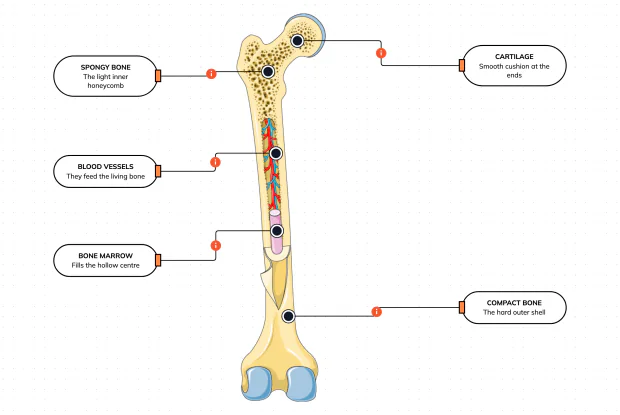
Cut a bone open and it is nowhere near solid: a hard outer shell, a light honeycomb inside, a hollow centre full of marrow, blood vessels threading through, and a smooth cushion at each end. Learn what each part does — then label them yourself in an interactive playground.
What Is Inside Your Elbow Joint?
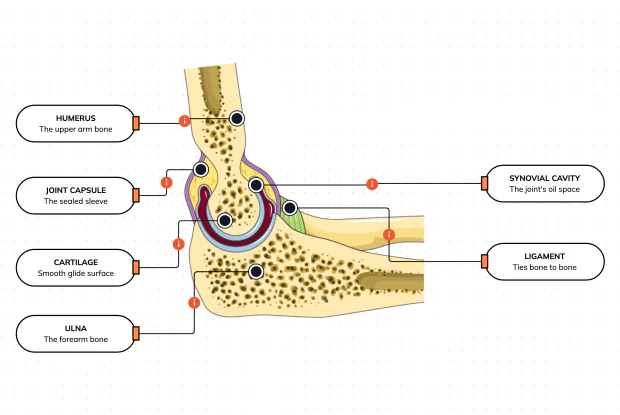
A joint is where two bones meet and move — and it is far more than just the bones. Cut open the elbow and you find smooth cartilage caps, a sealed capsule of slippery fluid, and tough ligaments holding it all together. Learn what each part does, then label them yourself in an interactive playground.
What Makes Your Elbow Bend?
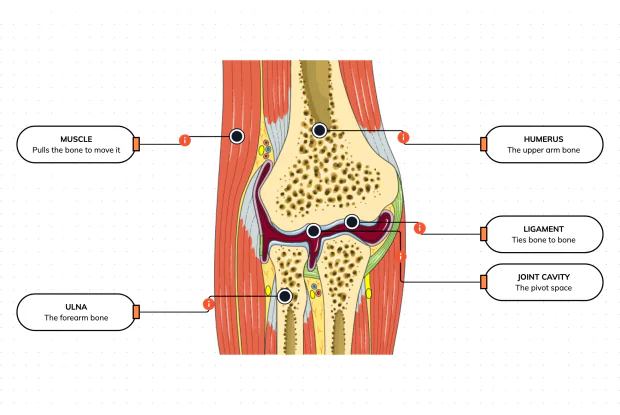
Bones and joints are just the hardware; nothing moves until a muscle pulls. Label the elbow to see the parts that turn a joint into movement — the muscle that pulls, the ligament that holds bone to bone, the two bones it links, and the space they pivot in — then build it yourself in an interactive playground.
What Holds Your Elbow Together?
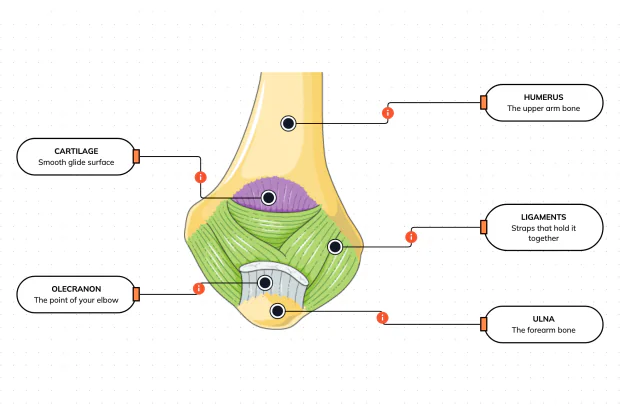
Your elbow is pulled on all day — by gravity, by every bag you carry, by every time you hang or push. So what stops the two bones from simply coming apart? Look at the back of the elbow and label the ligaments, the bony point, the cartilage and the two bones — and learn what holds the whole joint together.
What Are the Main Bones of the Skull?
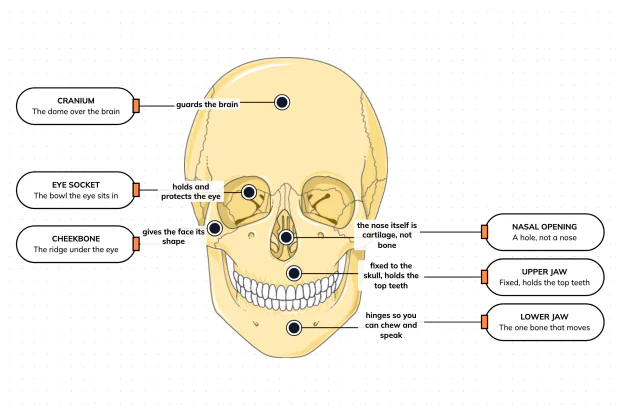
The skull looks like a single bone, but it is really about twenty-two locked together — with just one left free to move. Learn what each main part does, then label a skull yourself in an interactive playground.
What Are the Parts of Your Ear?
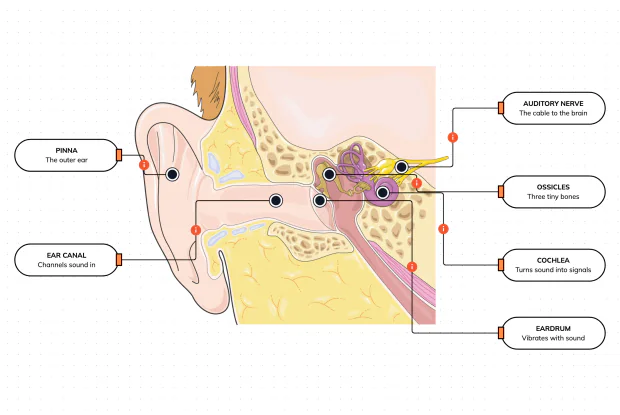
Hearing is a chain of parts passing a sound along, each handing it to the next. Label the pinna, ear canal, eardrum, ossicles, cochlea and auditory nerve, and follow a sound all the way from the air outside to a signal your brain can read — in an interactive playground.
How Does Your Ear Keep You Balanced?
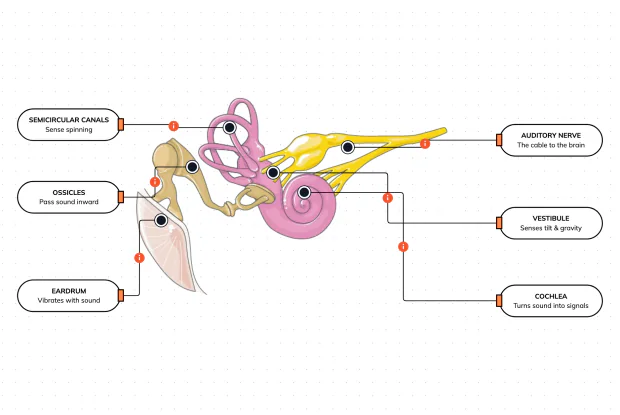
Your ear does a second, hidden job: balance. Inside it sit fluid-filled loops that sense spinning and a chamber that senses tilt and gravity. Label the semicircular canals, vestibule, cochlea, ossicles, eardrum and nerve, and learn how one organ both hears and keeps you upright — in an interactive playground.
What Are the Parts of the Eye You Can See?
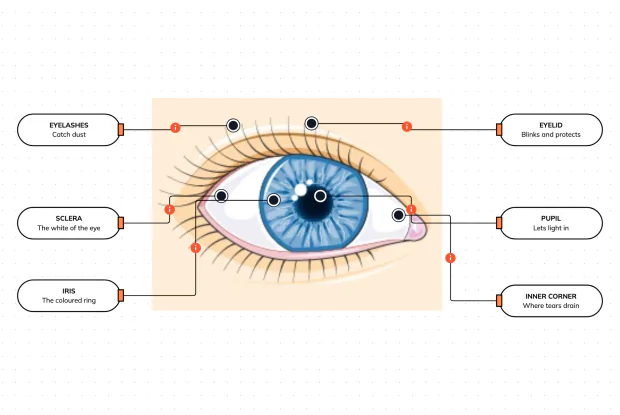
Before you look inside the eye, learn the parts you can already see in a mirror. Label the pupil, iris, sclera, eyelid, eyelashes and the tear-duct corner, and learn what each visible part does to let in light and protect the eye — in an interactive playground.
Where Do Your Tears Come From and Go?
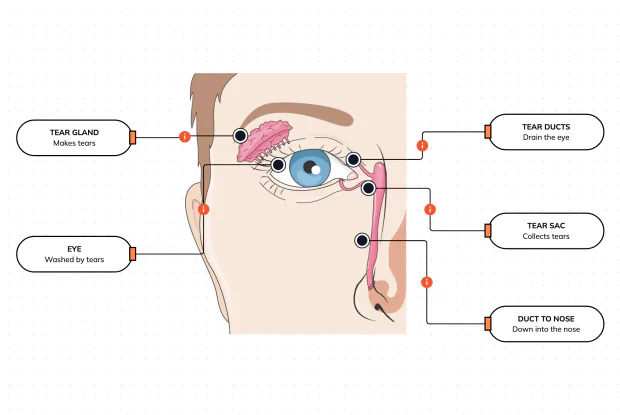
Your eyes make and drain tears all day to stay clean and wet. Label the tear gland, the eye, the tear ducts, the tear sac and the duct to the nose, and follow a tear from where it is made to where it drains — in an interactive playground.
How Does Your Eye Turn Light Into a Picture?
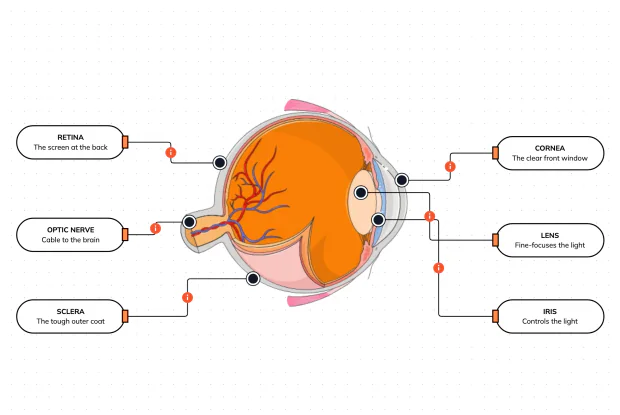
Your eye works like a living camera. Cut it open and label the cornea, lens, iris, retina, optic nerve and sclera, and follow light as it is focused onto a screen at the back of the eye and sent to the brain — in an interactive playground.