How Do Your Taste Buds Work?
Root Concept
A taste bud is an onion-shaped cluster of taste cells set in the tongue's surface. Dissolved food enters through a tiny taste pore at the top, the taste cells detect the flavour chemicals, and a nerve fibre carries the signal to the brain, which recognises it as a taste.
CodePLU Goal
Upgrading Human Mental Models
Learn how to think in Workflows

Concept Development By codeplu.com
Inside a taste bud, each part joined to the job it does — from the pore where flavour enters to the nerve that carries it to the brain
How Does a Mouthful of Food Become a Flavour?
When you taste something, it feels instant and effortless — but a lot is happening in a place far too small to see. Tasting is done by taste buds: tiny onion-shaped sense organs, thousands of them, buried in the bumps (papillae) on your tongue. Each one is a cluster of special cells whose only job is to detect the chemicals in food and report them to your brain as a flavour.
Zoom in on a single taste bud and its design is neat and logical. The bud sits embedded in the epithelium — the surface skin of the tongue — like an onion set into the ground. At the top is a small opening called the taste pore, which connects the inside of the bud to the food in your mouth. Inside the bud are the taste cells, slim sensing cells that reach up toward the pore. And from the bottom of the bud, nerve fibres run off toward the brain.
That layout tells you exactly how tasting works, step by step. Food, once dissolved in saliva, drifts in through the taste pore and touches the tips of the taste cells. The taste cells react to the flavour chemicals and fire off a signal, which the nerve fibre carries to the brain, where it is recognised as sweet, salty, sour, bitter or savoury. In the playground you will label the taste bud, its taste cells, the pore, the nerve and the surrounding surface — and the label on each connection tells you the job that part does.
What Is Inside a Taste Bud?
What is a taste bud?
A taste bud is a tiny, onion-shaped cluster of cells that is the actual organ of taste. You have around ten thousand of them, most tucked into the little bumps (papillae) on your tongue, with a few on the roof of the mouth and in the throat. Each bud is far too small to see on its own — what you can see, the bumps on your tongue, are the papillae that hold many buds each. So when people say 'taste buds' pointing at the bumps, they are close but not quite right: the bumps are the bumps, and the taste buds are the microscopic sensors packed inside them. A single taste bud is a self-contained little taste detector, with an opening to sample food, sensing cells to detect it, and a nerve to report what it found.
What are taste cells?
Inside each taste bud is a bundle of slim sensing cells called taste cells, packed together like the segments of an onion. These are the cells that actually do the tasting: their tips carry receptors that react to particular flavour chemicals — the molecules that make something sweet, salty, sour, bitter or savoury. When a matching chemical touches a taste cell, the cell responds and passes on a signal. Different taste cells respond to different tastes, so a single bud can detect a range of flavours. One surprising fact about taste cells is that they wear out and are replaced roughly every week or two — your tongue constantly grows fresh ones. This is why taste can recover after you burn your tongue on a hot drink: the damaged cells are simply replaced by new ones, and your sense of taste returns.
What is the taste pore?
The taste pore is the small opening at the top of each taste bud, where it meets the surface of the tongue. It is the doorway of the whole system: the only way for food to reach the sensing cells tucked inside the bud. The tips of the taste cells poke up into this pore, waiting. For anything to be tasted, its flavour chemicals have to travel through the pore and touch those tips. This is why food must be dissolved to be tasted — a dry lump cannot slip through the tiny pore, but once saliva dissolves it, the flavour chemicals can flow in. The pore is small, but it is the essential gateway: no pore, no way for the food to reach the cells, and no taste.
How does the signal reach the brain?
At the base of each taste bud, nerve fibres are waiting, connected to the taste cells. When a taste cell detects a flavour and fires, it passes that signal to a nerve fibre, and the nerve carries it away, up to the brain. Only when the brain receives and reads these signals do you actually experience a taste — the taste bud senses, but the brain is where 'sweet' or 'bitter' is recognised, exactly as the eye captures light but the brain does the seeing. Signals from all your taste buds stream along these nerves to a taste region in the brain, which combines them into the flavour you notice. So the nerve fibre is the messenger, turning a tiny chemical reaction in a cell on your tongue into a flavour in your mind.
How does taste happen, step by step?
Put the parts together and tasting is a clear little chain. First, food is dissolved by saliva in your mouth — this is an essential and often-forgotten step. The dissolved flavour chemicals then flow through the taste pore into the taste bud. There they touch the tips of the taste cells, which react to the chemicals they are tuned to detect. The taste cells fire a signal, which passes to the nerve fibres at the base of the bud, and the nerve carries it to the brain, which recognises the flavour. Dissolve, enter the pore, trigger the cells, fire the nerve, read it in the brain. Every flavour you have ever enjoyed followed exactly this path, thousands of times over, through the tiny onion-shaped buds hidden in your tongue.
Real World Example
Why Can Taste Fail — and Then Come Back?
Because tasting is a chain of small steps, it can be blocked or dulled at different points — and, remarkably, it repairs itself. Three familiar experiences show why:
Why food must be wet to taste
The pore needs dissolved food
Try tasting something with a completely dry tongue — dry a fingertip and touch it to a little sugar, then to a bone-dry patch of your tongue, and you will notice almost nothing until saliva wets it. This is because flavour chemicals can only reach the taste cells by flowing in through the tiny taste pore, and they can only do that once they are dissolved in liquid. A dry lump of food simply sits on the surface, its chemicals locked up, unable to slip through the pore. Saliva is what unlocks taste, dissolving the food so its flavour can flow into the buds. It is why a dry mouth makes food seem bland, and why you produce more saliva the moment tasty food is near — your body is getting ready to actually taste it.
Why a cold makes food taste flat
Taste needs smell too
When you have a heavy cold, food often seems to lose almost all its flavour — yet your taste buds are working perfectly. The reason is that what we call 'flavour' is mostly smell, not taste. The taste buds only detect a handful of basic tastes — sweet, salty, sour, bitter and savoury — while the rich detail of, say, strawberry or coffee comes from your nose smelling it as you eat. A blocked nose cuts off that smell information, so all that is left is the plain basic taste, and food seems flat. It is a neat demonstration of what taste buds do and do not do: they handle the five basic tastes, and the brain blends those with smell to build the full flavour. Pinch your nose while eating a jelly bean and you will taste sweetness but struggle to name the fruit.
Why a burnt tongue recovers
Taste cells regrow
Sip a drink that is too hot and you can scald your tongue, leaving it sore and your sense of taste briefly dulled — and yet within a few days it is back to normal. This is thanks to the taste cells inside the buds, which are constantly being replaced, roughly every one to two weeks, throughout your life. Damaged cells are simply cleared away and fresh ones grow in their place, so a minor injury like a burn does not cost you your sense of taste for long. Few parts of the body renew themselves so readily. It is a reassuring example of the taste bud's design: the delicate sensing cells are treated as disposable and endlessly refreshed, keeping your sense of taste sharp across a lifetime of hot dinners and cold drinks.
FAQs
Final Words
Taste happens inside tiny onion-shaped taste buds packed into the bumps of your tongue. Each bud sits in the tongue's surface, opens through a taste pore, holds slim taste cells that detect flavour chemicals, and connects to a nerve fibre at its base. The chain is simple: food dissolves in saliva, flows through the pore, triggers the taste cells, and the nerve carries the signal to the brain to be recognised as a flavour.
Seeing the parts explains why taste can fail and recover — why food must be wet to taste, why a cold makes it flat (taste needs smell), and why a scalded tongue heals as its cells regrow. From the whole tongue down to a single taste bud, you now know how flavour is sensed. Next in the mouth comes the last step before food leaves it: how you swallow.
Continue This Track
This concept is part 27 of The Human Body, Head to Toe.
What Is a Bone Made Of?
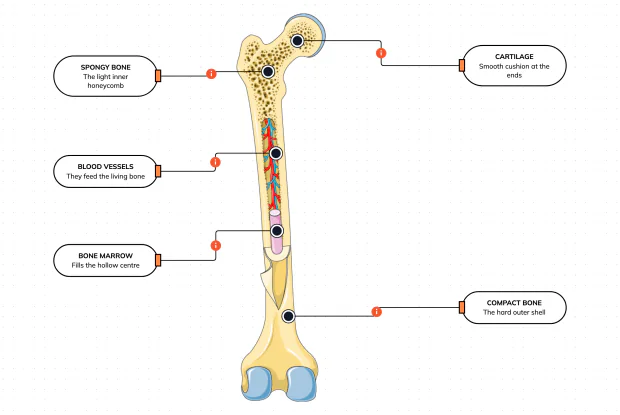
Cut a bone open and it is nowhere near solid: a hard outer shell, a light honeycomb inside, a hollow centre full of marrow, blood vessels threading through, and a smooth cushion at each end. Learn what each part does — then label them yourself in an interactive playground.
What Is Inside Your Elbow Joint?
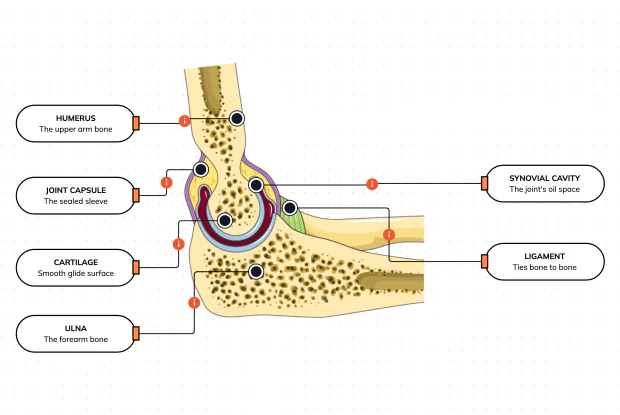
A joint is where two bones meet and move — and it is far more than just the bones. Cut open the elbow and you find smooth cartilage caps, a sealed capsule of slippery fluid, and tough ligaments holding it all together. Learn what each part does, then label them yourself in an interactive playground.
What Makes Your Elbow Bend?
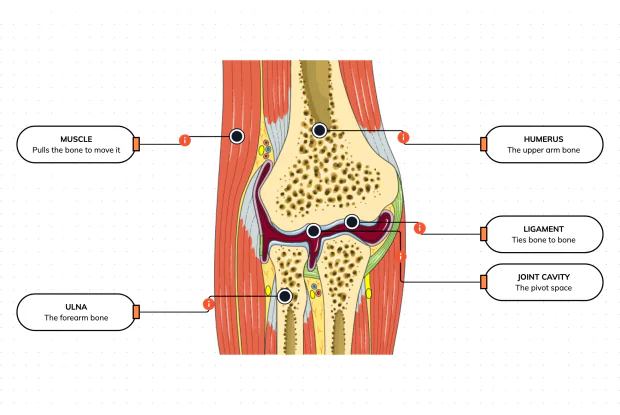
Bones and joints are just the hardware; nothing moves until a muscle pulls. Label the elbow to see the parts that turn a joint into movement — the muscle that pulls, the ligament that holds bone to bone, the two bones it links, and the space they pivot in — then build it yourself in an interactive playground.
What Holds Your Elbow Together?
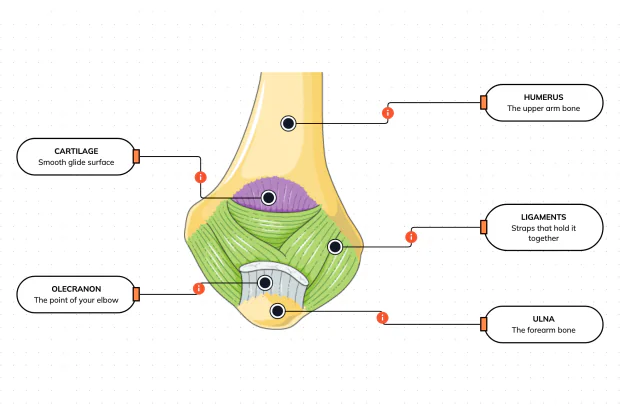
Your elbow is pulled on all day — by gravity, by every bag you carry, by every time you hang or push. So what stops the two bones from simply coming apart? Look at the back of the elbow and label the ligaments, the bony point, the cartilage and the two bones — and learn what holds the whole joint together.
What Are the Main Bones of the Skull?
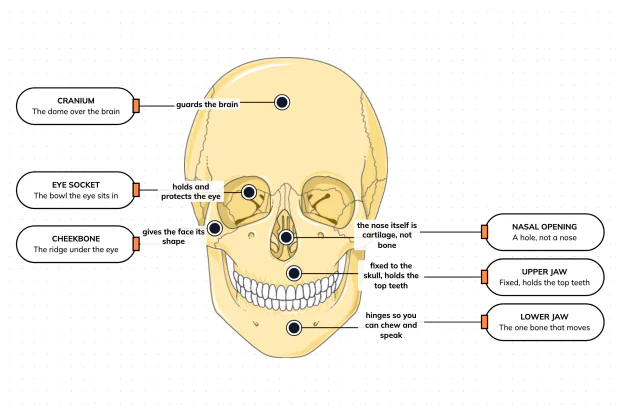
The skull looks like a single bone, but it is really about twenty-two locked together — with just one left free to move. Learn what each main part does, then label a skull yourself in an interactive playground.
What Are the Parts of Your Ear?
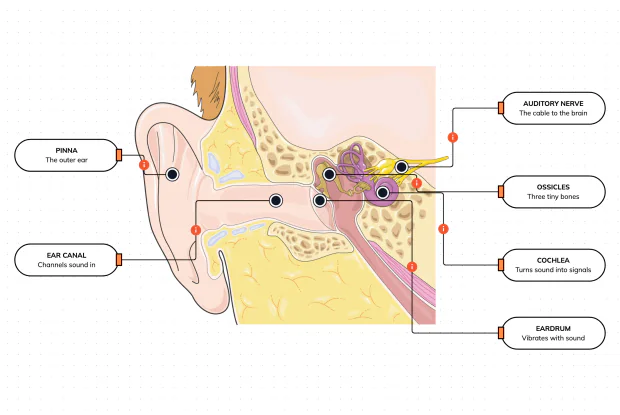
Hearing is a chain of parts passing a sound along, each handing it to the next. Label the pinna, ear canal, eardrum, ossicles, cochlea and auditory nerve, and follow a sound all the way from the air outside to a signal your brain can read — in an interactive playground.
How Does Your Ear Keep You Balanced?
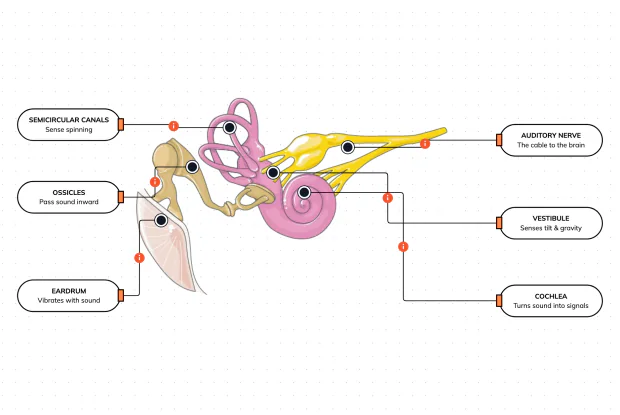
Your ear does a second, hidden job: balance. Inside it sit fluid-filled loops that sense spinning and a chamber that senses tilt and gravity. Label the semicircular canals, vestibule, cochlea, ossicles, eardrum and nerve, and learn how one organ both hears and keeps you upright — in an interactive playground.
What Are the Parts of the Eye You Can See?
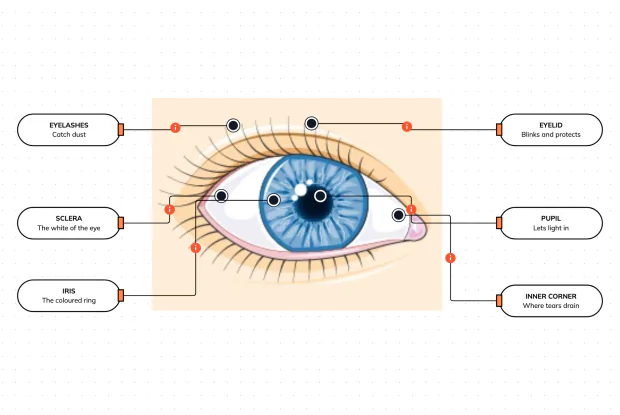
Before you look inside the eye, learn the parts you can already see in a mirror. Label the pupil, iris, sclera, eyelid, eyelashes and the tear-duct corner, and learn what each visible part does to let in light and protect the eye — in an interactive playground.
Where Do Your Tears Come From and Go?
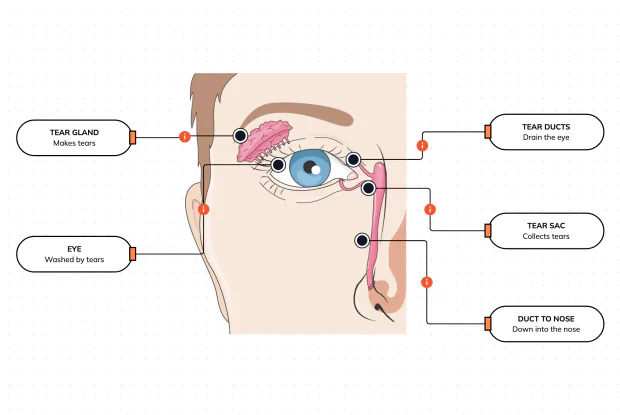
Your eyes make and drain tears all day to stay clean and wet. Label the tear gland, the eye, the tear ducts, the tear sac and the duct to the nose, and follow a tear from where it is made to where it drains — in an interactive playground.
How Does Your Eye Turn Light Into a Picture?
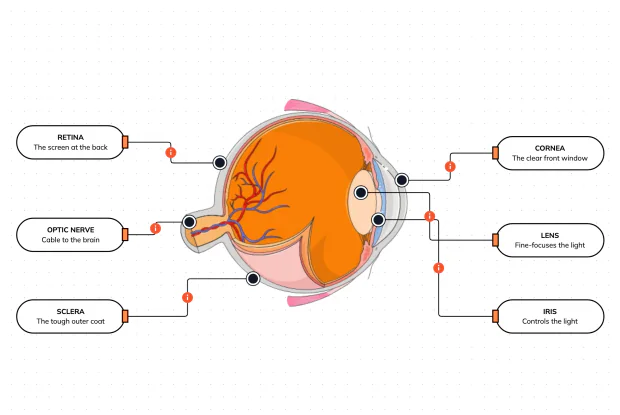
Your eye works like a living camera. Cut it open and label the cornea, lens, iris, retina, optic nerve and sclera, and follow light as it is focused onto a screen at the back of the eye and sent to the brain — in an interactive playground.