Why Is Your Small Intestine So Long and Folded?
Root Concept
The small intestine is the long tube where most nutrients are absorbed. It is about seven metres long, coiled to fit inside the belly; its inner lining is thrown into circular folds to increase the absorbing surface; food travels slowly through the hollow lumen; and its muscular wall squeezes the food along.
CodePLU Goal
Upgrading Human Mental Models
Learn how to think in Workflows

Concept Development By codeplu.com
The small intestine, each part joined to the job it does — coiled, folded and muscular, all to absorb as much of your food as possible
Where Does the Goodness in Food Actually Get Absorbed?
The stomach breaks food down, and the large intestine deals with the leftovers — but the actual point of eating, getting the nutrients out of your food and into your body, happens in the small intestine. This is where the digested food finally gives up its sugars, proteins, fats and vitamins, which pass through the intestine's wall into your blood to feed every cell. Because that absorption is so important, the small intestine is built, in every way, to do as much of it as possible — and its whole design is one long answer to a single problem: how do you soak up the most from a meal?
The answer is surface area and time. First, length: the small intestine is astonishingly long — around seven metres, far longer than you are tall — which is why it has to be looped into tightly packed coils to fit inside your belly at all. More tube means more wall to absorb through. Second, the inner lining is not smooth but thrown into ridges called circular folds, which wrinkle the surface to pack even more of it into the same space (and those folds are themselves covered in tiny projections, taking the trick further still).
Down the middle of all this runs the lumen, the hollow channel the food actually travels through, and wrapping it is the muscular wall, which slowly squeezes the food along so it spends plenty of time in contact with the absorbing surface. Long, coiled, folded, and unhurried — every feature buys more contact between the food and the wall. In the playground above you will label the coils, the circular folds, the lumen and the wall, and see how each contributes to that one goal.
How Is the Small Intestine Built to Absorb?
Why is the small intestine so long, and why coiled?
The small intestine is about seven metres long — roughly four times your height — and that length is the point: the longer the tube, the more inner surface there is to absorb nutrients as food passes along it. But seven metres could never fit in your belly stretched out, so it is packed into a dense mass of coils and loops, held in place by a fan of tissue that also carries its blood supply. The 'small' in its name is misleading — it refers to the tube being narrow, not short; in fact it is by far the longest part of the digestive tract. Those coils you see filling the picture are one continuous tube, folded up like a long hose stuffed into a small box, all to give a meal the longest possible journey past the absorbing wall.
What are the circular folds?
If you cut the small intestine open, its inner lining is not smooth like a pipe — it is thrown into ring-shaped ridges called circular folds, which you can see on the cut-open section as the wrinkled inner surface. Their job is to increase the surface area even further, on top of what the length already provides. By folding the lining into ridges, the intestine fits much more absorbing surface into the same length of tube, and the folds also make the food swirl and slow as it passes, giving more chance for contact. This is the second layer of the same surface-area trick: the tube is long, and then its lining is crumpled. And there is a third layer beyond these folds — the whole surface is carpeted with millions of microscopic finger-like projections called villi, which multiply the area again.
What is the lumen, and how does food move through it?
The lumen is simply the hollow space running down the middle of the tube — the channel the food actually travels through, which you can see as the open centre in the cut-across loop. Everything the small intestine does happens at the boundary between this lumen and the wall: digested food in the lumen meets the absorbing surface of the wall, and nutrients cross from one to the other. The food does not rush through; it is moved slowly and deliberately, taking hours to travel the whole length. That slow pace is deliberate — the longer the food lingers in the lumen against the wall, the more of its nutrients can be absorbed before it moves on. A meal can spend several hours making its way through the small intestine's lumen.
What does the wall do?
The wall is the muscular tube itself, and it does two jobs. Structurally, it holds everything together and carries the absorbing lining on its inner surface, backed by the blood vessels that carry absorbed nutrients away. But it is also active: layers of muscle in the wall contract in waves to move the food along (peristalsis) and to churn and mix it back and forth against the lining (segmentation), so that fresh food is constantly brought into contact with fresh absorbing surface. So the wall is not a passive pipe — it is a slow, rhythmic pump and mixer, keeping the food moving at the right pace and stirring it so nothing is missed. Its muscle is why the intestine keeps working steadily long after a meal, without any effort or awareness from you.
Real World Example
How Does Your Gut Soak Up a Whole Meal?
Every feature of the small intestine is really the same idea repeated — maximise the surface where food meets wall. Three of those features stack up to an astonishing result:
Longer than you are tall, many times over
The coils
The first way to get more absorbing surface is simply to make the tube longer, and the small intestine takes this to an extreme: about seven metres, roughly four times an adult's height. A tube that long obviously cannot fit inside you stretched out, so it is packed into dense coils, looped back and forth to fit the whole length into the space below your stomach. Every extra metre of tube is extra wall for nutrients to cross, and extra journey time for the food. It is the same reason a long, winding queue fits more people into a hall than a straight line would: fold the path back on itself, and you pack far more of it into a small space. The coils you see are that folded-up length.
Folded, then folded again
The circular folds and villi
Length alone is not enough, so the small intestine wrinkles its inner surface too. The lining is thrown into circular folds — ridges that pack more surface into the same tube — and those folds are carpeted with millions of tiny finger-like villi, and each villus is covered in even tinier projections. Each level of folding multiplies the area again, and the combined effect is staggering: the inner surface of the small intestine, if it could be spread out flat, would cover something like a tennis court — all packed inside your belly. This nested folding, surface upon surface upon surface, is one of the clearest examples in the whole body of a design built to maximise area, the same principle the lungs use for absorbing oxygen.
Slow and squeezed
The wall and lumen
The final trick is time. Absorption is not instant, so the more slowly food travels through the lumen, the more can be soaked up — and the muscular wall makes sure the pace is unhurried. Instead of rushing food through, the wall squeezes it along gently with waves of muscle and constantly churns it back and forth, mixing it so fresh food keeps meeting fresh absorbing surface. A meal spends several hours creeping through the small intestine this way. It is the opposite of the fast, forceful push of swallowing: here the goal is to dawdle, stir and linger, extracting as much as possible before the leftovers finally move on to the large intestine. Long, folded and slow — three ways of saying the same thing: absorb everything you can.
FAQs
Final Words
The small intestine is where a meal finally becomes fuel for your body, and its whole design is one relentless answer to a single question: how do you absorb the most? It is extremely long — about seven metres — and coiled to fit; its inner lining is thrown into circular folds, and those folds are carpeted with millions of tiny villi, layering surface upon surface until it would cover a tennis court; and its muscular wall moves food slowly through the lumen, churning it so nothing is missed. Long, folded and unhurried, all to maximise contact between food and wall.
This is one of the body's clearest lessons in design: a big job (absorbing a whole meal) solved by maximising surface area and time, the same trick the lungs use for oxygen. Next you can zoom in on the tiny villi that carpet this surface to see exactly how a nutrient crosses from the gut into your blood — and follow the tube on into the duodenum, its all-important first stretch.
Continue This Track
This concept is part 35 of The Human Body, Head to Toe.
What Is a Bone Made Of?
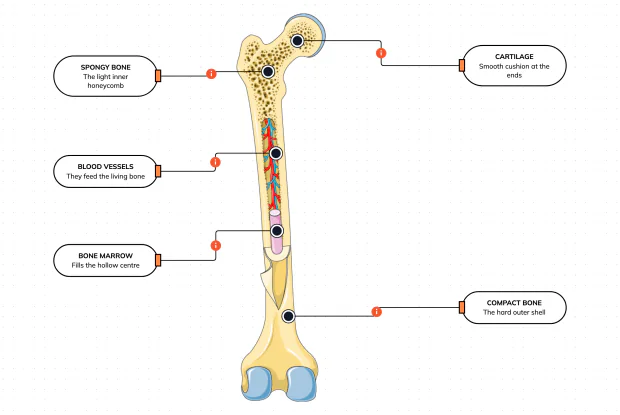
Cut a bone open and it is nowhere near solid: a hard outer shell, a light honeycomb inside, a hollow centre full of marrow, blood vessels threading through, and a smooth cushion at each end. Learn what each part does — then label them yourself in an interactive playground.
What Is Inside Your Elbow Joint?
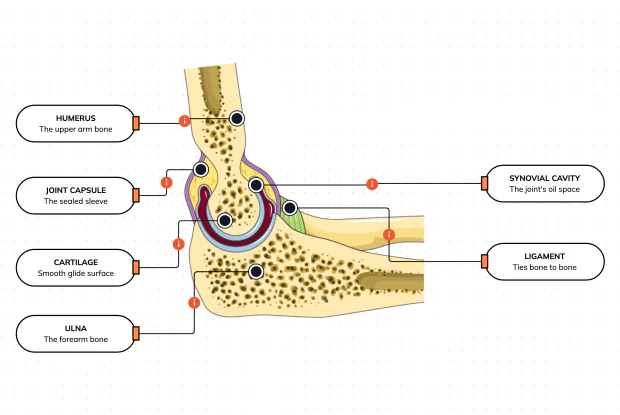
A joint is where two bones meet and move — and it is far more than just the bones. Cut open the elbow and you find smooth cartilage caps, a sealed capsule of slippery fluid, and tough ligaments holding it all together. Learn what each part does, then label them yourself in an interactive playground.
What Makes Your Elbow Bend?
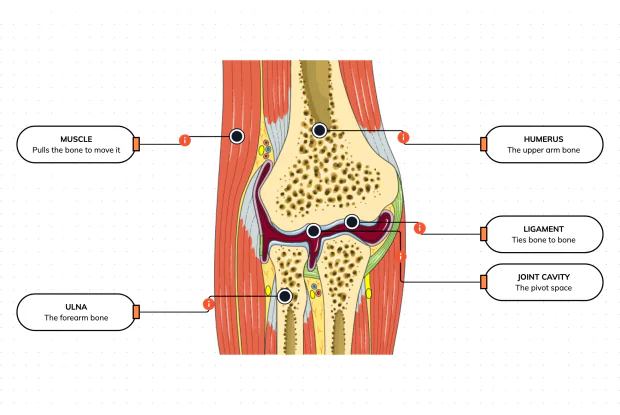
Bones and joints are just the hardware; nothing moves until a muscle pulls. Label the elbow to see the parts that turn a joint into movement — the muscle that pulls, the ligament that holds bone to bone, the two bones it links, and the space they pivot in — then build it yourself in an interactive playground.
What Holds Your Elbow Together?
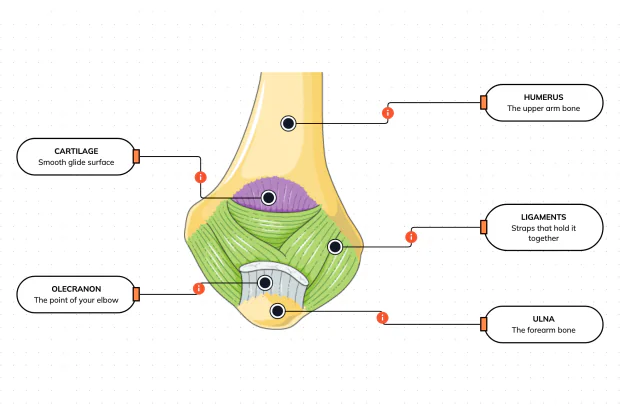
Your elbow is pulled on all day — by gravity, by every bag you carry, by every time you hang or push. So what stops the two bones from simply coming apart? Look at the back of the elbow and label the ligaments, the bony point, the cartilage and the two bones — and learn what holds the whole joint together.
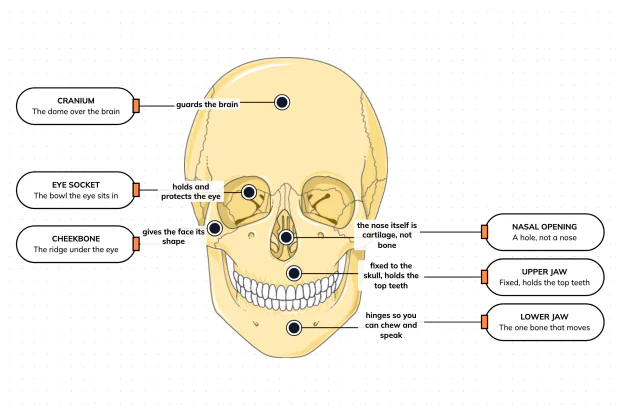
What Are the Main Bones of the Skull?
The skull looks like a single bone, but it is really about twenty-two locked together — with just one left free to move. Learn what each main part does, then label a skull yourself in an interactive playground.
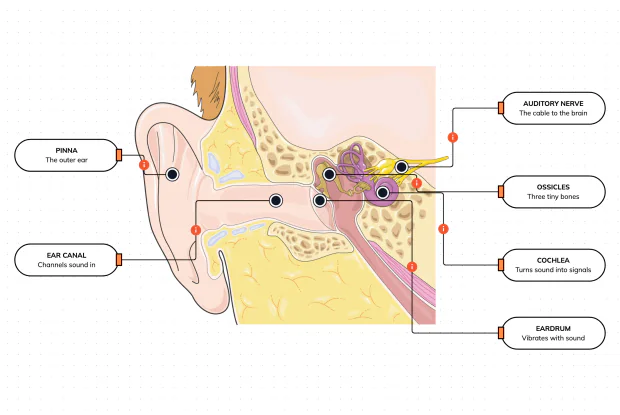
What Are the Parts of Your Ear?
Hearing is a chain of parts passing a sound along, each handing it to the next. Label the pinna, ear canal, eardrum, ossicles, cochlea and auditory nerve, and follow a sound all the way from the air outside to a signal your brain can read — in an interactive playground.
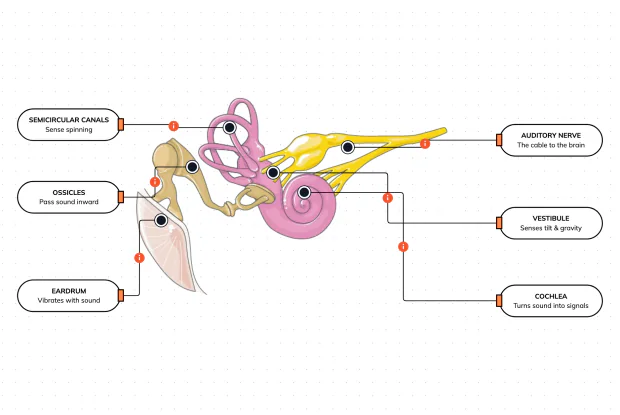
How Does Your Ear Keep You Balanced?
Your ear does a second, hidden job: balance. Inside it sit fluid-filled loops that sense spinning and a chamber that senses tilt and gravity. Label the semicircular canals, vestibule, cochlea, ossicles, eardrum and nerve, and learn how one organ both hears and keeps you upright — in an interactive playground.
What Are the Parts of the Eye You Can See?
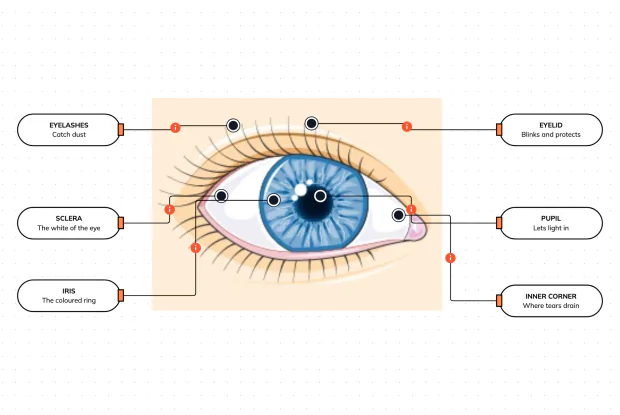
Before you look inside the eye, learn the parts you can already see in a mirror. Label the pupil, iris, sclera, eyelid, eyelashes and the tear-duct corner, and learn what each visible part does to let in light and protect the eye — in an interactive playground.
Where Do Your Tears Come From and Go?
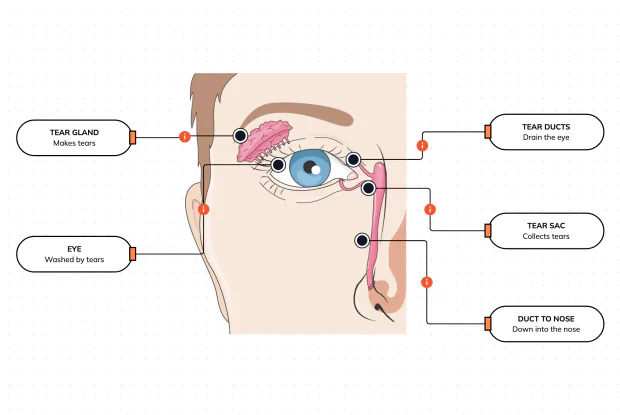
Your eyes make and drain tears all day to stay clean and wet. Label the tear gland, the eye, the tear ducts, the tear sac and the duct to the nose, and follow a tear from where it is made to where it drains — in an interactive playground.
How Does Your Eye Turn Light Into a Picture?
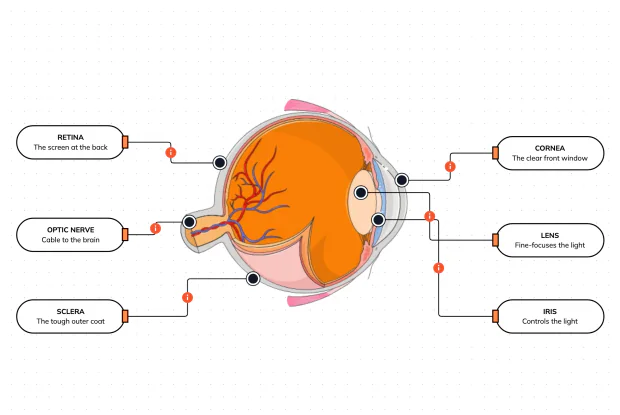
Your eye works like a living camera. Cut it open and label the cornea, lens, iris, retina, optic nerve and sclera, and follow light as it is focused onto a screen at the back of the eye and sent to the brain — in an interactive playground.