What Are Your Salivary Glands?
Root Concept
Saliva is made by three pairs of salivary glands: the parotid (largest, by the ear), the submandibular (under the jaw, makes most of your saliva) and the sublingual (smallest, under the tongue). Saliva wets food so you can taste and swallow it, begins breaking down starchy food, and protects the teeth.
CodePLU Goal
Upgrading Human Mental Models
Learn how to think in Workflows

Concept Development By codeplu.com
The three salivary glands around the mouth, each joined to its place — parotid by the ear, submandibular under the jaw, sublingual under the tongue
Where Does the Spit in Your Mouth Come From?
Your mouth is never really dry. Even when you are not eating, it stays wet with a watery liquid called saliva — the proper word for spit. That saliva does not just appear; it is made and poured into your mouth all day long by special organs called salivary glands, tucked into your cheeks, under your jaw and under your tongue.
There are three pairs of them, one of each on the left and right. The parotid glands are the biggest, sitting just in front of your ears. The submandibular glands sit lower down, under your jawbone, and quietly make most of your everyday saliva. The sublingual glands are the smallest, hidden under your tongue in the floor of your mouth. Each gland has a tiny tube, a duct, that carries its saliva out into your mouth.
Saliva does far more than keep your mouth comfortable. It wets your food so you can taste it and swallow it, it starts breaking down starchy foods like bread before the food even reaches your stomach, and it washes and protects your teeth. In the playground you will place each gland where it belongs and connect the tongue and teeth to the jobs saliva helps them do.
How Do the Salivary Glands Work?
What is a salivary gland?
A gland is an organ whose job is to make a useful liquid and release it. Your salivary glands make saliva. You have three pairs of them around your mouth, and together they produce something like a litre or more of saliva every single day — most of it while you eat, but a steady trickle even when you do not. Each gland is connected to the inside of your mouth by a thin tube called a duct, a bit like a tap connected by a pipe. When you see, smell or even think about tasty food, your brain tells the glands to turn on, the ducts open, and saliva flows in ready for the meal. That sudden watery feeling — your 'mouth watering' — is your salivary glands getting to work before the food has even arrived.
Meet the three glands
The three pairs are named for where they sit. The parotid glands are the largest, one in each cheek just in front of and below the ear — these are the ones that swell up and hurt if you catch mumps. The submandibular glands sit under the lower jaw ('mandible' means jaw), and although they are medium-sized they make the biggest share of your everyday saliva. The sublingual glands are the smallest of the three, lying under the tongue ('sub-lingual' means under-the-tongue) in the floor of the mouth. Between them, these three pairs keep saliva flowing from all around the mouth, so wherever your food goes, there is spit ready to meet it.
What does saliva actually do?
Saliva has several jobs, and they all help you eat. First, it wets and softens your food, gluing the chewed pieces into a smooth lump that is easy and safe to swallow. Second, it lets you taste: your taste buds can only detect flavours that are dissolved in liquid, so without saliva food would be almost tasteless. Third, saliva contains a chemical that begins digesting starchy foods right there in your mouth — chew a piece of bread for a while and it slowly turns sweet, because the saliva is already breaking the starch down into sugar. Fourth, it cleans and protects: saliva washes food off your teeth and cancels out acids that would otherwise wear away the enamel, which is why a dry mouth leads to more tooth decay.
Real World Example
When Have You Noticed Your Salivary Glands?
Your salivary glands are quiet workers, but there are moments when you really notice them. Here are three:
Your mouth waters at the smell of food
The glands switch on before you even take a bite
Walk past a bakery, or picture biting into a juicy lemon, and your mouth suddenly floods with saliva. That is your salivary glands responding to a signal from your brain, getting ready before the food arrives so that the moment you take a bite, the saliva is already there to wet it, help you taste it and start digesting it. You do not decide to do this — it happens automatically, triggered by the sight, smell or even the thought of food. 'My mouth is watering' is a real, physical event: three pairs of glands turning on at once. It is one of the clearest signs that eating begins in the mouth, well before the stomach ever gets involved.
Your mouth goes dry when you are nervous
Stress can switch the glands down
Have you ever had to speak in front of a class and felt your mouth turn dry and sticky? That is the opposite effect: when your body is nervous or frightened, it switches into an alert 'fight or flight' state and slows down jobs it does not need right that second — including making saliva. With less saliva, your mouth feels dry, your tongue sticks, and talking gets harder. It is completely normal and it passes once you calm down and the glands turn back on. It shows that the salivary glands are controlled by your nervous system, speeding up when you are relaxed and eating, and slowing down when your body thinks there are more urgent things to deal with.
Chewing bread until it tastes sweet
Saliva starts digesting food in your mouth
Try holding a plain piece of bread or a cracker in your mouth and chewing it slowly without swallowing. After a little while it starts to taste faintly sweet, even though you added no sugar. That is saliva at work: it contains a chemical that breaks the starch in the bread down into small sugar pieces, and your tongue tastes that new sugar. It is proof that digestion does not wait for the stomach — your salivary glands begin breaking food down the instant it enters your mouth. The wetter and more chewed the food gets, the more the saliva can do, which is one reason chewing your food well makes it easier for the rest of your body to digest.
FAQs
Final Words
Your salivary glands are three pairs of organs that keep your mouth wet with saliva: the large parotid glands in front of the ears, the submandibular glands under the jaw that make most of your saliva, and the small sublingual glands under the tongue. Each pours its saliva into the mouth through a little duct, and together they run all day, speeding up when you eat and slowing down when you are stressed.
That saliva is the quiet start of digestion. It softens your food, lets you taste it, begins breaking down starch, and guards your teeth against decay. So the next time your mouth waters at the smell of dinner, you will know exactly what is happening: three pairs of glands, switching on to get your mouth ready for the very first step of eating.
Continue This Track
This concept is part 41 of The Human Body, Head to Toe.
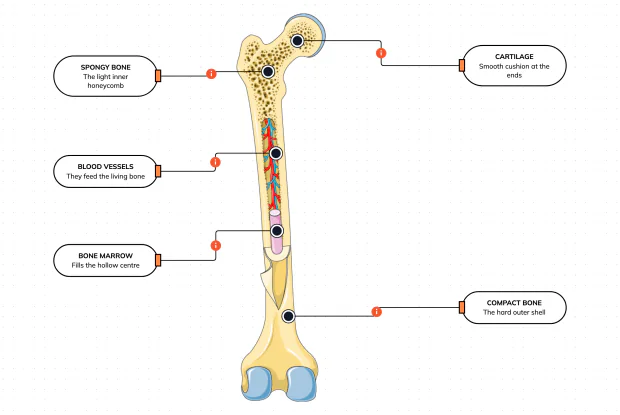
What Is a Bone Made Of?
Cut a bone open and it is nowhere near solid: a hard outer shell, a light honeycomb inside, a hollow centre full of marrow, blood vessels threading through, and a smooth cushion at each end. Learn what each part does — then label them yourself in an interactive playground.
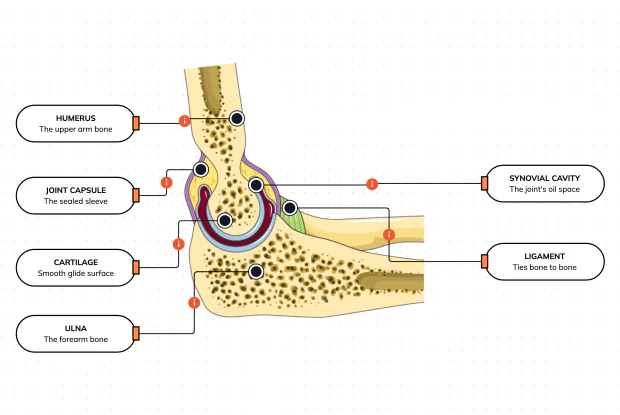
What Is Inside Your Elbow Joint?
A joint is where two bones meet and move — and it is far more than just the bones. Cut open the elbow and you find smooth cartilage caps, a sealed capsule of slippery fluid, and tough ligaments holding it all together. Learn what each part does, then label them yourself in an interactive playground.
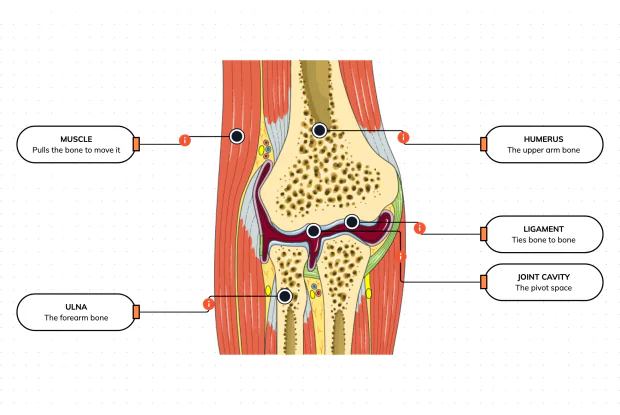
What Makes Your Elbow Bend?
Bones and joints are just the hardware; nothing moves until a muscle pulls. Label the elbow to see the parts that turn a joint into movement — the muscle that pulls, the ligament that holds bone to bone, the two bones it links, and the space they pivot in — then build it yourself in an interactive playground.
What Holds Your Elbow Together?
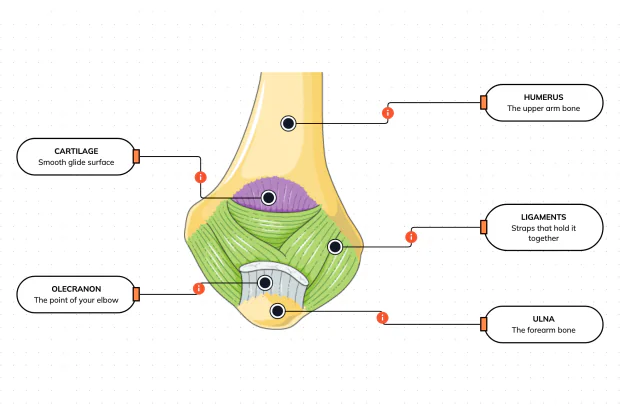
Your elbow is pulled on all day — by gravity, by every bag you carry, by every time you hang or push. So what stops the two bones from simply coming apart? Look at the back of the elbow and label the ligaments, the bony point, the cartilage and the two bones — and learn what holds the whole joint together.
What Are the Main Bones of the Skull?
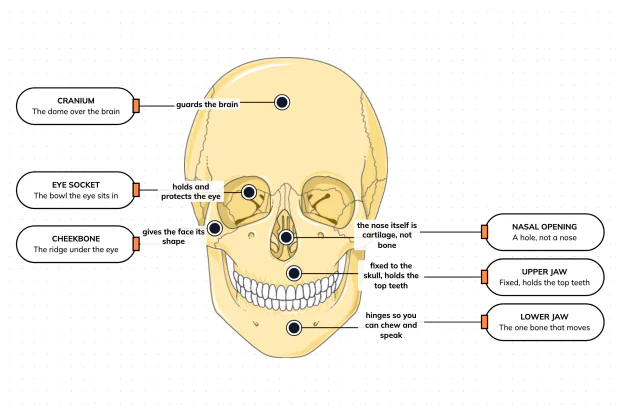
The skull looks like a single bone, but it is really about twenty-two locked together — with just one left free to move. Learn what each main part does, then label a skull yourself in an interactive playground.
What Are the Parts of Your Ear?
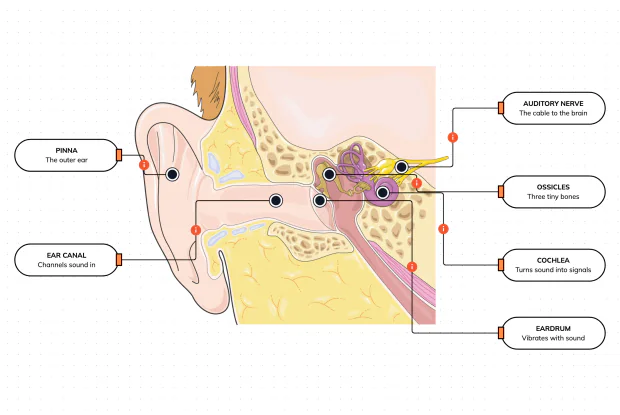
Hearing is a chain of parts passing a sound along, each handing it to the next. Label the pinna, ear canal, eardrum, ossicles, cochlea and auditory nerve, and follow a sound all the way from the air outside to a signal your brain can read — in an interactive playground.
How Does Your Ear Keep You Balanced?
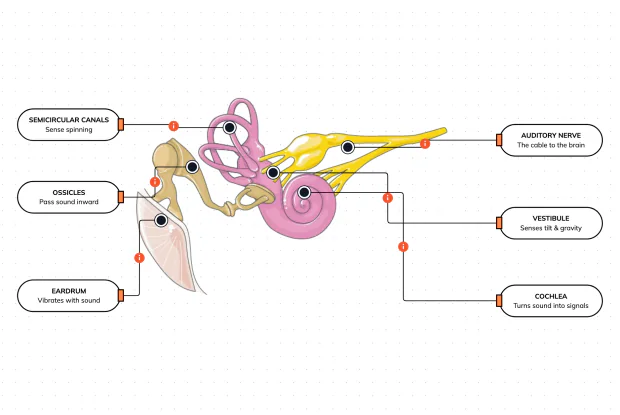
Your ear does a second, hidden job: balance. Inside it sit fluid-filled loops that sense spinning and a chamber that senses tilt and gravity. Label the semicircular canals, vestibule, cochlea, ossicles, eardrum and nerve, and learn how one organ both hears and keeps you upright — in an interactive playground.
What Are the Parts of the Eye You Can See?
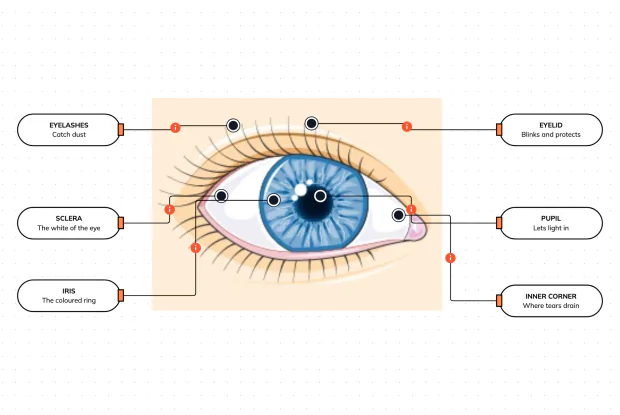
Before you look inside the eye, learn the parts you can already see in a mirror. Label the pupil, iris, sclera, eyelid, eyelashes and the tear-duct corner, and learn what each visible part does to let in light and protect the eye — in an interactive playground.
Where Do Your Tears Come From and Go?
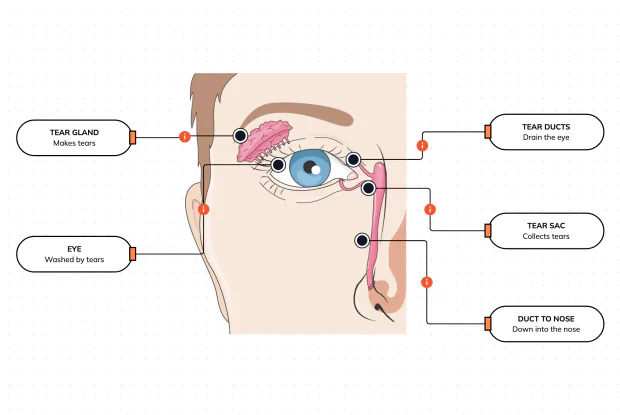
Your eyes make and drain tears all day to stay clean and wet. Label the tear gland, the eye, the tear ducts, the tear sac and the duct to the nose, and follow a tear from where it is made to where it drains — in an interactive playground.
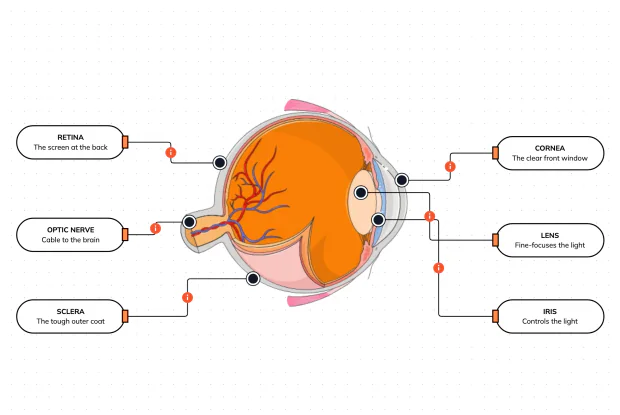
How Does Your Eye Turn Light Into a Picture?
Your eye works like a living camera. Cut it open and label the cornea, lens, iris, retina, optic nerve and sclera, and follow light as it is focused onto a screen at the back of the eye and sent to the brain — in an interactive playground.