What Are the Parts of the Tongue?
Root Concept
The tongue is a muscle with a tip at the front, a body, and a root at the back. Its surface is covered in small bumps called papillae that grip food and hold taste buds, with a row of large papillae in a V near the back and a groove down the middle.
CodePLU Goal
Upgrading Human Mental Models
Learn how to think in Workflows

Concept Development By codeplu.com
The tongue from above, each part joined to the job it does — from the movable tip to the bumpy, taste-bud-covered surface
What Makes the Tongue More Than a Lump of Muscle?
The tongue looks like a simple flap in your mouth, but it is one of the busiest and most versatile organs you have. It is really a bundle of muscles, which is why it can twist, curl, flatten and dart about so freely — no bones, just muscle that can change shape in an instant. That flexibility lets it do three big jobs at once: taste your food, push it around while you chew and swallow, and shape the sounds you make when you speak.
Seen from above, the tongue has three regions along its length. The tip is the flexible front — the most mobile part, the bit you stick out and touch things with. Behind it is the body, the main middle surface. And at the far back is the root, anchored down near the throat, where you cannot easily see it and where swallowing begins. Running down the whole length is a faint groove marking the line where the tongue's two halves meet.
The surface is the clever part. It is covered in tiny bumps called papillae, which make the tongue feel rough and, crucially, hold your taste buds. Most are small, but near the back there is a row of much larger papillae arranged in a V, each ringed with many taste buds. In the playground you will label the tip, the root, the papillae, the large taste bumps and the midline groove — and the label on each connection tells you the job that part does.
What Are the Parts of the Tongue?
What is the tongue, and what are its regions?
The tongue is a muscular organ — a bundle of muscles covered in a moist lining — and having no bones is exactly what makes it so nimble. Along its length it has three named regions. The tip is the pointed front, the most movable part, which you can poke out, curl, and press against your teeth. The body is the broad middle. The root is the back portion, anchored down toward the throat, which stays hidden from view. These are not separate structures but simply names for front, middle and back, the same way you might describe the ends and middle of any long thing. Knowing them is useful because different parts do slightly different jobs: the agile tip does the fine work of speech and exploring, while the root is where the tongue drives food backward to be swallowed.
What are papillae — the bumps on the tongue?
Papillae are the many small bumps that cover the top of the tongue and give it its slightly rough, velvety texture. They do two jobs. First, their roughness helps grip and move food around the mouth, a bit like the tread on a tyre — a perfectly smooth tongue would let food slip about. Second, and more famously, most papillae carry taste buds, the tiny sense organs that detect flavour. So the bumps you can feel with a fingertip are not just texture; they are the landscape your sense of taste is built on. There are several types of papillae in different shapes and sizes across the tongue, but the key idea for now is simple: the tongue's surface is deliberately bumpy, and those bumps are where tasting happens.
What are the large bumps at the back?
Near the back of the tongue, if you look closely, there is a row of noticeably larger, round bumps arranged in a wide V shape. These are the largest papillae, and although there are only a handful of them compared with the thousands of tiny ones, each big bump is ringed by a large number of taste buds — so they are powerhouses of taste. Their position at the back is why some strong or bitter flavours seem to hit hardest as food moves toward your throat. You do not usually notice these bumps day to day because they sit far back on the tongue, but they are one of its most distinctive features and a major part of how you taste. They are a good example of the tongue concentrating a lot of taste-sensing into a few large structures.
What is the groove down the middle?
Running from the tip toward the back, down the centre of the tongue, is a faint shallow line called the midline groove. It marks where the tongue's two halves meet — the tongue actually develops as two sides that join together down this middle line, and the groove is the seam left behind. It has no special sensing job; it is mainly a landmark. It is worth knowing simply because it explains the tongue's neat left–right symmetry: whatever is on one side of the groove is mirrored on the other, from the pattern of papillae to the muscles inside. When you notice that faint central line on your own tongue in the mirror, you are seeing the join between its two matching halves.
What does the tongue actually do?
The tongue quietly does three important jobs, all at once, all day. It tastes: its papillae hold the taste buds that detect sweet, salty, sour, bitter and savoury flavours. It handles food: its muscles push food between the teeth to be chewed, gather it into a ball, and drive it to the back to be swallowed — try eating with your tongue held still and you will find it nearly impossible. And it helps you speak: the constant, precise movements of the tongue, especially the tip, shape the flow of air into the different sounds of speech, which is why a numb tongue makes talking so hard. One flexible, muscular, bump-covered organ, doing the work of a taster, a food-mover and a speaker together.
Real World Example
How Does One Organ Taste, Chew and Talk at Once?
The tongue's mix of muscle and bumpy, taste-covered surface lets it juggle jobs you never think about. Here is each one in action:
Moving food while you eat
The muscle and papillae
Take a bite of an apple and watch what your tongue does — it is never still. Its muscles flatten, curl and push to shovel the food between your teeth, then sweep it back into the middle and roll it into a ball ready to swallow. The rough papillae on its surface give it grip, so the food does not just slide around uselessly; the tongue can actually hold and steer it. This is why eating feels effortless yet becomes clumsy if your tongue is numb from the dentist: the boneless, muscular tongue is doing constant, skilled handling of every mouthful. The same bumps that let you taste are also the tread that lets you grip — one surface, two uses.
Tasting your food
The papillae and their taste buds
As that apple breaks up, its juices spread across the tongue and seep into the papillae, where the taste buds are waiting. The many tiny papillae across the surface, and especially the large ones in the V at the back, are packed with these taste buds, and they send signals to your brain that you experience as sweet, sour and the rest. Without the bumpy, taste-bud-covered surface, food would just be texture and temperature with no flavour at all — which is roughly what happens when a heavy cold blocks your nose and dulls your sense of taste. The tongue's whole rough landscape exists so that flavour can be detected all over it, and the big back papillae make sure strong tastes are caught as food heads for the throat.
Shaping your words
The agile tip
Now say the words 'little turtle' out loud and feel how much your tongue tip moves, tapping just behind your top teeth. Speech is built from the tongue — especially its flexible tip — darting to precise positions to shape the air coming from your lungs into consonants and vowels. Sounds like 't', 'd', 'l' and 'n' are made by the tip touching the roof of the mouth, while others use the body and back. This is why a numb or injured tongue makes speech slur immediately, and why the tongue's boneless, muscular flexibility matters as much for talking as for eating. The same movable front you use to lick an ice cream is, a moment later, doing the fine gymnastics of language.
FAQs
Final Words
The tongue is a boneless bundle of muscle with a movable tip, a body, and a root at the back, and a surface covered in bumps called papillae. Those papillae grip food and hold the taste buds, with a row of large ones in a V near the back and a faint groove marking the join down the middle. Flexible muscle below, taste-covered bumps above — that combination is what lets one organ taste, handle food and help you speak, all at once.
The real magic of taste happens inside those bumps, in the taste buds themselves — which is exactly where we zoom in next: what a taste bud looks like up close and how it turns a mouthful of food into a flavour your brain can recognise.
Continue This Track
This concept is part 26 of The Human Body, Head to Toe.
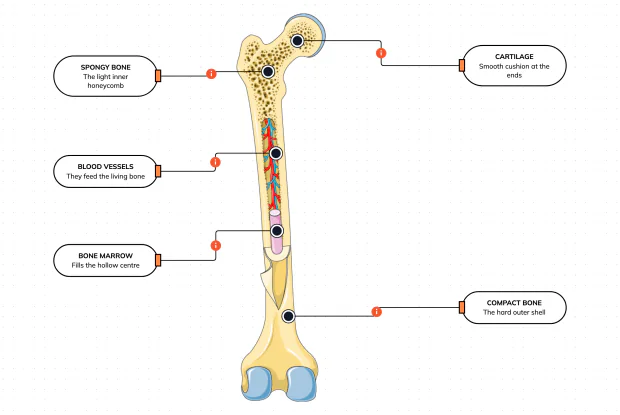
What Is a Bone Made Of?
Cut a bone open and it is nowhere near solid: a hard outer shell, a light honeycomb inside, a hollow centre full of marrow, blood vessels threading through, and a smooth cushion at each end. Learn what each part does — then label them yourself in an interactive playground.
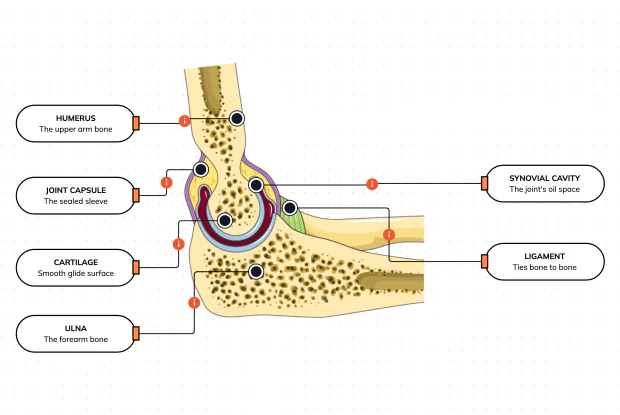
What Is Inside Your Elbow Joint?
A joint is where two bones meet and move — and it is far more than just the bones. Cut open the elbow and you find smooth cartilage caps, a sealed capsule of slippery fluid, and tough ligaments holding it all together. Learn what each part does, then label them yourself in an interactive playground.
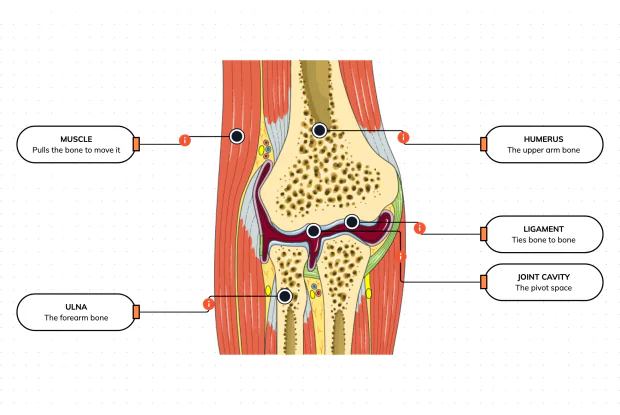
What Makes Your Elbow Bend?
Bones and joints are just the hardware; nothing moves until a muscle pulls. Label the elbow to see the parts that turn a joint into movement — the muscle that pulls, the ligament that holds bone to bone, the two bones it links, and the space they pivot in — then build it yourself in an interactive playground.
What Holds Your Elbow Together?
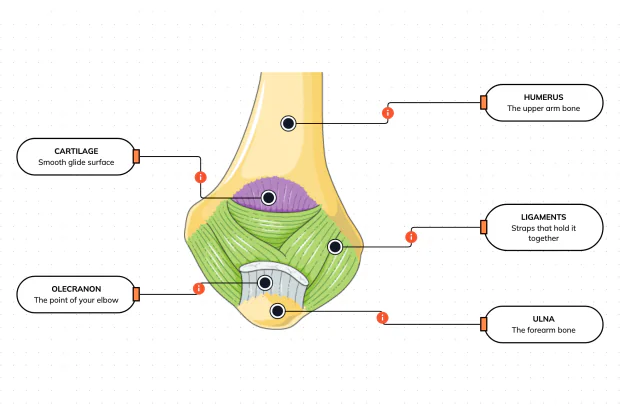
Your elbow is pulled on all day — by gravity, by every bag you carry, by every time you hang or push. So what stops the two bones from simply coming apart? Look at the back of the elbow and label the ligaments, the bony point, the cartilage and the two bones — and learn what holds the whole joint together.
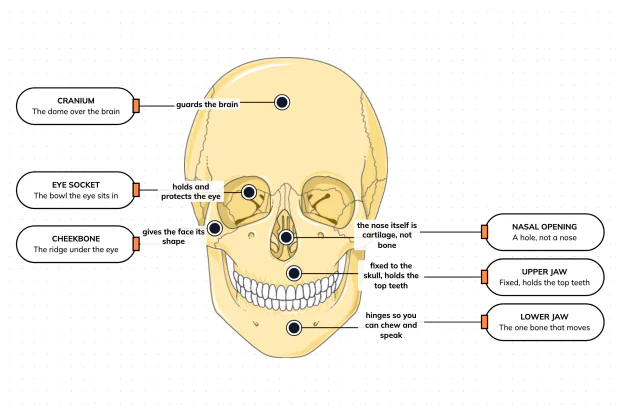
What Are the Main Bones of the Skull?
The skull looks like a single bone, but it is really about twenty-two locked together — with just one left free to move. Learn what each main part does, then label a skull yourself in an interactive playground.
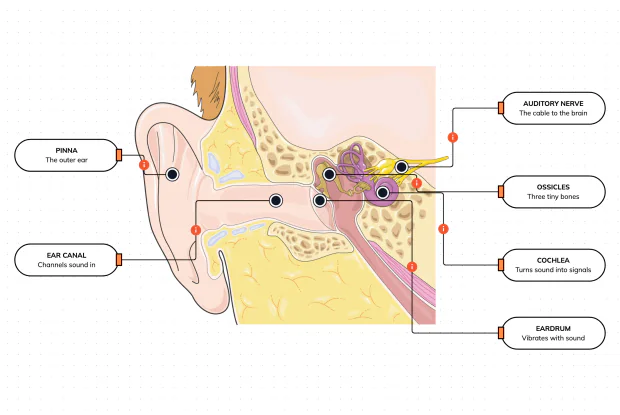
What Are the Parts of Your Ear?
Hearing is a chain of parts passing a sound along, each handing it to the next. Label the pinna, ear canal, eardrum, ossicles, cochlea and auditory nerve, and follow a sound all the way from the air outside to a signal your brain can read — in an interactive playground.
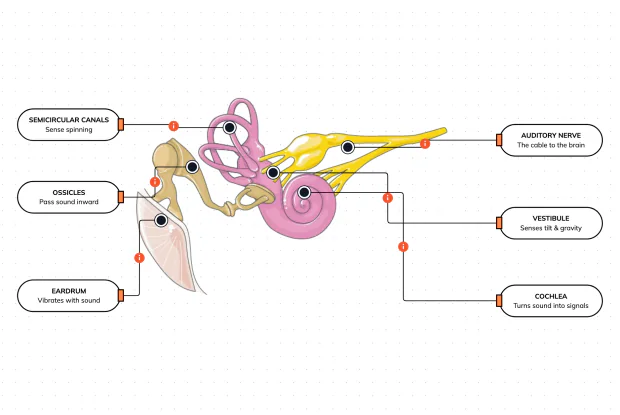
How Does Your Ear Keep You Balanced?
Your ear does a second, hidden job: balance. Inside it sit fluid-filled loops that sense spinning and a chamber that senses tilt and gravity. Label the semicircular canals, vestibule, cochlea, ossicles, eardrum and nerve, and learn how one organ both hears and keeps you upright — in an interactive playground.
What Are the Parts of the Eye You Can See?
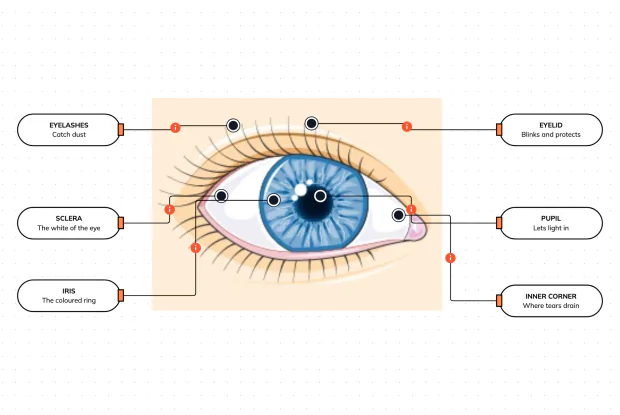
Before you look inside the eye, learn the parts you can already see in a mirror. Label the pupil, iris, sclera, eyelid, eyelashes and the tear-duct corner, and learn what each visible part does to let in light and protect the eye — in an interactive playground.
Where Do Your Tears Come From and Go?
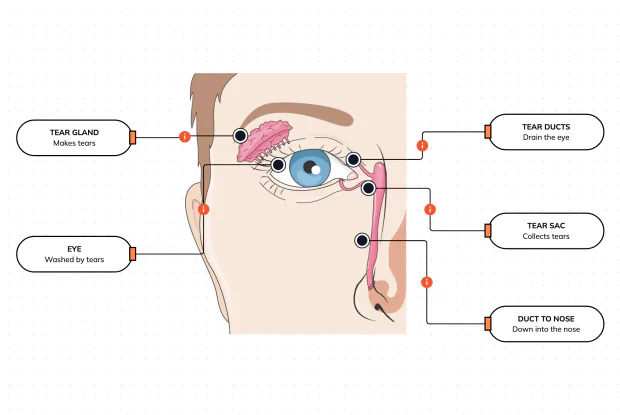
Your eyes make and drain tears all day to stay clean and wet. Label the tear gland, the eye, the tear ducts, the tear sac and the duct to the nose, and follow a tear from where it is made to where it drains — in an interactive playground.
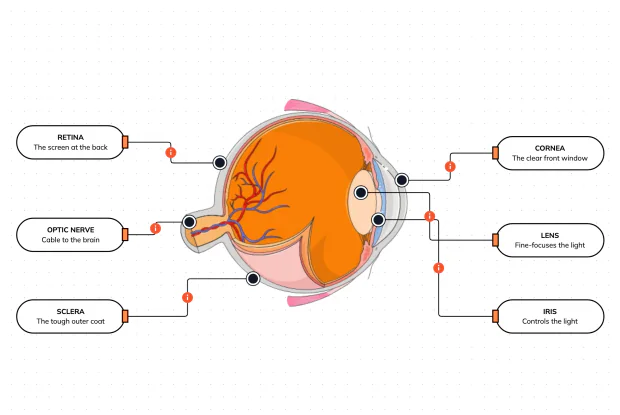
How Does Your Eye Turn Light Into a Picture?
Your eye works like a living camera. Cut it open and label the cornea, lens, iris, retina, optic nerve and sclera, and follow light as it is focused onto a screen at the back of the eye and sent to the brain — in an interactive playground.