What Are the Main Parts of the Spine?
Root Concept
The spine is a stack of about thirty-three bones split into five regions — neck, chest, lower back, sacrum and tailbone — each shaped for the balance of movement, weight and protection its position needs.
CodePLU Goal
Upgrading Human Mental Models
Learn how to think in Workflows

Concept Development By codeplu.com
Each region of the spine, joined to the stretch of backbone its job belongs to
Why Is the Backbone Split Into Regions?
Your spine has one job that pulls in two opposite directions. It has to be a stiff pillar — strong enough to hold you upright and carry your whole weight — and at the same time it has to bend, so you can nod, twist and lean. A single solid rod could do the first job and none of the second. So the spine is not one bone at all: it is a stack of about thirty-three small bones, called vertebrae, with soft cushions between them. Being made of many small pieces is what lets a strong column still curl and turn.
But the demands are not the same all the way down. At the top, the spine has to let your head swivel and nod, so those bones are small and loosely stacked. In the middle, it has to hold the rib cage steady, so those bones are locked to the ribs and barely move. At the bottom, it has to bear the load of everything above, so those bones are the biggest of all. Different jobs at different heights — that is exactly why the spine falls into regions rather than being uniform.
There are five regions, and once you know what each one is for, their order stops being a list to memorise. In the playground above you will label them from the neck down to the tailbone, and the label on each connection is the job that region does — so you are learning what each stretch of spine is for at the same time as where it sits.
What Does Each Region of the Spine Do?
Is the spine really one bone?
No — and this is the thing most people picture wrongly. The spine is a stack of about thirty-three separate bones called vertebrae, with a soft disc between each pair like a cushion. That stacked design is the whole point: a single rigid rod could hold you up but never bend, while a tower of small blocks with cushions between them can carry weight and still curl and twist. The cushions also soak up shock, which is why you can jump and land without jarring your skull — the discs squash a little at every step.
What do the neck bones do?
The top seven vertebrae make up the cervical spine — your neck. They are the smallest and the most freely moving bones in the whole column, because their job is to carry your head and let it turn, nod and tilt. The very top two are specially shaped: one lets you nod 'yes', the other lets you shake 'no'. All that movement has a cost — the neck is slender and mobile, which is also why it is one of the easier parts of the spine to injure in a sudden jolt.
Why does the middle of the back barely bend?
The middle twelve vertebrae form the thoracic spine, and each one is joined to a pair of ribs. That is deliberate: this region's job is to hold the rib cage steady so it can protect the heart and lungs and pump air. A cage that flexed freely could not do that, so the thoracic spine is the stiffest stretch of the back. You can feel the difference — you can twist and arch far more at your neck and lower back than you can in the middle, where the ribs hold everything in place.
Why does the lower back give so many people trouble?
The lumbar spine is the five vertebrae of the lower back, and they are the biggest bones in the whole column. They have to be: everything above them — head, arms, chest, organs — presses down through this narrow stack, so these five carry the most weight of any part of the spine. That heavy load, combined with how much we bend and lift there, is exactly why the lower back is the most common place for back pain. Big bones handle big loads, but they are not indestructible.
What are the sacrum and the tailbone?
Below the lumbar spine the bones stop being separate. The sacrum is a set of vertebrae that have fused into one broad, triangular plate, and it acts as the solid base that bolts the spine to the pelvis — the join that passes your body's weight down into your legs. Below it is the coccyx, or tailbone: a few tiny fused bones that are the leftover of a tail our distant ancestors had. It does little now beyond anchoring a few muscles, which is why the movable, working spine is really the three regions above these two.
Real World Example
Why Are You Taller in the Morning Than at Night?
Measure yourself when you wake and again before bed and you will be up to a centimetre or two shorter by night. Nothing is wrong; it is the discs between your vertebrae doing their job:
Through the day
The cushions squash
From the moment you stand up in the morning, gravity goes to work on your spine. Every time you stand, walk, lift or even sit upright, your body weight presses straight down through the tall stack of vertebrae. Between each pair of those bones sits an intervertebral disc — a soft, fluid-filled cushion — and under that steady, all-day load the discs slowly squeeze thinner, like a sponge being pressed under a weight. Multiply that tiny loss across every disc in the column and it adds up: by evening your spine has settled and shortened by as much as a centimetre or two. Nothing has gone wrong. The discs are simply doing their job of absorbing your weight, and paying for it with a little lost height.
Overnight
The cushions refill
The moment you lie down to sleep, the pressure comes off. For several hours the weight of your head and trunk no longer bears down through the vertebrae, and the discs finally get their chance to recover. Freed from the load, they slowly soak fluid back up from the surrounding tissue and swell out to their full thickness again — the sponge refilling overnight. By the time you wake, the whole column has lengthened back to its morning maximum, which is why you are always at your tallest first thing in the day. This quiet cycle of loading and refilling repeats every single night of your life, and it is one reason a good spell lying flat leaves your back feeling that bit looser and taller.
What this tells you
The spine is many parts, not one
A single solid rod of bone could never do this — it could not shrink under load and then grow back by morning. The fact that you measurably lose height through the day and regain it overnight is direct, everyday proof that your spine is not one bone at all, but a stack of many separate vertebrae with a living, fluid-filled cushion between each pair. That segmented design is exactly what the regions of the spine are built from, from the neck all the way down to the tailbone. It is also what lets the spine bend, twist and absorb shock: the very separateness that leaves you a touch shorter by bedtime is what keeps your back flexible and cushioned through every step of the day.
FAQs
Final Words
The spine makes sense the moment you stop picturing a single rod and start seeing a stack. About thirty-three bones with cushions between them give you a column that is strong enough to hold you up and supple enough to bend — and because the demands change from top to bottom, the stack falls into five regions. The neck is small and mobile for the head, the mid-back is stiff to guard the ribs, the lower back is heavy-boned to carry the load, and the sacrum and tailbone are fused into a solid base.
Label the five regions from the neck to the tailbone and the backbone stops being a mystery rod down your back. It is a stack of jobs — move the head, hold the ribs, carry the weight, anchor to the pelvis — and every region sits exactly where its job requires.
Continue This Track
This concept is part 15 of The Human Body, Head to Toe.
What Is a Bone Made Of?
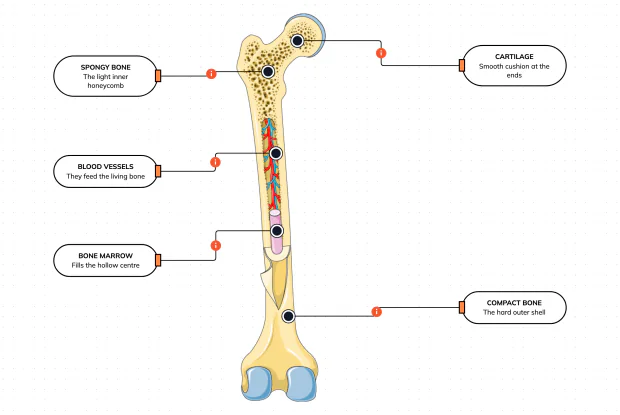
Cut a bone open and it is nowhere near solid: a hard outer shell, a light honeycomb inside, a hollow centre full of marrow, blood vessels threading through, and a smooth cushion at each end. Learn what each part does — then label them yourself in an interactive playground.
What Is Inside Your Elbow Joint?
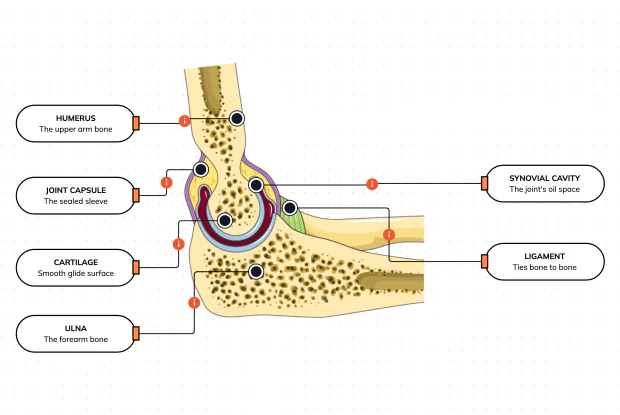
A joint is where two bones meet and move — and it is far more than just the bones. Cut open the elbow and you find smooth cartilage caps, a sealed capsule of slippery fluid, and tough ligaments holding it all together. Learn what each part does, then label them yourself in an interactive playground.
What Makes Your Elbow Bend?
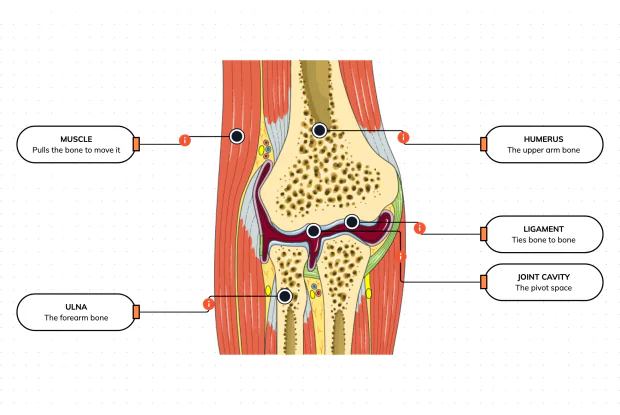
Bones and joints are just the hardware; nothing moves until a muscle pulls. Label the elbow to see the parts that turn a joint into movement — the muscle that pulls, the ligament that holds bone to bone, the two bones it links, and the space they pivot in — then build it yourself in an interactive playground.
What Holds Your Elbow Together?
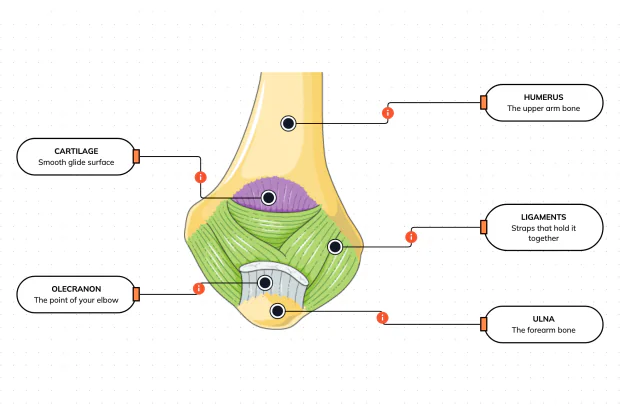
Your elbow is pulled on all day — by gravity, by every bag you carry, by every time you hang or push. So what stops the two bones from simply coming apart? Look at the back of the elbow and label the ligaments, the bony point, the cartilage and the two bones — and learn what holds the whole joint together.
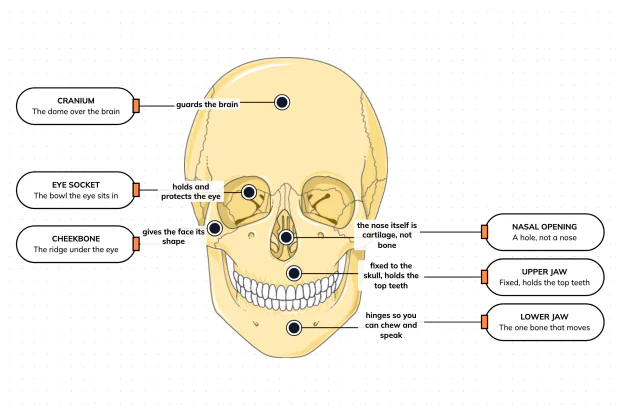
What Are the Main Bones of the Skull?
The skull looks like a single bone, but it is really about twenty-two locked together — with just one left free to move. Learn what each main part does, then label a skull yourself in an interactive playground.
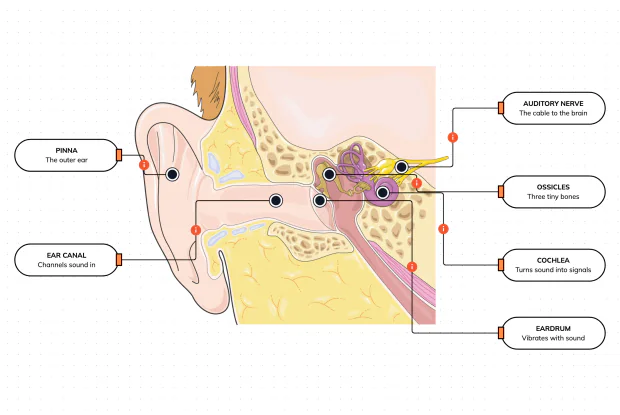
What Are the Parts of Your Ear?
Hearing is a chain of parts passing a sound along, each handing it to the next. Label the pinna, ear canal, eardrum, ossicles, cochlea and auditory nerve, and follow a sound all the way from the air outside to a signal your brain can read — in an interactive playground.
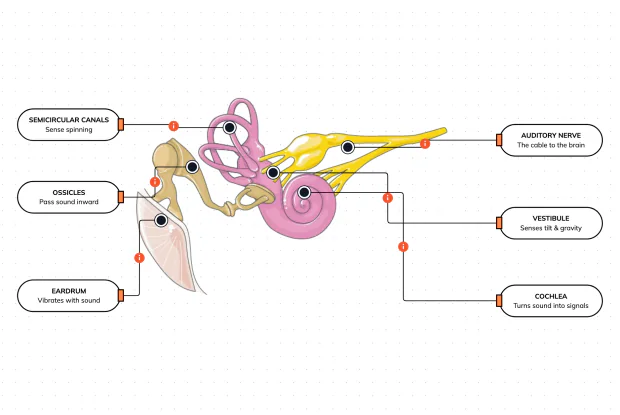
How Does Your Ear Keep You Balanced?
Your ear does a second, hidden job: balance. Inside it sit fluid-filled loops that sense spinning and a chamber that senses tilt and gravity. Label the semicircular canals, vestibule, cochlea, ossicles, eardrum and nerve, and learn how one organ both hears and keeps you upright — in an interactive playground.
What Are the Parts of the Eye You Can See?
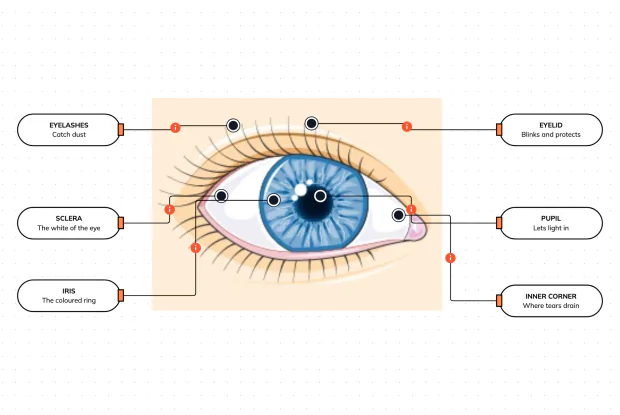
Before you look inside the eye, learn the parts you can already see in a mirror. Label the pupil, iris, sclera, eyelid, eyelashes and the tear-duct corner, and learn what each visible part does to let in light and protect the eye — in an interactive playground.
Where Do Your Tears Come From and Go?
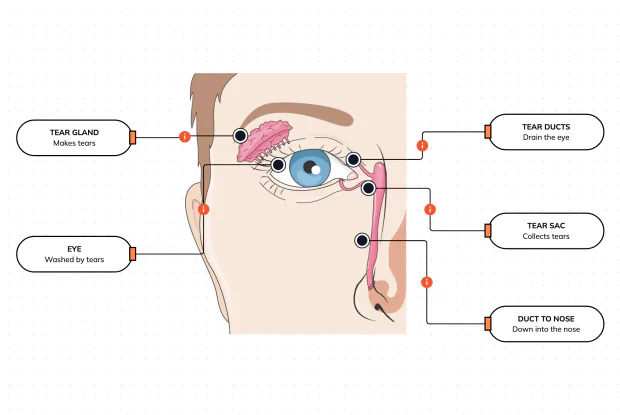
Your eyes make and drain tears all day to stay clean and wet. Label the tear gland, the eye, the tear ducts, the tear sac and the duct to the nose, and follow a tear from where it is made to where it drains — in an interactive playground.
How Does Your Eye Turn Light Into a Picture?
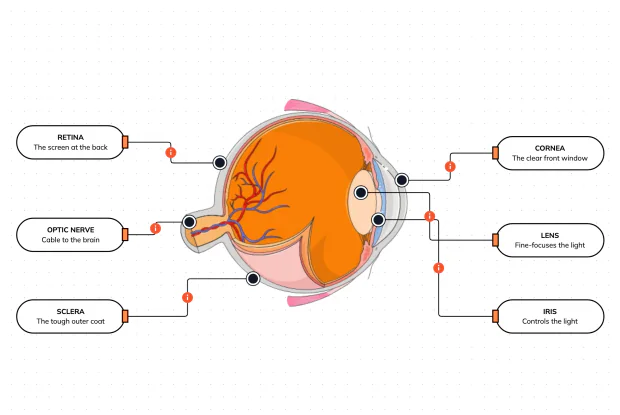
Your eye works like a living camera. Cut it open and label the cornea, lens, iris, retina, optic nerve and sclera, and follow light as it is focused onto a screen at the back of the eye and sent to the brain — in an interactive playground.