What Are the Parts of the Rib Cage?
Root Concept
The rib cage is twelve pairs of bony ribs joined to the breastbone by springy cartilage — rigid enough to shield the heart and lungs, flexible enough to expand with every breath.
CodePLU Goal
Upgrading Human Mental Models
Learn how to think in Workflows

Concept Development By codeplu.com
Each part of the rib cage, joined to what it is — bone, cartilage, or the ribs grouped by how they attach in front
Why Is the Chest Built as a Cage?
Your chest has a hard problem to solve. Inside it are the two organs you cannot live a few minutes without — the heart and the lungs — so they need armour. But one of those organs, the lungs, only works by getting bigger and smaller, thousands of times a day. Armour that never moves would crush the very thing it protects. So the chest cannot be a solid shell. It is a cage: bars strong enough to guard, with gaps and hinges that let the whole thing swell and shrink.
The bars are the ribs — twelve curved pairs sweeping round from the spine at the back to the breastbone at the front. If they were solid bone all the way round, the cage would be rigid and breathing would be impossible. The trick is at the front: the ribs do not reach the breastbone as bone. They finish in costal cartilage — a springy material that bends. That flexible front is what lets the cage lift and widen with every breath, then settle back, without anything snapping.
Not every rib attaches the same way, and that is the last piece of the design. The top ribs each reach the breastbone by their own cartilage; the next few share a cartilage instead of having their own; and the bottom pair or two do not reach the front at all. In the playground above you will label the breastbone, the cartilage and the three kinds of rib — and spot the collarbone resting across the top, which is not a rib at all — and the label on each connection tells you what that part does, or how it attaches.
What Does Each Part of the Rib Cage Do?
Is the rib cage made only of bone?
No — and the part that is not bone is what makes it work. The ribs themselves are bone, and so is the breastbone down the front. But the ribs do not meet the breastbone as bone: each connects through a bar of costal cartilage, the same springy material that stiffens your outer ear. That cartilage is the hinge. It lets the ribs swing up and out as you breathe in and settle back as you breathe out. A rib cage made of solid bone all the way round could protect your heart and lungs but could never let you take a breath.
How many ribs are there, and why are there three kinds?
There are twelve pairs — twenty-four ribs — and they are grouped by how they attach at the front. The top seven pairs are true ribs: each reaches the breastbone through its own strip of cartilage. The next three pairs are false ribs: they do not get their own connection, but join onto the cartilage of the rib above, so they reach the breastbone only indirectly. The bottom two pairs are floating ribs: they curve only partway round and their front ends attach to nothing at all. Same bar, three ways of joining — because the cage needs to be tightest at the top, around the heart, and looser at the bottom.
Why does the cage move when you breathe?
Breathing in is not the lungs pulling air; it is the cage making room. Muscles between the ribs, helped by the dome-shaped diaphragm below, swing the ribs upward and outward. Because the front of each rib is springy cartilage rather than rigid bone, the whole cage can widen — and as the space inside grows, air rushes in to fill it. Breathe out and the ribs drop back and the cartilage recoils, squeezing the air out again. You can feel it: put a hand on your chest and take a deep breath, and you will feel the cage lift under your palm.
Why do the bottom ribs float free?
The floating ribs seem like a design flaw — ribs that protect nothing at the front — but the gap is on purpose. Leaving the lower front open lets the belly move and swell: it makes room for a full stomach, for the diaphragm to drop on a deep breath, and, in pregnancy, for a growing baby. A cage sealed all the way down would fight all of that. The floating ribs still do useful work at the back, where they shelter the kidneys tucked high against the spine.
What does the breastbone protect?
The sternum, or breastbone, is the flat bone running down the centre of your chest, and it is the front wall of the cage — directly over the heart. It is where the true ribs anchor, so it holds the whole front of the cage together. It is also why chest compressions in CPR are done right on the breastbone: pressing there squeezes the heart between the sternum in front and the spine behind, pushing blood around the body when the heart has stopped doing it on its own.
Real World Example
Why Can't You Put a Broken Rib in a Cast?
Break an arm and it is wrapped in a cast that holds it dead still so it can knit. Break a rib and the doctor sends you home with painkillers and no cast at all. That is not neglect — it follows directly from what the rib cage is for:
A bone heals when held still
So most breaks are immobilised
For almost every broken bone in the body, the treatment rests on one idea: hold the two broken ends together and stop them moving. A cast around a forearm, a splint on a finger, a heavy cast on a leg — all of them do the same single job, which is to keep the fracture perfectly still. Bone heals by growing fresh tissue across the gap between the broken ends, and that bridge can only set properly if the ends are not constantly shifting. Movement tears the fragile new growth apart before it has a chance to harden. So immobilising a break is not just about easing the pain; it is what actually allows the bone to knit back into one solid piece, which is why a cast has to stay on for weeks.
But the cage must keep moving
It cannot be held still
The rib cage cannot play by that rule, because holding it still is simply not an option. Every breath you take lifts and widens the whole cage — the ribs swing up and out to draw air in, then drop back down to push it out, and this repeats twelve to twenty times a minute, day and night, for your entire life. There is no way to freeze that motion without stopping breathing itself. And a single cracked rib cannot be isolated either: it is built into a ring of twenty-four ribs that all move together, so you could never strap one rib still while the other twenty-three keep rising and falling around it. For the rib cage, constant movement is not optional — it is the whole point.
So a rib heals on its own
The design forbids a cast
So a broken rib is left to do something almost no other bone is asked to do: heal while it keeps moving. The doctor sends you home with painkillers instead of a cast, and the crack slowly knits over several weeks even as the cage rises and falls with every breath. It is a slower and more painful recovery precisely because the ends never fully rest — but it is the only route the body's design allows. And the reason cuts straight to what the rib cage is: it is called a cage because it is built to move, flexing with each breath to drive your lungs and shield your heart. The very feature that rules out a cast is the same feature that keeps you alive.
FAQs
Final Words
The rib cage is the answer to a two-sided problem: guard the heart and lungs, but let the lungs move. It solves it by being a cage rather than a shell — bony ribs for strength, springy costal cartilage at the front for movement, and a breastbone holding the front wall together over the heart. Get that and the three kinds of rib fall into place: true ribs anchor firmly at the top around the heart, false ribs share a connection lower down, and floating ribs leave the belly free.
Label the breastbone, the cartilage and the true, false and floating ribs, and the chest stops being a mysterious basket of bones. It is a shield that breathes — and every part is shaped by having to be both at once.
Continue This Track
This concept is part 16 of The Human Body, Head to Toe.
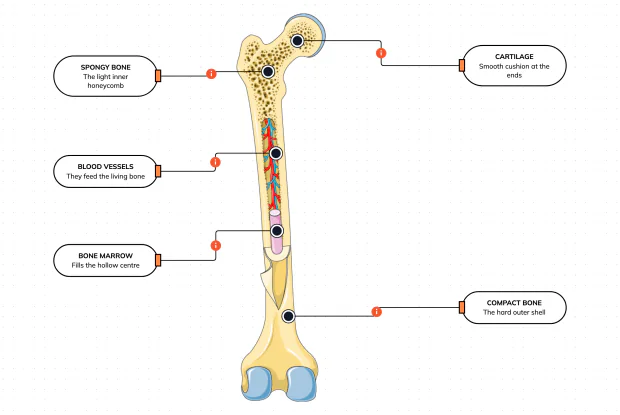
What Is a Bone Made Of?
Cut a bone open and it is nowhere near solid: a hard outer shell, a light honeycomb inside, a hollow centre full of marrow, blood vessels threading through, and a smooth cushion at each end. Learn what each part does — then label them yourself in an interactive playground.
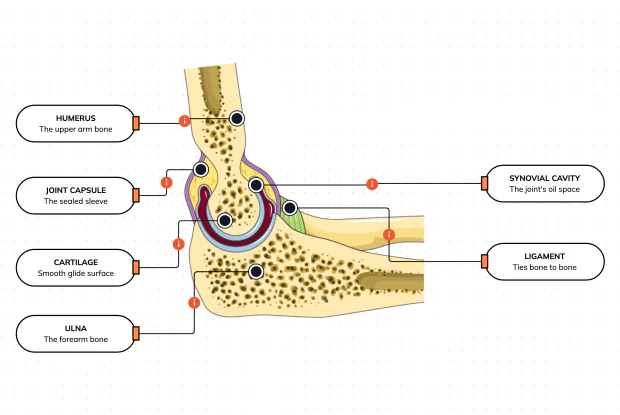
What Is Inside Your Elbow Joint?
A joint is where two bones meet and move — and it is far more than just the bones. Cut open the elbow and you find smooth cartilage caps, a sealed capsule of slippery fluid, and tough ligaments holding it all together. Learn what each part does, then label them yourself in an interactive playground.
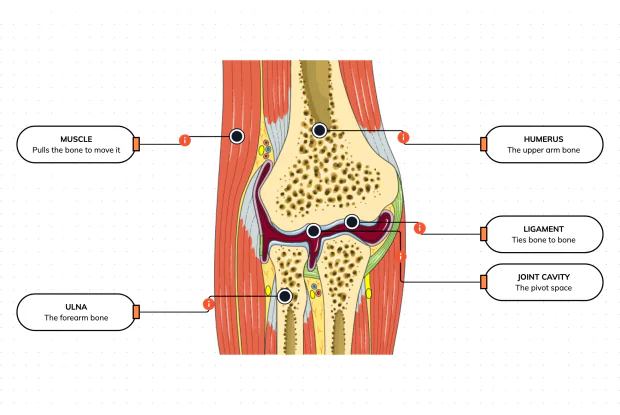
What Makes Your Elbow Bend?
Bones and joints are just the hardware; nothing moves until a muscle pulls. Label the elbow to see the parts that turn a joint into movement — the muscle that pulls, the ligament that holds bone to bone, the two bones it links, and the space they pivot in — then build it yourself in an interactive playground.
What Holds Your Elbow Together?
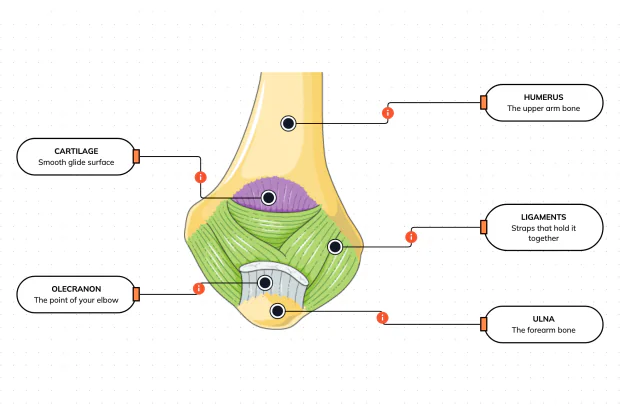
Your elbow is pulled on all day — by gravity, by every bag you carry, by every time you hang or push. So what stops the two bones from simply coming apart? Look at the back of the elbow and label the ligaments, the bony point, the cartilage and the two bones — and learn what holds the whole joint together.
What Are the Main Bones of the Skull?
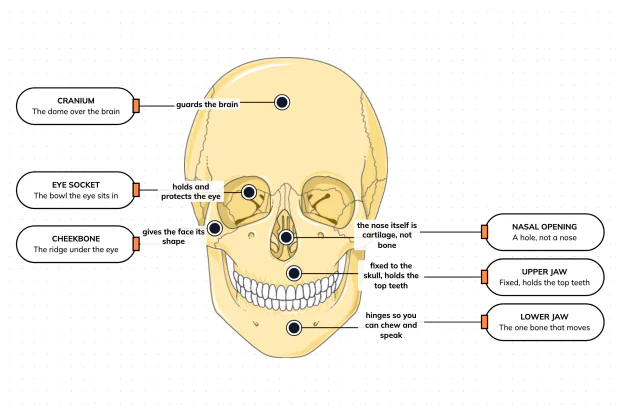
The skull looks like a single bone, but it is really about twenty-two locked together — with just one left free to move. Learn what each main part does, then label a skull yourself in an interactive playground.
What Are the Parts of Your Ear?
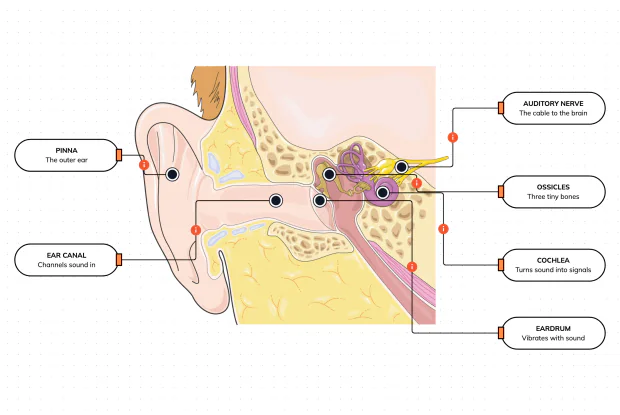
Hearing is a chain of parts passing a sound along, each handing it to the next. Label the pinna, ear canal, eardrum, ossicles, cochlea and auditory nerve, and follow a sound all the way from the air outside to a signal your brain can read — in an interactive playground.
How Does Your Ear Keep You Balanced?
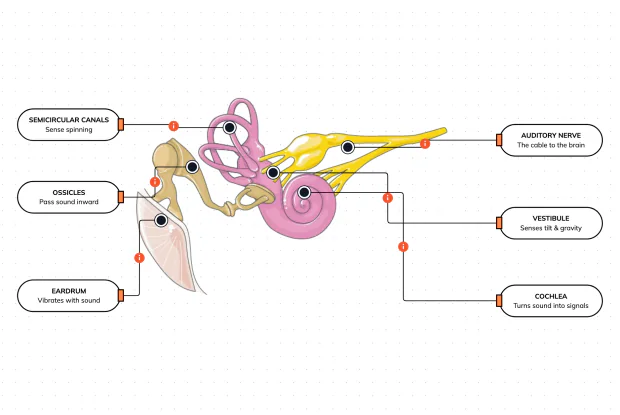
Your ear does a second, hidden job: balance. Inside it sit fluid-filled loops that sense spinning and a chamber that senses tilt and gravity. Label the semicircular canals, vestibule, cochlea, ossicles, eardrum and nerve, and learn how one organ both hears and keeps you upright — in an interactive playground.
What Are the Parts of the Eye You Can See?
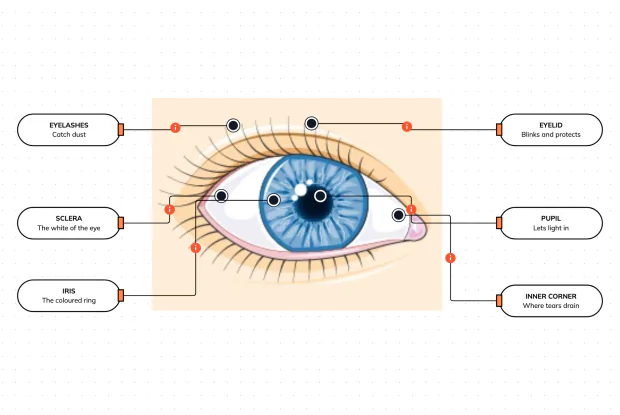
Before you look inside the eye, learn the parts you can already see in a mirror. Label the pupil, iris, sclera, eyelid, eyelashes and the tear-duct corner, and learn what each visible part does to let in light and protect the eye — in an interactive playground.
Where Do Your Tears Come From and Go?
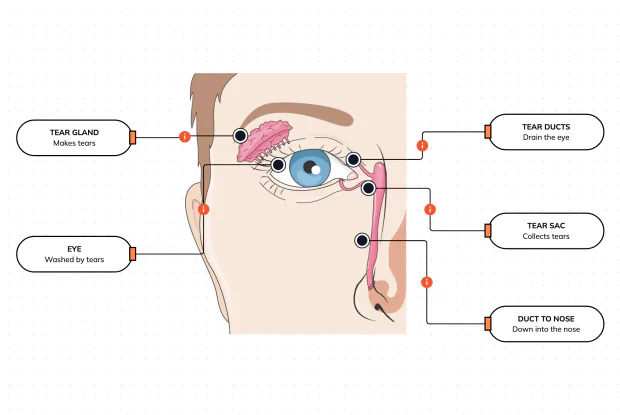
Your eyes make and drain tears all day to stay clean and wet. Label the tear gland, the eye, the tear ducts, the tear sac and the duct to the nose, and follow a tear from where it is made to where it drains — in an interactive playground.
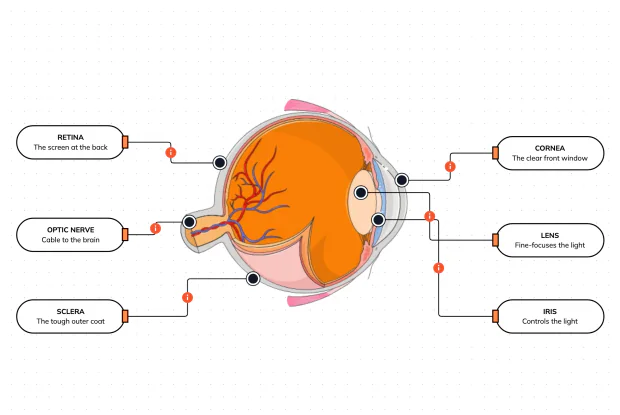
How Does Your Eye Turn Light Into a Picture?
Your eye works like a living camera. Cut it open and label the cornea, lens, iris, retina, optic nerve and sclera, and follow light as it is focused onto a screen at the back of the eye and sent to the brain — in an interactive playground.