What Are the Parts of the Pelvis?
Root Concept
Each hip bone is three bones — ilium, ischium and pubis — fused into one around the acetabulum, the deep socket that holds the thigh bone; together the two hip bones form the bowl that carries your weight into your legs.
CodePLU Goal
Upgrading Human Mental Models
Learn how to think in Workflows

Concept Development By codeplu.com
Each part of the hip bone, joined to the job it does — bear weight, sit, or socket the leg
Why Is the Pelvis Shaped Like a Bowl?
Everything above your legs — your head, arms, chest and everything they carry — presses straight down through your spine. Somehow that weight has to be handed off to two legs at the sides. A straight bone could not do it; the load has to spread out and split in two. That is why the pelvis is a bowl: a wide ring of bone that catches the weight from the spine at the back and passes it down and out into each hip joint.
The bowl is built from two hip bones, one on each side, meeting at the front and cradling the base of the spine between them at the back. And here is the surprise: each hip bone is not one bone but three — the ilium, the ischium and the pubis — that start separate in a child and fuse into a single bone as you grow. The clue to why they fuse where they do is a deep cup on the outer side of each: the acetabulum, the socket that holds the ball at the top of your thigh bone. All three bones meet exactly there, ringing the socket, because that join is where the leg's whole load arrives.
So the pelvis reads as a chain of jobs: catch the weight, spread it round the ring, and drop it into the hip sockets and on down the legs. In the playground above you will label the four parts of the hip bone — the blade, the sit bone, the front bone and the socket — plus the sacrum and the tailbone that close the bowl at the back, and the label on each connection tells you what that part does.
What Does Each Part of the Pelvis Do?
Is the pelvis a single bone?
No — and it surprises people twice over. First, the pelvis is two hip bones, one on each side, joined at the front and clasping the sacrum at the back. Second, each of those hip bones is itself three bones — the ilium, ischium and pubis — that are separate in a child and fuse into one as you grow up. So the smooth 'hip bone' an adult has is really three bones grown together, and the whole pelvic bowl is those halves plus the base of the spine. Being built from parts is what lets the bowl form its rounded, weight-spreading shape.
What is the ilium?
The ilium is the large, fan-shaped blade that makes up most of what you think of as your 'hip'. Its top edge is the crest you feel when you put your hands on your hips — rest them there and you are holding the top of your ilium. Being broad is the point: a wide blade gives the big muscles of the buttock and lower back a large surface to anchor to, and it flares out to help carry and spread the weight coming down from the spine.
Why is the ischium called the 'sit bone'?
The ischium is the lower, sturdy part of each hip bone, and it is the part you actually sit on. When you sit down, your weight comes to rest on two rounded knobs of the ischium — the reason you can feel your seat bones pressing into a hard chair. They are built thick and strong precisely because they take your whole upper-body weight every time you sit. A well-padded chair simply spreads the load over those two points.
What is the acetabulum, and why is it so deep?
The acetabulum is the deep, rounded socket on the outer side of each hip bone, and it is where all three bones of the hip meet. The ball at the top of your thigh bone sits inside it, forming the hip joint. Its depth is what makes the hip so stable: unlike the shallow shoulder socket, the hip cup grips the ball so firmly that the joint can carry your whole weight and rarely pops out. You trade some range of movement for a great deal of security — exactly the opposite bargain to the shoulder.
Real World Example
Why Is the Hip So Much Harder to Dislocate Than the Shoulder?
Shoulders dislocate in sport all the time; hips almost never do without a serious crash. Both joints are a ball sitting in a socket, so the difference is the socket itself — and the acetabulum is the key:
The shoulder's socket is shallow
Range over security
The shoulder is built for reach, and its socket gives the game away. The ball at the top of your upper-arm bone sits in a socket called the glenoid, which is shallow and saucer-like — it barely cups the ball at all. That shallowness is a deliberate trade-off: with so little bone wrapped around the joint, your arm is free to swing forward, back, overhead and right around in a full circle, which is why you can throw a ball, reach a high shelf and scratch between your own shoulder blades. But the same shallow socket that grants all that freedom also grips the ball only loosely, so a hard knock, an awkward fall or a violent wrench can lever it clean out of its cup. Mobility is bought at the price of security.
The hip's socket is deep
Security over range
The hip strikes the opposite bargain, and the acetabulum is where you see it written in bone. This is the socket of the pelvis, and unlike the shoulder's shallow saucer it is a deep, rounded cup that wraps well over halfway around the ball at the top of the thigh bone. Bone encloses the joint from almost every side, and a tough rim and strong ligaments deepen that grip further still. Held so firmly, the hip can carry your entire body weight with every step, soak up the pounding of running and jumping, and still almost never slip out of place. The price it pays is range: your leg cannot swing as freely or spin as far as your arm can. But the hip does not need to — it is built to bear load, not to reach.
What this tells you
The socket sets the trade-off
So two joints of exactly the same type — ball-and-socket — end up with opposite personalities, and the deciding factor is simply how deep the socket is. A shallow socket buys a huge range of movement but surrenders stability; a deep socket buys rock-solid stability but surrenders some range. There is no way to have both at full measure at once, so each joint is tuned to its real job. The shoulder's job is to place the hand anywhere in space, so it takes the mobility. The hip's job is to hold you upright and carry you mile after mile, so the pelvis chose stability, sinking the thigh bone deep into the acetabulum. Read the depth of the socket and you can read exactly what the joint was built to do.
FAQs
Final Words
The pelvis is the body's load-spreader. Weight drops from the spine into a bowl made of two hip bones, and each hip bone is three bones — ilium, ischium and pubis — fused around the acetabulum, the deep socket that hands the load on to the leg. Read it that way and every part has a reason: the broad ilium spreads and anchors, the ischium takes your weight when you sit, the pubis closes the ring at the front, and the socket grips the thigh bone tightly enough to carry you.
Label the blade, the sit bone, the front bone and the socket, and the pelvis stops being a confusing tangle in the middle of the skeleton. It is a weight-spreading bowl with a deep, secure socket on each side — built to carry, not to swing. Next in the skeleton, the leg drops out of that socket toward the ground.
Continue This Track
This concept is part 19 of The Human Body, Head to Toe.
What Is a Bone Made Of?
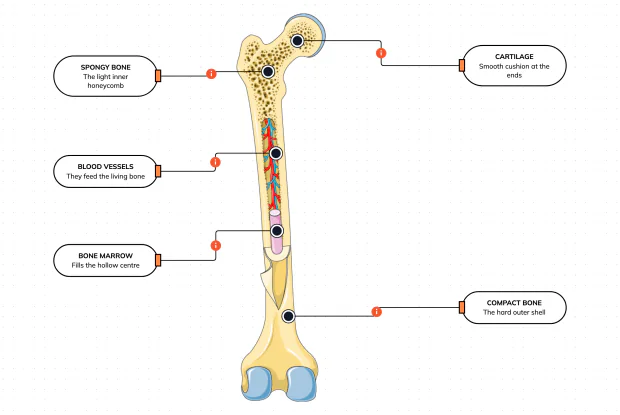
Cut a bone open and it is nowhere near solid: a hard outer shell, a light honeycomb inside, a hollow centre full of marrow, blood vessels threading through, and a smooth cushion at each end. Learn what each part does — then label them yourself in an interactive playground.
What Is Inside Your Elbow Joint?
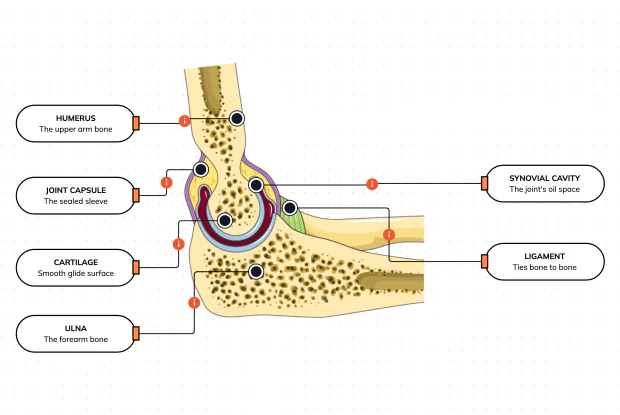
A joint is where two bones meet and move — and it is far more than just the bones. Cut open the elbow and you find smooth cartilage caps, a sealed capsule of slippery fluid, and tough ligaments holding it all together. Learn what each part does, then label them yourself in an interactive playground.
What Makes Your Elbow Bend?
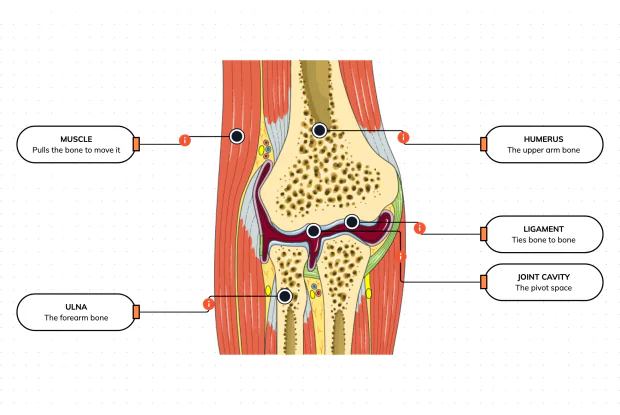
Bones and joints are just the hardware; nothing moves until a muscle pulls. Label the elbow to see the parts that turn a joint into movement — the muscle that pulls, the ligament that holds bone to bone, the two bones it links, and the space they pivot in — then build it yourself in an interactive playground.
What Holds Your Elbow Together?
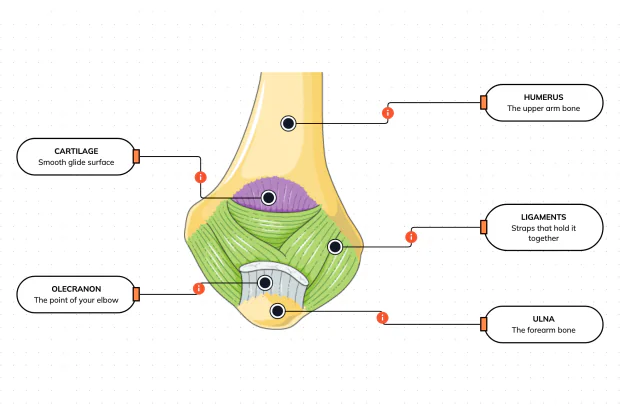
Your elbow is pulled on all day — by gravity, by every bag you carry, by every time you hang or push. So what stops the two bones from simply coming apart? Look at the back of the elbow and label the ligaments, the bony point, the cartilage and the two bones — and learn what holds the whole joint together.
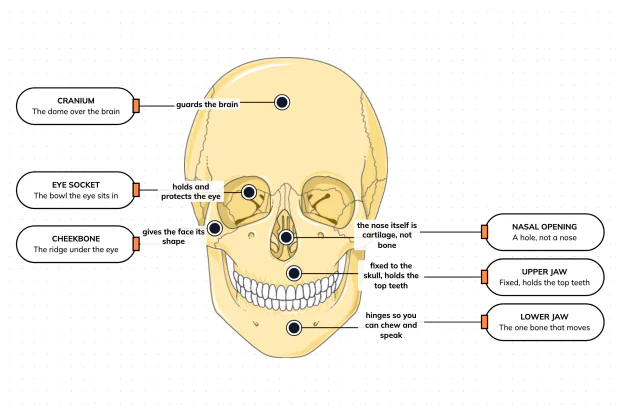
What Are the Main Bones of the Skull?
The skull looks like a single bone, but it is really about twenty-two locked together — with just one left free to move. Learn what each main part does, then label a skull yourself in an interactive playground.
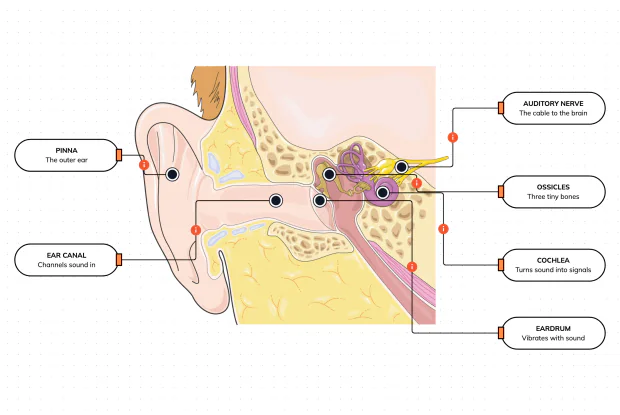
What Are the Parts of Your Ear?
Hearing is a chain of parts passing a sound along, each handing it to the next. Label the pinna, ear canal, eardrum, ossicles, cochlea and auditory nerve, and follow a sound all the way from the air outside to a signal your brain can read — in an interactive playground.
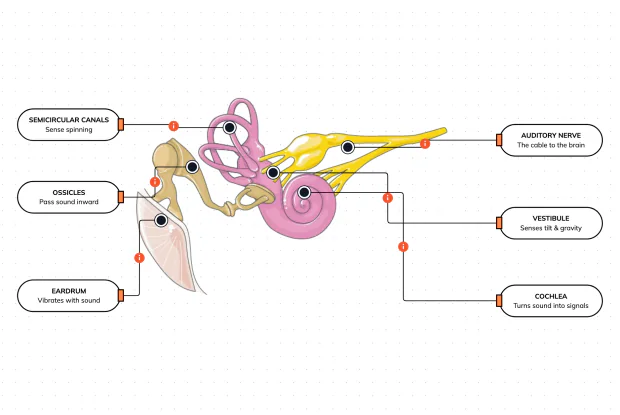
How Does Your Ear Keep You Balanced?
Your ear does a second, hidden job: balance. Inside it sit fluid-filled loops that sense spinning and a chamber that senses tilt and gravity. Label the semicircular canals, vestibule, cochlea, ossicles, eardrum and nerve, and learn how one organ both hears and keeps you upright — in an interactive playground.
What Are the Parts of the Eye You Can See?
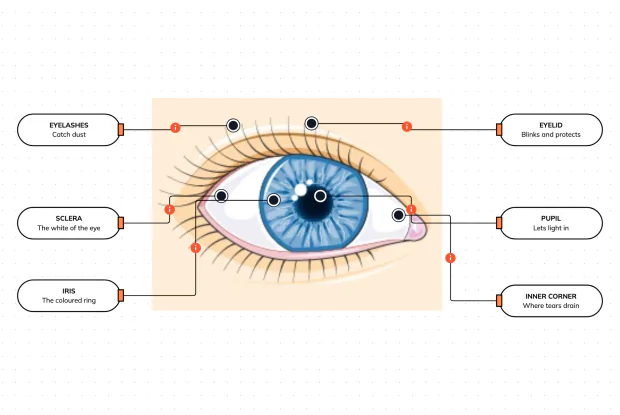
Before you look inside the eye, learn the parts you can already see in a mirror. Label the pupil, iris, sclera, eyelid, eyelashes and the tear-duct corner, and learn what each visible part does to let in light and protect the eye — in an interactive playground.
Where Do Your Tears Come From and Go?
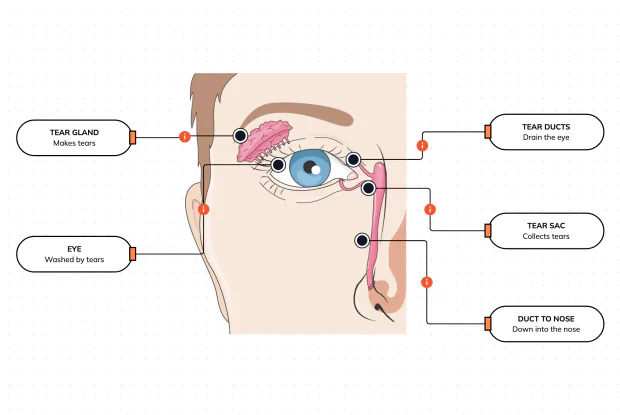
Your eyes make and drain tears all day to stay clean and wet. Label the tear gland, the eye, the tear ducts, the tear sac and the duct to the nose, and follow a tear from where it is made to where it drains — in an interactive playground.
How Does Your Eye Turn Light Into a Picture?
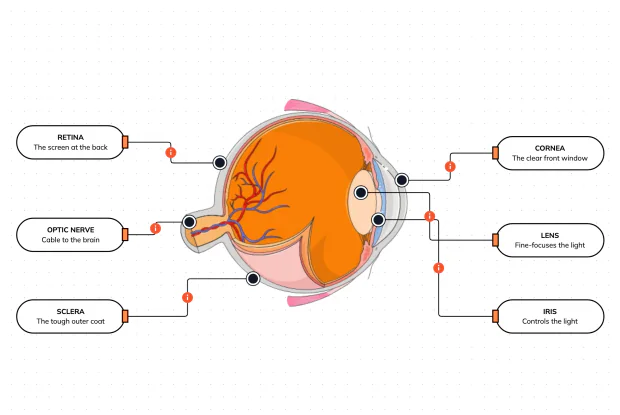
Your eye works like a living camera. Cut it open and label the cornea, lens, iris, retina, optic nerve and sclera, and follow light as it is focused onto a screen at the back of the eye and sent to the brain — in an interactive playground.