What Are the Parts of Your Knee?
Root Concept
The knee is the joint where the femur meets the tibia. Thigh muscles bend and straighten it, collateral ligaments down each side stop it buckling sideways, cruciate ligaments crossing deep inside stop the bones sliding back and forth, and a wedge of cartilage called the meniscus cushions the two bones and spreads the load.
CodePLU Goal
Upgrading Human Mental Models
Learn how to think in Workflows
Concept Development By codeplu.com
The parts of the knee, each joined to the job it does — the bones that meet, the muscle that moves them, the ligaments that hold them and the cushion that protects them
Why Is the Knee the Biggest and Most Complicated Joint You Have?
Stand up, sit down, walk, climb stairs, jump — every one of those depends on your knees, and they take a pounding. The knee is the largest joint in the body and, arguably, the most complicated, because it has to do two things that usually fight each other: carry your whole body weight without collapsing, and still bend freely through a wide arc. A stiff, solid joint would be stable but useless for walking; a loose, floppy one would bend easily but buckle under you. The knee's clever design is what lets it be both strong and mobile — and it is also why the knee is the joint people injure most.
At its core the knee is where two big bones meet: the femur (the thigh bone) coming down from your hip, and the tibia (the shin bone) carrying on down to your ankle. The powerful muscles of your thigh pull on these bones to bend and straighten the joint. But two bones and a muscle would just flop apart, so the knee is laced together by ligaments: collateral ligaments run down each side to stop the knee caving in sideways, and cruciate ligaments cross over each other deep in the centre to stop the bones sliding forwards and backwards.
Finally, because all your weight presses through this joint, there is a shock absorber: the meniscus, a pair of tough cushion-wedges of cartilage sitting between the femur and tibia that spread the load and stop bone pounding on bone. In the playground above you will label all six parts — the two bones, the muscle, the two kinds of ligament and the meniscus — and the label on each connection tells you the job that part does.
What Does Each Part of the Knee Do?
Which bones meet at the knee?
The knee is the joint between the two longest bones in your leg. Coming down from your hip is the femur, the thigh bone — the big bone you learned about on its own — and its lower end, with two rounded knuckles, forms the top of the knee. Rising up from your ankle is the tibia, the shin bone (the hard ridge you can feel down the front of your lower leg), and its flat top forms the bottom of the knee. The knee is where the rounded end of the femur sits on the flat top of the tibia. That rounded-on-flat shape is exactly why the knee is basically a hinge: the femur can roll and bend on the tibia to open and close the leg, but the two bones stay stacked so they can carry weight.
What actually bends and straightens the knee?
Bones do not move themselves — muscles move them, and the knee is worked by the big muscles of your thigh. On the front, the large quadriceps muscle pulls the shin forward to straighten the knee (the move you feel when you kick a ball or stand up); on the back, the hamstring muscles pull the shin back to bend the knee. Like every muscle, these can only pull, never push, which is why the knee needs muscles on both the front and the back — one group to straighten it and an opposing group to bend it. The muscles attach across the joint and tug on the bones, so every step you take is really these thigh muscles taking turns to open and close the hinge.
What are the collateral ligaments on the sides?
A hinge that only had bones and muscle would wobble and give way sideways, so the knee is strapped together by ligaments — and the first pair run down the outer sides. These are the collateral ligaments: one on the inner side of the knee and one on the outer side, each a strong band tying the femur directly to the bone below. Their job is to stop the knee bending in the wrong direction — caving inwards or bowing outwards — while still letting it hinge cleanly forwards and back. When someone is tackled from the side in football and the knee is forced inward, it is often a collateral ligament that gets stretched or torn, which is why the joint then feels unstable and 'loose' from side to side.
What are the cruciate ligaments inside?
The second pair of ligaments sits deep in the very centre of the knee, and instead of running down the sides they cross over each other like an X — which is why they are called the cruciate ('cross') ligaments. There are two, the anterior and posterior cruciate, and together they stop the femur and tibia sliding forwards and backwards over each other as you move, keeping the joint lined up. The anterior cruciate ligament — the famous 'ACL' — is the one athletes dread tearing: a sudden twist or hard stop can snap it, the knee gives way, and it often needs surgery to rebuild. Side straps plus this inner cross-brace are what make the knee stable in every direction at once.
What is the meniscus, and why does it matter?
Because your whole body weight presses down through the knee, the rounded end of the femur would dig into the flat top of the tibia — so between them sits a cushion called the meniscus. It is a pair of tough, wedge-shaped pads of cartilage, thicker at the rim and thinner in the middle, that fill the gap and turn a small point of contact into a broad, cushioned surface. The meniscus spreads your weight over a wider area, absorbs the shock of every step and jump, and helps the joint glide smoothly. It is also, along with the ACL, one of the most commonly torn parts of the knee: a bad twist while the leg is bearing weight can split the meniscus, which is why a 'torn cartilage' in the knee is such a familiar injury.
Why is the knee injured so often?
Put the parts together and it makes sense that the knee is the joint people hurt most. It carries huge loads, it is only a hinge (so a sideways or twisting force hits it in a direction it is not built for), and it depends on soft ligaments and cartilage rather than a deep, protective socket like the hip. Sports that involve sudden stops, turns and tackles load the knee exactly where it is weakest — twisting a weight-bearing, bent knee — which is why torn ACLs, torn menisci and stretched collateral ligaments fill sports clinics. Understanding the knee's parts is really understanding a trade-off: to give you a leg that can both hold you up and bend freely, the knee accepts being more vulnerable than a simpler joint would be.
Real World Example
Why Do Athletes 'Blow Out' Their Knees So Often?
The knee is asked to do something almost contradictory: hold your entire weight and bend freely and take the twisting forces of running and turning. When one of those demands goes too far, something inside gives — and which part fails tells a clear story about how the knee is built:
The cross-brace that snaps on a twist
The cruciate ligament (ACL)
Deep in the centre of the knee, the cruciate ligaments cross like an X to stop the two bones sliding and twisting apart. They are strong, but they are only soft tissue, and they have a limit. When an athlete plants a foot and suddenly changes direction — or lands from a jump and the knee rotates while bearing weight — the anterior cruciate ligament can be stretched past that limit and tear, often with an audible pop. The knee immediately feels unstable because the brace that kept the bones aligned is gone. This single ligament, the ACL, is one of the most common serious sports injuries in the world, and repairing it usually means surgery and months of rehabilitation — all because the knee's stability leans on a ligament rather than on bone.
The cushion that splits under load
The meniscus
Between the femur and tibia sit the menisci, wedge-shaped cartilage cushions that spread your weight and soak up shock. They do their job precisely because they are squeezed hard between the bones every time you stand, walk or land. But that same position makes them vulnerable: if you twist the knee sharply while it is bent and loaded — a common movement in football, skiing or even just turning awkwardly — the trapped cushion can be sheared and split. A torn meniscus can catch or lock the joint and lets the bones grind closer together, which over years can wear the surfaces. It is the classic 'torn cartilage', and it happens exactly where the knee's shock-absorbing design is under the most pressure.
Why it is a design trade-off
Mobility versus stability
None of this means the knee is badly made — it means the knee is a compromise. Your hip is deeply socketed and hard to dislocate, but it cannot bend into the tight, weight-bearing fold a knee makes when you squat or sprint. To give you a joint that both carries your weight and swings through a big arc, evolution built a shallow hinge held together by ligaments and padded by cartilage, rather than a deep, rigid socket. That buys enormous mobility at the cost of relying on soft parts that can tear when twisted or overloaded. So the knee's frequent injuries are really the price of its usefulness: the very features that let you run, jump and change direction are the ones that give way when you push them too far.
FAQs
Final Words
The knee is the body's biggest joint and a masterclass in compromise: it must carry your full weight and bend through a wide arc, so it is built from several cooperating parts rather than one simple shape. The femur and tibia meet as a hinge, the thigh muscles bend and straighten it, the collateral ligaments stop it buckling sideways, the cruciate ligaments cross inside to stop the bones sliding, and the meniscus cushions the whole thing. Name those six and you understand how one joint can be both strong and mobile.
The same design explains why the knee is injured so often — torn ACLs and torn menisci are the price of a joint that lets you run, jump and turn. You now know what a bone and a joint are made of, the femur that meets here, and the knee it forms; next you can follow the leg down to the ankle and the bones of the foot that carry you the last step to the ground.
Continue This Track
This concept is part 22 of The Human Body, Head to Toe.
What Is a Bone Made Of?
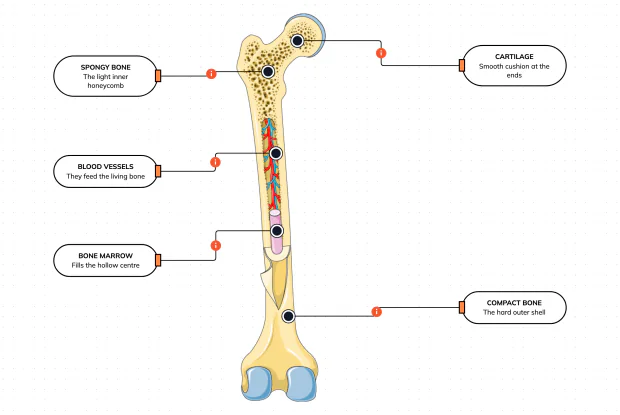
Cut a bone open and it is nowhere near solid: a hard outer shell, a light honeycomb inside, a hollow centre full of marrow, blood vessels threading through, and a smooth cushion at each end. Learn what each part does — then label them yourself in an interactive playground.
What Is Inside Your Elbow Joint?
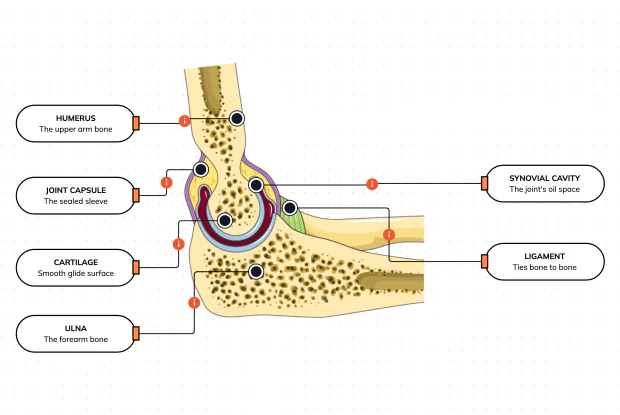
A joint is where two bones meet and move — and it is far more than just the bones. Cut open the elbow and you find smooth cartilage caps, a sealed capsule of slippery fluid, and tough ligaments holding it all together. Learn what each part does, then label them yourself in an interactive playground.
What Makes Your Elbow Bend?
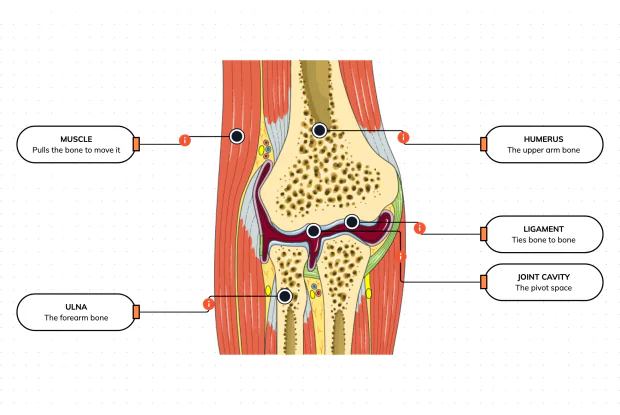
Bones and joints are just the hardware; nothing moves until a muscle pulls. Label the elbow to see the parts that turn a joint into movement — the muscle that pulls, the ligament that holds bone to bone, the two bones it links, and the space they pivot in — then build it yourself in an interactive playground.
What Holds Your Elbow Together?
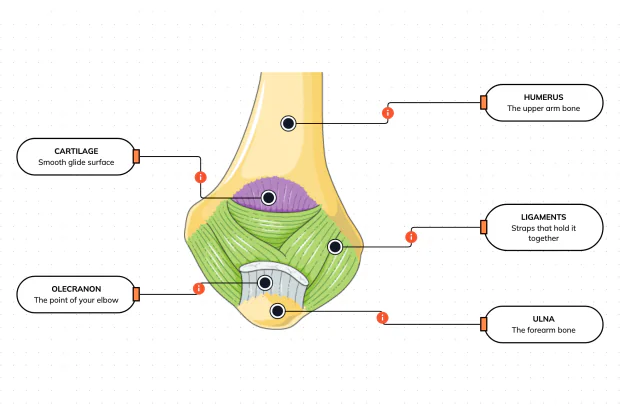
Your elbow is pulled on all day — by gravity, by every bag you carry, by every time you hang or push. So what stops the two bones from simply coming apart? Look at the back of the elbow and label the ligaments, the bony point, the cartilage and the two bones — and learn what holds the whole joint together.
What Are the Main Bones of the Skull?
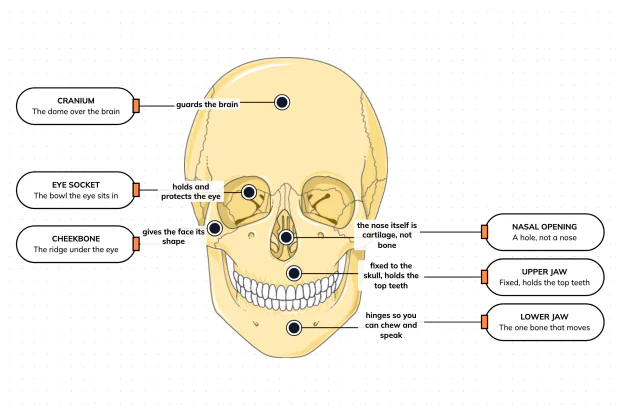
The skull looks like a single bone, but it is really about twenty-two locked together — with just one left free to move. Learn what each main part does, then label a skull yourself in an interactive playground.
What Are the Parts of Your Ear?
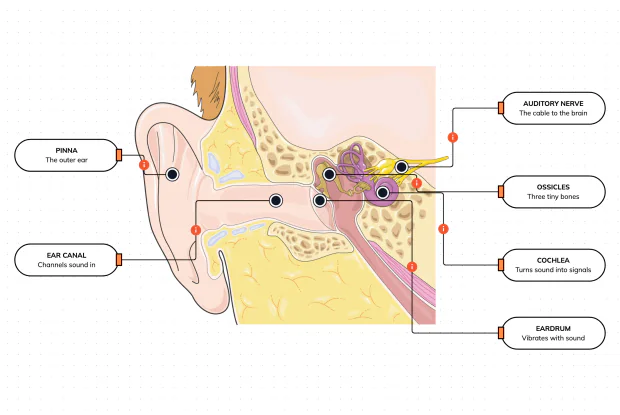
Hearing is a chain of parts passing a sound along, each handing it to the next. Label the pinna, ear canal, eardrum, ossicles, cochlea and auditory nerve, and follow a sound all the way from the air outside to a signal your brain can read — in an interactive playground.
How Does Your Ear Keep You Balanced?
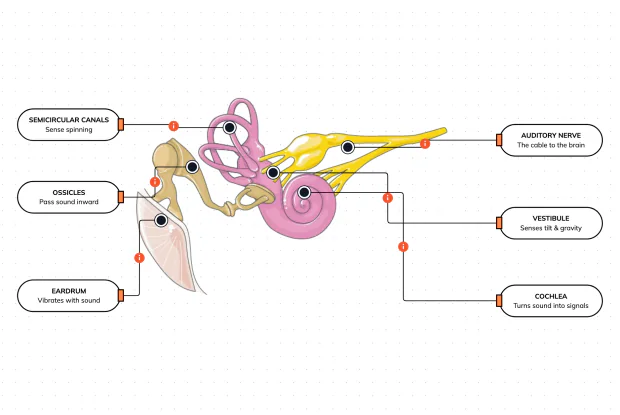
Your ear does a second, hidden job: balance. Inside it sit fluid-filled loops that sense spinning and a chamber that senses tilt and gravity. Label the semicircular canals, vestibule, cochlea, ossicles, eardrum and nerve, and learn how one organ both hears and keeps you upright — in an interactive playground.
What Are the Parts of the Eye You Can See?
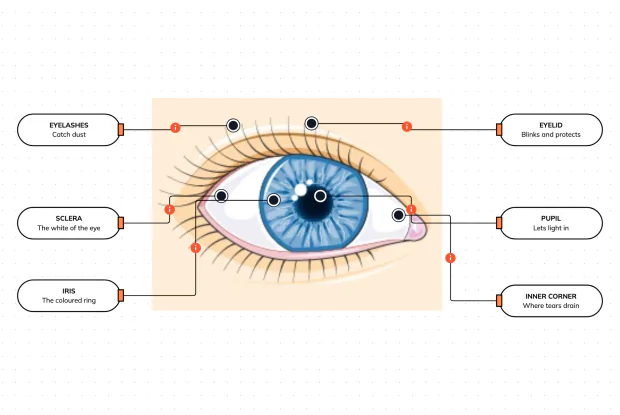
Before you look inside the eye, learn the parts you can already see in a mirror. Label the pupil, iris, sclera, eyelid, eyelashes and the tear-duct corner, and learn what each visible part does to let in light and protect the eye — in an interactive playground.
Where Do Your Tears Come From and Go?
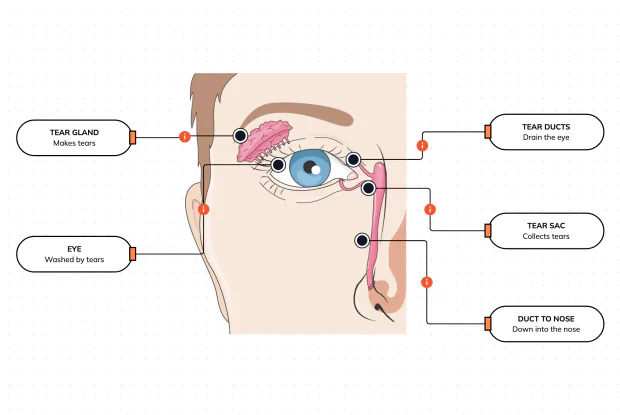
Your eyes make and drain tears all day to stay clean and wet. Label the tear gland, the eye, the tear ducts, the tear sac and the duct to the nose, and follow a tear from where it is made to where it drains — in an interactive playground.
How Does Your Eye Turn Light Into a Picture?
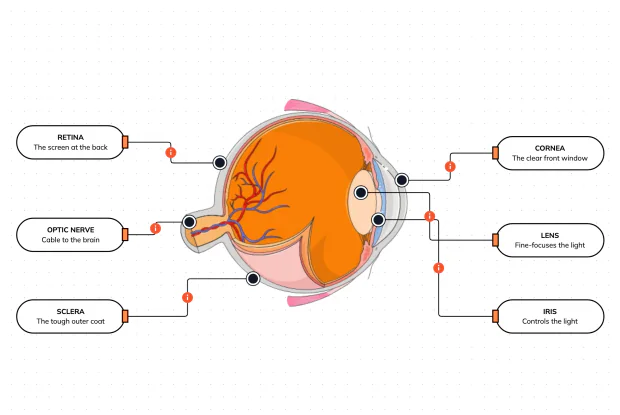
Your eye works like a living camera. Cut it open and label the cornea, lens, iris, retina, optic nerve and sclera, and follow light as it is focused onto a screen at the back of the eye and sent to the brain — in an interactive playground.