What Are the Parts of Your Pancreas?
Root Concept
The pancreas is a soft gland lying behind the stomach, shaped with a wide head tucked in the curve of the small intestine, a long body, and a thin tail reaching toward the spleen. Its lobules make digestive juice, collected by the pancreatic duct and delivered to the gut; hidden among them, small islets also make insulin to control blood sugar.
CodePLU Goal
Upgrading Human Mental Models
Learn how to think in Workflows

Concept Development By codeplu.com
The pancreas, each part joined to the job it does — the regions of the gland, the cells that make its juice, and the duct that carries it out
What Does the Pancreas Actually Do?
The pancreas is one of the body's most under-appreciated organs. Most people could not point to it, yet it quietly does two completely different and vital jobs at the same time. It is a soft, lumpy gland, around 15 centimetres long, lying tucked away behind the stomach at the back of your belly — which is why you never feel it and rarely think about it, until something goes wrong. And when it does go wrong, the result is one of the most common serious diseases in the world: diabetes.
Its shape is worth knowing because doctors describe it by region. One end, the head, is wide and rounded, and it nestles into the C-shaped curve of the small intestine just past the stomach. From there the gland narrows into its long middle, the body, which stretches across the back of the abdomen. Finally it tapers to a thin tail on the far side, which reaches over toward the spleen. Head, body, tail — a simple way to name where along the gland you are.
Inside, the pancreas is packed with tiny clusters of cells called lobules that manufacture a powerful digestive juice, which is collected by a branching pancreatic duct running the length of the organ and delivered into the intestine to help digest food. But hidden among those clusters are separate little islands of cells with a totally different job: making hormones — above all insulin — which are released straight into the blood to control your blood sugar. In the playground above you will label the head, body, tail, pancreatic duct and a lobule — and the label on each connection tells you the job that part does.
What Are the Parts of the Pancreas?
Where is the pancreas, and what shape is it?
The pancreas lies deep in the upper belly, behind the stomach and across the back wall of the abdomen — a hidden position that is why you cannot feel it and why its diseases are often silent until advanced. It is a soft, tapering gland, wider at one end than the other, lying roughly horizontal. Anatomists divide it into three regions purely by where they are along its length: the head (the wide end), the body (the long middle), and the tail (the thin end). These are not different organs or different jobs — the whole pancreas does the same work throughout — they are just handy names for locations, the same way you might describe the start, middle and end of a loaf of bread.
What is the head of the pancreas?
The head is the wide, rounded end of the pancreas, and its position is important: it sits snugly inside the C-shaped curve of the duodenum, the first part of the small intestine just after the stomach. This is no accident — the pancreas delivers its digestive juice into the intestine right here, so having the head tucked into the intestine's curve puts the outlet exactly where the juice is needed. The bile duct from the liver also passes through or beside the head to join the pancreatic duct at this point, so the head is a busy junction. Because it is wrapped so closely with the intestine and the bile duct, a problem in the head of the pancreas (such as a tumour) can block the bile duct and cause jaundice.
What is the body and the tail?
From the head, the pancreas narrows into the body, its long middle section, which lies stretched across the back of the abdomen behind the stomach. The body then tapers further into the tail, the slender far end, which reaches over toward the spleen on the left side of the body. There is nothing anatomically different about the body and tail from the head — they make the same digestive juice and contain the same hormone-making islands — but their location matters clinically: the tail, being tucked away near the spleen, is one reason problems there can go unnoticed for a long time, while the body's position draped over major blood vessels affects how surgeons approach it. Together, head, body and tail simply span the gland from the intestine across to the spleen.
What do the lobules do, and what is the pancreatic duct?
The bulk of the pancreas is made of lobules — little grape-like clusters of cells whose job is to manufacture pancreatic juice, a powerful digestive fluid full of enzymes. These enzymes are strong: they can break down all three main types of food — carbohydrates, proteins and fats — which is why the pancreas is such a key digestive organ. Each cluster empties its juice into a tiny duct, and all these tiny ducts join into ever-larger ones until they form the main pancreatic duct, the branching tube that runs the whole length of the gland. It works like the veins of a leaf in reverse, gathering juice from everywhere and channelling it toward the head, where it pours into the small intestine to get to work on your food.
What is the pancreas's other, hidden job?
Scattered among the juice-making lobules are about a million tiny separate clusters of cells called the islets of Langerhans — the pancreas's second, completely different gland, hidden inside the first. Instead of making digestive juice that flows out through a duct, the islets make hormones that go straight into the bloodstream, chief among them insulin and glucagon, which together control the level of sugar in your blood. Insulin lowers blood sugar after a meal by letting your cells take sugar in; glucagon raises it when you have not eaten. This is the pancreas's most famous role, because when the insulin-making cells fail or the body stops responding to insulin, the result is diabetes. So one soft organ is really two glands in one: a digestive-juice factory and a blood-sugar controller.
Real World Example
Why Is the Pancreas the Organ Behind Diabetes?
The key to the pancreas is that it does two unrelated jobs at once. Seeing how each one works — and what happens when it fails — makes sense of this quiet but crucial organ:
The two-in-one gland
Two jobs, one organ
The pancreas is unusual because it is really two glands packed into the same body. The vast majority of it is an 'exocrine' gland — the lobules that make digestive juice and send it out through a duct to the intestine, like the salivary glands or the liver. But scattered through it are a million tiny 'endocrine' islands that make hormones and release them straight into the blood, with no duct at all. Most organs do one type of secretion or the other; the pancreas does both, side by side, in the same tissue. This is why the pancreas can be involved in two totally different kinds of illness — digestive problems when the juice side goes wrong, and diabetes when the hormone side fails — and why understanding it means keeping its two jobs clearly separate in your mind.
The juice that digests everything
The pancreatic juice and duct
The pancreas's digestive juice is arguably the most important in the whole gut, because it can break down all three major food types at once: carbohydrate-splitting, protein-splitting and fat-splitting enzymes all pour out of the lobules together. This juice travels along the pancreatic duct and empties into the small intestine right where food arrives from the stomach, joining the bile from the liver. It is so powerful that the pancreas has to make its enzymes in an inactive form and only switch them on once they are safely inside the intestine — otherwise they would digest the pancreas itself. When that safety system fails and the enzymes activate too early, the pancreas does begin to digest itself, causing the intensely painful condition called pancreatitis. The juice that breaks down your dinner is strong enough to be dangerous to its own maker.
Insulin and diabetes
The islets of Langerhans
The pancreas's hidden hormone job is the one most people have heard of, even if they do not know the organ responsible. The islets of Langerhans make insulin, the hormone that lets your body's cells take sugar out of the blood for energy after you eat. If those islet cells are destroyed, the body makes no insulin at all — this is type 1 diabetes, and it means injecting insulin for life. If the body gradually stops responding properly to insulin and the pancreas cannot keep up, that is type 2 diabetes, the far more common form linked to lifestyle and age. Either way, blood sugar climbs dangerously because the pancreas's tiny islands can no longer control it. It is remarkable that a disease affecting hundreds of millions of people comes down to a few clusters of cells hidden inside this one quiet organ.
FAQs
Final Words
The pancreas is a soft gland hidden behind the stomach, and its genius is that it does two completely different jobs at once. Named by region — head in the curve of the small intestine, body across the back of the belly, tail reaching toward the spleen — it is packed with lobules that make a powerful digestive juice, gathered by the pancreatic duct and poured into the gut to break down your food. And tucked among those lobules are tiny islands that make insulin, released into the blood to control your sugar.
That two-in-one design explains everything about the pancreas: why it is central to digestion, why it can painfully digest itself in pancreatitis, and above all why it is the organ behind diabetes. It is a striking reminder that a single quiet organ, one most people cannot even locate, can be responsible for one of the world's most common diseases. With the digestive overview, the liver and now the pancreas, the chemistry of digestion is taking shape.
Continue This Track
This concept is part 32 of The Human Body, Head to Toe.
What Is a Bone Made Of?
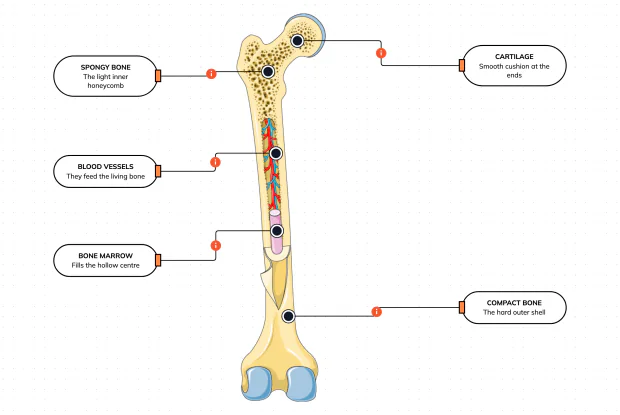
Cut a bone open and it is nowhere near solid: a hard outer shell, a light honeycomb inside, a hollow centre full of marrow, blood vessels threading through, and a smooth cushion at each end. Learn what each part does — then label them yourself in an interactive playground.
What Is Inside Your Elbow Joint?
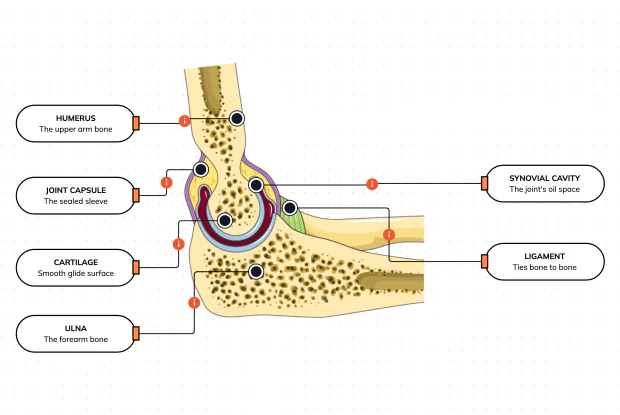
A joint is where two bones meet and move — and it is far more than just the bones. Cut open the elbow and you find smooth cartilage caps, a sealed capsule of slippery fluid, and tough ligaments holding it all together. Learn what each part does, then label them yourself in an interactive playground.
What Makes Your Elbow Bend?
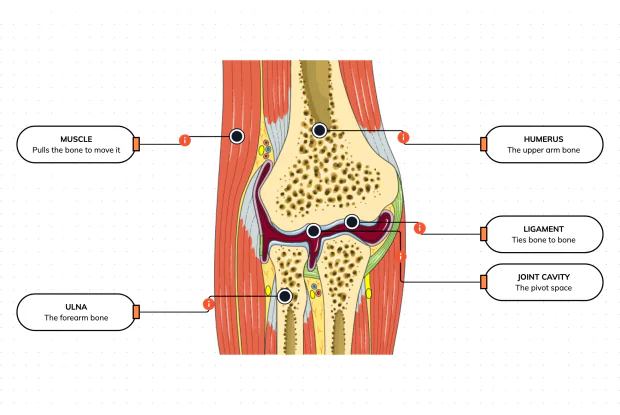
Bones and joints are just the hardware; nothing moves until a muscle pulls. Label the elbow to see the parts that turn a joint into movement — the muscle that pulls, the ligament that holds bone to bone, the two bones it links, and the space they pivot in — then build it yourself in an interactive playground.
What Holds Your Elbow Together?
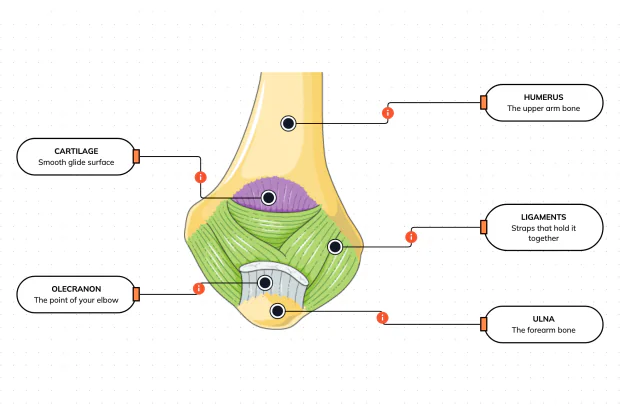
Your elbow is pulled on all day — by gravity, by every bag you carry, by every time you hang or push. So what stops the two bones from simply coming apart? Look at the back of the elbow and label the ligaments, the bony point, the cartilage and the two bones — and learn what holds the whole joint together.
What Are the Main Bones of the Skull?
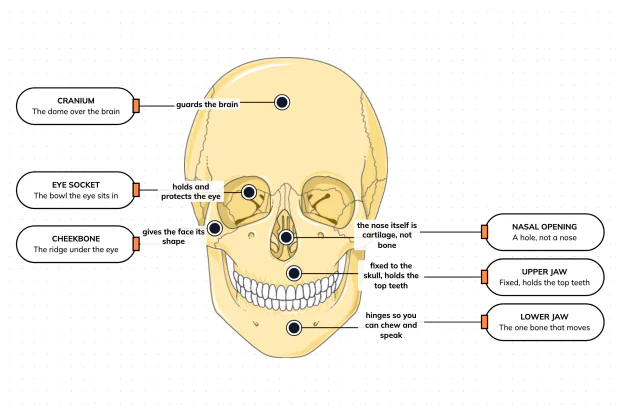
The skull looks like a single bone, but it is really about twenty-two locked together — with just one left free to move. Learn what each main part does, then label a skull yourself in an interactive playground.
What Are the Parts of Your Ear?
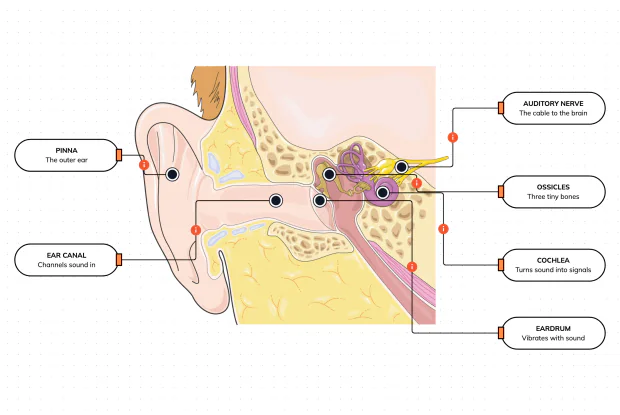
Hearing is a chain of parts passing a sound along, each handing it to the next. Label the pinna, ear canal, eardrum, ossicles, cochlea and auditory nerve, and follow a sound all the way from the air outside to a signal your brain can read — in an interactive playground.
How Does Your Ear Keep You Balanced?
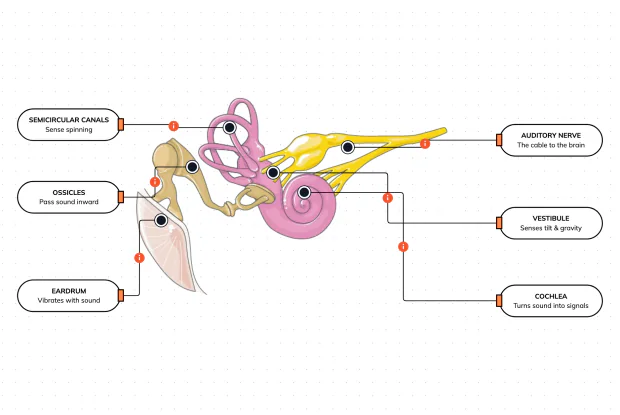
Your ear does a second, hidden job: balance. Inside it sit fluid-filled loops that sense spinning and a chamber that senses tilt and gravity. Label the semicircular canals, vestibule, cochlea, ossicles, eardrum and nerve, and learn how one organ both hears and keeps you upright — in an interactive playground.
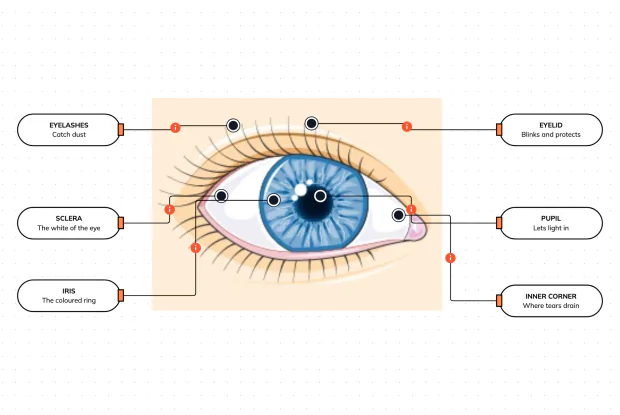
What Are the Parts of the Eye You Can See?
Before you look inside the eye, learn the parts you can already see in a mirror. Label the pupil, iris, sclera, eyelid, eyelashes and the tear-duct corner, and learn what each visible part does to let in light and protect the eye — in an interactive playground.
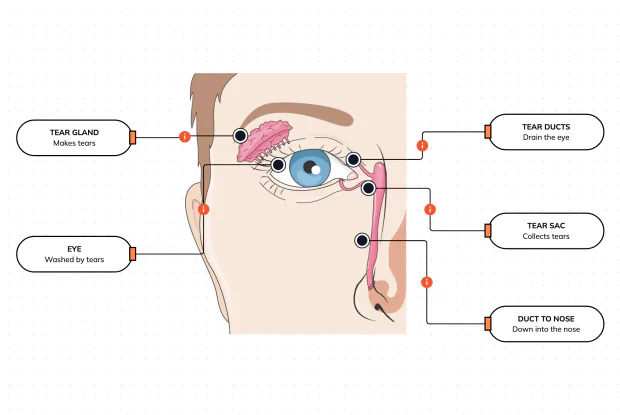
Where Do Your Tears Come From and Go?
Your eyes make and drain tears all day to stay clean and wet. Label the tear gland, the eye, the tear ducts, the tear sac and the duct to the nose, and follow a tear from where it is made to where it drains — in an interactive playground.
How Does Your Eye Turn Light Into a Picture?
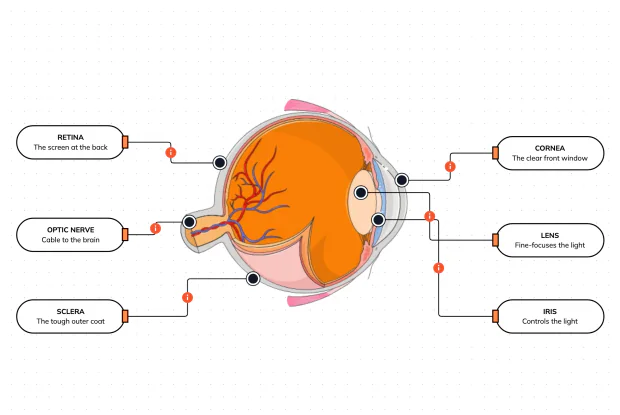
Your eye works like a living camera. Cut it open and label the cornea, lens, iris, retina, optic nerve and sclera, and follow light as it is focused onto a screen at the back of the eye and sent to the brain — in an interactive playground.