What Does an Ovary Do Each Month?
Root Concept
An ovary is a small organ that stores eggs inside tiny sacs called follicles. Every month a few follicles start to grow, one ripens fully and bursts to release its egg, and the empty sac left behind turns into a hormone-making body that fades away a couple of weeks later if no pregnancy begins.
CodePLU Goal
Upgrading Human Mental Models
Learn how to think in Workflows

Concept Development By codeplu.com
One month inside an ovary — resting follicles, one growing and ripening, the egg released, and the yellow body that is left behind
What Is Actually Happening Inside an Ovary?
An ovary is small — about the size of an almond — and there are two of them, one on each side of the uterus. Inside, an ovary is not a bag of loose eggs. Every egg sits in its own tiny sac, called a follicle, and that sac is what does the work: it protects the egg, feeds it, ripens it, and finally lets it go.
The picture in the playground is a clever one, because it shows a whole month happening at once. Around the edge of a single ovary you can see every stage side by side: the tiny resting follicles, a few that have started growing, one big ripe one swollen with fluid, an egg escaping at the bottom, and the yellow body left behind after the egg has gone. A real ovary does these stages in sequence, but drawing them together lets you see the whole cycle in one glance.
Here is the part most people find surprising. A baby girl is born with every egg she will ever have — around one to two million of them — and she makes no new ones after that. The ovary's monthly job is not to create eggs. It is to choose one, ripen it properly, and release it, while the rest keep waiting. In the playground you will label each stage of that month.
How Does an Ovary Ripen and Release an Egg?
Why does an egg need a sac around it?
An egg cell cannot look after itself. It needs feeding, protecting and a signal telling it when to finish ripening, and all of that comes from the ball of cells packed around it — the follicle. Think of it as a nursery rather than a wrapper: the cells of the follicle pass nutrients inward to the egg and make hormones that travel out into the blood. Most follicles in an ovary are the smallest kind, resting quietly with an immature egg inside, and they can stay that way for decades. Many beginners picture eggs floating loose inside the ovary, ready to go. They are not. An egg only becomes usable once its follicle has spent weeks growing around it.
How is one egg chosen each month?
Each month a small group of follicles — not one — begins to grow, woken by a hormone from the brain. They swell, and a fluid-filled space opens up inside each one, pushing the egg to one side. Then comes the competition: usually a single follicle outgrows the rest and becomes the mature follicle, big enough to bulge from the ovary's surface. The others stop and quietly break down. This is why the big ripe follicle in the picture sits alongside several smaller ones. When the mature follicle is ready, a surge of hormone makes it burst open and release its egg. That release is ovulation, and it takes only minutes after weeks of preparation.
What happens to the empty sac?
The follicle does not disappear once the egg has gone — and this is the step most explanations skip. The collapsed sac seals up, its cells fill with a yellow fat-rich substance, and it becomes the corpus luteum, which simply means 'yellow body'. For about two weeks it works as a small temporary gland, pouring out hormones that thicken the lining of the uterus and keep it ready in case the egg is fertilised. If a pregnancy begins, the corpus luteum keeps going for months. If it does not, the corpus luteum shuts down, shrinks, and leaves behind a pale patch of scar tissue called the corpus albicans — the 'white body'. Then the whole cycle starts again.
Real World Example
Why This One Month Explains So Much
Follow one follicle from start to finish and three familiar things suddenly make sense:
Why a period arrives
The yellow body switches off
A period is not really about the egg — it is about the corpus luteum. After ovulation, that yellow body spends around two weeks making hormones that keep the uterus lining thick and blood-rich, ready to receive a fertilised egg. If no pregnancy begins, the corpus luteum runs out of time, shrinks and stops making those hormones. Without them the lining cannot be maintained, so it is shed, and that shedding is the period. This is why the second half of the cycle is so reliably about two weeks long in most people: it is set by how long a corpus luteum lasts, not by anything the egg does. The ovary, not the uterus, is keeping time.
Why home pregnancy tests work
A signal keeps the yellow body alive
If the released egg is fertilised and settles into the uterus lining, the tiny growing embryo starts making a hormone whose whole job is to tell the corpus luteum 'do not shut down'. The yellow body keeps going, keeps making its hormones, and the lining is never shed — which is why a missed period is often the first sign of pregnancy. That same embryo hormone spills into the blood and then into urine, and it is exactly what a home pregnancy test detects. So the test is really listening in on a message sent from an embryo to a leftover follicle sac in the ovary, asking it to stay at work a little longer.
What this tells you
Fertility follows a monthly window
Because an ovary usually releases just one egg per cycle, and that egg survives only about a day, there is a short window each month when a pregnancy can begin. That is why people trying to conceive track ovulation, and why the timing of the release matters so much more than the number of eggs stored. It also explains a common mix-up: running out of eggs is not what ends fertility abruptly each month — the store is enormous. What limits any given month is that the ovary ripens and releases one egg, once, and everything else in the cycle is built around that single moment.
FAQs
Final Words
An ovary is a small organ with one monthly job: take one of the eggs it has stored since before birth and get it ready to leave. That work is done by follicles. Most sit resting, a few begin to grow each month, one ripens fully and swells with fluid, and at ovulation it bursts and releases its egg. The sac left behind becomes the corpus luteum, a temporary gland that keeps the uterus lining ready, and if no pregnancy follows it fades to a pale corpus albicans.
Seeing all of those stages in one picture is the fastest way to understand the female reproductive cycle, because the ovary is what keeps the time. Next, zoom in on a single follicle to see how an egg is packaged, or follow the released egg along the fallopian tube on its journey toward the uterus.
Continue This Track
This concept is part 59 of The Human Body, Head to Toe.
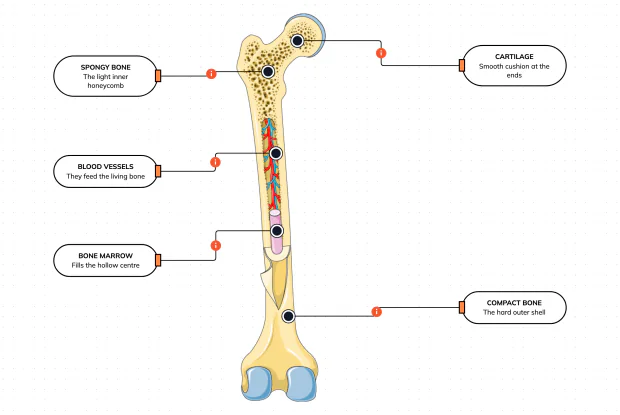
What Is a Bone Made Of?
Cut a bone open and it is nowhere near solid: a hard outer shell, a light honeycomb inside, a hollow centre full of marrow, blood vessels threading through, and a smooth cushion at each end. Learn what each part does — then label them yourself in an interactive playground.
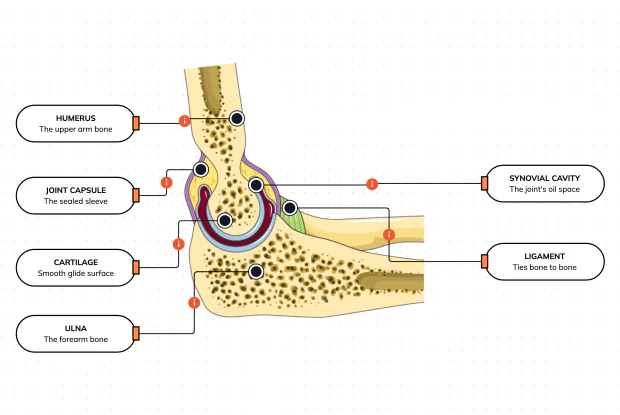
What Is Inside Your Elbow Joint?
A joint is where two bones meet and move — and it is far more than just the bones. Cut open the elbow and you find smooth cartilage caps, a sealed capsule of slippery fluid, and tough ligaments holding it all together. Learn what each part does, then label them yourself in an interactive playground.
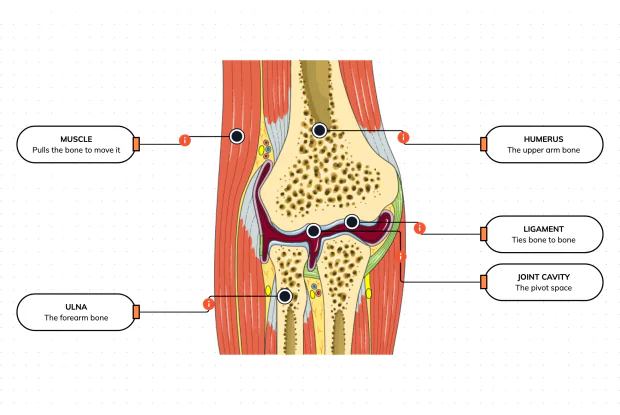
What Makes Your Elbow Bend?
Bones and joints are just the hardware; nothing moves until a muscle pulls. Label the elbow to see the parts that turn a joint into movement — the muscle that pulls, the ligament that holds bone to bone, the two bones it links, and the space they pivot in — then build it yourself in an interactive playground.
What Holds Your Elbow Together?
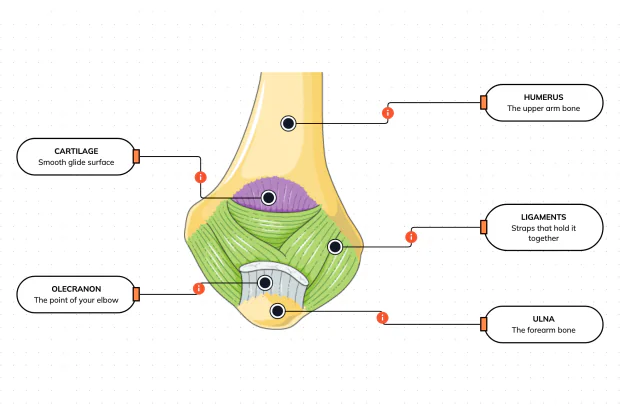
Your elbow is pulled on all day — by gravity, by every bag you carry, by every time you hang or push. So what stops the two bones from simply coming apart? Look at the back of the elbow and label the ligaments, the bony point, the cartilage and the two bones — and learn what holds the whole joint together.
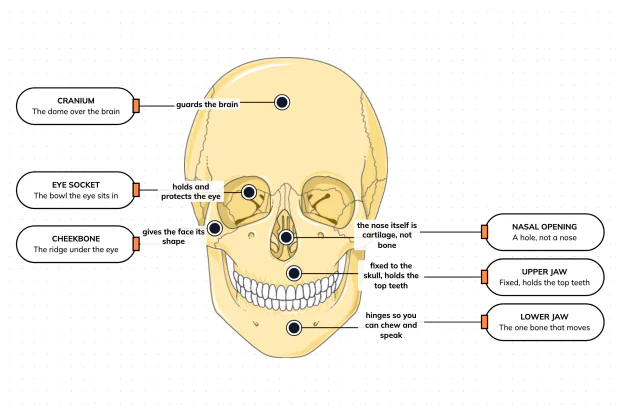
What Are the Main Bones of the Skull?
The skull looks like a single bone, but it is really about twenty-two locked together — with just one left free to move. Learn what each main part does, then label a skull yourself in an interactive playground.
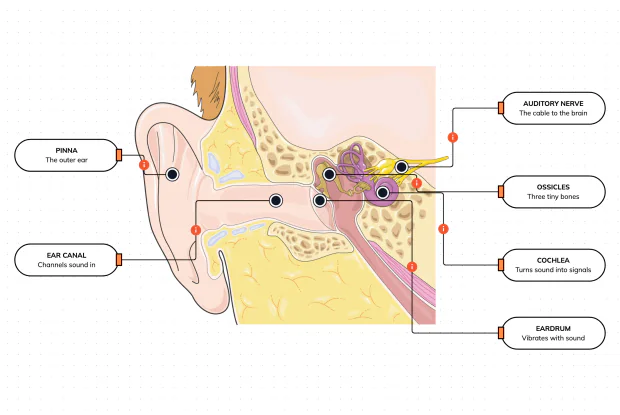
What Are the Parts of Your Ear?
Hearing is a chain of parts passing a sound along, each handing it to the next. Label the pinna, ear canal, eardrum, ossicles, cochlea and auditory nerve, and follow a sound all the way from the air outside to a signal your brain can read — in an interactive playground.
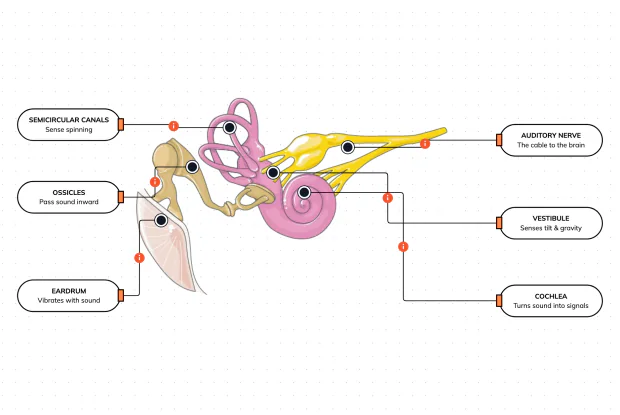
How Does Your Ear Keep You Balanced?
Your ear does a second, hidden job: balance. Inside it sit fluid-filled loops that sense spinning and a chamber that senses tilt and gravity. Label the semicircular canals, vestibule, cochlea, ossicles, eardrum and nerve, and learn how one organ both hears and keeps you upright — in an interactive playground.
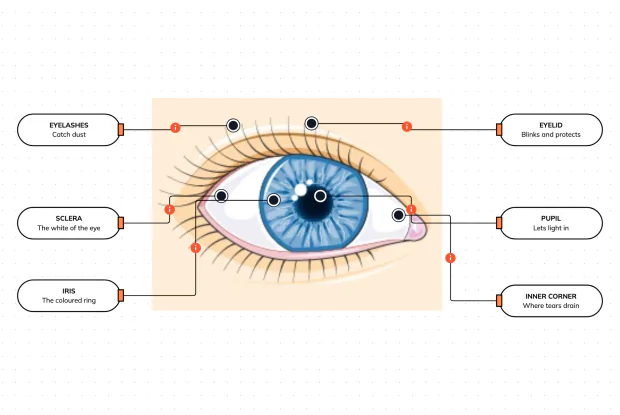
What Are the Parts of the Eye You Can See?
Before you look inside the eye, learn the parts you can already see in a mirror. Label the pupil, iris, sclera, eyelid, eyelashes and the tear-duct corner, and learn what each visible part does to let in light and protect the eye — in an interactive playground.
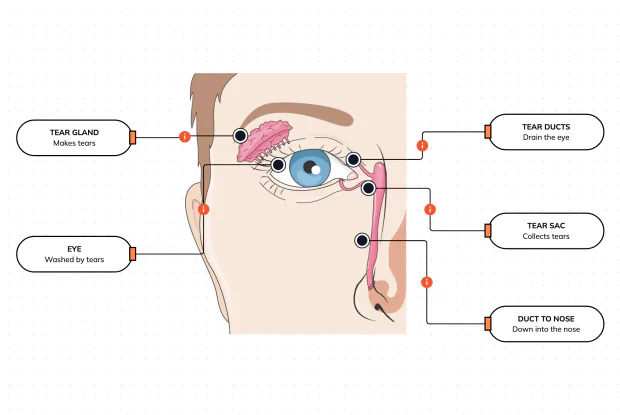
Where Do Your Tears Come From and Go?
Your eyes make and drain tears all day to stay clean and wet. Label the tear gland, the eye, the tear ducts, the tear sac and the duct to the nose, and follow a tear from where it is made to where it drains — in an interactive playground.
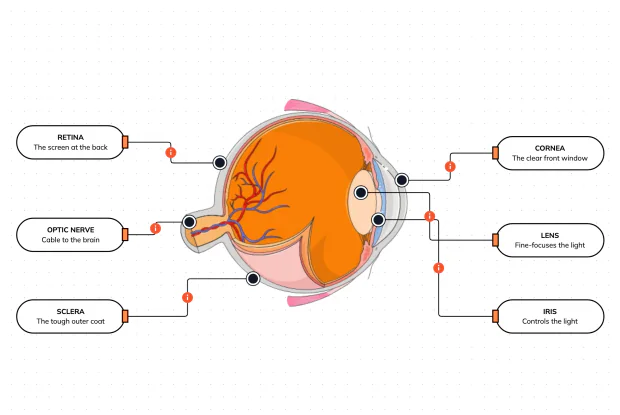
How Does Your Eye Turn Light Into a Picture?
Your eye works like a living camera. Cut it open and label the cornea, lens, iris, retina, optic nerve and sclera, and follow light as it is focused onto a screen at the back of the eye and sent to the brain — in an interactive playground.