What Does Your Thyroid Gland Do?
Root Concept
The thyroid is a butterfly-shaped gland in the front of the neck, made of a right lobe and a left lobe joined by a bridge called the isthmus, sitting just below the voice box and wrapped around the windpipe. It makes thyroid hormone, which controls how fast the body's cells work — its metabolism, or speed.
CodePLU Goal
Upgrading Human Mental Models
Learn how to think in Workflows

Concept Development By codeplu.com
The thyroid gland in the front of the neck — its two lobes and connecting isthmus, below the voice box and wrapped around the windpipe
What Sets How Fast Your Body Runs?
Some days your body feels like it is running fast — you are warm, full of energy, wide awake. The speed your body works at, called its metabolism, is not an accident. It is set, quietly and constantly, by a small gland in the front of your neck: the thyroid gland.
The thyroid is shaped like a butterfly. It has two wings, called the right lobe and the left lobe, joined in the middle by a narrow bridge called the isthmus. You can find its home by feeling the front of your neck: it sits just below the voice box (the larynx, the bump you can feel move when you swallow) and wraps around the front of your windpipe (the trachea, the tube you breathe through).
Its job is to make a chemical messenger called thyroid hormone and release it into your blood. That hormone travels everywhere and tells your body's cells how fast to work — how quickly to burn food for energy, make heat, and keep everything ticking over. In the playground you will label the two lobes and the isthmus that make up the gland, plus the voice box above it and the windpipe it hugs.
How Does the Thyroid Gland Work?
What is the thyroid gland and where is it?
The thyroid is a gland — an organ that makes a useful substance and releases it — and it lives in the front of your neck. Its butterfly shape comes from two side pieces, the right lobe and the left lobe, joined across the middle by a thin bridge called the isthmus. It sits low in the neck, just under the larynx (your voice box) and draped around the front and sides of the trachea (your windpipe), a bit like a scarf wrapped around a pipe. It is not very big — only about the size of two thumbs — but it sits in a busy, important spot, right next to the tubes you use for breathing and speaking. A doctor can sometimes feel it move under the fingers when you swallow.
What does the thyroid actually do?
The thyroid makes a chemical messenger called thyroid hormone and pours it into the blood, which carries it to every cell in your body. Think of that hormone as the setting on your body's speed dial. When the thyroid makes the right amount, your cells work at a healthy pace: you feel energetic, stay warm, and grow properly. If the thyroid makes too much hormone, everything speeds up — the heart races, you feel hot and jittery, and you may lose weight. If it makes too little, everything slows down — you feel tired and cold, and things slow to a crawl. So the thyroid is like a thermostat for the whole body, keeping your speed steady rather than too fast or too slow.
Why the thyroid needs iodine
To build its hormone, the thyroid needs a special ingredient called iodine, which your body cannot make and has to get from food. Iodine is found in things like seafood, dairy and, in many countries, in table salt that has had iodine added on purpose. If someone does not get enough iodine, the thyroid cannot make enough hormone, and it may swell up as it works harder, forming a visible lump in the neck called a goitre. This is exactly why so much salt in shops is labelled 'iodised': adding a tiny amount of iodine to everyday salt was one of the simplest and most successful ways ever found to keep whole populations' thyroids healthy. A gland the size of two thumbs, kept working by a pinch of iodine, helps set the pace of your entire body.
Real World Example
Where Does the Thyroid Show Up in Real Life?
You rarely think about your thyroid, but its effects are all around you. Here are three:
Feeling full of energy, or worn out
The thyroid sets your everyday pace
How energetic you feel from day to day depends partly on your thyroid. When it makes the right amount of hormone, your cells burn food at a healthy pace and you feel awake and warm. When a person's thyroid makes too little hormone — a common condition — they often feel unusually tired, cold, and sluggish, because their whole body has been turned down a notch. When it makes too much, they can feel hot, restless and shaky, as if the body is stuck in fast-forward. Doctors can check the thyroid with a simple blood test, and treat it, which is why thyroid problems, though very common, are usually manageable once found. Your energy level is, in part, your thyroid's setting showing through.
Iodised salt on the shelf
A pinch of iodine keeps the gland healthy
Look closely at a box of table salt and you may see the words 'iodised salt'. That means a tiny amount of iodine has been added — and it is there for your thyroid. The thyroid needs iodine to build its hormone, but iodine is scarce in the food of many inland regions far from the sea. Long ago, people in those places often developed goitres, swollen thyroids straining to work without enough iodine. Adding a pinch of iodine to everyday salt fixed this so cheaply and completely that it became one of the great public-health successes in history. So a plain box of salt is quietly looking after millions of thyroid glands at once.
Growing up at the right pace
The thyroid helps children develop
Thyroid hormone does not only run your day-to-day energy; it is also vital for growing up. In babies and children, the right amount of thyroid hormone is needed for the body and especially the brain to develop properly and at the right speed. This is so important that in many countries every newborn baby has a heel-prick blood test in the first days of life, partly to check the thyroid is working. If it is not, treatment can be started straight away so the child grows and develops normally. It shows how central this small neck gland is: it helps set not just how fast you run today, but how you grow across your whole childhood.
FAQs
Final Words
The thyroid is a small, butterfly-shaped gland in the front of your neck, made of a right lobe and a left lobe joined by a bridge called the isthmus, sitting just below your voice box and wrapped around your windpipe. Its job is to make thyroid hormone and release it into the blood, where it sets the speed your whole body runs at — your energy, your warmth, and your growth.
For such a small gland, its reach is huge, and it depends on a tiny ingredient — iodine — to do its work, which is why a pinch of it is added to everyday salt. From how energetic you feel today to how you grew as a child, the butterfly in your neck has been quietly setting the pace all along.
Continue This Track
This concept is part 46 of The Human Body, Head to Toe.
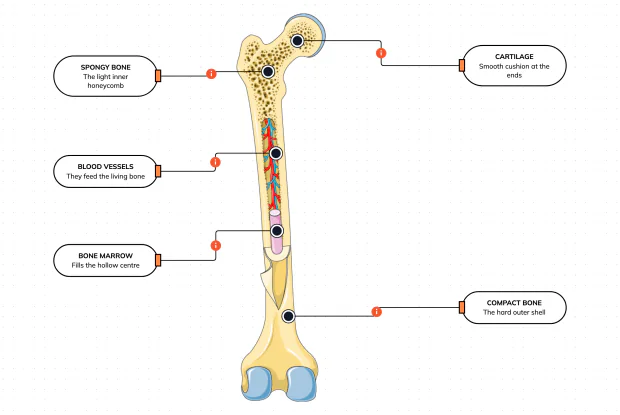
What Is a Bone Made Of?
Cut a bone open and it is nowhere near solid: a hard outer shell, a light honeycomb inside, a hollow centre full of marrow, blood vessels threading through, and a smooth cushion at each end. Learn what each part does — then label them yourself in an interactive playground.
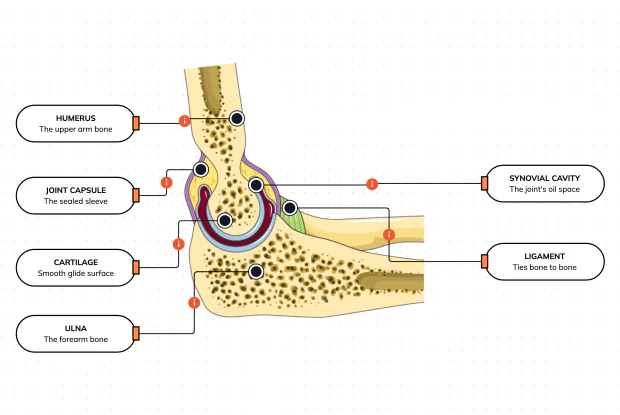
What Is Inside Your Elbow Joint?
A joint is where two bones meet and move — and it is far more than just the bones. Cut open the elbow and you find smooth cartilage caps, a sealed capsule of slippery fluid, and tough ligaments holding it all together. Learn what each part does, then label them yourself in an interactive playground.
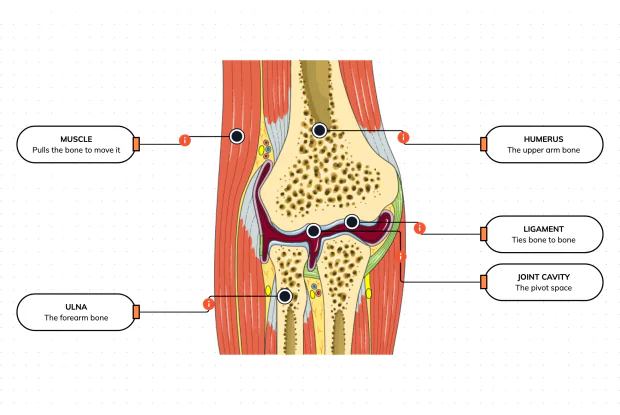
What Makes Your Elbow Bend?
Bones and joints are just the hardware; nothing moves until a muscle pulls. Label the elbow to see the parts that turn a joint into movement — the muscle that pulls, the ligament that holds bone to bone, the two bones it links, and the space they pivot in — then build it yourself in an interactive playground.
What Holds Your Elbow Together?
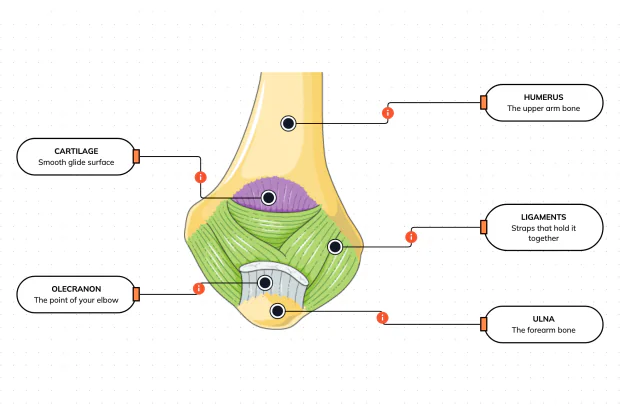
Your elbow is pulled on all day — by gravity, by every bag you carry, by every time you hang or push. So what stops the two bones from simply coming apart? Look at the back of the elbow and label the ligaments, the bony point, the cartilage and the two bones — and learn what holds the whole joint together.
What Are the Main Bones of the Skull?
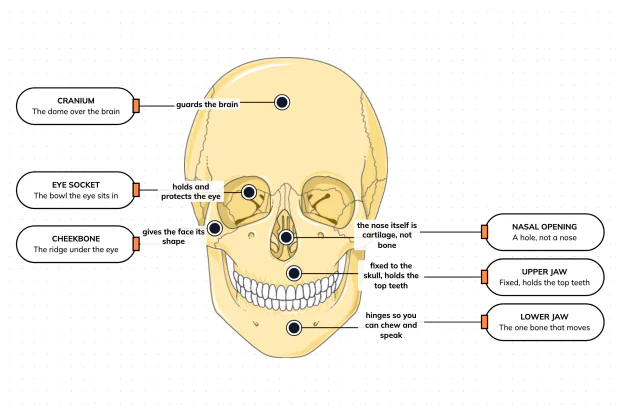
The skull looks like a single bone, but it is really about twenty-two locked together — with just one left free to move. Learn what each main part does, then label a skull yourself in an interactive playground.
What Are the Parts of Your Ear?
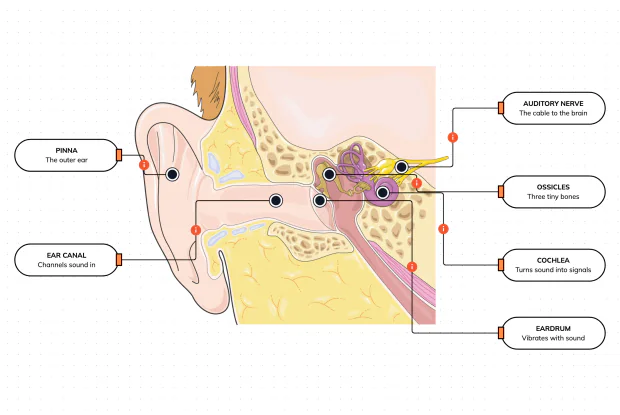
Hearing is a chain of parts passing a sound along, each handing it to the next. Label the pinna, ear canal, eardrum, ossicles, cochlea and auditory nerve, and follow a sound all the way from the air outside to a signal your brain can read — in an interactive playground.
How Does Your Ear Keep You Balanced?
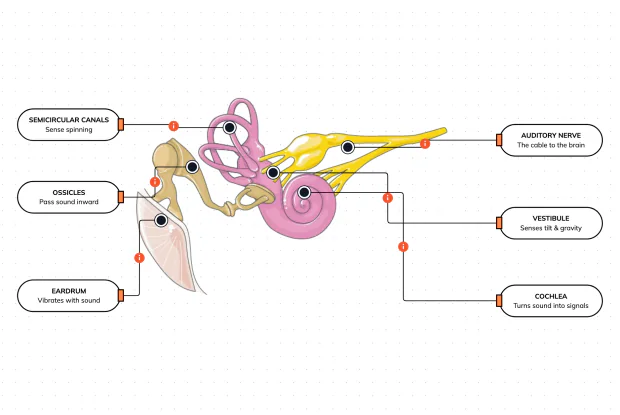
Your ear does a second, hidden job: balance. Inside it sit fluid-filled loops that sense spinning and a chamber that senses tilt and gravity. Label the semicircular canals, vestibule, cochlea, ossicles, eardrum and nerve, and learn how one organ both hears and keeps you upright — in an interactive playground.
What Are the Parts of the Eye You Can See?
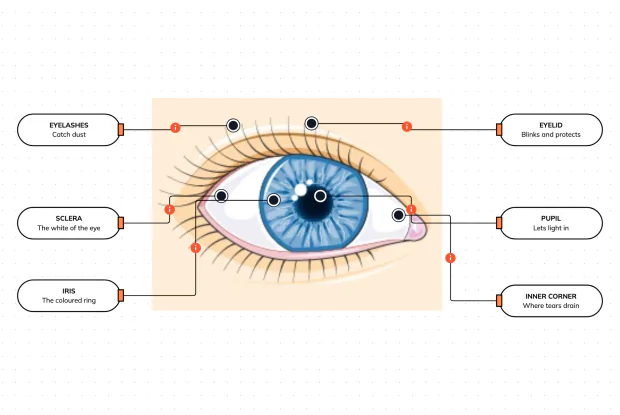
Before you look inside the eye, learn the parts you can already see in a mirror. Label the pupil, iris, sclera, eyelid, eyelashes and the tear-duct corner, and learn what each visible part does to let in light and protect the eye — in an interactive playground.
Where Do Your Tears Come From and Go?
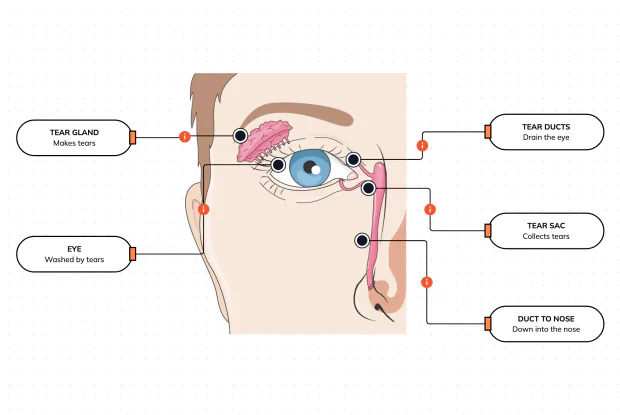
Your eyes make and drain tears all day to stay clean and wet. Label the tear gland, the eye, the tear ducts, the tear sac and the duct to the nose, and follow a tear from where it is made to where it drains — in an interactive playground.
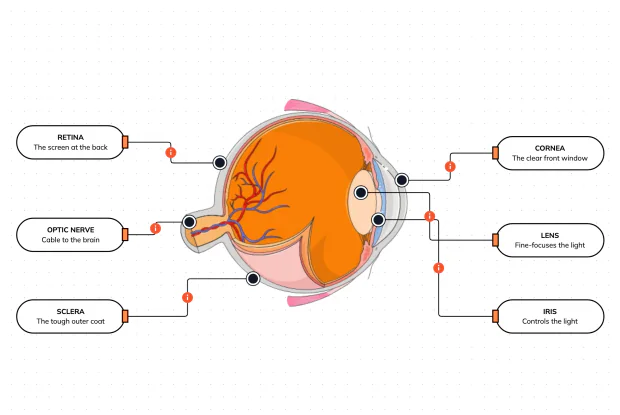
How Does Your Eye Turn Light Into a Picture?
Your eye works like a living camera. Cut it open and label the cornea, lens, iris, retina, optic nerve and sclera, and follow light as it is focused onto a screen at the back of the eye and sent to the brain — in an interactive playground.