What Are the Parts of Your Liver and Gallbladder?
Root Concept
The liver is the body's largest internal organ and chemical factory: it processes nutrients, stores energy, cleans the blood and makes bile. The gallbladder stores that bile and releases it down the bile duct to the intestine. Uniquely, the liver receives blood from two sources — the portal vein (nutrient-rich, from the gut) and the hepatic artery (oxygen-rich).
CodePLU Goal
Upgrading Human Mental Models
Learn how to think in Workflows

Concept Development By codeplu.com
The liver and gallbladder, each part joined to the job it does — making and storing bile, and the two blood supplies that feed the liver
Why Does Your Liver Get Blood From Two Different Places?
The liver is the largest organ inside your body and, by a wide margin, the busiest. It quietly performs hundreds of different jobs: it processes the nutrients absorbed from your food, stores energy for later, builds proteins your body needs, breaks down worn-out blood cells, filters toxins and drugs out of your blood, and makes bile to help you digest fat. If the digestive tube is where food is broken down, the liver is the factory that takes the raw materials and turns them into what your body can actually use — and cleans up the waste. No machine we build comes close to doing so many chemical jobs in one place.
Tucked underneath the liver is its small helper, the gallbladder — a little green sac whose only job is to store bile. The liver makes bile continuously, but you only need it when you eat, so the gallbladder holds it, concentrates it, and squirts it out when a meal (especially a fatty one) arrives. The bile travels from the liver and gallbladder down a tube called the bile duct, which empties into the small intestine to help digest fat.
The strangest thing about the liver is its plumbing: it receives blood from two different sources, which almost no other organ does. The hepatic artery brings ordinary oxygen-rich blood to keep the liver's own cells alive. But the portal vein brings something unusual — nutrient-rich blood straight from the gut, carrying everything you have just absorbed from your food, so the liver can process it first before it reaches the rest of the body. In the playground above you will label the liver, gallbladder, bile duct, portal vein and hepatic artery — and the label on each connection tells you the job that part does.
What Does Each Part Do?
What does the liver actually do?
More than almost any other organ — the liver is a chemical factory with hundreds of jobs. A few of the big ones: it takes the nutrients absorbed from your food and processes them, storing sugar as a reserve and releasing it when your energy runs low; it builds many of the proteins your blood needs, including those that make blood clot; it breaks down old, worn-out red blood cells; and it acts as the body's filter, removing toxins, alcohol and the by-products of medicines from your blood and making them safe to get rid of. It also makes bile for digesting fat. Because it does so much, the liver is remarkable in another way too: it is the only human organ that can regrow, rebuilding itself even if a large part is removed or damaged.
What is the gallbladder for?
The gallbladder is the small green sac tucked under the liver, and it is purely a storage tank for bile. Here is the problem it solves: the liver makes bile all the time, drip by drip, but you only need a burst of it when there is food (especially fatty food) to digest. So rather than waste the steady trickle, the gallbladder collects it, and while it sits there it concentrates the bile by removing water, making it stronger. Then, when a meal arrives in the small intestine, the gallbladder squeezes and sends a jet of concentrated bile down to meet it. You can actually live without a gallbladder — if it is removed, bile just drips continuously from the liver to the intestine instead — but you lose that ability to deliver a concentrated burst on demand.
What is the bile duct?
The bile duct is the tube that carries bile from the liver and gallbladder down to the small intestine — the delivery pipe of the bile system. Bile made in the liver either flows straight down this duct to the intestine, or takes a detour into the gallbladder to be stored; when a meal comes, the stored bile rejoins the duct and travels down to do its job. Bile matters because fat and water do not mix, so a blob of fat in your meal would be hard to digest — bile breaks it into tiny droplets, the way washing-up liquid cuts grease, so the fat can be absorbed. If the bile duct gets blocked (for example by a gallstone), bile backs up, which can turn the skin and eyes yellow — a condition called jaundice.
What does the portal vein bring?
The portal vein is the liver's most unusual supply line: it brings blood straight from the gut — the stomach and intestines — to the liver first, before that blood goes anywhere else in the body. This is deliberate and clever. When you digest a meal, all the nutrients absorbed by the intestine are dumped into this blood, so the portal vein delivers a rich soup of freshly-absorbed sugars, amino acids and other substances directly to the liver for processing. The liver checks it, stores what should be stored, converts what needs converting, and neutralises anything harmful — acting as a customs checkpoint between your gut and the rest of you. It is why the liver gets 'first pick' of everything you eat, drink or swallow.
What does the hepatic artery bring, and why two supplies?
The hepatic artery brings ordinary oxygen-rich blood from the heart to the liver — the same kind of fresh blood every organ needs to keep its own cells alive and working. So the liver has two blood supplies for two different reasons: the hepatic artery feeds the liver's cells with oxygen, and the portal vein delivers the gut's nutrients for the liver to process. Almost every other organ gets blood from just an artery, uses the oxygen, and passes the blood on. The liver is special because it is not only a living tissue that needs oxygen (artery) but also a processing plant that must handle everything coming from the gut (portal vein). Two jobs, two supplies — and the liver blends both streams together as the blood filters slowly through it.
Real World Example
Why Does Everything You Eat and Drink Go to Your Liver First?
Because the portal vein routes gut blood through the liver before the rest of the body, the liver gets first crack at everything you absorb. That single fact explains a lot:
First stop for everything you absorb
The portal vein
When you eat or drink, whatever your gut absorbs does not go straight into general circulation — it is funnelled through the portal vein to the liver first. This makes the liver a checkpoint standing between your intestines and the rest of your body. Nutrients get sorted and stored, sugar levels are smoothed out so your blood does not spike, and anything toxic is caught before it can reach your heart and brain. It is a brilliant piece of design: the one organ best equipped to process and detoxify is placed directly downstream of the gut, so it can screen the incoming flood from every meal. Nothing you swallow bypasses this inspection — which is exactly why the next two facts follow.
Why the liver handles alcohol and medicines
The liver as filter
Because gut blood passes through the liver first, the liver is where alcohol and most swallowed medicines are broken down. Drink alcohol, and it is absorbed by the gut and carried to the liver, which sets about dismantling it — which is why heavy or long-term drinking damages the liver specifically, and why the liver, not the stomach, is the organ that 'processes' a night out. The same is true of tablets: the liver often breaks down a large fraction of a swallowed drug before it ever reaches the bloodstream, which is why doses are calculated around this 'first pass' and why some medicines cannot be taken by mouth at all. The liver's role as the body's detox filter is a direct result of where its blood comes from.
When stored bile turns to stone
The gallbladder and bile duct
The gallbladder's job of storing and concentrating bile has a downside: sometimes the concentrated bile hardens into small solid lumps called gallstones. Often they cause no trouble, but if a stone escapes the gallbladder and lodges in the bile duct, it blocks the pipe — and then bile cannot drain. This causes sudden, severe pain after fatty meals (when the gallbladder squeezes against the blockage), and if bile backs up far enough it can spill into the blood and turn the skin and eyes yellow, the sign called jaundice. It is why a very common operation is simply to remove the gallbladder: with the storage tank gone, bile drips straight from the liver to the intestine, and though you lose the concentrated on-demand burst, digestion carries on fine.
FAQs
Final Words
The liver is the body's chemical factory — the largest internal organ, running hundreds of jobs from processing your food to cleaning your blood and making bile. Beside it, the small gallbladder stores and concentrates that bile, sending it down the bile duct to the intestine when a meal needs it. And uniquely, the liver draws blood from two sources: the hepatic artery for oxygen to keep its own cells alive, and the portal vein for the gut's nutrients to process.
That double blood supply is the key to understanding the liver's role as the body's gatekeeper: everything absorbed from your gut passes through it first, which is why it handles your food, your medicines and your alcohol, and why gallstones and jaundice happen when the bile system is blocked. Next you can zoom in past this whole-organ view to see how the liver does its work at the tiniest scale — inside a single liver lobule.
Continue This Track
This concept is part 30 of The Human Body, Head to Toe.
What Is a Bone Made Of?
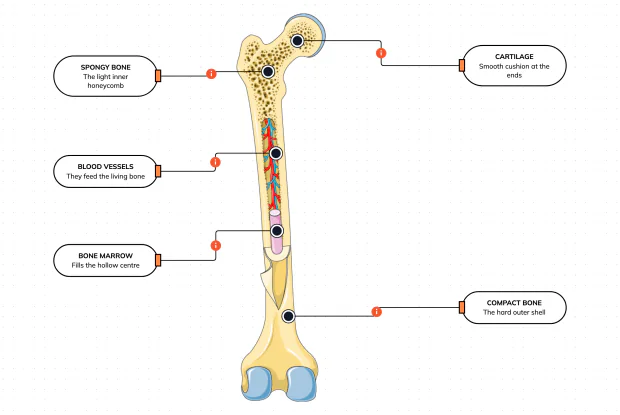
Cut a bone open and it is nowhere near solid: a hard outer shell, a light honeycomb inside, a hollow centre full of marrow, blood vessels threading through, and a smooth cushion at each end. Learn what each part does — then label them yourself in an interactive playground.
What Is Inside Your Elbow Joint?
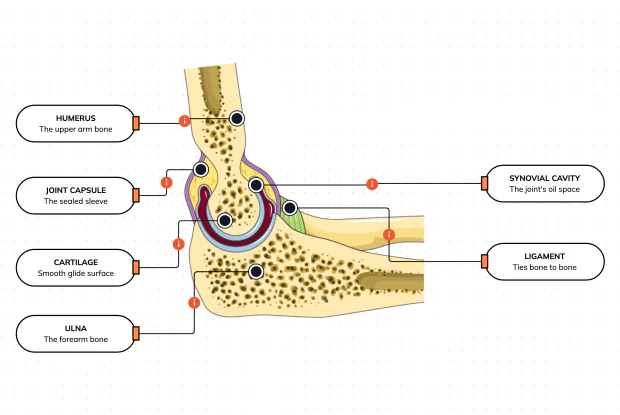
A joint is where two bones meet and move — and it is far more than just the bones. Cut open the elbow and you find smooth cartilage caps, a sealed capsule of slippery fluid, and tough ligaments holding it all together. Learn what each part does, then label them yourself in an interactive playground.
What Makes Your Elbow Bend?
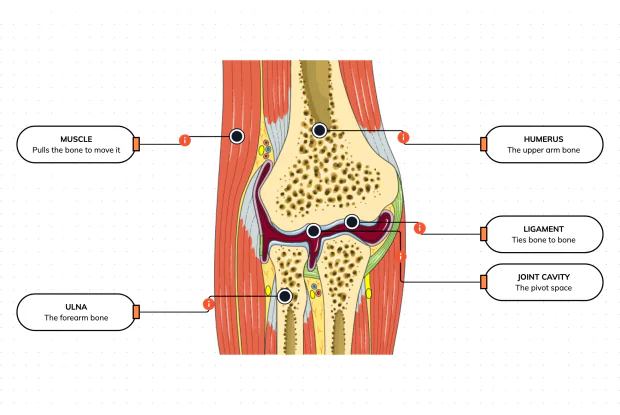
Bones and joints are just the hardware; nothing moves until a muscle pulls. Label the elbow to see the parts that turn a joint into movement — the muscle that pulls, the ligament that holds bone to bone, the two bones it links, and the space they pivot in — then build it yourself in an interactive playground.
What Holds Your Elbow Together?
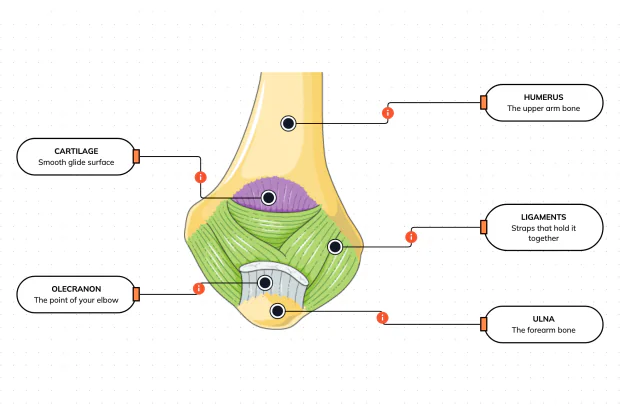
Your elbow is pulled on all day — by gravity, by every bag you carry, by every time you hang or push. So what stops the two bones from simply coming apart? Look at the back of the elbow and label the ligaments, the bony point, the cartilage and the two bones — and learn what holds the whole joint together.
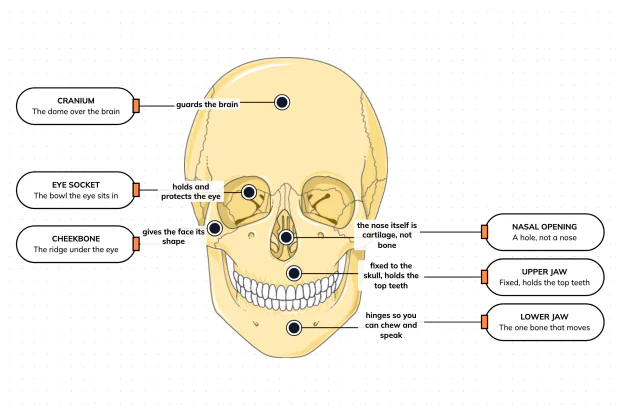
What Are the Main Bones of the Skull?
The skull looks like a single bone, but it is really about twenty-two locked together — with just one left free to move. Learn what each main part does, then label a skull yourself in an interactive playground.
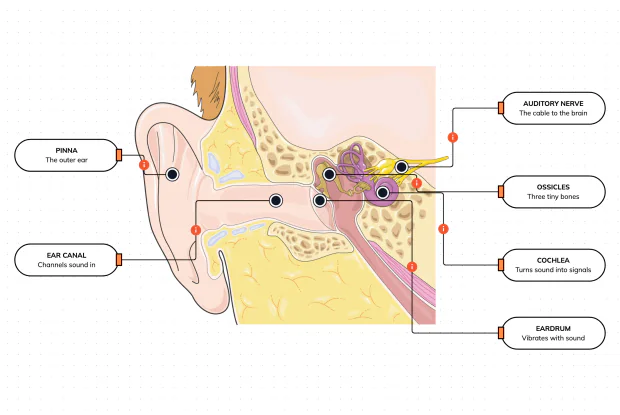
What Are the Parts of Your Ear?
Hearing is a chain of parts passing a sound along, each handing it to the next. Label the pinna, ear canal, eardrum, ossicles, cochlea and auditory nerve, and follow a sound all the way from the air outside to a signal your brain can read — in an interactive playground.
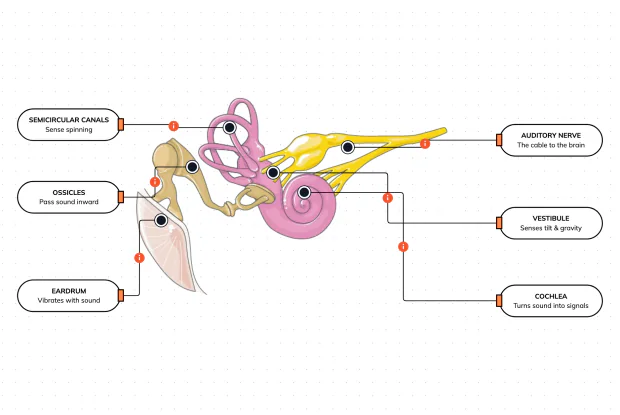
How Does Your Ear Keep You Balanced?
Your ear does a second, hidden job: balance. Inside it sit fluid-filled loops that sense spinning and a chamber that senses tilt and gravity. Label the semicircular canals, vestibule, cochlea, ossicles, eardrum and nerve, and learn how one organ both hears and keeps you upright — in an interactive playground.
What Are the Parts of the Eye You Can See?
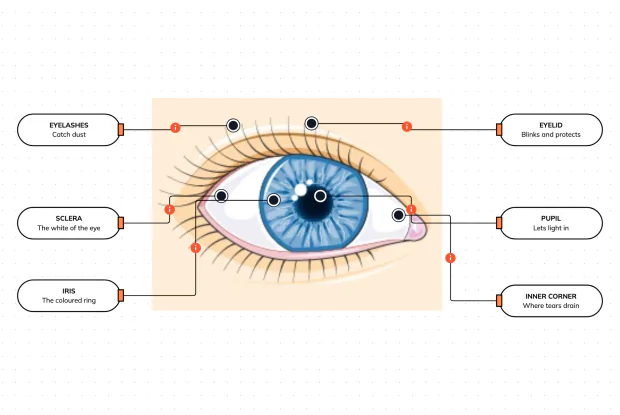
Before you look inside the eye, learn the parts you can already see in a mirror. Label the pupil, iris, sclera, eyelid, eyelashes and the tear-duct corner, and learn what each visible part does to let in light and protect the eye — in an interactive playground.
Where Do Your Tears Come From and Go?
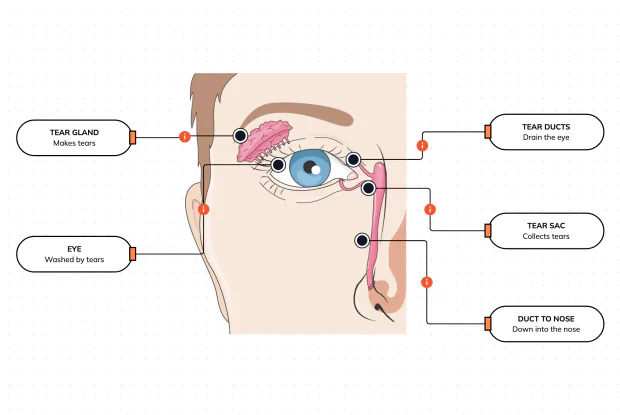
Your eyes make and drain tears all day to stay clean and wet. Label the tear gland, the eye, the tear ducts, the tear sac and the duct to the nose, and follow a tear from where it is made to where it drains — in an interactive playground.
How Does Your Eye Turn Light Into a Picture?
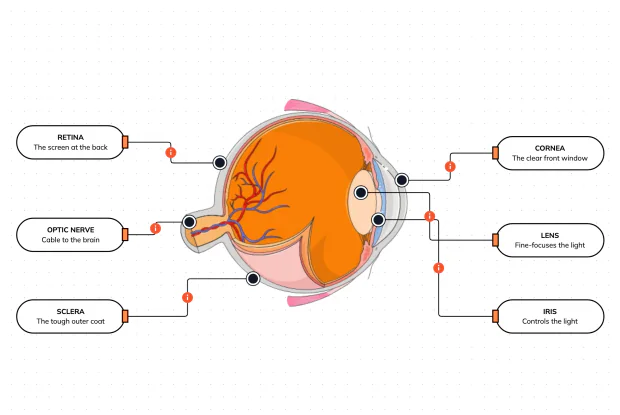
Your eye works like a living camera. Cut it open and label the cornea, lens, iris, retina, optic nerve and sclera, and follow light as it is focused onto a screen at the back of the eye and sent to the brain — in an interactive playground.