What Is Your Voice Box Made Of?
Root Concept
The larynx (voice box) is a frame of cartilage in the front of the neck. It hangs from the hyoid bone, its largest piece is the shield-shaped thyroid cartilage (the Adam's apple), below which sits the ring-shaped cricoid cartilage, and it continues downward as the cartilage rings of the trachea.
CodePLU Goal
Upgrading Human Mental Models
Learn how to think in Workflows

Concept Development By codeplu.com
The larynx frame from the front — the hyoid bone on top, the thyroid cartilage (Adam's apple), the cricoid ring below, and the trachea continuing down
What Is the Lump You Feel at the Front of Your Neck?
Press gently on the front of your neck and swallow. You will feel a firm lump move up and down — that is the front of your larynx, or voice box. The larynx is not made of bone; it is built from cartilage, the same tough but bendy material that shapes the tip of your nose and your ears. This frame of cartilage sits at the top of your windpipe and holds your airway open.
The frame has a few main pieces. At the very top is a small U-shaped bone, the hyoid bone, which the whole voice box hangs from. Below it, a stretchy sheet called a membrane connects to the largest piece: the thyroid cartilage, a broad shield of cartilage that juts forward as the bump known as the Adam's apple. Underneath that sits a complete ring of cartilage called the cricoid cartilage.
Below the cricoid, the same cartilage design continues as the rings of the trachea, the windpipe. So the larynx is really a stack of cartilage pieces, held together by membranes, keeping the airway open and housing the parts that make your voice. In the playground you will label the hyoid bone, the membrane, the thyroid and cricoid cartilages, and the trachea.
How Is the Voice Box Built?
Cartilage, not bone
The larynx is made almost entirely of cartilage — the firm, rubbery material you can feel in your nose and ears — rather than hard bone. This choice matters. Cartilage is strong enough to hold the airway permanently open, so the tube never collapses shut as air rushes in and out, yet it is flexible enough to move and flex as you swallow, speak and turn your head. If the voice box were solid bone it would be stiff and fragile; if it were soft flesh it would flop closed. Cartilage is the perfect in-between. The one true bone in the region is the little hyoid at the top, which acts as an anchor. Everything else — the shield, the ring, the windpipe rings below — is springy cartilage doing the job of keeping your airway open.
The main pieces, top to bottom
From the top down, the frame stacks up neatly. First is the hyoid bone, a small U-shaped bone that the larynx hangs from, connected by muscles to the jaw and tongue. Below it, a stretchy sheet called the thyrohyoid membrane bridges the gap to the next piece. That next piece is the thyroid cartilage, the largest part of the larynx: a broad shield of cartilage, angled forward, whose front point you feel as the Adam's apple. Directly beneath the thyroid cartilage is the cricoid cartilage, the only piece shaped as a complete ring all the way round — it forms the solid base of the voice box. And below the cricoid, the airway continues as the trachea, built from a stack of C-shaped cartilage rings that carry air down toward the lungs.
What the frame is for
This cartilage frame does two big jobs at once. First, it keeps the airway open: stacked, springy cartilage means the passage for air stays reliably propped open from your throat all the way down the windpipe, no matter how hard you breathe. Second, it houses and protects the delicate parts that make your voice — the vocal cords are stretched across the inside of the thyroid cartilage, sheltered within this sturdy shield. So the voice box is both a support and a container: it holds your airway open for breathing and, at the same time, forms the protective case around the sound-making machinery inside. How those inner parts actually make sound is the story of a separate tutorial; here, the focus is the frame that holds it all.
Real World Example
Where You Notice Your Voice Box's Frame
The larynx frame is not hidden away — you meet it every day. Here are three:
Feeling your Adam's apple
The thyroid cartilage juts out at the front
Put a finger on the front of your neck and you can feel a firm ridge, sometimes a clear bump — that is the front edge of your thyroid cartilage, the shield-shaped piece of the larynx, and its nickname is the Adam's apple. Swallow, and you will feel the whole voice box glide upward and then back down, because it is hung from the hyoid bone by muscles that lift it during swallowing. This simple self-check lets you feel two parts of this tutorial at once: the thyroid cartilage under your finger and the movement that shows how the larynx hangs from above. It is one of the few internal organs you can locate just by touch.
Why voices deepen at puberty
The thyroid cartilage grows, especially in boys
During puberty, the larynx grows, and in many boys the thyroid cartilage enlarges and tilts forward more sharply — which is why the Adam's apple often becomes more noticeable in teenage boys. As the voice box gets bigger, the vocal cords inside it grow longer and thicker, and longer cords vibrate more slowly, producing a deeper voice. This is the reason voices 'break' and drop during the teenage years. So the change you can see on the outside — a more prominent Adam's apple — and the change you hear — a deeper voice — are two sides of the same event: the cartilage frame of the voice box growing larger.
The ring that holds the airway
The cricoid cartilage is a complete circle
Most of the airway's cartilage is C-shaped — open at the back — but the cricoid cartilage is special: it is the one piece that forms a complete ring all the way around. This makes it the strongest, most stable part of the voice box, a solid foundation the rest is built on. Its complete-ring strength is so reliable that in medical emergencies, when someone cannot breathe, it is a known landmark that rescuers use. You do not need to know the medical details, but the idea is worth keeping: among all the springy, open cartilages of the airway, the cricoid is the sturdy closed ring that anchors the whole voice box and keeps the airway dependably open.
FAQs
Final Words
Your voice box is a frame of cartilage, not bone, stacked in the front of your neck. It hangs from the little hyoid bone, its largest piece is the shield-shaped thyroid cartilage you feel as the Adam's apple, and below that sits the complete ring of the cricoid cartilage, before the airway continues as the cartilage rings of the trachea. Cartilage is the perfect material: strong enough to hold the airway open, flexible enough to move as you breathe and swallow.
This frame both keeps your airway open and forms a protective case around the parts that make your voice. You can feel it for yourself — the Adam's apple under your finger, the whole box gliding up as you swallow — and see it change as voices deepen at puberty. Inside this sturdy frame sit the vocal cords, and how they turn moving air into sound is the next story.
Continue This Track
This concept is part 54 of The Human Body, Head to Toe.
What Is a Bone Made Of?
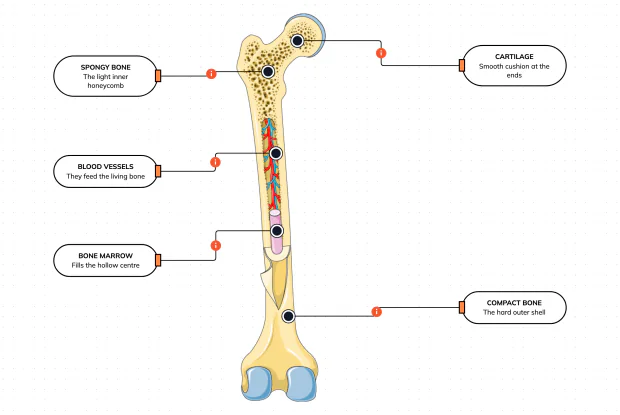
Cut a bone open and it is nowhere near solid: a hard outer shell, a light honeycomb inside, a hollow centre full of marrow, blood vessels threading through, and a smooth cushion at each end. Learn what each part does — then label them yourself in an interactive playground.
What Is Inside Your Elbow Joint?
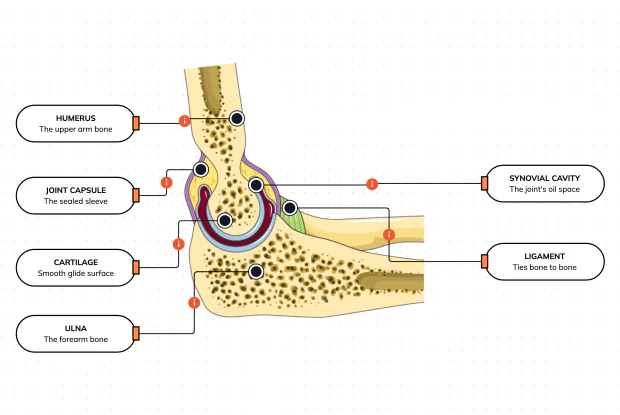
A joint is where two bones meet and move — and it is far more than just the bones. Cut open the elbow and you find smooth cartilage caps, a sealed capsule of slippery fluid, and tough ligaments holding it all together. Learn what each part does, then label them yourself in an interactive playground.
What Makes Your Elbow Bend?
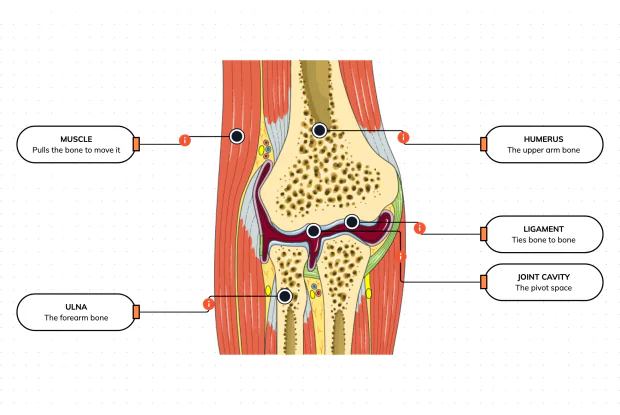
Bones and joints are just the hardware; nothing moves until a muscle pulls. Label the elbow to see the parts that turn a joint into movement — the muscle that pulls, the ligament that holds bone to bone, the two bones it links, and the space they pivot in — then build it yourself in an interactive playground.
What Holds Your Elbow Together?
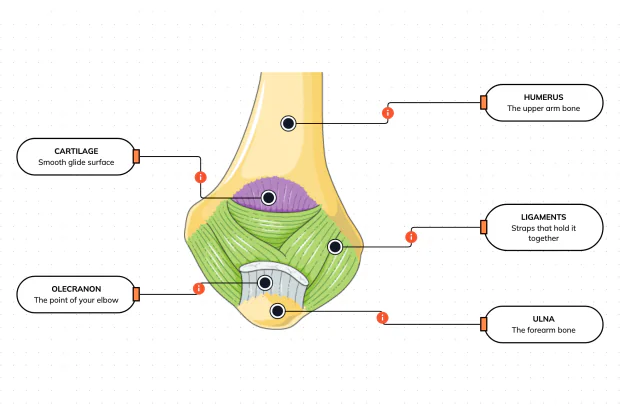
Your elbow is pulled on all day — by gravity, by every bag you carry, by every time you hang or push. So what stops the two bones from simply coming apart? Look at the back of the elbow and label the ligaments, the bony point, the cartilage and the two bones — and learn what holds the whole joint together.
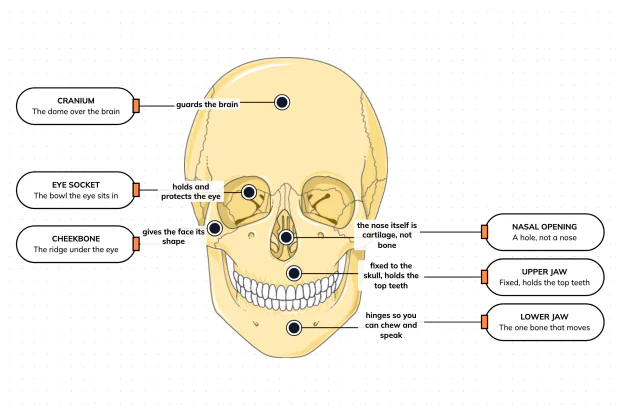
What Are the Main Bones of the Skull?
The skull looks like a single bone, but it is really about twenty-two locked together — with just one left free to move. Learn what each main part does, then label a skull yourself in an interactive playground.
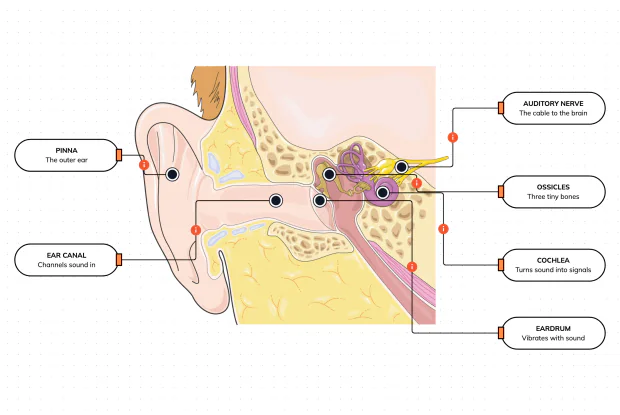
What Are the Parts of Your Ear?
Hearing is a chain of parts passing a sound along, each handing it to the next. Label the pinna, ear canal, eardrum, ossicles, cochlea and auditory nerve, and follow a sound all the way from the air outside to a signal your brain can read — in an interactive playground.
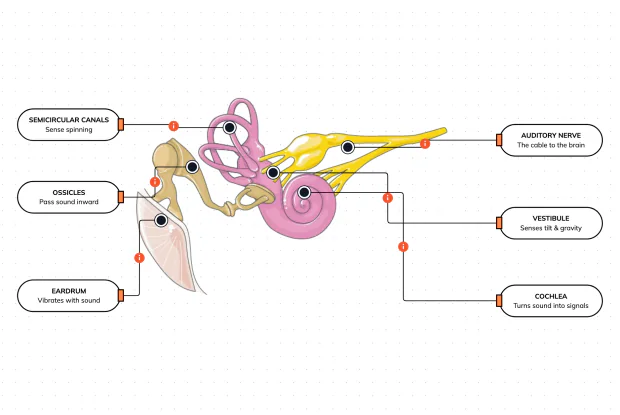
How Does Your Ear Keep You Balanced?
Your ear does a second, hidden job: balance. Inside it sit fluid-filled loops that sense spinning and a chamber that senses tilt and gravity. Label the semicircular canals, vestibule, cochlea, ossicles, eardrum and nerve, and learn how one organ both hears and keeps you upright — in an interactive playground.
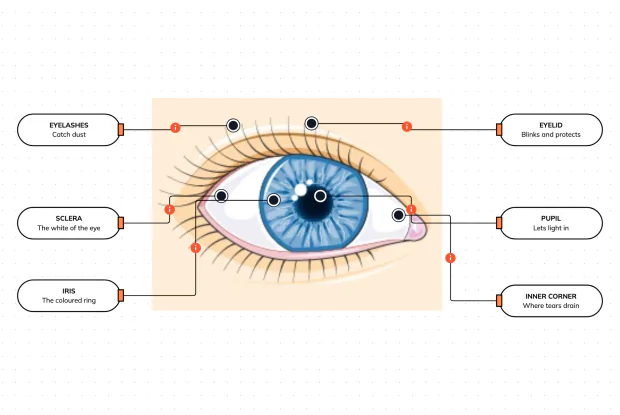
What Are the Parts of the Eye You Can See?
Before you look inside the eye, learn the parts you can already see in a mirror. Label the pupil, iris, sclera, eyelid, eyelashes and the tear-duct corner, and learn what each visible part does to let in light and protect the eye — in an interactive playground.
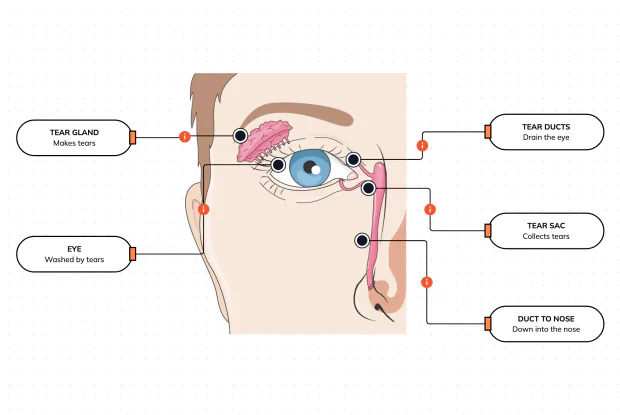
Where Do Your Tears Come From and Go?
Your eyes make and drain tears all day to stay clean and wet. Label the tear gland, the eye, the tear ducts, the tear sac and the duct to the nose, and follow a tear from where it is made to where it drains — in an interactive playground.
How Does Your Eye Turn Light Into a Picture?
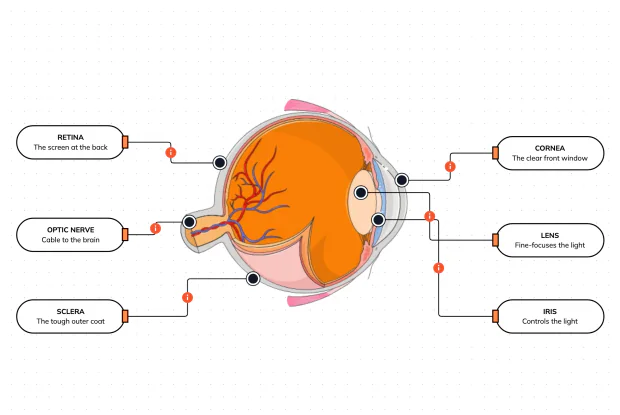
Your eye works like a living camera. Cut it open and label the cornea, lens, iris, retina, optic nerve and sclera, and follow light as it is focused onto a screen at the back of the eye and sent to the brain — in an interactive playground.