How Does Your Voice Box Make Sound?
Root Concept
Sound is made in the larynx when air from the lungs passes between two folds called the vocal cords, making them vibrate. Above them sit the vestibular folds (false cords); the epiglottis guards the airway opening from above; and below, the passage continues down the trachea to the lungs.
CodePLU Goal
Upgrading Human Mental Models
Learn how to think in Workflows

Concept Development By codeplu.com
Inside the voice box — the vocal cords that vibrate to make sound, the vestibular folds above, the epiglottis guarding the top, and the airway leading down to the trachea
Where Does Your Voice Actually Come From?
When you speak, sing or shout, the sound is made in one small place: inside your larynx, or voice box, in your neck. The larynx is not just a tube for air to pass through — stretched across the inside of it are two small folds called the vocal cords, and they are the source of your voice. Cut the voice box open and you can see them, along with the passage air takes on its way to the lungs.
Making sound works like this. When you breathe quietly, the vocal cords are held apart so air slips through silently. But when you want to speak, muscles pull the cords close together, leaving only a narrow slit. Air pushed up from your lungs then forces its way through that slit and makes the cords vibrate very fast — and that vibration is sound, your voice.
Around the cords are a few other parts you can label: the vestibular folds, a pair of 'false cords' just above the real ones; the epiglottis, a flap at the very top that folds down to keep food out of the airway; the open airway itself; and the trachea leading down to the lungs. In the playground you will label all five and see how a puff of air becomes a voice.
How Does the Voice Box Make Sound?
The vocal cords: where sound is made
The stars of the voice box are the vocal cords — two small folds of tissue stretched across the inside of the larynx, side by side, with a gap between them. Sound is made when air from the lungs is pushed up through that gap and sets the cords vibrating, very fast, many times a second. That rapid vibration ripples the air into the sound waves we hear as a voice. The clever part is that you can change the sound by changing the cords: tightening and stretching them makes them vibrate faster, giving a higher pitch, while loosening them lowers the pitch. Push more air and the sound gets louder. So from two little vibrating folds you get the whole range of your voice — high or low, loud or soft — all controlled by tiny muscles adjusting the cords.
The parts around the cords
The vocal cords do not sit alone. Just above them is a second pair of folds called the vestibular folds, often nicknamed the 'false cords' because they look similar but do not usually make sound — they help protect the real cords below. Above everything, at the very top of the voice box, is the epiglottis, a leaf-shaped flap that stands up out of the way when you breathe but folds down over the airway when you swallow, steering food and drink toward the stomach instead of the lungs. Running through the middle of it all is the airway, the open passage air travels along. So the larynx is a small, busy space: an open airway for breathing, a set of folds that make and shield the voice, and a flap on top that keeps food out.
Breathing versus speaking
The same voice box does two different jobs, and it switches between them constantly. When you are just breathing, the vocal cords are relaxed and held wide apart, so air flows in and out silently through the open airway — no vibration, no sound. When you decide to speak, muscles quickly draw the cords together across the airway, so the passing air has to squeeze through and makes them buzz. The instant you stop speaking, the cords part again for quiet breathing. Below the cords, the airway continues down the trachea to the lungs, which supply the puff of air that powers the whole thing — you cannot make a normal voice without breathing out. That is why you run out of voice when you run out of breath: your lungs are the bellows, and the vocal cords are the reeds that turn that moving air into sound.
Real World Example
Your Vocal Cords in Action
Once you know what the vocal cords do, everyday voice moments make sense. Here are three:
High notes and low notes
Tighter cords vibrate faster for a higher pitch
When a singer slides from a low note up to a high one, they are changing their vocal cords. To sing higher, tiny muscles stretch and tighten the cords so they vibrate faster, and faster vibration means a higher pitch; to go lower, the cords loosen and vibrate more slowly. It is exactly like a guitar string: tighten it and the note rises. This is also why adult men usually have deeper voices than children — their vocal cords are longer and thicker, so they vibrate more slowly. Every time you speak with expression, raising your voice in a question or dropping it at the end of a sentence, you are making these fast, delicate adjustments to your cords without even thinking about it.
Whispering with no voice
Air without cord vibration makes a whisper
When you whisper, something interesting happens: you hold your vocal cords apart so they do not vibrate, and simply let air rush through the gap. Because the cords are not buzzing, there is no true voice — just the hiss of moving air shaped into words by your mouth and tongue. That is why a whisper carries no pitch and cannot be sung, and why whispering can be quieter and more private than speaking. It is a neat proof of what the vocal cords do: switch off their vibration and your voice disappears, leaving only breath. Speaking and whispering use the same airway and the same mouth, but only speaking sets the cords vibrating.
Losing your voice
Swollen vocal cords cannot vibrate properly
After a cold, or a night of shouting at a concert, your voice can go hoarse or vanish altogether — a condition called laryngitis. It happens because the vocal cords become swollen and irritated, and swollen cords cannot come together cleanly or vibrate freely, so the sound comes out croaky, weak, or not at all. Resting your voice lets the swelling settle and the cords recover. This everyday experience points straight at the anatomy: your voice depends on two small folds being healthy enough to vibrate, and when they are inflamed, the whole instrument goes out of action. Look after them, especially by not shouting for too long, and they will keep working for a lifetime.
FAQs
Final Words
Your voice is made inside the larynx, where two small folds called the vocal cords vibrate as air from the lungs is pushed between them. Tightening the cords raises the pitch and loosening them lowers it, while more air makes the sound louder. Around them sit the vestibular folds (the 'false cords'), the epiglottis that folds down to keep food out of the airway, and the open airway leading down the trachea to the lungs.
So the voice box is one small space doing two jobs — an open airway for breathing and a sound-maker for speaking — switching between them every time you talk. You hear the vocal cords at work in every high note, every whisper, and every hoarse morning after shouting. Together with the cartilage frame that houses them, they turn a simple puff of breath into the whole range of the human voice.
Continue This Track
This concept is part 55 of The Human Body, Head to Toe.
What Is a Bone Made Of?
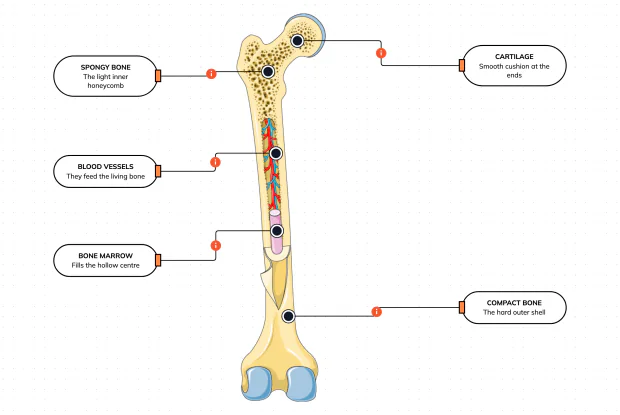
Cut a bone open and it is nowhere near solid: a hard outer shell, a light honeycomb inside, a hollow centre full of marrow, blood vessels threading through, and a smooth cushion at each end. Learn what each part does — then label them yourself in an interactive playground.
What Is Inside Your Elbow Joint?
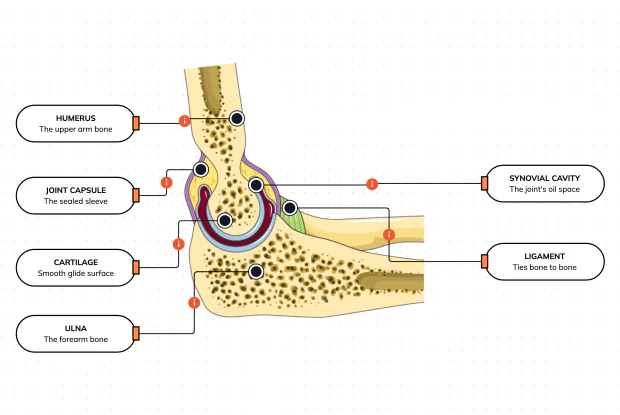
A joint is where two bones meet and move — and it is far more than just the bones. Cut open the elbow and you find smooth cartilage caps, a sealed capsule of slippery fluid, and tough ligaments holding it all together. Learn what each part does, then label them yourself in an interactive playground.
What Makes Your Elbow Bend?
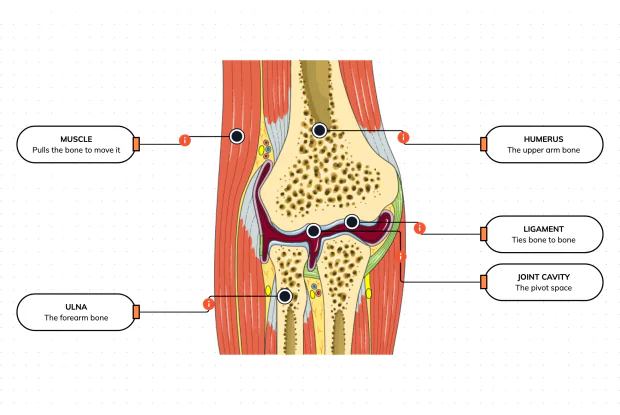
Bones and joints are just the hardware; nothing moves until a muscle pulls. Label the elbow to see the parts that turn a joint into movement — the muscle that pulls, the ligament that holds bone to bone, the two bones it links, and the space they pivot in — then build it yourself in an interactive playground.
What Holds Your Elbow Together?
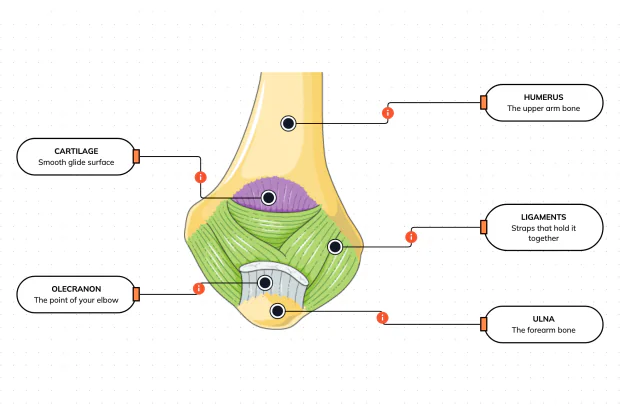
Your elbow is pulled on all day — by gravity, by every bag you carry, by every time you hang or push. So what stops the two bones from simply coming apart? Look at the back of the elbow and label the ligaments, the bony point, the cartilage and the two bones — and learn what holds the whole joint together.
What Are the Main Bones of the Skull?
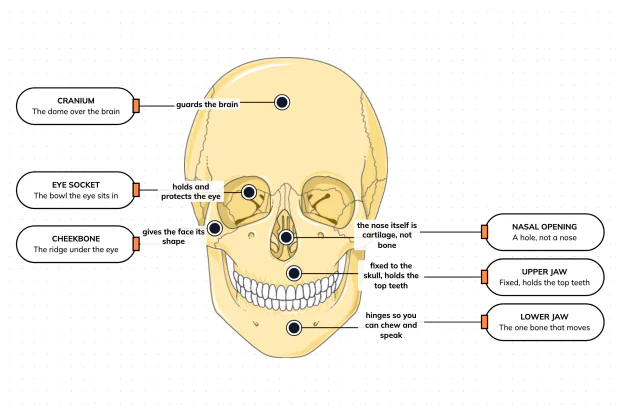
The skull looks like a single bone, but it is really about twenty-two locked together — with just one left free to move. Learn what each main part does, then label a skull yourself in an interactive playground.
What Are the Parts of Your Ear?
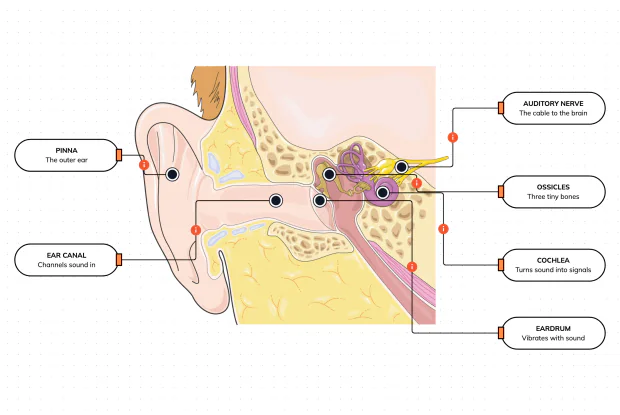
Hearing is a chain of parts passing a sound along, each handing it to the next. Label the pinna, ear canal, eardrum, ossicles, cochlea and auditory nerve, and follow a sound all the way from the air outside to a signal your brain can read — in an interactive playground.
How Does Your Ear Keep You Balanced?
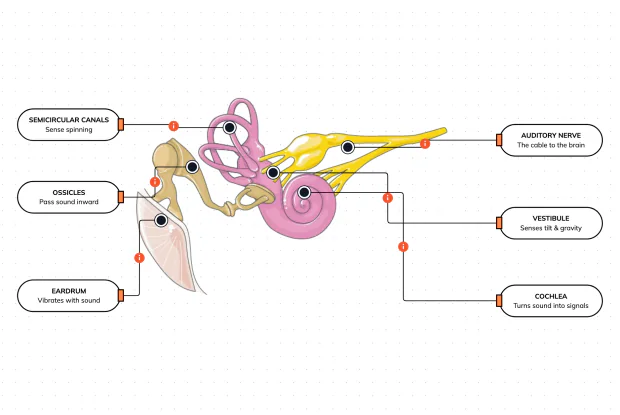
Your ear does a second, hidden job: balance. Inside it sit fluid-filled loops that sense spinning and a chamber that senses tilt and gravity. Label the semicircular canals, vestibule, cochlea, ossicles, eardrum and nerve, and learn how one organ both hears and keeps you upright — in an interactive playground.
What Are the Parts of the Eye You Can See?
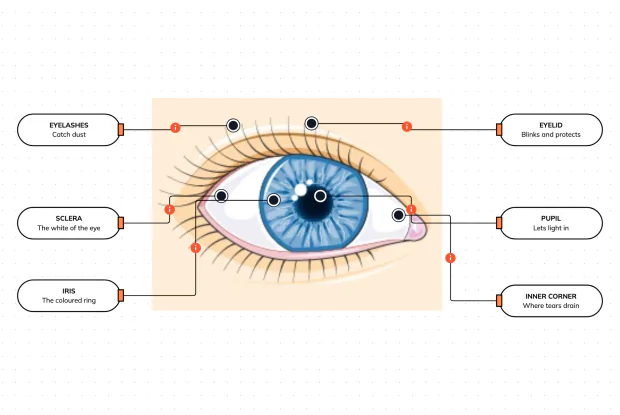
Before you look inside the eye, learn the parts you can already see in a mirror. Label the pupil, iris, sclera, eyelid, eyelashes and the tear-duct corner, and learn what each visible part does to let in light and protect the eye — in an interactive playground.
Where Do Your Tears Come From and Go?
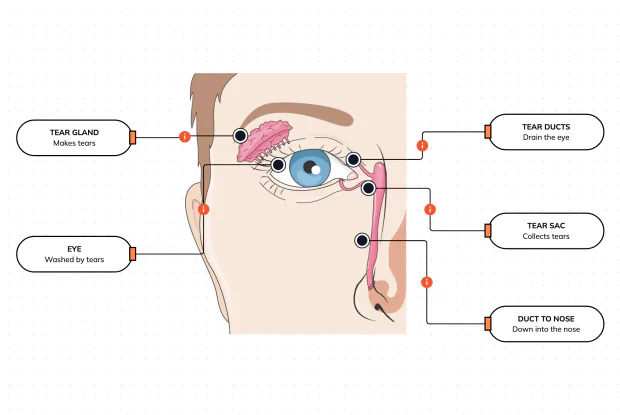
Your eyes make and drain tears all day to stay clean and wet. Label the tear gland, the eye, the tear ducts, the tear sac and the duct to the nose, and follow a tear from where it is made to where it drains — in an interactive playground.
How Does Your Eye Turn Light Into a Picture?
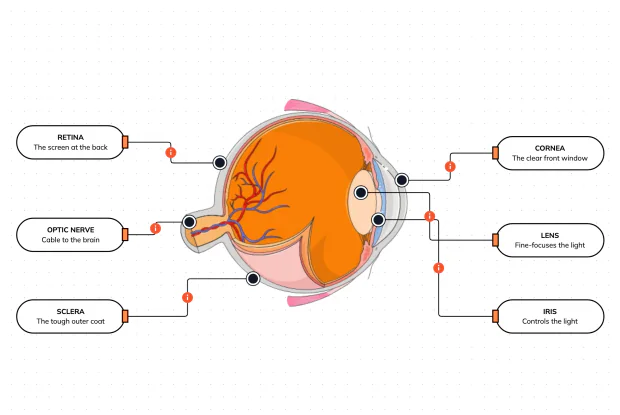
Your eye works like a living camera. Cut it open and label the cornea, lens, iris, retina, optic nerve and sclera, and follow light as it is focused onto a screen at the back of the eye and sent to the brain — in an interactive playground.