What Are the Parts of Your Large Intestine?
Root Concept
The large intestine (colon) is the final part of the gut, framing the belly. Leftovers from the small intestine enter the cecum (which bears the appendix), then travel up the ascending colon, across the transverse colon, down the descending colon, and through the S-shaped sigmoid colon to the rectum. Along the way it absorbs water, houses gut bacteria and forms waste.
CodePLU Goal
Upgrading Human Mental Models
Learn how to think in Workflows

Concept Development By codeplu.com
The large intestine, each part joined to the job it does — following the leftovers around the loop from cecum to sigmoid colon
What Happens to Food After the Small Intestine Is Done With It?
By the time the small intestine has finished, almost all the useful nutrients are gone — what is left is a watery slurry of the parts your body could not digest, mostly fibre and water. The job of the large intestine, or colon, is to deal with these leftovers: to reclaim the water your body should not waste, to pack what remains into solid waste, and to store it until you are ready to pass it. It is the final stretch of the digestive tube, and it is built quite differently from the busy, absorbing small intestine.
Its most striking feature is its shape and position: the large intestine forms a big frame around the outside of the belly, with the coiled small intestine sitting inside the loop. The leftovers enter at the lower right, into a pouch called the cecum (which carries the little dangling appendix). From there the colon climbs up the right side of the belly (the ascending colon), crosses over the top from right to left (the transverse colon), and runs down the left side (the descending colon).
Near the bottom it curves through an S-shaped bend, the sigmoid colon, which leads down to the rectum, where waste is stored before it leaves the body. Along this whole journey, water is steadily absorbed back into the body and trillions of helpful bacteria feed on the remnants. In the playground above you will label the cecum, appendix, and the ascending, transverse, descending and sigmoid colon — and the label on each connection tells you the job that part does.
What Are the Parts of the Large Intestine?
What does the large intestine do?
The large intestine has three main jobs, and none of them is absorbing nutrients — that was finished in the small intestine. First, it reclaims water: the leftovers arrive as a watery slurry, and the colon absorbs most of that water back into the body, which is why healthy stool is solid rather than liquid. Second, it forms and stores waste: what remains after the water is removed is packed into solid faeces and held in the last part until it is convenient to pass. Third, it is home to trillions of helpful bacteria — your 'gut flora' — which feed on the fibre your body cannot digest and, in return, make some vitamins and keep the gut healthy. So the colon is a water-recovery plant, a waste-packer and a bacterial garden, all in one long frame around the belly.
What are the cecum and appendix?
The cecum is the pouch at the very start of the large intestine, in the lower-right of the belly, where the small intestine empties its leftovers in. It is a blind-ended bag — a kind of collecting pocket at the beginning of the colon. Hanging off the cecum is the appendix, a small, thin, finger-like or worm-shaped tail. For a long time the appendix was thought to be useless, a leftover of evolution, but it is now believed to act as a small safe-house for helpful gut bacteria, from which they can repopulate the colon after an illness. The appendix is famous mostly for going wrong: if it gets blocked and infected, it swells painfully — appendicitis — and may need to be removed in an emergency operation before it bursts.
What are the ascending, transverse and descending colon?
These three are the main frame of the large intestine, named simply for the direction they run. The ascending colon is the first stretch, climbing straight up the right side of your belly from the cecum. At the top it turns and becomes the transverse colon, which crosses the belly horizontally from your right side to your left, just under the stomach and liver. On the left it turns downward again into the descending colon, running down the left side of your belly. Together they trace three sides of a square frame — up, across, and down — with the small intestine coiled inside. As the leftovers travel this route, more and more water is absorbed, so the contents gradually change from a watery slurry near the cecum to a more solid mass by the descending colon.
What is the sigmoid colon?
At the bottom of the descending colon, the large intestine makes an S-shaped bend called the sigmoid colon — 'sigmoid' means S-shaped. This short, curving stretch is the last part of the colon before the rectum, and it acts partly as a holding area: by this point the waste is solid, and the sigmoid colon stores it and delivers it into the rectum when it is time to go. Its S-curve lets it fit into the lower-left of the pelvis and connect the descending colon down to the midline where the rectum sits. Because it holds solid waste and is quite narrow and curved, the sigmoid colon is a common site for problems like diverticular disease (small pouches forming in the wall) — but its everyday job is simply to be the final bend that leads waste to the exit.
Why is it called 'large' if the small intestine is longer?
It seems backwards: the small intestine is about seven metres long, while the large intestine is only about one and a half — so why is one 'small' and the other 'large'? The names refer to width, not length. The large intestine is a wider tube (roughly twice the diameter of the small intestine), even though it is much shorter. It does not need to be long, because it is not doing the fine, slow work of absorbing nutrients across a huge surface — that job needs length and folds and villi. The colon's jobs (removing water, forming waste, housing bacteria) suit a shorter, wider, simpler tube. So 'small' and 'large' describe the calibre of the two tubes, and the large intestine earns its name by being the fat, wide frame around the slim, coiled small intestine.
Real World Example
Why Do You Get Diarrhoea, Constipation — and Appendicitis?
Once you know the colon absorbs water, forms waste and shelters bacteria, several familiar things fall into place:
The water-recovery plant
The colon and its water absorption
The colon's main daily job is to reclaim water from the leftovers, and getting that balance wrong explains two very common complaints. If the contents pass through too fast — because of an infection or irritation — the colon has no time to absorb the water, so the waste leaves as a liquid: that is diarrhoea. If instead the contents move too slowly, the colon keeps absorbing water for too long, and the waste becomes hard, dry and difficult to pass: that is constipation. Healthy stool is the result of just the right amount of water being reclaimed over just the right time. This is also why diarrhoea can be dangerous, especially in young children: losing all that unrecovered water and salts can lead to dehydration, which is why rehydration is the key treatment.
A home for trillions of bacteria
The gut bacteria in the colon
The large intestine is the most densely populated place in your whole body — home to trillions of bacteria, your gut microbiome, far outnumbering all the leftovers they live among. Far from being harmful, these bacteria are essential lodgers: they feed on the fibre your own body cannot digest, and in return they produce certain vitamins, help train your immune system, and crowd out dangerous germs. This is why fibre matters in your diet even though you cannot digest it — it is food for your gut bacteria, not for you directly. It is also why a course of antibiotics can upset your digestion: the drugs kill helpful colon bacteria along with the harmful ones, and it takes time for the garden to regrow (which is where the appendix's bacterial safe-house may help).
The appendix and appendicitis
The appendix
The little appendix hanging off the cecum is famous for one reason: appendicitis. The appendix is a narrow, dead-ended tube, and that shape is its weakness — if its opening gets blocked (by a small hard lump of stool, or swelling), bacteria multiply inside the trapped space, and it becomes infected and inflamed. It swells, and causes pain that classically starts near the belly button and then settles in the lower-right of the abdomen, right over the cecum. This is appendicitis, and it is a medical emergency, because a swollen appendix can burst and spread infection through the belly. The usual treatment is to remove it surgically — and, tellingly, people live perfectly well without an appendix, which is why it was long thought to be useless. Its likely role as a bacterial safe-house is a modern rethink of that old idea.
FAQs
Final Words
The large intestine is the gut's final stretch — a wide tube that frames the belly and deals with the leftovers. The small intestine empties into the cecum (with its dangling appendix); from there the colon climbs the ascending colon, crosses the transverse colon, runs down the descending colon, and bends through the S-shaped sigmoid colon to the rectum. Along the way it reclaims water so waste becomes solid, forms and stores that waste, and shelters the trillions of bacteria that make up your gut microbiome.
Knowing its parts explains everyday life — why diarrhoea and constipation are both about water, why fibre feeds your gut bacteria, and why the little appendix can cause a sudden emergency. It is called 'large' for its width, not its length: the fat frame around the slim, coiled small intestine. The very end of the journey — the rectum, where waste is stored and released — is the last stop on the tour of the digestive tract.
Continue This Track
This concept is part 39 of The Human Body, Head to Toe.
What Is a Bone Made Of?
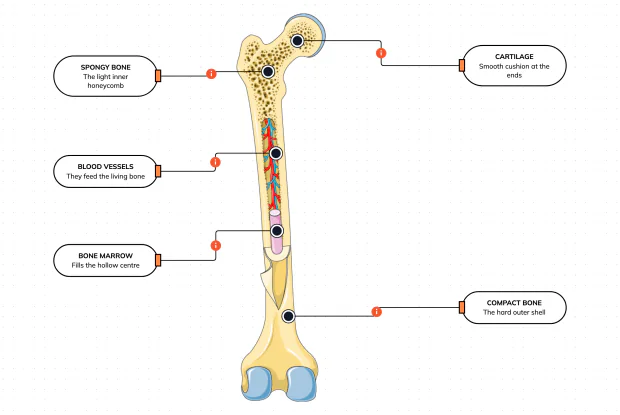
Cut a bone open and it is nowhere near solid: a hard outer shell, a light honeycomb inside, a hollow centre full of marrow, blood vessels threading through, and a smooth cushion at each end. Learn what each part does — then label them yourself in an interactive playground.
What Is Inside Your Elbow Joint?
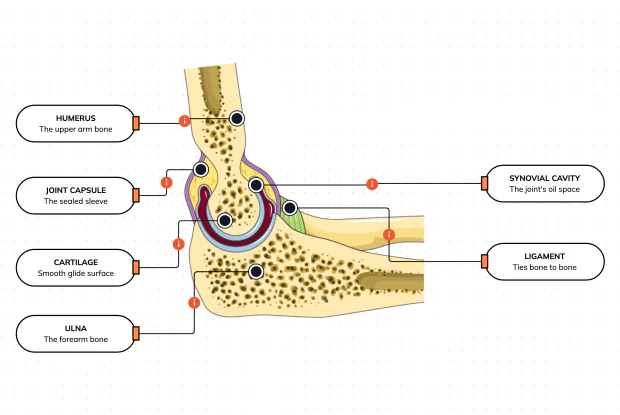
A joint is where two bones meet and move — and it is far more than just the bones. Cut open the elbow and you find smooth cartilage caps, a sealed capsule of slippery fluid, and tough ligaments holding it all together. Learn what each part does, then label them yourself in an interactive playground.
What Makes Your Elbow Bend?
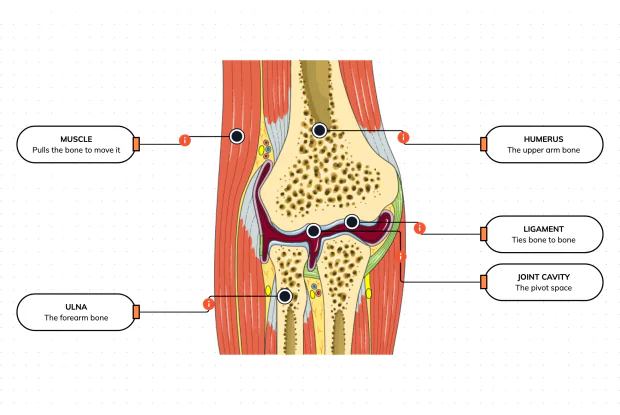
Bones and joints are just the hardware; nothing moves until a muscle pulls. Label the elbow to see the parts that turn a joint into movement — the muscle that pulls, the ligament that holds bone to bone, the two bones it links, and the space they pivot in — then build it yourself in an interactive playground.
What Holds Your Elbow Together?
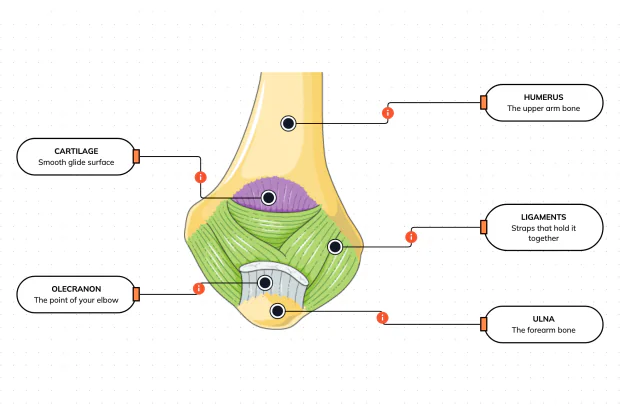
Your elbow is pulled on all day — by gravity, by every bag you carry, by every time you hang or push. So what stops the two bones from simply coming apart? Look at the back of the elbow and label the ligaments, the bony point, the cartilage and the two bones — and learn what holds the whole joint together.
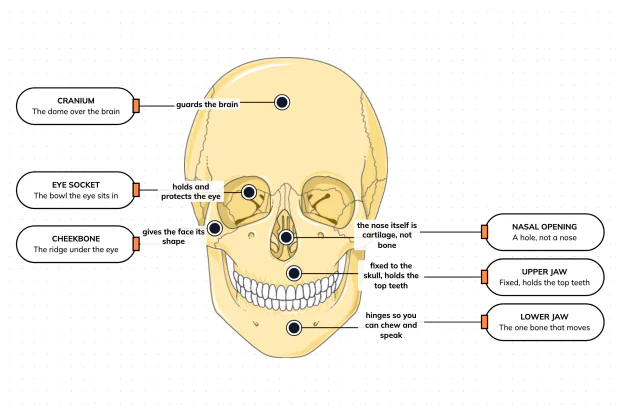
What Are the Main Bones of the Skull?
The skull looks like a single bone, but it is really about twenty-two locked together — with just one left free to move. Learn what each main part does, then label a skull yourself in an interactive playground.
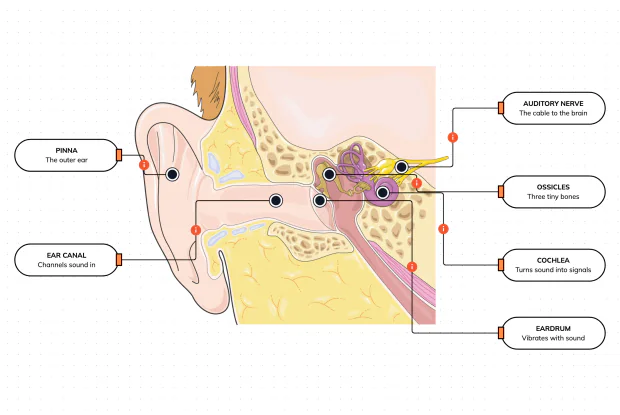
What Are the Parts of Your Ear?
Hearing is a chain of parts passing a sound along, each handing it to the next. Label the pinna, ear canal, eardrum, ossicles, cochlea and auditory nerve, and follow a sound all the way from the air outside to a signal your brain can read — in an interactive playground.
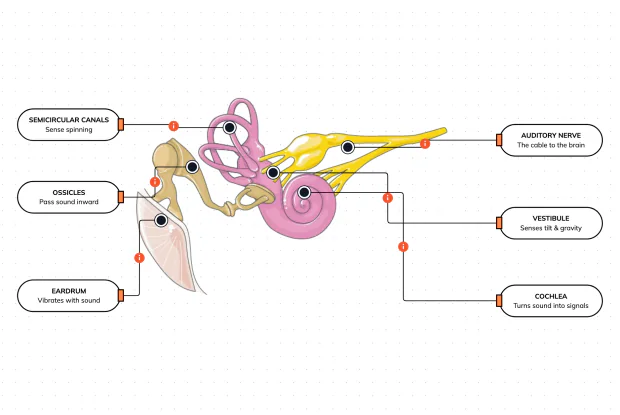
How Does Your Ear Keep You Balanced?
Your ear does a second, hidden job: balance. Inside it sit fluid-filled loops that sense spinning and a chamber that senses tilt and gravity. Label the semicircular canals, vestibule, cochlea, ossicles, eardrum and nerve, and learn how one organ both hears and keeps you upright — in an interactive playground.
What Are the Parts of the Eye You Can See?
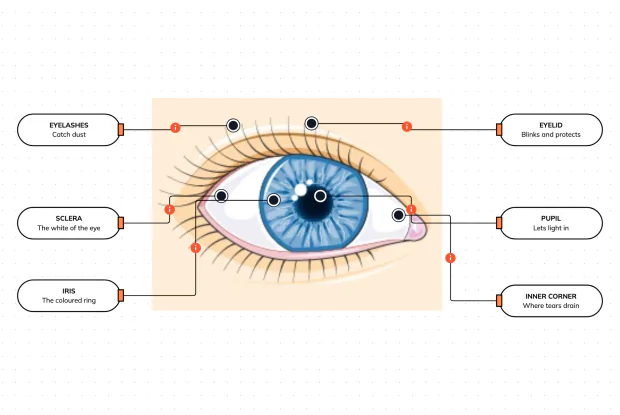
Before you look inside the eye, learn the parts you can already see in a mirror. Label the pupil, iris, sclera, eyelid, eyelashes and the tear-duct corner, and learn what each visible part does to let in light and protect the eye — in an interactive playground.
Where Do Your Tears Come From and Go?
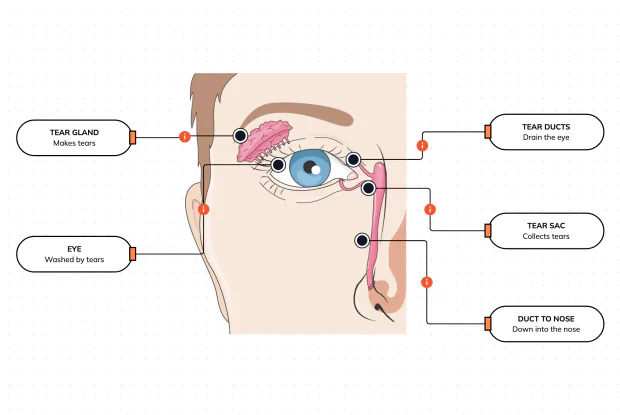
Your eyes make and drain tears all day to stay clean and wet. Label the tear gland, the eye, the tear ducts, the tear sac and the duct to the nose, and follow a tear from where it is made to where it drains — in an interactive playground.
How Does Your Eye Turn Light Into a Picture?
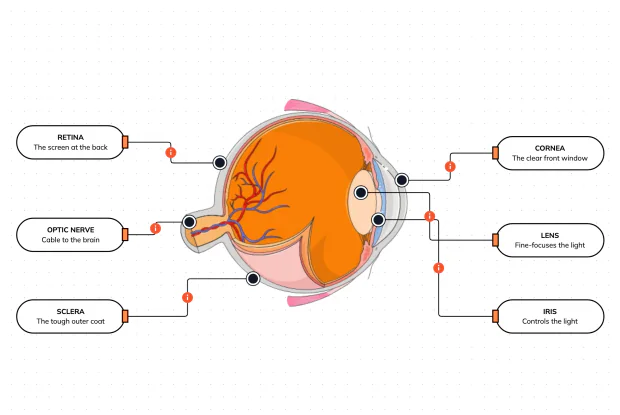
Your eye works like a living camera. Cut it open and label the cornea, lens, iris, retina, optic nerve and sclera, and follow light as it is focused onto a screen at the back of the eye and sent to the brain — in an interactive playground.