The Journey of an Egg
Root Concept
About once a month, one of the ovaries releases a mature egg from a tiny sac called a follicle. The egg is caught by the nearby fallopian tube and travels slowly along it toward the uterus. If it meets a sperm and is fertilised, it can settle into the thick uterus lining and begin to grow; if not, it passes on and the lining is shed.
CodePLU Goal
Upgrading Human Mental Models
Learn how to think in Workflows

Concept Development By codeplu.com
An egg's journey — released from a follicle in the ovary, travelling along the fallopian tube, toward the uterus lining where it may settle
What Happens After an Ovary Releases an Egg?
Roughly once a month, one of the two ovaries does something remarkable: it releases a single tiny egg. That release is called ovulation, and it is the start of a short journey the egg makes toward the uterus. Following that journey — from the ovary, along the tube, to the lining of the uterus — is the clearest way to understand the female reproductive system in action.
Inside the ovary, each egg grows and ripens within its own little fluid-filled sac called a follicle. When an egg is ready, its follicle opens and the egg pops out of the ovary. Waiting right beside the ovary is the opening of the fallopian tube, which gently sweeps the egg inside and begins carrying it slowly along.
The egg travels down the fallopian tube toward the uterus over a few days. If it meets a sperm along the way and is fertilised, it can reach the uterus and settle into its thick, prepared lining to begin growing into a baby. If it is not fertilised, it simply passes on and the lining is shed. In the playground you will label the ovary, a follicle, the fallopian tube, the travelling egg and the uterus lining.
How Does an Egg Travel to the Uterus?
It starts in the ovary
Every egg's journey begins in an ovary, the small oval organ that stores a female's eggs. The eggs are not just sitting loose inside — each one develops within its own tiny sac called a follicle, a fluid-filled bubble that protects and ripens the egg. At any time an ovary holds many follicles at different stages, but usually only one egg fully ripens each month. When that egg is mature, its follicle swells and then bursts open at the surface of the ovary, releasing the egg. This release is ovulation. So the ovary is both the storehouse and the launch pad: it keeps the eggs safe inside their follicles, ripens one at a time, and then lets it go on cue, about once every month.
Along the fallopian tube
The moment an egg leaves the ovary, it is caught by the fallopian tube, whose fringed opening lies right beside the ovary. Tiny hairs and gentle muscle movements inside the tube sweep the egg along, carrying it slowly toward the uterus over the next few days — the egg cannot swim or move on its own, so the tube does the moving for it. The fallopian tube is more than a corridor, though: it is usually the place where, if a sperm is present, the egg and sperm meet and the egg is fertilised. So the tube is both the pathway from ovary to uterus and the meeting point of egg and sperm. An egg spends the first, crucial days of its journey travelling gently down this narrow tube.
Arriving at the uterus lining
At the end of the tube lies the uterus, and by this time its inner surface — the lining — has been thickening for weeks, building up a soft, blood-rich cushion ready to nourish a new life. What happens next depends on the egg. If the egg was fertilised on its way down the tube, it can settle into that thick lining and burrow in, a step called implantation, and begin to grow into a baby. If the egg was not fertilised, it does not settle; instead it quietly passes on, and the unused lining is shed and rebuilt again for the next month. This monthly cycle — ripen an egg, release it, ready the lining, and either grow a baby or start over — is the rhythm of the whole system, and the egg's journey sits right at its heart.
Real World Example
Why the Egg's Journey Matters
Following one egg explains several things people hear about. Here are three:
The monthly cycle
Releasing an egg and rebuilding the lining repeats each month
The egg's journey is the engine of the roughly monthly cycle. Each month an ovary ripens and releases an egg, while the uterus lining thickens in preparation. If the egg is not fertilised, the lining is shed — this is a period — and the whole process begins again. So the familiar monthly rhythm is really the outward sign of one egg being released and one lining being prepared and then renewed. Understanding the journey of a single egg makes the cycle far less mysterious: it is simply this sequence, ovary to tube to uterus, repeating month after month from puberty onward.
Where pregnancy begins
Egg and sperm usually meet in the tube
A new pregnancy almost always begins inside a fallopian tube, not the uterus. As the released egg travels down the tube, that is usually where it may meet a sperm and be fertilised. Only afterward does the fertilised egg continue on to the uterus and settle into the lining. This is why the fallopian tube is so important: it is both the road the egg travels and the place fertilisation typically happens. It also explains why a blocked tube can make it hard to start a pregnancy — if the egg cannot travel down the tube, it cannot meet a sperm or reach the uterus. The tube is the true starting line of the journey to a baby.
How identical twins can happen
One fertilised egg can split into two
Sometimes a single fertilised egg, on its way to or shortly after reaching the uterus, splits into two — and each half grows into a baby. Because both babies came from the very same egg and sperm, they are identical twins, sharing the same genes. This is different from non-identical twins, which come from two separate eggs released and fertilised at the same time. Either way, twins trace right back to the egg's journey: whether one egg splits, or two eggs travel down the tubes together. Following the path of an egg from the ovary onward is what makes these everyday facts about twins suddenly make sense.
FAQs
Final Words
An egg's journey runs from the ovary, along the fallopian tube, to the lining of the uterus. It begins when an ovary releases a ripe egg from its follicle — ovulation — about once a month. The fallopian tube catches the egg and carries it slowly toward the uterus, and it is usually in the tube that a sperm may fertilise it. Reaching the uterus, a fertilised egg can settle into the thick lining and grow, while an unfertilised one passes on and the lining is shed.
This one journey is the heart of the whole system: it drives the monthly cycle, it is where every pregnancy begins, and it even explains how twins come about. Ovary to tube to uterus — a tiny egg making a few days' trip — is one of the most important journeys in the human body.
Continue This Track
This concept is part 61 of The Human Body, Head to Toe.
What Is a Bone Made Of?
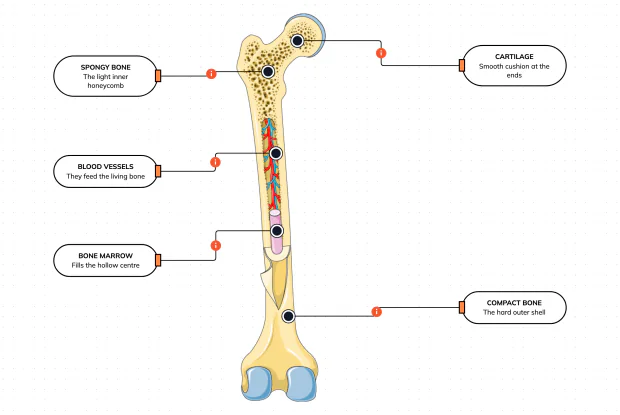
Cut a bone open and it is nowhere near solid: a hard outer shell, a light honeycomb inside, a hollow centre full of marrow, blood vessels threading through, and a smooth cushion at each end. Learn what each part does — then label them yourself in an interactive playground.
What Is Inside Your Elbow Joint?
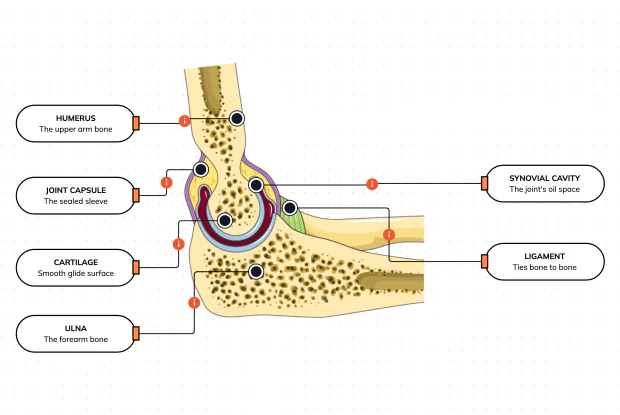
A joint is where two bones meet and move — and it is far more than just the bones. Cut open the elbow and you find smooth cartilage caps, a sealed capsule of slippery fluid, and tough ligaments holding it all together. Learn what each part does, then label them yourself in an interactive playground.
What Makes Your Elbow Bend?
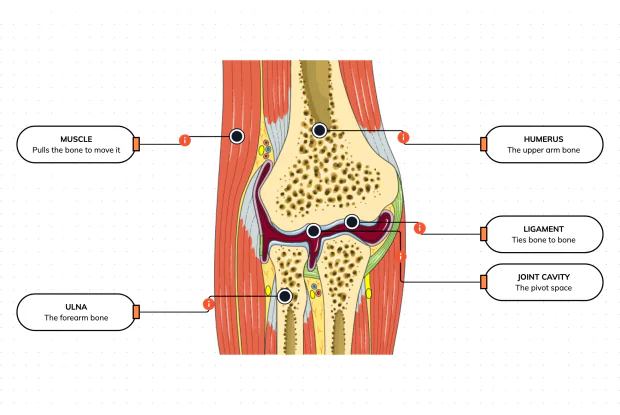
Bones and joints are just the hardware; nothing moves until a muscle pulls. Label the elbow to see the parts that turn a joint into movement — the muscle that pulls, the ligament that holds bone to bone, the two bones it links, and the space they pivot in — then build it yourself in an interactive playground.
What Holds Your Elbow Together?
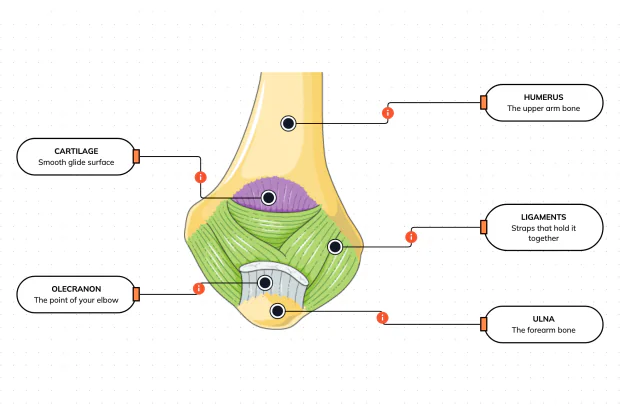
Your elbow is pulled on all day — by gravity, by every bag you carry, by every time you hang or push. So what stops the two bones from simply coming apart? Look at the back of the elbow and label the ligaments, the bony point, the cartilage and the two bones — and learn what holds the whole joint together.
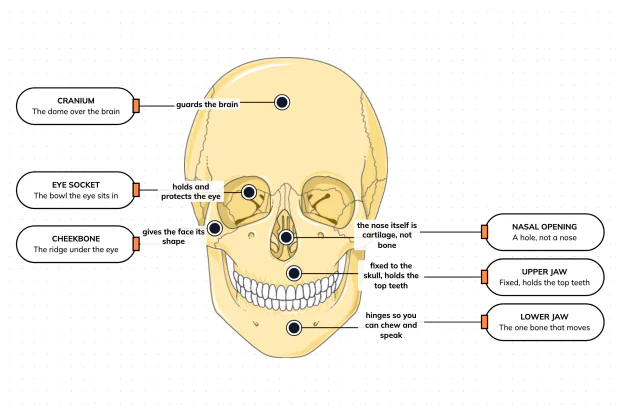
What Are the Main Bones of the Skull?
The skull looks like a single bone, but it is really about twenty-two locked together — with just one left free to move. Learn what each main part does, then label a skull yourself in an interactive playground.
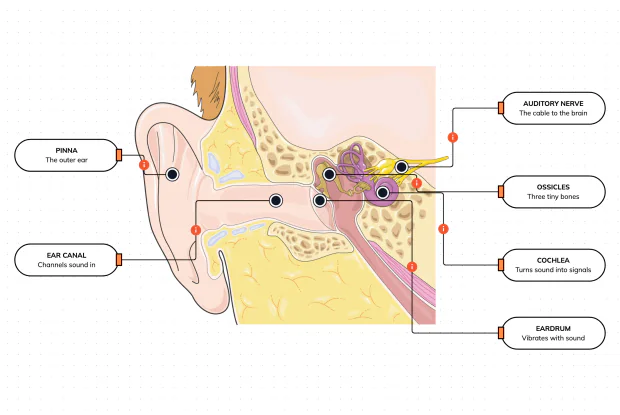
What Are the Parts of Your Ear?
Hearing is a chain of parts passing a sound along, each handing it to the next. Label the pinna, ear canal, eardrum, ossicles, cochlea and auditory nerve, and follow a sound all the way from the air outside to a signal your brain can read — in an interactive playground.
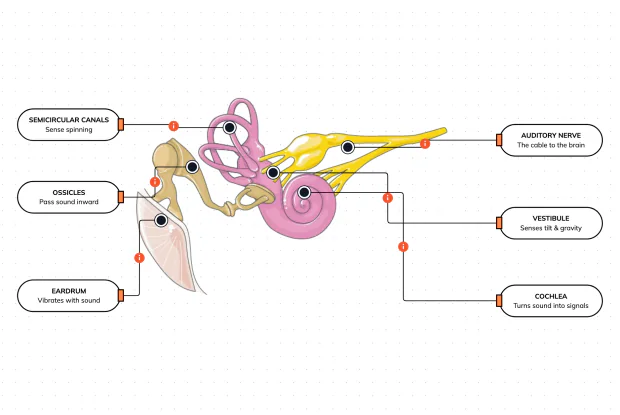
How Does Your Ear Keep You Balanced?
Your ear does a second, hidden job: balance. Inside it sit fluid-filled loops that sense spinning and a chamber that senses tilt and gravity. Label the semicircular canals, vestibule, cochlea, ossicles, eardrum and nerve, and learn how one organ both hears and keeps you upright — in an interactive playground.
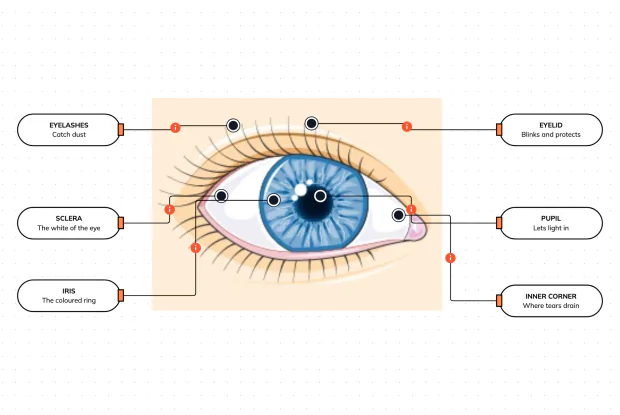
What Are the Parts of the Eye You Can See?
Before you look inside the eye, learn the parts you can already see in a mirror. Label the pupil, iris, sclera, eyelid, eyelashes and the tear-duct corner, and learn what each visible part does to let in light and protect the eye — in an interactive playground.
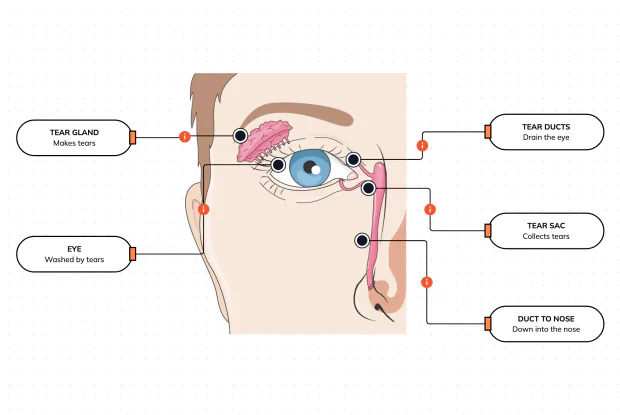
Where Do Your Tears Come From and Go?
Your eyes make and drain tears all day to stay clean and wet. Label the tear gland, the eye, the tear ducts, the tear sac and the duct to the nose, and follow a tear from where it is made to where it drains — in an interactive playground.
How Does Your Eye Turn Light Into a Picture?
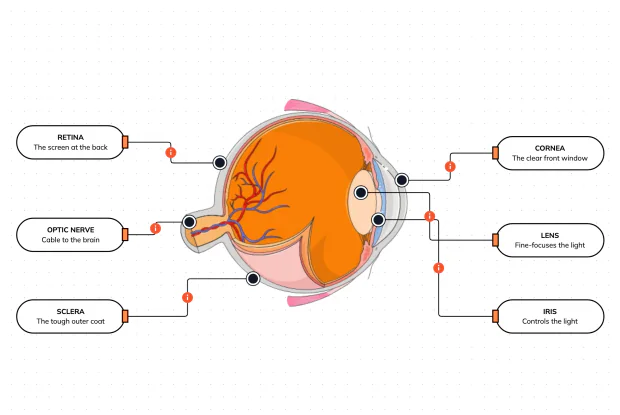
Your eye works like a living camera. Cut it open and label the cornea, lens, iris, retina, optic nerve and sclera, and follow light as it is focused onto a screen at the back of the eye and sent to the brain — in an interactive playground.