How Does Your Intestine Mix Your Food?
Root Concept
Segmentation is the intestine's mixing movement: rings of muscle in the wall contract at intervals, pinching the soupy food (chyme) into pockets, then relax as different rings contract, sloshing the food back and forth. This churns the chyme, mixing it with digestive juices and bringing it into contact with the absorbing wall — unlike peristalsis, which pushes food along.
CodePLU Goal
Upgrading Human Mental Models
Learn how to think in Workflows

Concept Development By codeplu.com
Segmentation in the intestine, each part joined to the job it does — pinching, bulging and churning the food to mix it thoroughly
Why Doesn't Food Just Slide Straight Through Your Intestine?
You might imagine the intestine as a slide that food slips down and out the other end. But if food simply slid straight through, most of it would leave undigested and unabsorbed — there would be no time for the juices to work or the wall to soak up nutrients. So the intestine does something cleverer: for much of the time it does not push food onward at all. Instead it churns it in place, mixing it thoroughly and holding it against the absorbing wall. That churning movement is called segmentation, and this figure captures it in the act.
Look at the shape of the tube. All along it, rings of muscle in the intestine wall have tightened and pinched inward, creating constrictions that squeeze the food into a row of separate pockets. Between those pinch points, the muscle is relaxed, so the tube bulges outward into relaxed sections that hold the trapped food. The soupy, part-digested food filling these pockets is called chyme.
Now imagine this happening over and over: the rings that are pinched relax, and new rings pinch in at what were the middles of the pockets — chopping and re-chopping the food at different points, so it is sloshed back and forth rather than moved along. That back-and-forth is what mixes the chyme with the digestive juices and keeps bringing fresh food into contact with the absorbing wall. In the playground above you will label the intestine wall, a constriction, a relaxed section and the chyme — and the label on each connection tells you the job that part does.
How Does Segmentation Work?
What is segmentation, and how is it different from peristalsis?
Segmentation is the intestine's mixing movement, and it is different from the pushing movement you may already know, peristalsis. Peristalsis is a travelling wave of squeezing that moves food along the tube, like squeezing toothpaste — it is one-directional and it transports. Segmentation does not travel: rings of muscle contract at intervals along a stretch of intestine, pinching it into pockets, then relax while different rings contract, so the food is sloshed back and forth on the spot without going anywhere much. If peristalsis is a conveyor belt moving food along, segmentation is a food processor churning it in place. The intestine uses both: mostly segmentation to mix and absorb, with occasional peristalsis to move the well-processed food onward. Segmentation is why a meal spends hours in the small intestine rather than passing straight through.
What is a constriction?
A constriction is a point where a ring of muscle in the intestine wall has contracted and squeezed the tube inward, pinching it almost shut. You can see several of these in the figure as the narrow 'waists' between the bulges. Each constriction divides the food, cutting the continuous column of chyme into separate pockets — like pinching a long balloon at intervals. On their own, constrictions just chop the food up, but the real trick is that they do not stay put: a moment later they relax, and new constrictions form where the pockets used to be. This constant re-pinching at shifting points is what churns the food. The muscle doing this is a circular layer that wraps around the tube, so when it tightens it acts like a series of tightening rings, squeezing the tube's contents from all sides.
What is the relaxed section?
A relaxed section is the opposite of a constriction: a stretch where the muscle is not contracting, so the tube stays open and bulges outward, forming a pocket that holds the food. In the figure these are the wide, ballooned parts between the pinched waists. Segmentation works precisely because constrictions and relaxed sections alternate and then swap: where the tube is pinched now, it will relax in a moment, and where it bulges now, it will pinch. That swapping is what pushes the chyme from a shrinking pocket into a neighbouring bulging one, back and forth, mixing it. So the relaxed sections are not passive — they are the temporary reservoirs the food is sloshed between as the pattern of squeezing shifts along the intestine, again and again.
Why does the food (chyme) need mixing?
Chyme is the name for the soupy, part-digested food in the intestine — a thick, speckled liquid, seen here filling the pockets. It needs vigorous mixing for two reasons. First, the digestive juices (bile and pancreatic enzymes) have to reach every part of the food to break it down; without stirring, the enzymes would only work on the outside of a lump while the middle stayed undigested. Second, absorption happens only where chyme actually touches the intestine's absorbing wall, and the food nearest the wall gets absorbed first — so unless it is stirred, the wall would soon be surrounded by already-emptied chyme. Segmentation solves both: it constantly folds fresh chyme into the juices and pushes new chyme against the wall. Mixing, not moving, is what actually gets a meal digested and absorbed.
Real World Example
Why Does Digestion Take Hours, Not Seconds?
The intestine's decision to churn food in place rather than rush it through is the key to digestion. Three aspects of segmentation show why:
Mixing, not pushing
Segmentation versus peristalsis
The gut has two very different movements, and knowing the difference explains a lot. Peristalsis is a travelling squeeze that moves food along — it is what carries a mouthful down the esophagus and, occasionally, moves intestinal contents onward. Segmentation, the movement shown here, does the opposite job: it stays in one place and churns. Rings of muscle pinch the food into pockets and then let go as other rings pinch, so the chyme is worked back and forth rather than transported. For most of a meal's time in the small intestine, segmentation dominates — the gut is busy mixing, not moving. This is deliberate: moving food along is easy and quick, but extracting everything from it is slow work, and slow work is exactly what segmentation is built for.
Sloshing to spread the juices and reach the wall
Constrictions and relaxed sections
Segmentation works by alternation. A ring of muscle pinches the tube into a constriction, chopping the chyme into pockets; then that ring relaxes and a new one pinches where a pocket used to be, squeezing the food into the neighbouring bulge. Repeated over and over at shifting points, this sloshes the chyme endlessly back and forth. That sloshing does two essential things: it folds the digestive juices evenly through the food so the enzymes reach every part, and it keeps pushing fresh, unabsorbed chyme against the absorbing wall while sweeping the already-emptied food away from it. Without this constant churning, enzymes would only reach the surface of a food lump and the wall would quickly be blanketed in spent chyme — and much of your meal would pass through unused.
Slow on purpose
The churned chyme
All this mixing is unhurried, and that is the point. A meal spends several hours creeping through the small intestine, and most of that time is segmentation churning it rather than peristalsis pushing it. The slowness maximises two things at once: the time for enzymes to finish breaking the food down, and the time for the wall to absorb the results. It is the same philosophy as the intestine's long, folded, villi-covered surface — everything about the small intestine is designed to slow food down and wring the most from it. So the reason digestion takes hours, not seconds, is not inefficiency; it is segmentation deliberately holding the food, churning it, and pressing it against the wall until almost all the goodness has been absorbed. Fast would mean wasteful; slow means fed.
FAQs
Final Words
Your intestine does not simply pass food through — for most of a meal's journey it churns it in place, using a movement called segmentation. Rings of muscle in the wall pinch the tube into constrictions, dividing the soupy chyme into pockets, while the relaxed sections between them bulge to hold the food; then the pattern shifts, sloshing the chyme back and forth. This constant churning folds the digestive juices through the food and keeps pressing fresh food against the absorbing wall.
It is the counterpart to peristalsis, the wave that pushes food along: segmentation mixes, peristalsis moves, and the gut uses both. And it explains why digestion takes hours — the slowness is deliberate, wringing the most from every meal. With the small intestine's structure, its first stretch, its absorbing villi and now its mixing movement all covered, the tour follows the leftovers onward into the large intestine.
Continue This Track
This concept is part 38 of The Human Body, Head to Toe.
What Is a Bone Made Of?
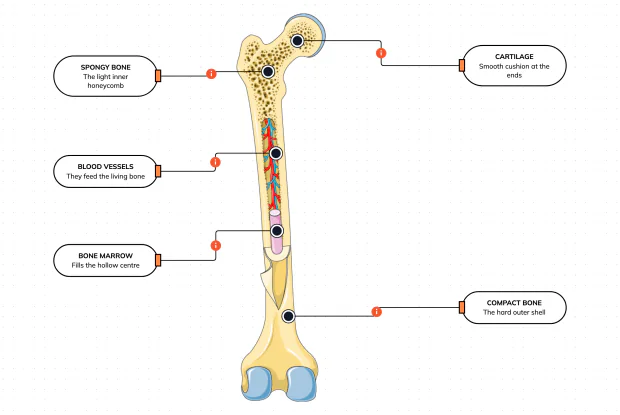
Cut a bone open and it is nowhere near solid: a hard outer shell, a light honeycomb inside, a hollow centre full of marrow, blood vessels threading through, and a smooth cushion at each end. Learn what each part does — then label them yourself in an interactive playground.
What Is Inside Your Elbow Joint?
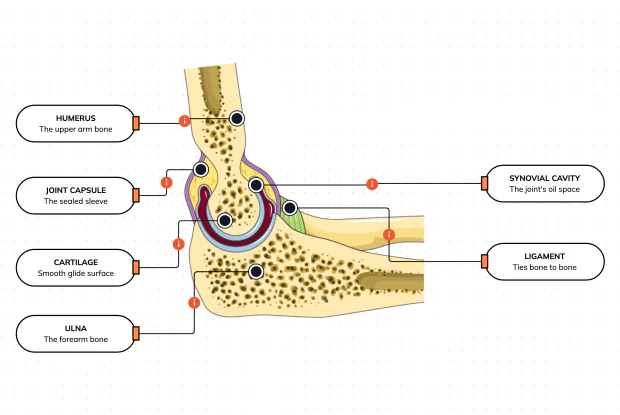
A joint is where two bones meet and move — and it is far more than just the bones. Cut open the elbow and you find smooth cartilage caps, a sealed capsule of slippery fluid, and tough ligaments holding it all together. Learn what each part does, then label them yourself in an interactive playground.
What Makes Your Elbow Bend?
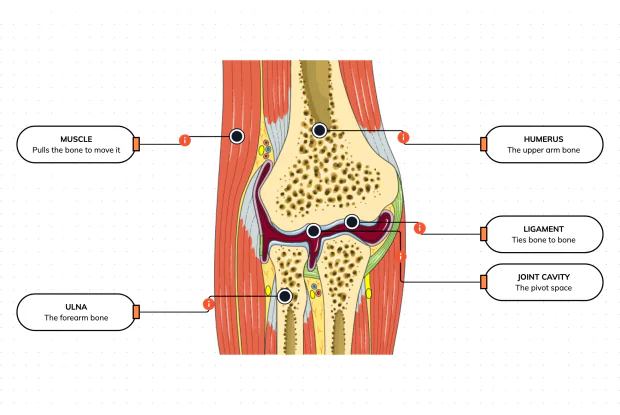
Bones and joints are just the hardware; nothing moves until a muscle pulls. Label the elbow to see the parts that turn a joint into movement — the muscle that pulls, the ligament that holds bone to bone, the two bones it links, and the space they pivot in — then build it yourself in an interactive playground.
What Holds Your Elbow Together?
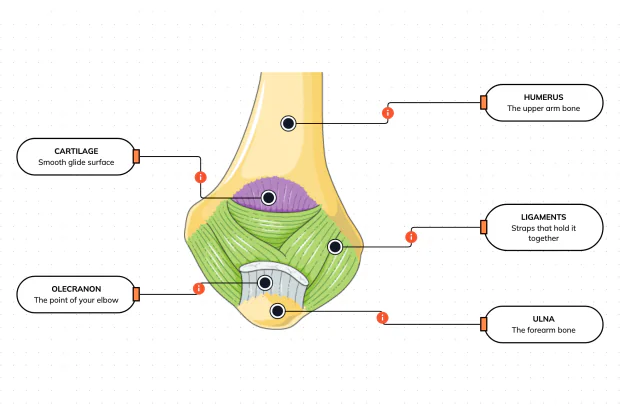
Your elbow is pulled on all day — by gravity, by every bag you carry, by every time you hang or push. So what stops the two bones from simply coming apart? Look at the back of the elbow and label the ligaments, the bony point, the cartilage and the two bones — and learn what holds the whole joint together.
What Are the Main Bones of the Skull?
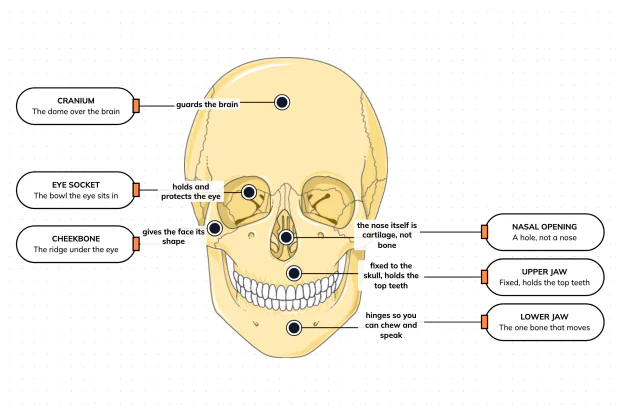
The skull looks like a single bone, but it is really about twenty-two locked together — with just one left free to move. Learn what each main part does, then label a skull yourself in an interactive playground.
What Are the Parts of Your Ear?
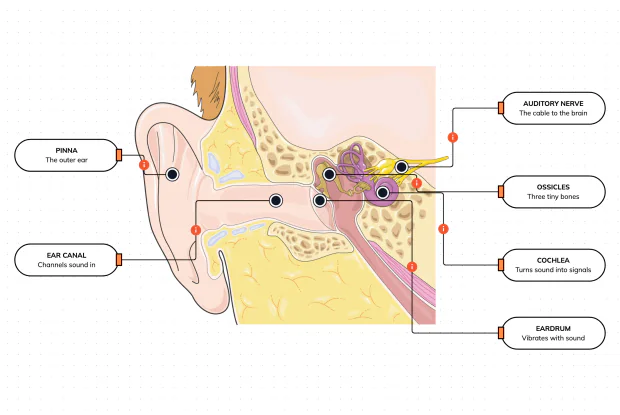
Hearing is a chain of parts passing a sound along, each handing it to the next. Label the pinna, ear canal, eardrum, ossicles, cochlea and auditory nerve, and follow a sound all the way from the air outside to a signal your brain can read — in an interactive playground.
How Does Your Ear Keep You Balanced?
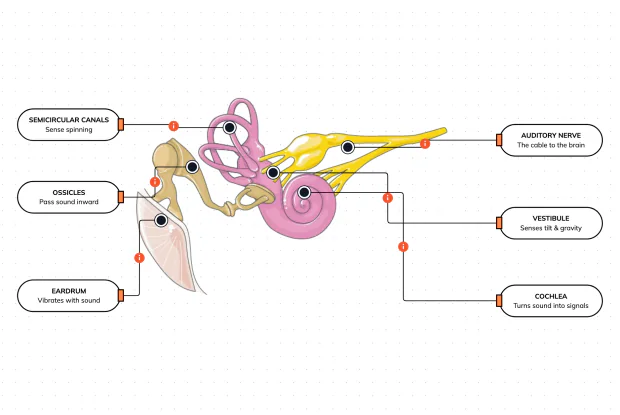
Your ear does a second, hidden job: balance. Inside it sit fluid-filled loops that sense spinning and a chamber that senses tilt and gravity. Label the semicircular canals, vestibule, cochlea, ossicles, eardrum and nerve, and learn how one organ both hears and keeps you upright — in an interactive playground.
What Are the Parts of the Eye You Can See?
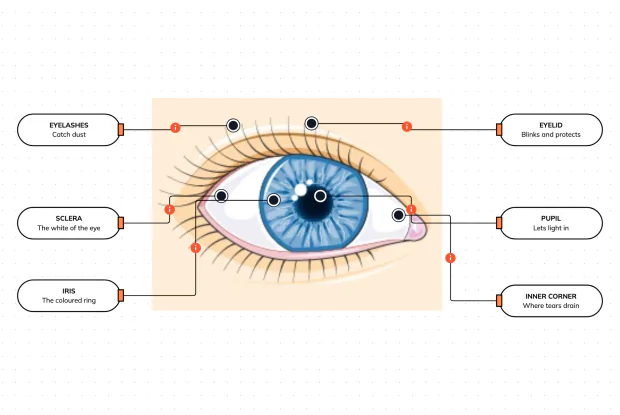
Before you look inside the eye, learn the parts you can already see in a mirror. Label the pupil, iris, sclera, eyelid, eyelashes and the tear-duct corner, and learn what each visible part does to let in light and protect the eye — in an interactive playground.
Where Do Your Tears Come From and Go?
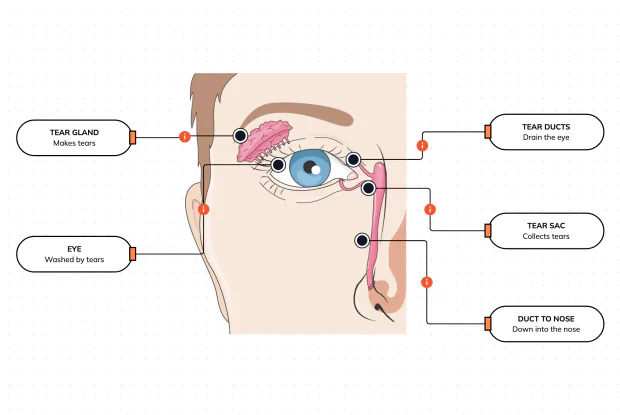
Your eyes make and drain tears all day to stay clean and wet. Label the tear gland, the eye, the tear ducts, the tear sac and the duct to the nose, and follow a tear from where it is made to where it drains — in an interactive playground.
How Does Your Eye Turn Light Into a Picture?
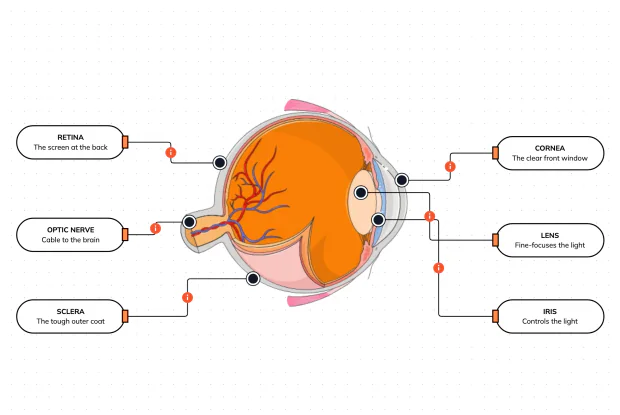
Your eye works like a living camera. Cut it open and label the cornea, lens, iris, retina, optic nerve and sclera, and follow light as it is focused onto a screen at the back of the eye and sent to the brain — in an interactive playground.