How Do You Swallow Without Choking?
Root Concept
The throat (pharynx) is a crossroads where the food path and air path cross. In a swallow, the tongue pushes food back, the soft palate seals off the nose, and the epiglottis folds down to cover the windpipe (trachea) so food goes down the food pipe (esophagus) to the stomach instead of into the lungs.
CodePLU Goal
Upgrading Human Mental Models
Learn how to think in Workflows
Concept Development By codeplu.com
The mouth and throat during a swallow, each part joined to its job — routing food safely past the windpipe and down the food pipe
How Does Food Get to Your Stomach Without Going Down the Wrong Pipe?
Swallowing feels automatic, but it is one of the trickiest things your body does — because of a design problem in your throat. The tube that carries food to your stomach and the tube that carries air to your lungs both start in the same place, at the back of your mouth, and their paths actually cross. Every time you swallow, food has to pass right by the entrance to your airway. Get it wrong and food goes 'down the wrong pipe' toward your lungs. Get it right, every time, without thinking — that is what the swallowing system is built to do.
The parts involved run from the mouth down into the neck. The tongue starts things off, pushing the chewed food to the back of the mouth. At the back of the roof of the mouth, the soft palate lifts up to seal off the entrance to the nose, so food cannot escape upward. Behind the tongue is the pharynx — the throat — the shared crossroads where the food path and air path meet.
The clever safety switch is lower down. As you swallow, a small flap called the epiglottis folds down over the entrance to the trachea (the windpipe to your lungs), briefly closing it off. With the windpipe covered and the nose sealed, the only way left for the food to go is down the esophagus (the food pipe) to the stomach. In the playground you will label the tongue, soft palate, pharynx, epiglottis, windpipe and food pipe — and the label on each connection tells you the job that part does in a swallow.
What Happens When You Swallow?
Why is swallowing tricky at all?
Because your throat is a crossroads where two important routes cross. Air needs to travel from your nose and mouth down the windpipe (trachea) to your lungs, and food needs to travel from your mouth down the food pipe (esophagus) to your stomach — and the entrances to both tubes sit right next to each other at the back of the throat. This shared design is efficient (one opening, the mouth, can take in both air and food) but risky: food passing through must go past the open doorway of the airway. If food or drink slips into the windpipe, it heads toward the lungs, which is dangerous. So every swallow has to briefly and precisely redirect traffic at this crossroads, sending food one way while blocking the other. That is why swallowing, though it feels like nothing, is a carefully coordinated reflex.
How does the swallow start?
It starts with the tongue. Once food has been chewed and mixed with saliva into a soft ball, the tongue presses up against the roof of the mouth and pushes the food backward, toward the throat. This is the one part of swallowing you control on purpose — you decide when to send the food back. Try to swallow with your tongue held still and you will find you barely can; the tongue's push is what launches the whole sequence. As the food reaches the back of the mouth, it triggers the swallowing reflex, and from that moment everything else happens automatically and very fast, without you having to think about it. So the tongue is both the mixer that prepares the food and the piston that fires it into the throat to begin the swallow.
How is the nose sealed off?
As the swallow begins, the soft palate — the soft, flexible back part of the roof of your mouth — lifts up and presses backward, closing off the passage that leads up to the nose. This matters because the back of the throat also connects upward to the nasal cavity, and without this seal, food or drink could be pushed up into the nose. You may have felt this go wrong: if you laugh while drinking, the timing is disrupted and liquid can come out of your nose — proof of the passage that the soft palate normally blocks. So the soft palate is the upper gatekeeper of the swallow, shutting the door to the nose so that the food is funnelled downward, not upward, as it moves through the throat.
How is the windpipe protected?
This is the crucial step. Sitting at the top of the windpipe is a small, flexible flap of cartilage called the epiglottis. Most of the time it stands up out of the way, leaving the windpipe open so you can breathe. But the instant you swallow, the epiglottis folds down like a lid over the entrance to the windpipe, sealing it shut for a moment. With the airway covered, food sliding down the throat cannot drop into it and is guided past, into the food pipe behind. At the same time your breathing briefly pauses. It is an elegant solution to the crossroads problem: rather than build separate openings, the body just closes the airway for the split second it takes food to pass. When the food is safely by, the epiglottis lifts again and you breathe on.
Where does the food actually go?
With the nose sealed by the soft palate and the windpipe covered by the epiglottis, the only open route left is downward into the esophagus — the food pipe that leads to the stomach. The food is squeezed into the top of the esophagus, which then pushes it down with waves of muscle. Notice how the throat (pharynx) has done its job as a crossroads: the same passage that a moment ago could have sent food toward the lungs has now directed it safely toward the stomach. The windpipe (trachea) and the food pipe (esophagus) run down the neck side by side — windpipe in front, food pipe behind — but a swallow makes sure the food only ever enters the one behind. This whole redirection happens in about a second, every single time you swallow.
Real World Example
Why Do You Cough When Something Goes Down the Wrong Way?
Everyone has felt a swallow go wrong. Each of these everyday moments shows the swallowing system, and its safety switch, in action:
The risky crossroads
The pharynx, shared by food and air
The root of it all is that your throat is shared. The pharynx is a single passage that both air and food must travel through, because your mouth serves double duty as the entrance for breathing and for eating. This is why we can breathe through the mouth when the nose is blocked, and why a single opening keeps the design simple. But sharing one passage means food and air routes must cross, and food has to pass the open door of the windpipe on its way down. Most animals share this layout, and it works reliably almost all the time — but it is the reason choking is even possible. Understanding swallowing starts with accepting this trade-off: one flexible shared throat, at the cost of needing a careful switch every time you swallow.
Down the wrong pipe
When the epiglottis is caught out
Sometimes you swallow at a bad moment — talking or laughing while eating — and the timing of the reflex is thrown off. The epiglottis does not close the windpipe in time, and a bit of food or drink slips into the airway instead of the food pipe: 'down the wrong pipe'. Your body reacts instantly with a violent cough. That cough is not random; it is an emergency reflex to blast the food back up out of the windpipe before it can reach the lungs. It is exactly why you are told not to talk with your mouth full — speaking uses the airway and disrupts the careful sequence that normally keeps the windpipe covered. The unpleasant coughing fit is the system's backup plan working correctly when the main switch is caught out.
You can't breathe and swallow at once
The windpipe closes during a swallow
Try to breathe in at the exact moment you swallow and you will find you simply cannot — the two cannot happen together. This is by design: during the split second of a swallow, the epiglottis covers the windpipe and breathing pauses, so there is no way for air (or food) to enter the airway just then. The moment the food has passed, the windpipe reopens and you breathe again, usually without noticing the tiny gap. This is also why gulping food too fast can leave you feeling briefly breathless — you are stacking swallows so quickly that your breathing keeps getting interrupted. The impossibility of breathing and swallowing at the same instant is the clearest sign of how completely the swallow takes over the crossroads to keep your lungs safe.
FAQs
Final Words
Swallowing is your body solving a genuinely hard problem: the throat is a crossroads where the food path and air path cross, so every swallow must send food safely past the entrance to your lungs. The tongue pushes the food back and starts the reflex, the soft palate seals off the nose, and — the key move — the epiglottis folds down to cover the windpipe, leaving the food pipe (esophagus) as the only open route to the stomach.
That switch happens in about a second, every time, which is why choking is the exception and not the rule — and why the coughing fit when something 'goes down the wrong pipe' is the safety backup kicking in. This is the last stop in the mouth: food chewed by the teeth, tasted and moved by the tongue, and now swallowed is on its way down the food pipe to the stomach, where the digestive journey continues.
Continue This Track
This concept is part 28 of The Human Body, Head to Toe.
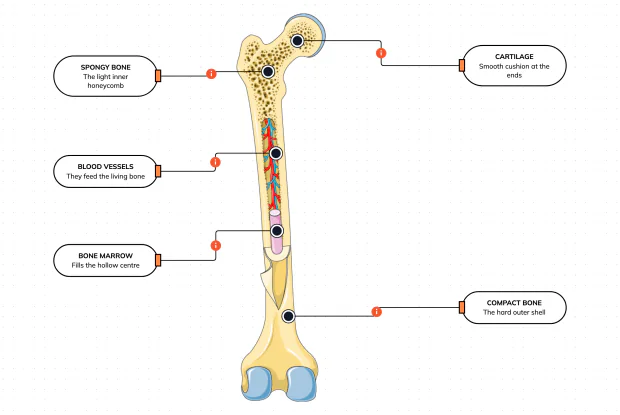
What Is a Bone Made Of?
Cut a bone open and it is nowhere near solid: a hard outer shell, a light honeycomb inside, a hollow centre full of marrow, blood vessels threading through, and a smooth cushion at each end. Learn what each part does — then label them yourself in an interactive playground.
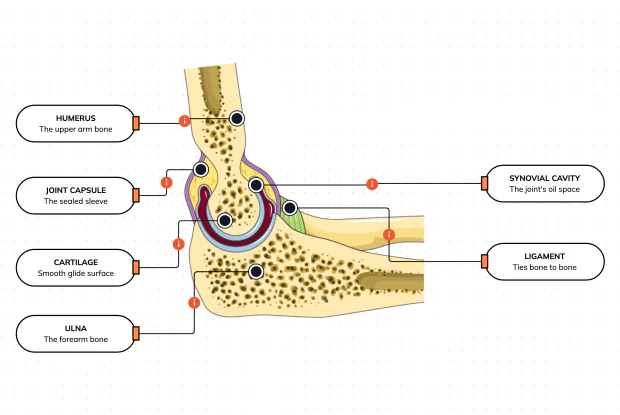
What Is Inside Your Elbow Joint?
A joint is where two bones meet and move — and it is far more than just the bones. Cut open the elbow and you find smooth cartilage caps, a sealed capsule of slippery fluid, and tough ligaments holding it all together. Learn what each part does, then label them yourself in an interactive playground.
What Makes Your Elbow Bend?
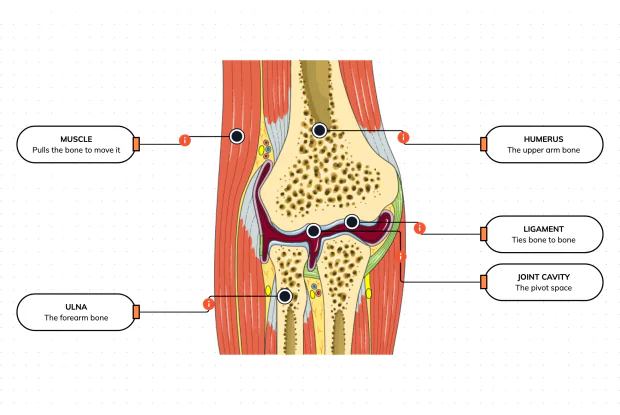
Bones and joints are just the hardware; nothing moves until a muscle pulls. Label the elbow to see the parts that turn a joint into movement — the muscle that pulls, the ligament that holds bone to bone, the two bones it links, and the space they pivot in — then build it yourself in an interactive playground.
What Holds Your Elbow Together?
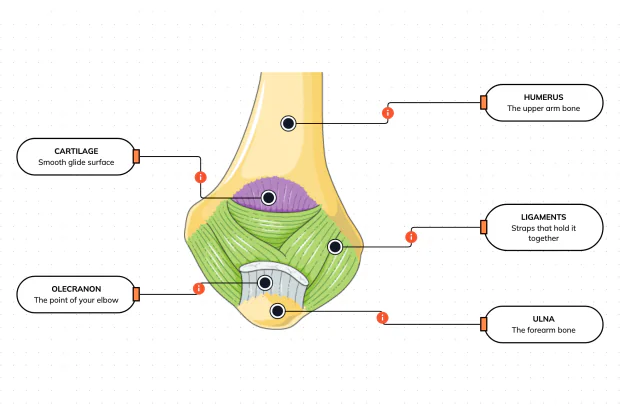
Your elbow is pulled on all day — by gravity, by every bag you carry, by every time you hang or push. So what stops the two bones from simply coming apart? Look at the back of the elbow and label the ligaments, the bony point, the cartilage and the two bones — and learn what holds the whole joint together.
What Are the Main Bones of the Skull?
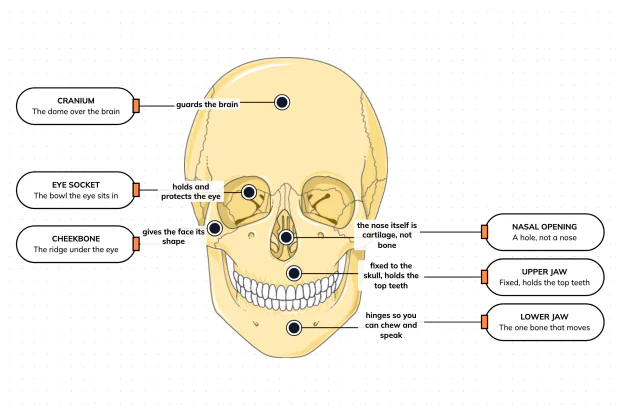
The skull looks like a single bone, but it is really about twenty-two locked together — with just one left free to move. Learn what each main part does, then label a skull yourself in an interactive playground.
What Are the Parts of Your Ear?
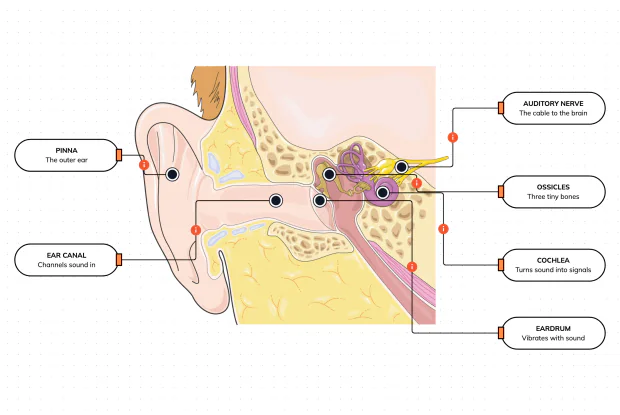
Hearing is a chain of parts passing a sound along, each handing it to the next. Label the pinna, ear canal, eardrum, ossicles, cochlea and auditory nerve, and follow a sound all the way from the air outside to a signal your brain can read — in an interactive playground.
How Does Your Ear Keep You Balanced?
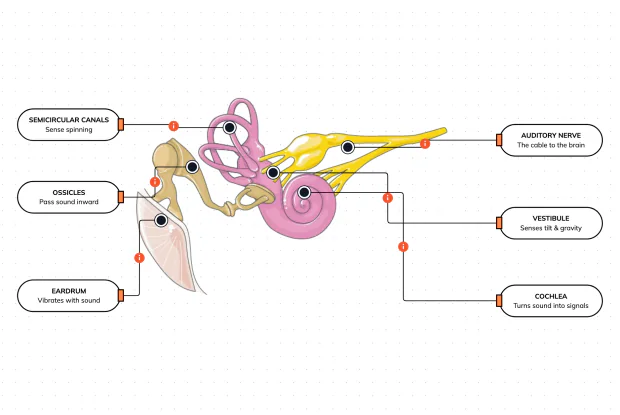
Your ear does a second, hidden job: balance. Inside it sit fluid-filled loops that sense spinning and a chamber that senses tilt and gravity. Label the semicircular canals, vestibule, cochlea, ossicles, eardrum and nerve, and learn how one organ both hears and keeps you upright — in an interactive playground.
What Are the Parts of the Eye You Can See?
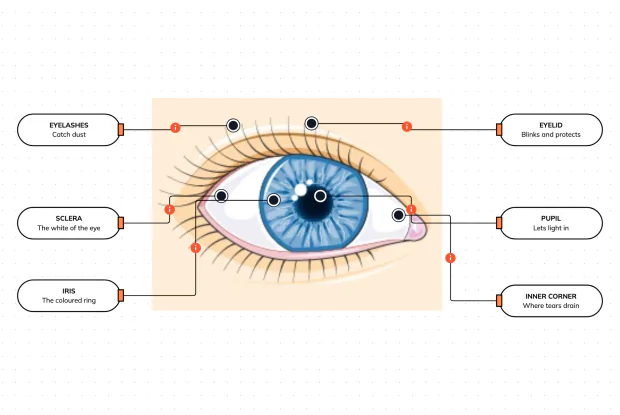
Before you look inside the eye, learn the parts you can already see in a mirror. Label the pupil, iris, sclera, eyelid, eyelashes and the tear-duct corner, and learn what each visible part does to let in light and protect the eye — in an interactive playground.
Where Do Your Tears Come From and Go?
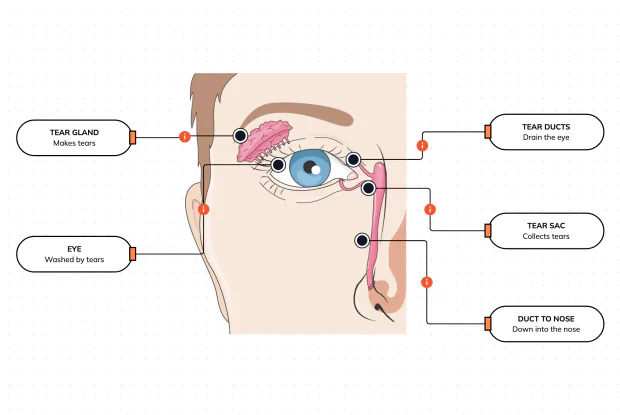
Your eyes make and drain tears all day to stay clean and wet. Label the tear gland, the eye, the tear ducts, the tear sac and the duct to the nose, and follow a tear from where it is made to where it drains — in an interactive playground.
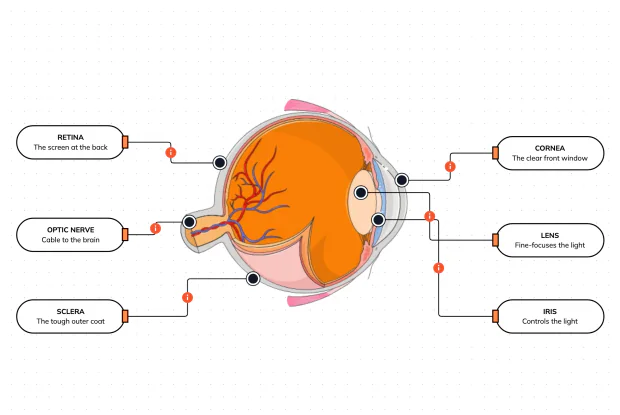
How Does Your Eye Turn Light Into a Picture?
Your eye works like a living camera. Cut it open and label the cornea, lens, iris, retina, optic nerve and sclera, and follow light as it is focused onto a screen at the back of the eye and sent to the brain — in an interactive playground.