What Are the Main Parts of Your Digestive System?
Root Concept
The digestive system is a long tube that turns food into fuel. Food is chewed in the mouth, pushed down the esophagus to the stomach, which churns it with acid; the small intestine then finishes digestion and absorbs the nutrients (helped by bile from the liver and juices from the pancreas), and the large intestine absorbs water and forms the leftover waste.
CodePLU Goal
Upgrading Human Mental Models
Learn how to think in Workflows

Concept Development By codeplu.com
The digestive system, each organ joined to the job it does as food travels from the mouth to the end of the gut
What Happens to Food After You Swallow It?
When you eat, the food is far too big and complex for your body to use straight away — a mouthful of sandwich is nothing like the tiny nutrients your cells actually run on. The job of the digestive system is to solve that: to take food in at one end, break it down step by step into pieces small enough to pass into your blood, soak up those pieces, and push the leftovers out the other end. Remarkably, it does this in a single long tube — roughly nine metres of it, coiled up inside you — with a few helper organs plumbed in along the way.
The tube itself is the main event, and food travels down it in order. It starts in the mouth, where your teeth grind the food and saliva begins softening it. A swallow sends it down the esophagus, a muscular tube that squeezes it down into the stomach — a stretchy bag that churns the food and mixes it with strong acid until it becomes a thick soup. From there the soup enters the small intestine, the long, narrow, coiled tube where the real work happens: digestion is finished and the useful nutrients are absorbed through the wall into the blood.
Two helper organs pour in juices to make that possible: the liver (with its little green gallbladder) sends in bile to break up fats, and the pancreas adds powerful digestive juices — both emptying into the start of the small intestine. Finally, whatever is left passes into the large intestine, the wide tube that frames the coils, which soaks the water back out of the leftovers and packs them into waste. In the playground above you will label the mouth, esophagus, stomach, liver, small intestine and large intestine — and the label on each connection tells you the job that part does.
What Does Each Part of the Digestive System Do?
Where does digestion begin?
It begins in the mouth, before you have even swallowed. Two things happen there at once. First, your teeth chew the food, grinding and tearing it into a soft, small-pieced mush — this is mechanical breakdown, and it matters because smaller pieces have far more surface for the digestive juices to work on later. Second, your saliva wets the food and begins the chemical side of digestion: saliva contains an enzyme that actually starts breaking down the starches in food, which is why a piece of bread slowly turns sweet if you hold it in your mouth. Your tongue rolls the chewed food into a soft ball and pushes it to the back of the mouth to be swallowed. So digestion is well underway before the food ever leaves your head.
How does food get to the stomach?
Through the esophagus — the muscular tube that connects your throat to your stomach, running down through your chest behind the windpipe. It is easy to assume swallowed food just falls down under gravity, but it does not: the esophagus actively squeezes the food downward with a wave of muscle contraction called peristalsis, a rhythmic tightening that pushes the mouthful along like squeezing toothpaste down a tube. This is why you can swallow even lying down or upside-down — the muscle does the work, not gravity. At the bottom, a ring of muscle opens to let the food into the stomach and then closes behind it, which normally stops the stomach's acid from splashing back up (when it does leak up, you feel it as heartburn).
What does the stomach do?
The stomach is a stretchy, muscular bag that acts as both a mixer and a holding tank. When food arrives, the stomach's thick walls churn and squeeze it, while glands in its lining pour out strong acid and enzymes. The acid is powerful enough to kill most germs in your food and to help break proteins apart, and the churning mixes everything into a thick, souce-like liquid. The stomach also stores the meal, releasing it into the small intestine slowly, a little at a time, rather than all at once — which is part of why a big meal keeps you feeling full for hours. Its own lining is protected from the acid by a layer of mucus; without that shield, the stomach would begin to digest itself.
What does the liver do for digestion?
The liver is the large brown organ tucked up under your ribs, and it is the body's great chemical factory — but its direct job in digestion is to make bile. Bile is a greenish juice that breaks large blobs of fat into tiny droplets, the way washing-up liquid cuts through grease, so that the fat can be digested and absorbed. The bile is stored in the little green gallbladder attached underneath the liver, which squirts it into the small intestine when a fatty meal arrives. The liver also does something no other digestive organ does: all the nutrients absorbed from your food are carried straight to it first, and it processes them — storing some, converting others, and filtering out toxins — before they go on to the rest of the body.
Where are nutrients actually absorbed?
In the small intestine — and despite its name, it is the longest part of the whole system, a narrow tube coiled up to fit around seven metres into your belly. This is where digestion is finished and, crucially, where the goodness in food is absorbed into your blood. Juices from the liver and pancreas pour into its start to complete the breakdown of fats, proteins and starches into their tiniest building blocks. Then those nutrients pass through the intestine's wall into the bloodstream to feed your whole body. The inside wall is covered in millions of tiny finger-like folds that give it an enormous surface area — as big as a tennis court if spread flat — so that as much as possible can be soaked up as the food slides slowly past.
What does the large intestine do?
By the time the leftovers reach the large intestine, almost all the useful nutrients are gone — what arrives is a watery mush of the parts your body could not digest. The large intestine (the wide tube that frames the coils of the small intestine) has two main jobs: it soaks the water back out of that mush, returning it to your body so you do not become dehydrated, and it packs what remains into solid waste. Huge numbers of helpful bacteria live here too, feeding on the leftovers and making some vitamins in the process. The dried, packed waste is then stored in the last stretch, the rectum, until it is passed out. This water-recovery step is why illnesses that rush things through the large intestine too fast, before the water is reabsorbed, cause diarrhoea.
Real World Example
Where Does Your Breakfast Actually Go?
The best way to understand the digestive system is to follow one meal through it. A bite of buttered toast passes through three big stages, and each one is a different set of the organs you just labelled:
Chewed, swallowed and churned
Mouth, esophagus, stomach
It starts the moment you bite. Your teeth grind the toast to a paste while saliva wets it and begins breaking down its starch — the toast would even start tasting slightly sweet if you held it in your mouth. You swallow, and the esophagus squeezes the mouthful down into the stomach in a few seconds, not by dropping it but by pushing it with waves of muscle. In the stomach it lands in a bath of acid and is churned for a few hours into a thick soup, the acid killing germs and starting to break down the protein, the butter's fat still in blobs. Nothing is absorbed for use yet; this whole first stage is about breaking the food down and getting it ready. By the time it leaves the stomach, your breakfast is unrecognisable.
Absorbing the goodness
Small intestine, liver, pancreas
The soup is released slowly into the small intestine, and this is where your breakfast actually becomes fuel. Bile from the liver's gallbladder breaks the butter's fat into tiny droplets, and juices from the pancreas finish splitting the starch and protein into their smallest pieces. Then, over several hours, those nutrients are absorbed through the intestine's vast folded wall into your blood — the sugars from the toast, the fats from the butter — and carried first to the liver, which sorts and stores them before sending them on to feed your whole body. This is the payoff of the entire system: the actual point of eating happens here, quietly, in a coiled tube seven metres long. Everything before it was preparation for this moment of absorption.
Water back, waste out
The large intestine
Whatever your body could not digest — mostly the fibre from the toast — passes on into the large intestine as a watery leftover. Here the system recovers its resources: the wall soaks the water back out and returns it to your body, and the friendly bacteria living there feed on the remnants. What is left is packed down into solid waste and stored in the rectum until it is convenient to pass it out, often a day or more after the meal first went in. This final stage is why staying hydrated matters and why fibre keeps you regular — it gives the large intestine bulk to move along. From bite to exit, your breakfast has travelled about nine metres and been worked on by half a dozen organs, each doing one step of the job.
FAQs
Final Words
Your digestive system is one long tube — about nine metres of it — that turns food into fuel your body can use. Food is chewed in the mouth, pushed down the esophagus, churned with acid in the stomach, then finished off and absorbed in the small intestine, with bile from the liver and juices from the pancreas helping break it down. The large intestine reclaims the water and packs the leftovers into waste. Each organ does one clear step, and the food passes through them in order.
Following a single meal from bite to exit shows how the parts cooperate: break it down, absorb the goodness, recover the water, remove the waste. This is the first of the body's great internal systems in your head-to-toe tour — the same 'trace the journey, part by part' approach will open up the others, from the breath you take to the blood that carries all these absorbed nutrients around your body.
Continue This Track
This concept is part 29 of The Human Body, Head to Toe.
What Is a Bone Made Of?
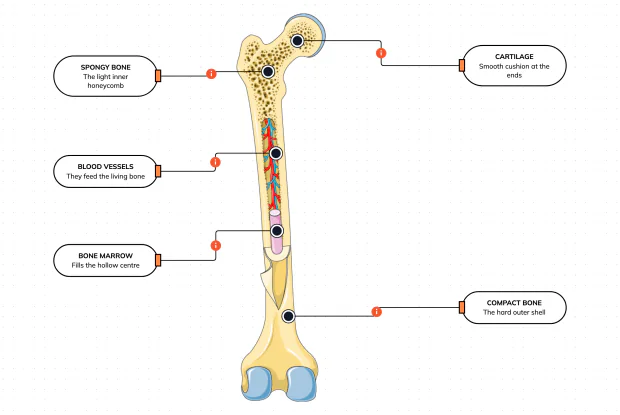
Cut a bone open and it is nowhere near solid: a hard outer shell, a light honeycomb inside, a hollow centre full of marrow, blood vessels threading through, and a smooth cushion at each end. Learn what each part does — then label them yourself in an interactive playground.
What Is Inside Your Elbow Joint?
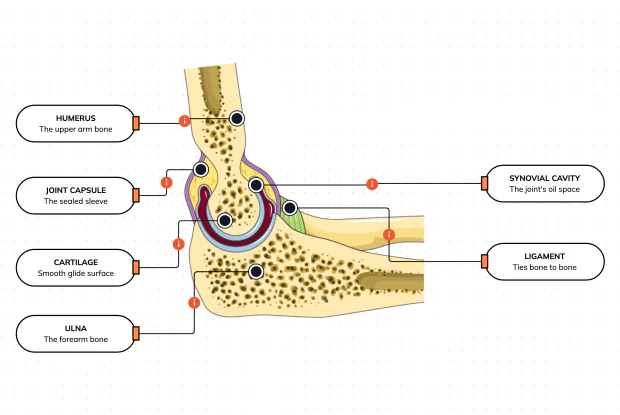
A joint is where two bones meet and move — and it is far more than just the bones. Cut open the elbow and you find smooth cartilage caps, a sealed capsule of slippery fluid, and tough ligaments holding it all together. Learn what each part does, then label them yourself in an interactive playground.
What Makes Your Elbow Bend?
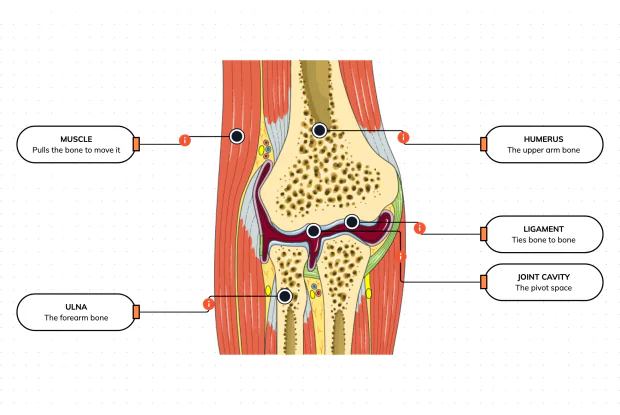
Bones and joints are just the hardware; nothing moves until a muscle pulls. Label the elbow to see the parts that turn a joint into movement — the muscle that pulls, the ligament that holds bone to bone, the two bones it links, and the space they pivot in — then build it yourself in an interactive playground.
What Holds Your Elbow Together?
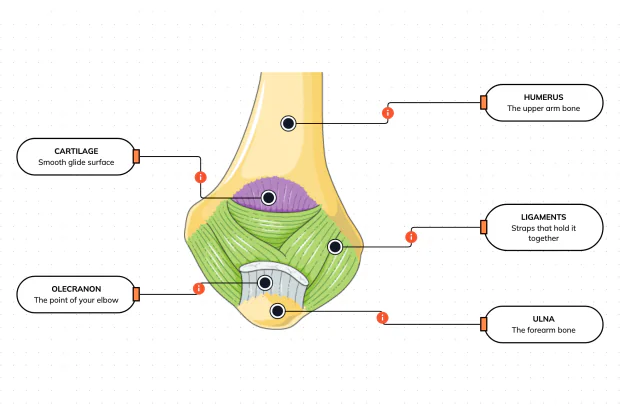
Your elbow is pulled on all day — by gravity, by every bag you carry, by every time you hang or push. So what stops the two bones from simply coming apart? Look at the back of the elbow and label the ligaments, the bony point, the cartilage and the two bones — and learn what holds the whole joint together.
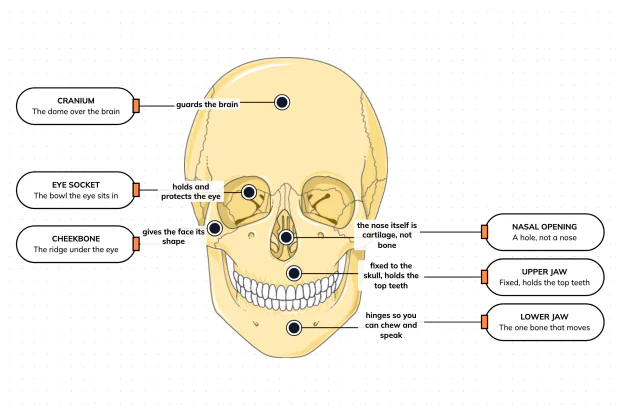
What Are the Main Bones of the Skull?
The skull looks like a single bone, but it is really about twenty-two locked together — with just one left free to move. Learn what each main part does, then label a skull yourself in an interactive playground.
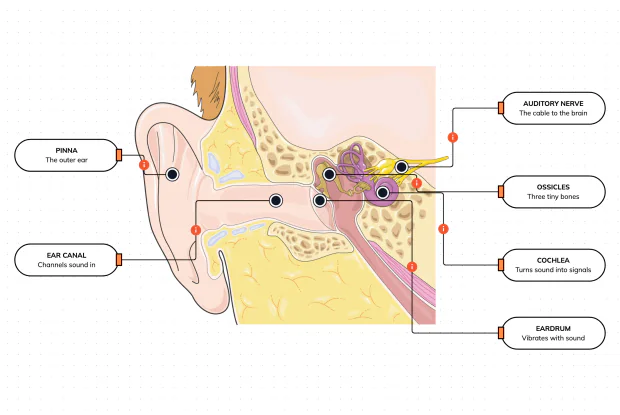
What Are the Parts of Your Ear?
Hearing is a chain of parts passing a sound along, each handing it to the next. Label the pinna, ear canal, eardrum, ossicles, cochlea and auditory nerve, and follow a sound all the way from the air outside to a signal your brain can read — in an interactive playground.
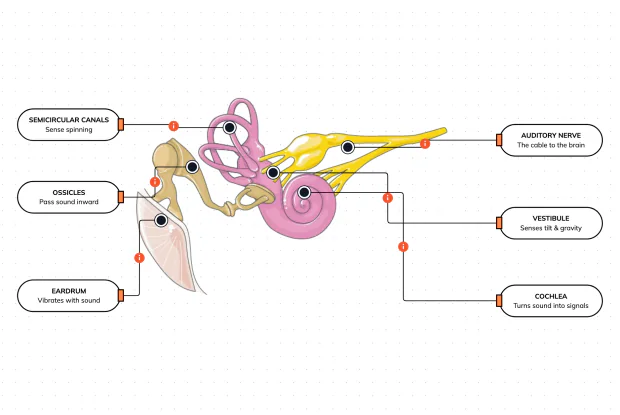
How Does Your Ear Keep You Balanced?
Your ear does a second, hidden job: balance. Inside it sit fluid-filled loops that sense spinning and a chamber that senses tilt and gravity. Label the semicircular canals, vestibule, cochlea, ossicles, eardrum and nerve, and learn how one organ both hears and keeps you upright — in an interactive playground.
What Are the Parts of the Eye You Can See?
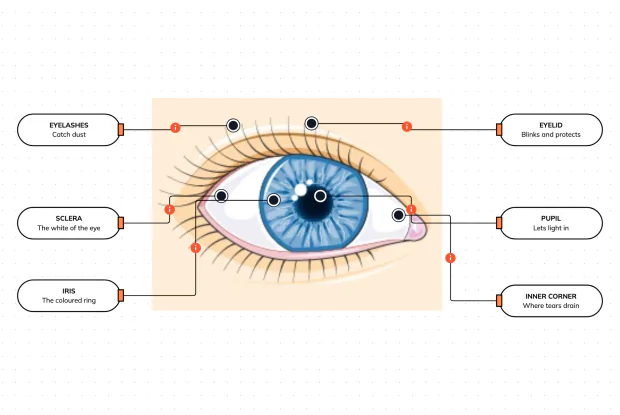
Before you look inside the eye, learn the parts you can already see in a mirror. Label the pupil, iris, sclera, eyelid, eyelashes and the tear-duct corner, and learn what each visible part does to let in light and protect the eye — in an interactive playground.
Where Do Your Tears Come From and Go?
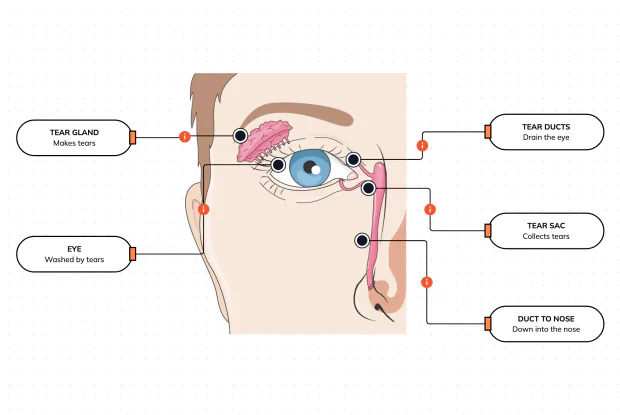
Your eyes make and drain tears all day to stay clean and wet. Label the tear gland, the eye, the tear ducts, the tear sac and the duct to the nose, and follow a tear from where it is made to where it drains — in an interactive playground.
How Does Your Eye Turn Light Into a Picture?
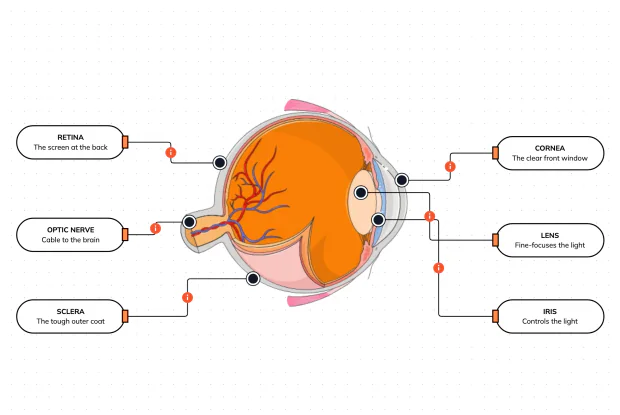
Your eye works like a living camera. Cut it open and label the cornea, lens, iris, retina, optic nerve and sclera, and follow light as it is focused onto a screen at the back of the eye and sent to the brain — in an interactive playground.