How Does Air Travel to Your Lungs?
Root Concept
Air travels to the lungs through a branching set of airways called the conducting zone: in through the nasal cavity, past the larynx, down the trachea, which splits into two bronchi (one per lung), and on into ever-smaller bronchioles that spread the air throughout the lungs.
CodePLU Goal
Upgrading Human Mental Models
Learn how to think in Workflows

Concept Development By codeplu.com
The path of a breath — nasal cavity, larynx and trachea down the neck, then bronchi and bronchioles branching through the lungs
Where Does a Breath Go After It Enters Your Nose?
Take a breath in. That air does not just appear in your lungs — it travels there, down a series of connected tubes that get smaller and smaller, branching like an upside-down tree. These airways are called the conducting zone, because their job is to conduct, or carry, air to and from the lungs. They do not do the actual gas exchange themselves; they are the delivery pipes.
The journey begins at the nasal cavity, the space inside your nose, which warms, wets and filters the air. From there the air passes down through the larynx (your voice box) and into the trachea, the windpipe you can feel at the front of your neck. Lower down, the trachea splits into two branches called bronchi — one heading into each lung.
Inside each lung, the bronchi keep dividing into smaller and smaller tubes called bronchioles, spreading the air out to every corner of the lung like the twigs of a tree. In the playground you will label this whole path — nasal cavity, larynx, trachea, bronchus and bronchioles — and follow a breath from your nose deep into your lungs.
How Do the Airways Work?
Air comes in: nose, larynx and trachea
Air usually enters through the nasal cavity, the hollow space inside your nose, which does three quiet but important jobs: it warms the air to body temperature, adds moisture so it does not dry out your lungs, and traps dust and germs on its sticky lining and tiny hairs. From the nose the air moves down the throat and through the larynx, the voice box, and then into the trachea — the windpipe, a tube about as wide as your thumb running down the front of your neck. The trachea is held open by C-shaped rings of cartilage, so it never collapses shut when you breathe. Together these are the first stretch of the airway: the single main pipe that carries every breath down toward the chest before it splits.
The airway branches: bronchi and bronchioles
Down in the chest, the trachea divides into two tubes called bronchi, one going into the right lung and one into the left. This is where the airway becomes a branching tree. Inside each lung, the bronchus splits again and again into narrower and narrower tubes, and the smallest of these are called bronchioles — some no wider than a hair. This branching spreads the incoming air evenly to every region of the lung, so that no part is left unsupplied. If you traced all the branches, one windpipe would divide into hundreds of thousands of tiny bronchioles. It is exactly like an upside-down tree: one trunk (the trachea), two big limbs (the bronchi), and countless twigs (the bronchioles) reaching into all corners of the lungs.
Delivery pipes, not the exchange itself
It is worth being clear about what these airways do and do not do. The nasal cavity, larynx, trachea, bronchi and bronchioles are all conducting airways: their job is only to carry air in and out, cleaning and warming it on the way. The actual swapping of oxygen into the blood and carbon dioxide out of it does not happen here — it happens at the very ends of the smallest bronchioles, in tiny air sacs that are a separate story. Think of the conducting zone as the roads and the air sacs as the destination. The whole branching system exists to deliver fresh air right to those sacs and to carry stale air back out, breath after breath, without ever getting blocked.
Real World Example
The Airways in Everyday Life
This branching set of tubes shows up in things you experience every day. Here are three:
Why breathing through your nose is better
The nasal cavity prepares the air
Ever notice that breathing through your nose feels more comfortable than through your mouth, especially in cold or dusty air? That is the nasal cavity doing its job. As air passes through it, the nose warms it, moistens it, and traps dust, pollen and germs on its sticky lining before they can reach your lungs. Breathing through your mouth skips most of this preparation, so cold air hits your lungs raw and more particles get through. This is why athletes are often told to breathe through their nose when they can, and why a blocked nose in winter makes breathing feel harsher. The very first airway in the path is also a built-in air conditioner and filter.
Food going down the wrong pipe
The airway and food pipe share a crossroads
Have you ever had a drink 'go down the wrong way' and set off a fit of coughing? At the top of the airway, near the larynx, the path for air and the path for food cross over. Normally, when you swallow, a small flap folds down to cover the airway so food goes to the stomach, not the lungs. But if something slips past while you are laughing or talking, it enters the larynx and trachea — the wrong pipe — and your body reacts instantly with violent coughing to blast it back out. That protective cough is your conducting airways defending themselves, because these tubes are meant for air only, and even a crumb in the trachea is treated as an emergency.
What happens in asthma
Narrowed bronchioles make breathing hard
In asthma, the smallest airways — the bronchioles — become swollen and tighten up, and their narrow openings get even narrower. Because air has to squeeze through these shrunken tubes, breathing becomes hard work, often with a wheezing sound as the air forces its way through. An inhaler helps by relaxing the muscle around the bronchioles so they widen again and air can flow freely. Asthma is a clear, if unwelcome, lesson in why the conducting zone matters: the air sacs deep in the lungs may be perfectly healthy, but if the delivery pipes leading to them are squeezed shut, fresh air simply cannot get through. Keeping the airways open is half of breathing.
FAQs
Final Words
Air reaches your lungs by travelling through the conducting airways: in through the nasal cavity, past the larynx, down the trachea, into the two bronchi, and on through ever-smaller bronchioles that fan out through the lungs. The whole system branches like an upside-down tree — one windpipe trunk dividing into hundreds of thousands of tiny twigs — delivering fresh air to every corner of the lungs.
These airways only carry and prepare the air; the real swap of oxygen and carbon dioxide happens at the very ends, in tiny air sacs. You feel this path working every day — the comfort of nose-breathing, a cough when food goes the wrong way, the wheeze of narrowed bronchioles in asthma. Keeping these delivery pipes open and clear is half of every breath you take.
Continue This Track
This concept is part 53 of The Human Body, Head to Toe.
What Is a Bone Made Of?
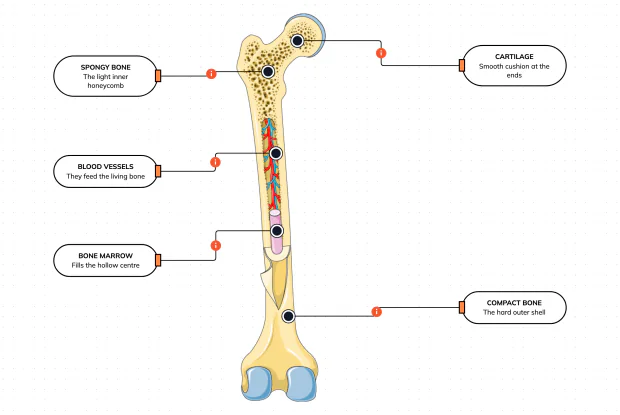
Cut a bone open and it is nowhere near solid: a hard outer shell, a light honeycomb inside, a hollow centre full of marrow, blood vessels threading through, and a smooth cushion at each end. Learn what each part does — then label them yourself in an interactive playground.
What Is Inside Your Elbow Joint?
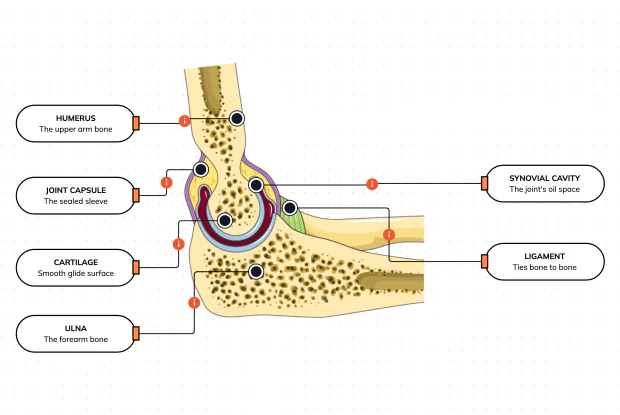
A joint is where two bones meet and move — and it is far more than just the bones. Cut open the elbow and you find smooth cartilage caps, a sealed capsule of slippery fluid, and tough ligaments holding it all together. Learn what each part does, then label them yourself in an interactive playground.
What Makes Your Elbow Bend?
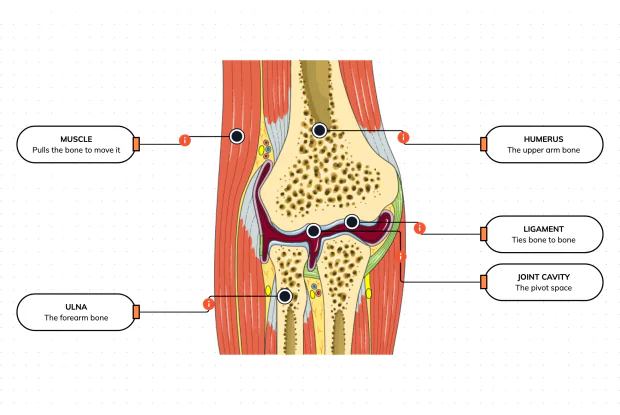
Bones and joints are just the hardware; nothing moves until a muscle pulls. Label the elbow to see the parts that turn a joint into movement — the muscle that pulls, the ligament that holds bone to bone, the two bones it links, and the space they pivot in — then build it yourself in an interactive playground.
What Holds Your Elbow Together?
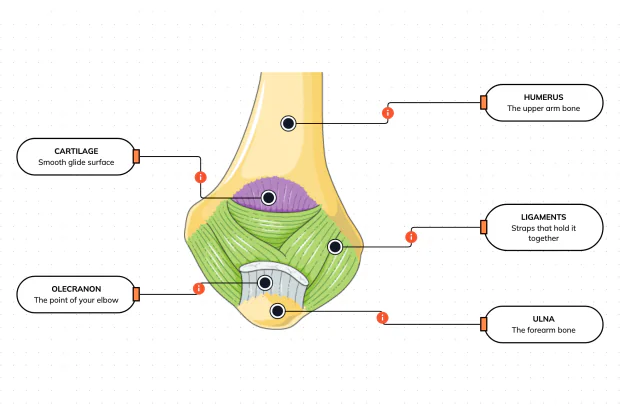
Your elbow is pulled on all day — by gravity, by every bag you carry, by every time you hang or push. So what stops the two bones from simply coming apart? Look at the back of the elbow and label the ligaments, the bony point, the cartilage and the two bones — and learn what holds the whole joint together.
What Are the Main Bones of the Skull?
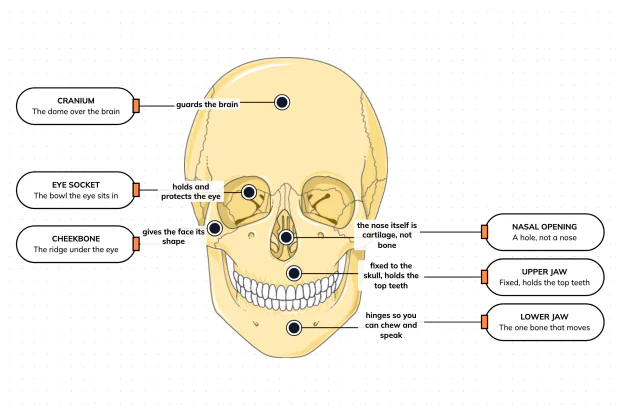
The skull looks like a single bone, but it is really about twenty-two locked together — with just one left free to move. Learn what each main part does, then label a skull yourself in an interactive playground.
What Are the Parts of Your Ear?
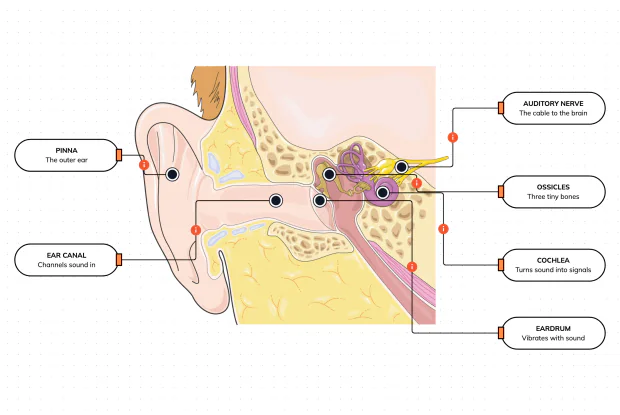
Hearing is a chain of parts passing a sound along, each handing it to the next. Label the pinna, ear canal, eardrum, ossicles, cochlea and auditory nerve, and follow a sound all the way from the air outside to a signal your brain can read — in an interactive playground.
How Does Your Ear Keep You Balanced?
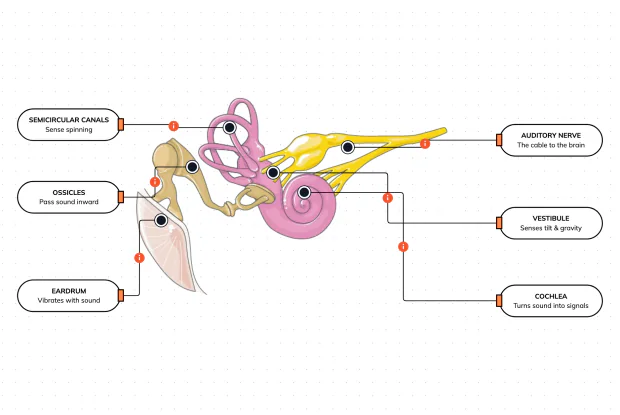
Your ear does a second, hidden job: balance. Inside it sit fluid-filled loops that sense spinning and a chamber that senses tilt and gravity. Label the semicircular canals, vestibule, cochlea, ossicles, eardrum and nerve, and learn how one organ both hears and keeps you upright — in an interactive playground.
What Are the Parts of the Eye You Can See?
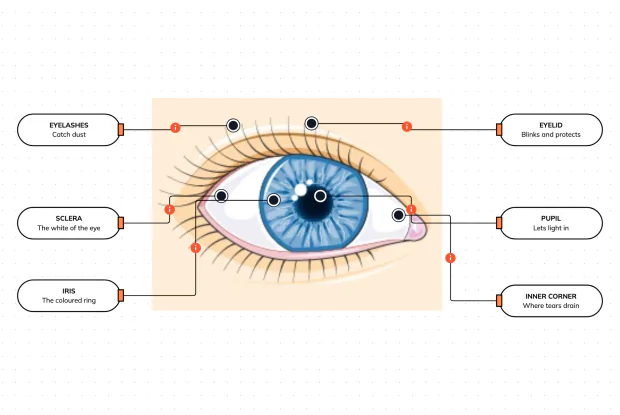
Before you look inside the eye, learn the parts you can already see in a mirror. Label the pupil, iris, sclera, eyelid, eyelashes and the tear-duct corner, and learn what each visible part does to let in light and protect the eye — in an interactive playground.
Where Do Your Tears Come From and Go?
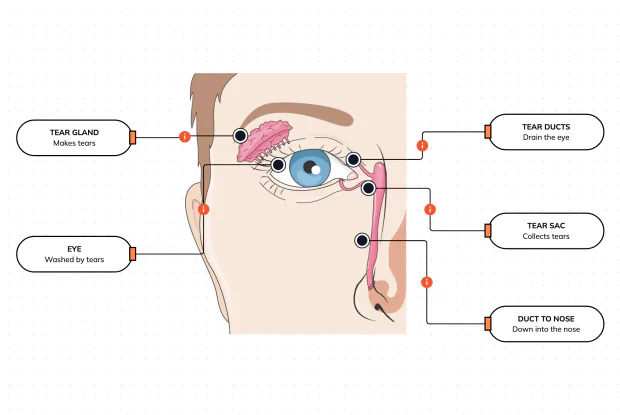
Your eyes make and drain tears all day to stay clean and wet. Label the tear gland, the eye, the tear ducts, the tear sac and the duct to the nose, and follow a tear from where it is made to where it drains — in an interactive playground.
How Does Your Eye Turn Light Into a Picture?
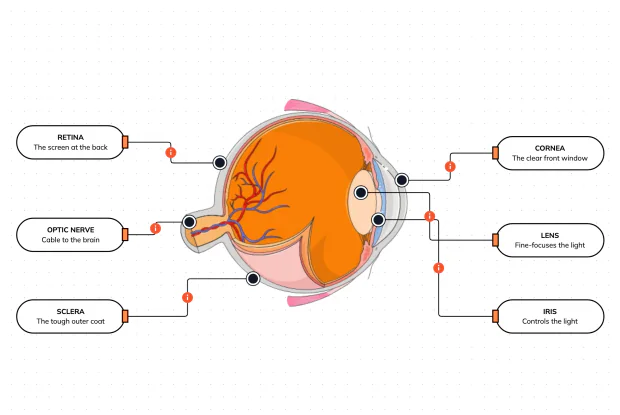
Your eye works like a living camera. Cut it open and label the cornea, lens, iris, retina, optic nerve and sclera, and follow light as it is focused onto a screen at the back of the eye and sent to the brain — in an interactive playground.