What Are the Parts of the Breast?
Root Concept
The breast is a mammary gland built to make and deliver milk. Milk-making glands called lobules produce milk, ducts carry it to the nipple where it leaves the breast, and fatty tissue fills the space and gives the breast its shape and size. The whole breast rests on the chest (pectoral) muscle and the ribs of the chest wall.
CodePLU Goal
Upgrading Human Mental Models
Learn how to think in Workflows

Concept Development By codeplu.com
A side-on cut through the breast, each part joined to its job — the milk glands, the ducts that carry milk to the nipple, the fat that shapes it, and the muscle and rib behind
What Is the Breast Made Of?
The breast is a part of the body that many people never really learn the inside of. From the outside it looks simple, but a side-on cut reveals a neat little system built for one main purpose: making milk to feed a baby. The proper name for it is the mammary gland, and every part inside has a role in producing that milk or delivering it.
At the heart of the breast are the milk glands, called lobules — small clusters of tissue that actually make the milk. Leading away from them are the ducts, thin tubes that carry the milk toward the front of the breast, all joining up and opening at the nipple, where the milk leaves. Around these glands and ducts is a large amount of fatty tissue, which fills the space and gives the breast most of its size and shape.
All of this sits on top of the chest muscle, the pectoral muscle, which in turn lies over the ribs of the chest wall. So the breast is really glands and ducts for making and moving milk, cushioned in fat, resting on muscle and bone. In the playground you will label each of these parts and see how they fit together.
How Is the Breast Built?
What is the breast for?
The breast is a mammary gland, and its main biological job is lactation — producing milk to feed a baby. All mammals, from mice to whales, have mammary glands; feeding young on milk is one of the things that makes an animal a mammal in the first place. In humans the breast develops during puberty and can make milk after a baby is born, when the body sends hormone signals telling the glands to switch on. At other times the milk-making tissue is present but resting. Understanding the breast as a gland — an organ designed to make and release a useful liquid — is the key to understanding all its parts, because each one is there either to make the milk, to carry it, or to support and shape the whole gland.
Milk glands, ducts and the nipple
The milk-making system works like a factory joined to a set of pipes. The lobules are the factory: small clusters of gland tissue that produce milk. The ducts are the pipes: fine tubes that lead away from the lobules, branching and joining together as they run toward the front of the breast, all heading for the same place. That place is the nipple, where the ducts open to the outside so the milk can leave. When a mother breastfeeds, milk made in the lobules travels down the ducts and out through the nipple to the baby. This is the whole point of the breast's inner design: make the milk in the lobules, carry it through the ducts, and release it at the nipple.
Fat, muscle and ribs: the support
Not all of the breast is glands and ducts. A large part of it is simply fatty tissue, packed around the milk-making system. This fat does not make milk; its job is to fill the space, protect the delicate glands, and give the breast its overall size and shape. In fact, differences in breast size from person to person are mostly differences in the amount of this fat, not in how much milk the glands can make. Behind all of this, the breast rests on the pectoral muscle — the flat chest muscle you use to push and lift — which itself lies over the curved ribs of the chest wall. So the soft, milk-making front of the breast is supported from behind by muscle and bone.
Real World Example
The Breast's Design in Real Life
Once you know the parts, several everyday facts about the breast start to make sense:
Feeding a baby
Milk travels glands → ducts → nipple
When a mother feeds her baby, the whole inner system of the breast works as a chain. Hormones released after birth switch the lobules on, and they begin making milk. The baby's sucking sends a signal that squeezes the milk out of the lobules and down the ducts, which all lead to the nipple, where the milk finally leaves and the baby drinks it. This is exactly the path the labelled picture shows: made in the glands, carried by the ducts, released at the nipple. It is a clear example of an organ built for one job, with each part handing over to the next — a maker, a set of pipes, and an exit, all in the right order.
Why breast size varies so much
Size is mostly the amount of fat
Breasts come in a wide range of sizes, and it is natural to assume a bigger breast must make more milk. In fact, the difference is mostly fat. The milk-making lobules are roughly similar from person to person, but the amount of fatty tissue packed around them varies a lot, and that fat is what changes the overall size. This is why breast size has very little to do with how well someone can feed a baby — a smaller breast can make just as much milk as a larger one. Knowing that the fat gives shape while the lobules make milk clears up one of the most common misunderstandings about the breast.
How the breast changes over a lifetime
The gland responds to the body's signals
The breast is not fixed; it changes as the body's hormone signals change. It develops during puberty, when signals tell the glands and fatty tissue to grow. It can change month to month, and it changes a great deal during and after pregnancy, when the lobules enlarge and switch on to make milk, then settle down again later. Much later in life, as hormone levels fall, some of the milk-making tissue is replaced by fat. All of these changes make sense once you see the breast as a living gland that grows, switches on, and quiets down in response to the body's needs — not a fixed lump, but active tissue that responds throughout life.
FAQs
Final Words
The breast is a mammary gland built to make and deliver milk. Inside, the lobules are the glands that make the milk, the ducts are the tubes that carry it to the nipple where it leaves, and fatty tissue fills the space around them and gives the breast its size and shape. Behind it all lie the chest muscle and the ribs, supporting the whole gland.
Seen this way, the breast is not a mystery but a tidy little system — a maker, a set of pipes, an exit, and the fat, muscle and bone that support them. Knowing the parts explains real things too: why milk flows the way it does when feeding a baby, why breast size is mostly about fat, and why the breast changes throughout a person's life as the body's signals change.
Continue This Track
This concept is part 45 of The Human Body, Head to Toe.
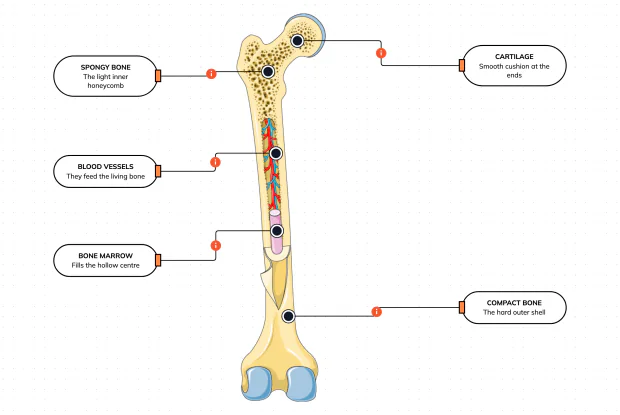
What Is a Bone Made Of?
Cut a bone open and it is nowhere near solid: a hard outer shell, a light honeycomb inside, a hollow centre full of marrow, blood vessels threading through, and a smooth cushion at each end. Learn what each part does — then label them yourself in an interactive playground.
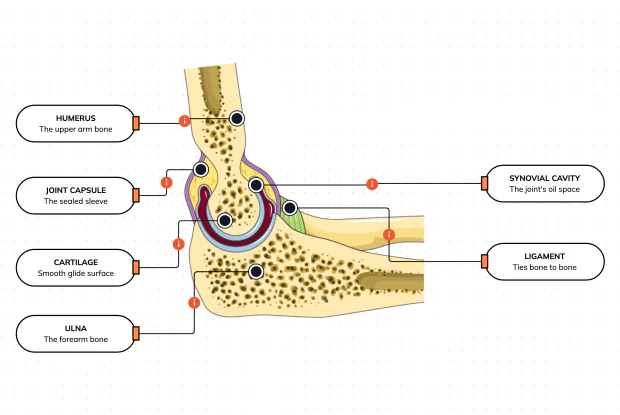
What Is Inside Your Elbow Joint?
A joint is where two bones meet and move — and it is far more than just the bones. Cut open the elbow and you find smooth cartilage caps, a sealed capsule of slippery fluid, and tough ligaments holding it all together. Learn what each part does, then label them yourself in an interactive playground.
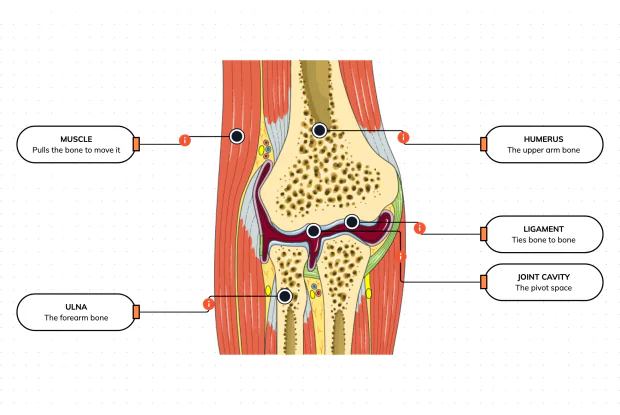
What Makes Your Elbow Bend?
Bones and joints are just the hardware; nothing moves until a muscle pulls. Label the elbow to see the parts that turn a joint into movement — the muscle that pulls, the ligament that holds bone to bone, the two bones it links, and the space they pivot in — then build it yourself in an interactive playground.
What Holds Your Elbow Together?
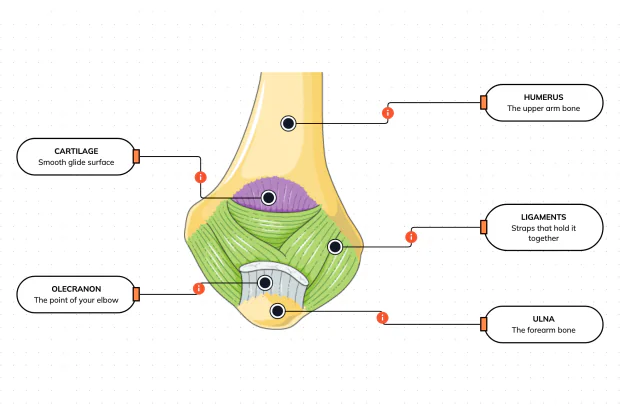
Your elbow is pulled on all day — by gravity, by every bag you carry, by every time you hang or push. So what stops the two bones from simply coming apart? Look at the back of the elbow and label the ligaments, the bony point, the cartilage and the two bones — and learn what holds the whole joint together.
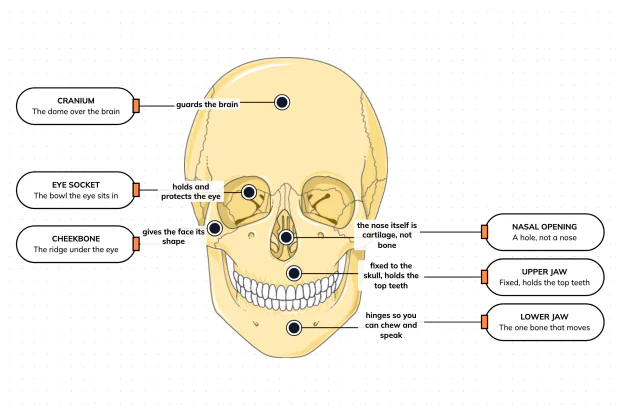
What Are the Main Bones of the Skull?
The skull looks like a single bone, but it is really about twenty-two locked together — with just one left free to move. Learn what each main part does, then label a skull yourself in an interactive playground.
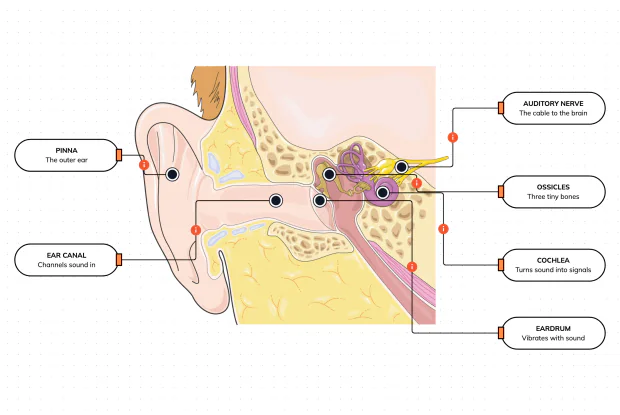
What Are the Parts of Your Ear?
Hearing is a chain of parts passing a sound along, each handing it to the next. Label the pinna, ear canal, eardrum, ossicles, cochlea and auditory nerve, and follow a sound all the way from the air outside to a signal your brain can read — in an interactive playground.
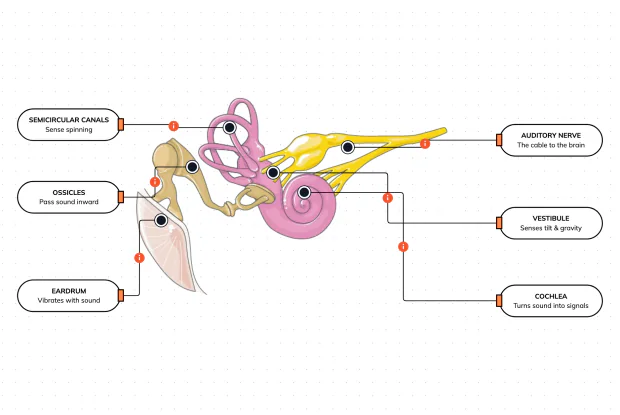
How Does Your Ear Keep You Balanced?
Your ear does a second, hidden job: balance. Inside it sit fluid-filled loops that sense spinning and a chamber that senses tilt and gravity. Label the semicircular canals, vestibule, cochlea, ossicles, eardrum and nerve, and learn how one organ both hears and keeps you upright — in an interactive playground.
What Are the Parts of the Eye You Can See?
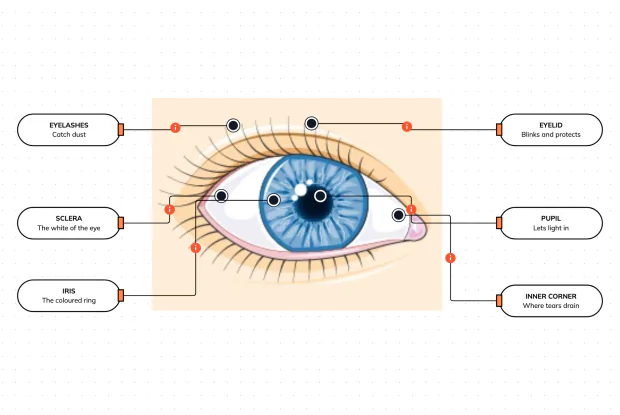
Before you look inside the eye, learn the parts you can already see in a mirror. Label the pupil, iris, sclera, eyelid, eyelashes and the tear-duct corner, and learn what each visible part does to let in light and protect the eye — in an interactive playground.
Where Do Your Tears Come From and Go?
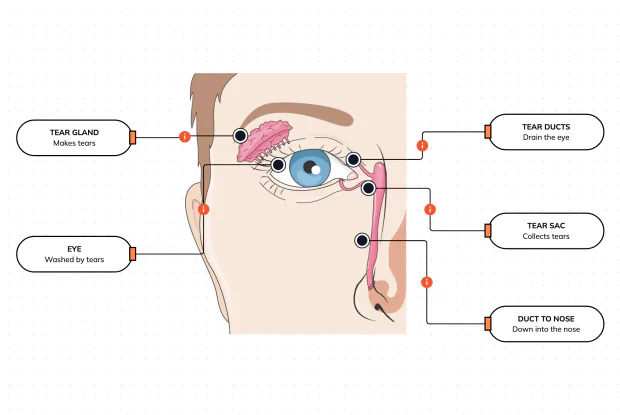
Your eyes make and drain tears all day to stay clean and wet. Label the tear gland, the eye, the tear ducts, the tear sac and the duct to the nose, and follow a tear from where it is made to where it drains — in an interactive playground.
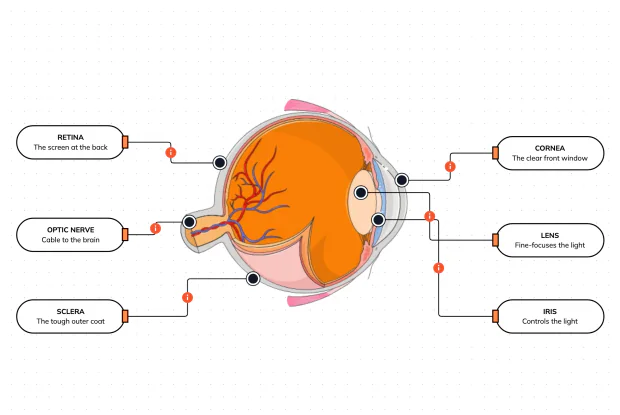
How Does Your Eye Turn Light Into a Picture?
Your eye works like a living camera. Cut it open and label the cornea, lens, iris, retina, optic nerve and sclera, and follow light as it is focused onto a screen at the back of the eye and sent to the brain — in an interactive playground.