What Are the Bones of the Hand?
Root Concept
The hand has twenty-seven bones in three groups — carpals at the wrist, metacarpals in the palm, and phalanges in the fingers — and the thumb is the odd one out, with only two finger bones set to swing across and meet the others.
CodePLU Goal
Upgrading Human Mental Models
Learn how to think in Workflows

Concept Development By codeplu.com
Each group of hand bones, joined to the job its shape is built for — grip, span, or bend
Why Does the Hand Need Twenty-Seven Bones?
Open and close your hand, then touch your thumb to each fingertip in turn. That much movement, that much precision, all from something small enough to fit in a pocket — it takes a lot of separate bones to do it. Twenty-seven, in fact, packed into a hand not much bigger than this screen. If the hand were one solid piece it could only ever be a paddle; it is the joints between many small bones that turn it into a tool.
Those twenty-seven bones fall into three tidy groups, and once you see the groups the hand stops looking complicated. At the wrist sit eight little bones called the carpals, packed like pebbles so the wrist can bend and swivel. Fanning out from them are five long bones, the metacarpals, that make the palm — you can feel them as the ridges on the back of your hand. And out at the ends are the fingers, each built from small bones called phalanges stacked end to end.
There is one exception, and it is the most useful bone story in the whole hand: the thumb. Every finger has three phalanges, but the thumb has only two — and it is set at an angle to the palm so it can swing across and press against each finger. In the playground above you will label a fingertip bone, the two other finger bones, a palm bone, the wrist cluster and the thumb — and the label on each connection tells you what that part is for.
What Does Each Group of Hand Bones Do?
Why does the hand have so many separate bones?
The hand has twenty-seven bones because every movement it makes happens at a joint between two bones — and the hand needs a great many movements. A single bone can only swing where it is attached; it cannot fold, curl or grip. By building the hand from many small bones, each with a joint to the next, evolution gave you a part that can wrap around a mug, pinch a needle, make a fist or lie flat. The number of bones is really the number of things the hand can do.
What are the phalanges?
The phalanges are the finger bones — the small bones stacked end to end that make up each finger and the thumb. Every ordinary finger has three: the proximal phalanx at the base where it joins the palm, the middle phalanx in the middle, and the distal phalanx at the tip, which carries the nail. Two joints between them are what let a finger curl into a hook. There are fourteen phalanges in each hand — three in each of the four fingers, and two in the thumb.
Why does the thumb have only two bones?
The thumb skips the middle phalanx, so it has just two bones instead of three. That sounds like it should make the thumb clumsier, but it is the opposite. A shorter, stiffer thumb is set at an angle to the palm and swings on a saddle-shaped joint at its base, so it can rotate across to meet every fingertip. That move — thumb touching finger — is called opposition, and it is what lets you pinch, grip and hold a pen. The thumb trades one bone for the most important trick the hand has.
What do the metacarpals do?
The metacarpals are the five long bones that make up the palm, running from the wrist out to the base of each finger. You can feel them as the firm ridges on the back of your hand, and their rounded ends are your knuckles — the bumps that stand up when you make a fist. They set how wide your hand can spread and give the fingers a solid base to pull against. The thumb's metacarpal is the one set apart, angled off to the side so the thumb can swing.
What are the carpals, the wrist bones?
The carpals are eight small bones packed together at the wrist, between the two forearm bones and the palm. Because there are many of them and each can shift a little against its neighbours, the wrist can bend forwards and back, tilt side to side, and help the hand twist — movements a single joint could never manage. They also spread the shock when you catch yourself on your hands. This is where the arm hands over to the hand: the wrist is the join between the two.
Real World Example
Why Can You Touch Your Thumb to Every Finger?
Press your thumb to the tip of your little finger, then walk it across to each finger in turn. No other part of your body can do that, and it is the single reason the human hand is such a good tool. Here is what makes it work:
The thumb sits apart
Angled off the palm
The thumb's talent begins before it even moves, with where it is planted. Its palm bone — the first metacarpal — is not lined up neatly alongside the other four the way the finger bones are; it is set lower on the hand and rotated, so the whole thumb juts out from the side and already points across the palm toward the fingers. That angled starting position is half the secret. Because the thumb begins aimed at its targets rather than lying parallel to them, it does not have to travel far or contort itself to reach them — the geometry has quietly done part of the work in advance. Look at an animal's paw, where the equivalent digit lies flat in line with the rest, and you can see just how much that small rotation buys the human hand.
A saddle joint lets it swing
The base that rotates
The other half of the secret is the joint at the base of the thumb, where its metacarpal meets the wrist. This is a saddle joint — two curved, saddle-shaped surfaces sitting across each other — and its shape lets the thumb do something the finger knuckles cannot: rotate, as well as simply bend and straighten. That extra spin is what carries the pad of the thumb round to press flat against the pad of each fingertip in turn, a movement doctors call opposition. Without the saddle joint the thumb could only flap back and forth in a single plane, next to useless for gripping. With it, the thumb can sweep in a wide arc across the whole hand, meeting the little finger, the index finger and everything in between.
What this tells you
Two bones, endless grips
Here is the trade the thumb makes: it gives up the third bone that every finger has, staying short and stiff, and in return it becomes strong and free to swing. That single trade is why the human hand is such a formidable tool. Pinching a coin, gripping a hammer, buttoning a shirt, holding a pen, turning a page — every one of those actions is really the same move underneath, the thumb opposing one or more fingers to trap something between them. It is precise, delicate work that a flat paw simply cannot manage, however clever the animal. Next time you pick up anything at all, watch the thumb swing in to meet your fingers: two small bones, angled and saddle-jointed, doing the defining work of the entire human hand.
FAQs
Final Words
The hand is the skeleton at its most detailed: twenty-seven bones in three clear groups. The carpals make a flexible wrist, the metacarpals spread into the palm, and the phalanges build fingers that curl and grip — with the two-boned thumb swinging across to meet them all. Every one of those bones earns its place by adding a movement, which is why the hand can do everything from a heavy grip to threading a needle.
Label the fingertip bone, the middle and base finger bones, a palm bone, the wrist cluster and the thumb, and you can name any part of your own hand and say what it does. That finishes the upper limb, from shoulder to fingertip. Next in the skeleton the body turns downward — to the pelvis, where the legs plug in.
Continue This Track
This concept is part 18 of The Human Body, Head to Toe.
What Is a Bone Made Of?
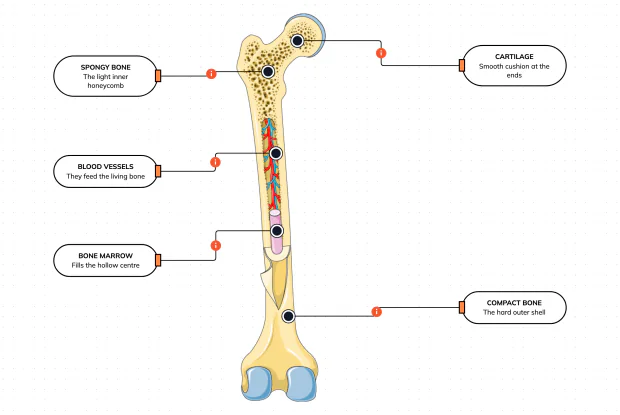
Cut a bone open and it is nowhere near solid: a hard outer shell, a light honeycomb inside, a hollow centre full of marrow, blood vessels threading through, and a smooth cushion at each end. Learn what each part does — then label them yourself in an interactive playground.
What Is Inside Your Elbow Joint?
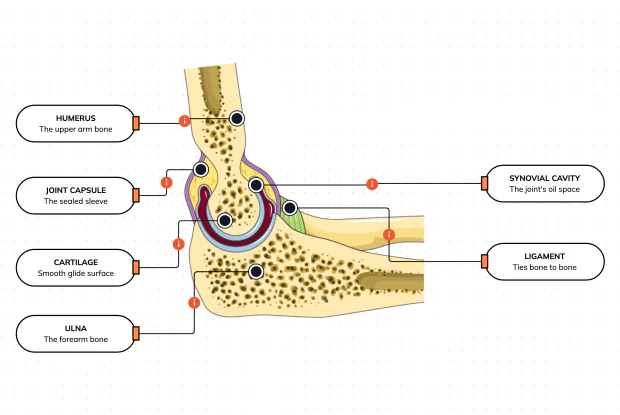
A joint is where two bones meet and move — and it is far more than just the bones. Cut open the elbow and you find smooth cartilage caps, a sealed capsule of slippery fluid, and tough ligaments holding it all together. Learn what each part does, then label them yourself in an interactive playground.
What Makes Your Elbow Bend?
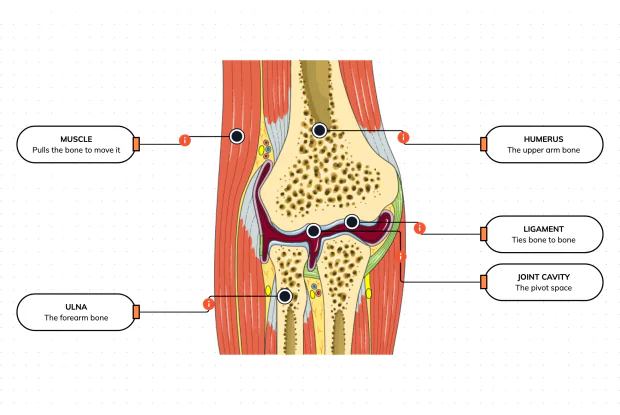
Bones and joints are just the hardware; nothing moves until a muscle pulls. Label the elbow to see the parts that turn a joint into movement — the muscle that pulls, the ligament that holds bone to bone, the two bones it links, and the space they pivot in — then build it yourself in an interactive playground.
What Holds Your Elbow Together?
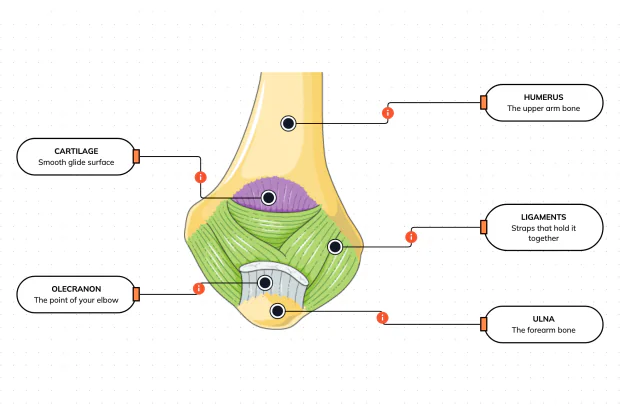
Your elbow is pulled on all day — by gravity, by every bag you carry, by every time you hang or push. So what stops the two bones from simply coming apart? Look at the back of the elbow and label the ligaments, the bony point, the cartilage and the two bones — and learn what holds the whole joint together.
What Are the Main Bones of the Skull?
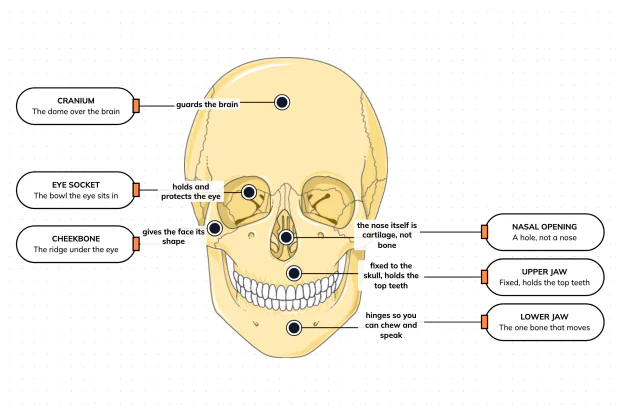
The skull looks like a single bone, but it is really about twenty-two locked together — with just one left free to move. Learn what each main part does, then label a skull yourself in an interactive playground.
What Are the Parts of Your Ear?
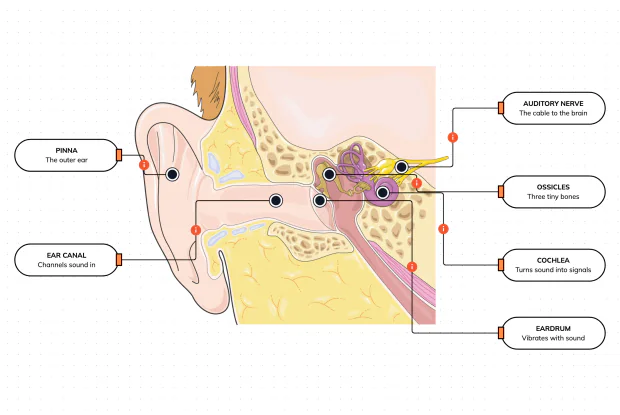
Hearing is a chain of parts passing a sound along, each handing it to the next. Label the pinna, ear canal, eardrum, ossicles, cochlea and auditory nerve, and follow a sound all the way from the air outside to a signal your brain can read — in an interactive playground.
How Does Your Ear Keep You Balanced?
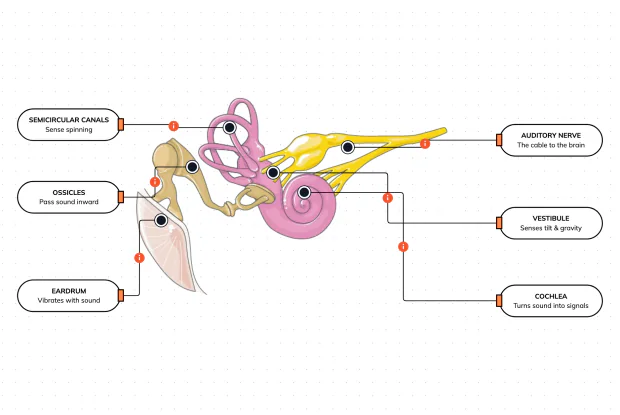
Your ear does a second, hidden job: balance. Inside it sit fluid-filled loops that sense spinning and a chamber that senses tilt and gravity. Label the semicircular canals, vestibule, cochlea, ossicles, eardrum and nerve, and learn how one organ both hears and keeps you upright — in an interactive playground.
What Are the Parts of the Eye You Can See?
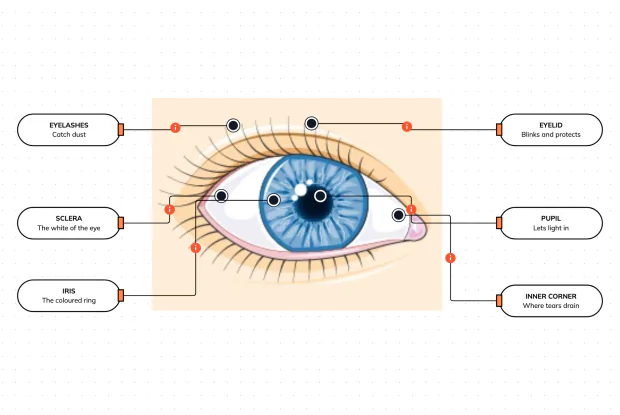
Before you look inside the eye, learn the parts you can already see in a mirror. Label the pupil, iris, sclera, eyelid, eyelashes and the tear-duct corner, and learn what each visible part does to let in light and protect the eye — in an interactive playground.
Where Do Your Tears Come From and Go?
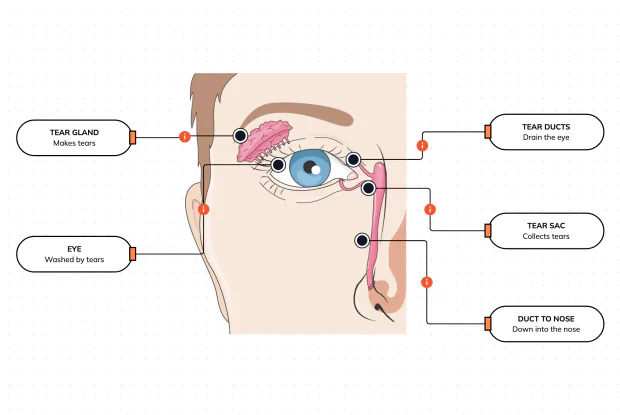
Your eyes make and drain tears all day to stay clean and wet. Label the tear gland, the eye, the tear ducts, the tear sac and the duct to the nose, and follow a tear from where it is made to where it drains — in an interactive playground.
How Does Your Eye Turn Light Into a Picture?
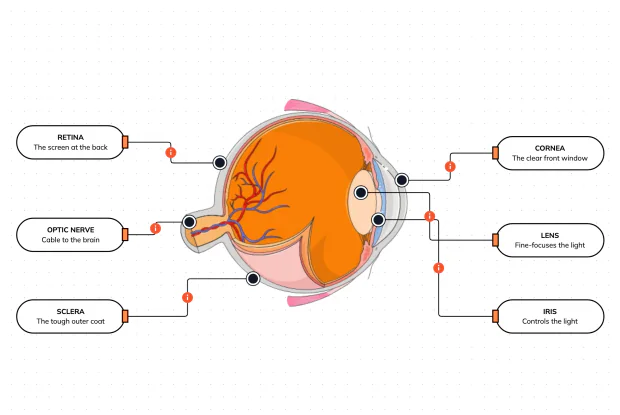
Your eye works like a living camera. Cut it open and label the cornea, lens, iris, retina, optic nerve and sclera, and follow light as it is focused onto a screen at the back of the eye and sent to the brain — in an interactive playground.