What Are the Bones of the Foot?
Root Concept
The foot has twenty-six bones in three groups — tarsals at the ankle and heel, metatarsals in the sole, and phalanges in the toes — with the talus passing your weight down from the leg and the calcaneus forming the heel, all shaped into an arch that springs you forward.
CodePLU Goal
Upgrading Human Mental Models
Learn how to think in Workflows

Concept Development By codeplu.com
Each group of foot bones, joined to the job its shape is built for — bear weight, span the arch, or push off
Why Does the Foot Need Twenty-Six Bones?
Stand up and rock gently from your heels to your toes. A flat board could hold you up, but it could not do that — bend, roll, grip the floor and push you off again. That is why the foot is not one solid piece but twenty-six bones, joined so it can act as a platform one moment and a springboard the next.
Those bones fall into three groups, and once you see them the foot makes sense. At the back and ankle are the tarsals — seven chunky bones including the talus, which the whole leg rests on, and the calcaneus, your heel. In the middle, five long metatarsals run forward to make the sole. And at the front are the phalanges, the small bones of the toes. Weight comes down through the ankle, spreads along the sole, and pushes off through the toes.
Shaped together, these bones curve into an arch — a bridge between the heel and the ball of the foot that flattens a little to absorb each landing and springs back to launch the next step. In the playground above you will label the talus, the heel, the midfoot bones, the metatarsals and the toes — and the label on each connection tells you the job that part does.
What Does Each Group of Foot Bones Do?
Why does the foot have so many bones?
The foot has twenty-six bones because it has two jobs that pull in opposite directions: it must be a stable platform that holds up your whole body, and a flexible spring that bends and pushes off. One solid bone could do the first but never the second. By building the foot from many bones with joints between them, the body gets a structure that can lock stiff to bear weight and then flex to roll you onto your toes. The bones also curve into an arch, which is what lets the foot soak up the shock of every step.
What is the talus, and why is it special?
The talus is the bone at the top of the foot that the whole leg rests on — the two leg bones sit directly on its dome. That makes it the doorway between leg and foot: every bit of weight you carry passes down through the talus before it spreads into the rest of the foot. It is also unusual because almost no muscles attach to it; it is held in place by its shape and the bones around it, working purely as a weight-passing hinge that lets the ankle bend up and down.
What does the heel bone (calcaneus) do?
The calcaneus is the heel — the largest bone in the foot, sitting at the back below the talus. It is the part that hits the ground first with every step, so it is built big and strong to take the thud. It also sticks out behind the ankle to give the calf muscle a lever: the Achilles tendon attaches to the back of the heel, and when the calf pulls on it, the whole foot levers down and pushes you off the ground.
What do the metatarsals do?
The metatarsals are the five long bones that make up the sole, running from the midfoot bones forward to the base of the toes. Together with the tarsals behind them they form the arch, and their front ends — the metatarsal heads — make the ball of the foot, the pad you push down on when you rise onto your toes. Spread across five bones, your weight is shared out along the front of the foot instead of resting on a single point.
What are the phalanges (toe bones)?
The phalanges are the toe bones — fourteen of them, three in each of the four smaller toes and two in the big toe, just like the thumb of the hand. They are the last thing to leave the ground in a step: as you roll forward, the toes grip and press down to give a final push. The big toe carries most of that push-off force, which is why it is built with thicker, stronger bones than the others.
Real World Example
Why Doesn't Landing From a Jump Shatter Your Foot?
Hop off a low step and land on the balls of your feet. A heavy weight dropped onto rigid bone would crack it, but your foot absorbs the blow and you barely feel it. The arch of the foot is the reason:
The arch flattens
A spring, not a rod
The moment your feet touch down, your whole body weight drops onto the arch — the curved bridge of bones that runs from your heel to the ball of your foot. Instead of meeting the ground as a single rigid block, the arch presses downward and flattens a little, and the tough band of tissue slung beneath it, the plantar fascia, stretches like a drawn bow. That flattening is the whole trick: it spreads the force of the landing out over a longer moment in time, rather than letting your full weight slam against solid bone in a single instant. The same load, delivered gradually, is one your bones and joints can absorb without harm — which is why a foot bends on impact instead of cracking.
The arch springs back
Energy returned
Stretched tissue wants to snap back, and that is exactly what the arch does next. As you shift your weight forward and prepare to lift off, the plantar fascia and the arch's ligaments recoil, pulling the tarsal and metatarsal bones back into their curved shape and giving some of the stored energy back as an upward, forward push. This is why running and jumping feel springy rather than dead underfoot: every landing quietly loads the arch like a spring, and every push-off releases it. Your foot is not merely absorbing each step — it is handing part of that energy straight back to help power the next one, so you spend a little less effort with every stride.
What this tells you
Many bones make a spring
A single flat slab of bone could carry your weight, but it could never do this — it cannot bend, store energy and rebound. It is precisely because the foot is built from many bones curved into an arch — the tarsals at the back, the five metatarsals along the sole, and the flexible joints knitting them together — that a hard landing becomes a controlled spring instead of a jarring shock. The number of bones is not clutter or over-engineering; it is the very thing that turns each step from a blunt impact into a smooth launch, and it is what quietly protects your skeleton from the pounding of every stride, mile after mile, for a lifetime of walking.
FAQs
Final Words
The foot is the skeleton doing two jobs at once. Twenty-six bones in three groups — tarsals, metatarsals and phalanges — give it the stiffness to hold you up and the flexibility to roll you forward. The talus takes your weight from the leg, the calcaneus forms the heel and levers you off the ground, the metatarsals spread the load along the sole, and the toes push off at the end of each step — all curved into an arch that turns every landing into a spring.
Label the talus, the heel, the midfoot bones, the metatarsals and the toes, and you can name any part of your own foot and say what it does. This is where the skeleton finally meets the ground — the head-to-toe journey reaching the toes at last.
Continue This Track
This concept is part 24 of The Human Body, Head to Toe.
What Is a Bone Made Of?
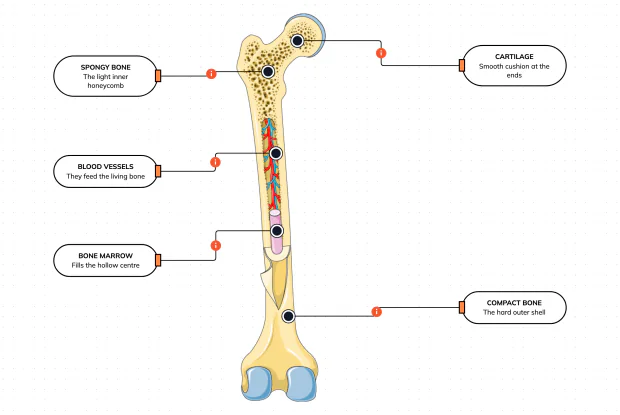
Cut a bone open and it is nowhere near solid: a hard outer shell, a light honeycomb inside, a hollow centre full of marrow, blood vessels threading through, and a smooth cushion at each end. Learn what each part does — then label them yourself in an interactive playground.
What Is Inside Your Elbow Joint?
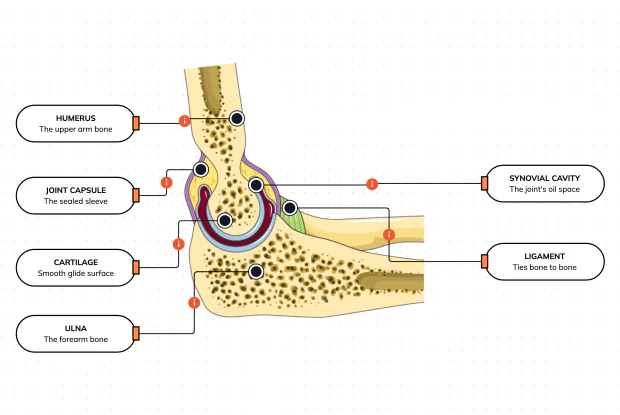
A joint is where two bones meet and move — and it is far more than just the bones. Cut open the elbow and you find smooth cartilage caps, a sealed capsule of slippery fluid, and tough ligaments holding it all together. Learn what each part does, then label them yourself in an interactive playground.
What Makes Your Elbow Bend?
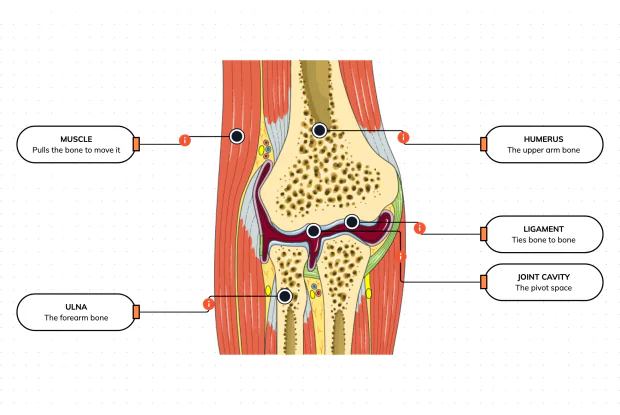
Bones and joints are just the hardware; nothing moves until a muscle pulls. Label the elbow to see the parts that turn a joint into movement — the muscle that pulls, the ligament that holds bone to bone, the two bones it links, and the space they pivot in — then build it yourself in an interactive playground.
What Holds Your Elbow Together?
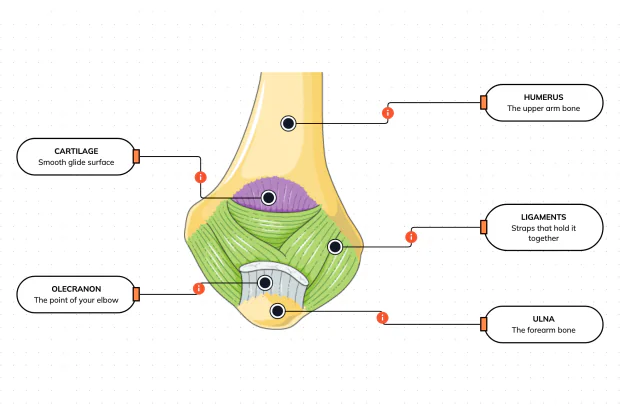
Your elbow is pulled on all day — by gravity, by every bag you carry, by every time you hang or push. So what stops the two bones from simply coming apart? Look at the back of the elbow and label the ligaments, the bony point, the cartilage and the two bones — and learn what holds the whole joint together.
What Are the Main Bones of the Skull?
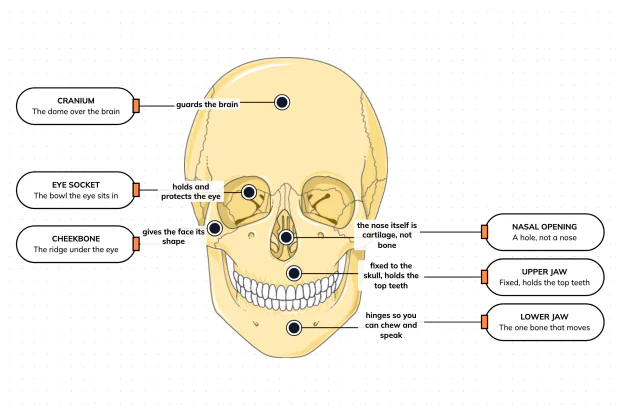
The skull looks like a single bone, but it is really about twenty-two locked together — with just one left free to move. Learn what each main part does, then label a skull yourself in an interactive playground.
What Are the Parts of Your Ear?
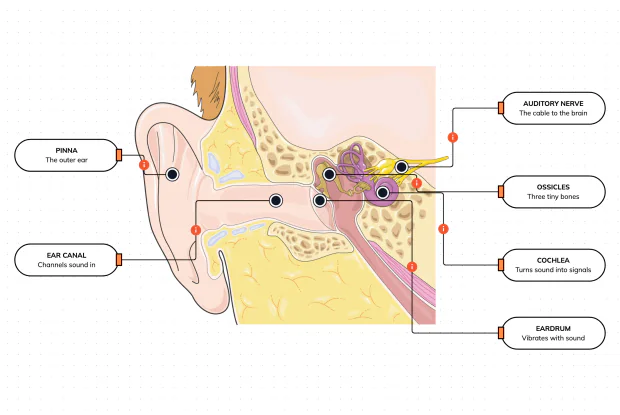
Hearing is a chain of parts passing a sound along, each handing it to the next. Label the pinna, ear canal, eardrum, ossicles, cochlea and auditory nerve, and follow a sound all the way from the air outside to a signal your brain can read — in an interactive playground.
How Does Your Ear Keep You Balanced?
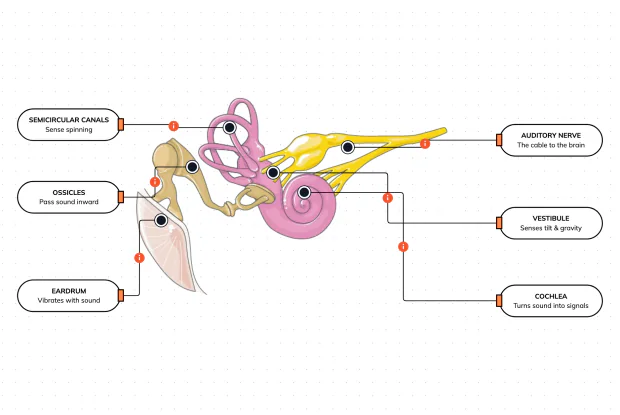
Your ear does a second, hidden job: balance. Inside it sit fluid-filled loops that sense spinning and a chamber that senses tilt and gravity. Label the semicircular canals, vestibule, cochlea, ossicles, eardrum and nerve, and learn how one organ both hears and keeps you upright — in an interactive playground.
What Are the Parts of the Eye You Can See?
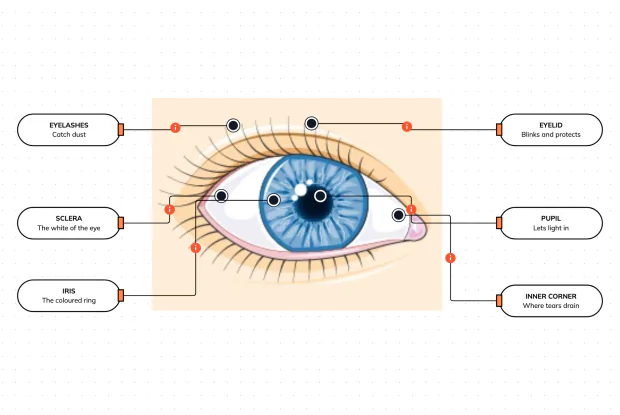
Before you look inside the eye, learn the parts you can already see in a mirror. Label the pupil, iris, sclera, eyelid, eyelashes and the tear-duct corner, and learn what each visible part does to let in light and protect the eye — in an interactive playground.
Where Do Your Tears Come From and Go?
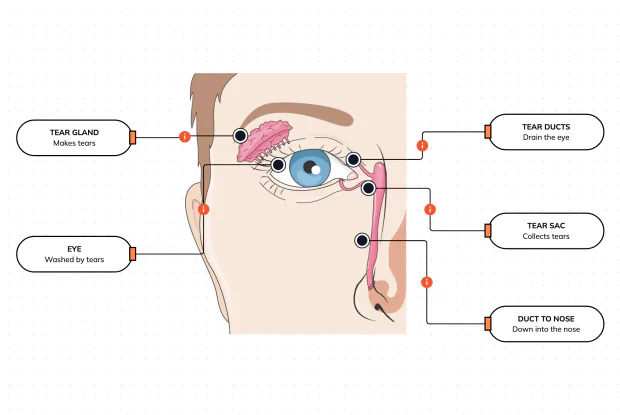
Your eyes make and drain tears all day to stay clean and wet. Label the tear gland, the eye, the tear ducts, the tear sac and the duct to the nose, and follow a tear from where it is made to where it drains — in an interactive playground.
How Does Your Eye Turn Light Into a Picture?
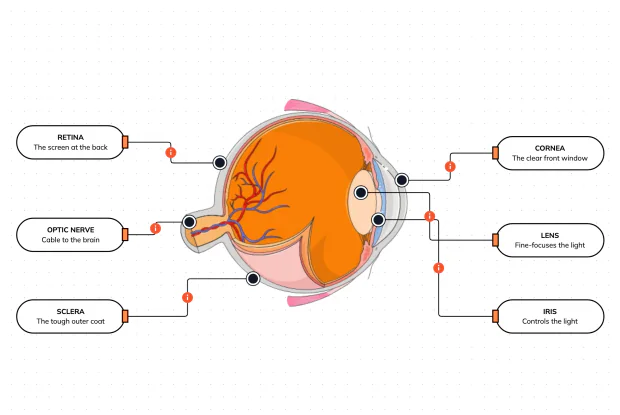
Your eye works like a living camera. Cut it open and label the cornea, lens, iris, retina, optic nerve and sclera, and follow light as it is focused onto a screen at the back of the eye and sent to the brain — in an interactive playground.