What Are the Bones of the Arm?
Root Concept
The arm has one bone in the upper arm for strength and reach, and two in the forearm so one can roll over the other to turn the palm — joined by a hinge at the elbow and a cluster of small bones at the wrist.
CodePLU Goal
Upgrading Human Mental Models
Learn how to think in Workflows
Concept Development By codeplu.com
Each bone of the arm, joined to the job its shape is built for — reach, hinge, or twist
Why Does the Arm Have One Bone in Some Places and Two in Others?
Hold your arm out and turn your palm up, then down. Your upper arm did not move — the twisting all happened below the elbow. That simple action is the whole reason the arm is built the way it is, and the clue is in the bones: the upper arm has one, the forearm has two.
One thick bone in the upper arm is the strong lever — it swings the whole arm from the shoulder and takes the load when you lift or push. But a single bone cannot twist along its length without twisting everything attached to it. So the forearm is given two slimmer bones instead, laid side by side. One stays put as an anchor while the other rolls across it, and that rolling is what turns your hand over without moving your shoulder. Two bones where you need rotation, one where you need strength.
Between them sits the elbow, a hinge that bends and straightens but deliberately does not twist — the twisting is the forearm's job, not the elbow's. And where the forearm meets the hand there is a cluster of small wrist bones that let the hand tilt and flex. In the playground above you will label the upper-arm bone, the elbow, the two forearm bones and the wrist — and the label on each connection is the job that bone does.
What Does Each Bone of the Arm Do?
Why is there just one bone in the upper arm?
The upper arm has a single, thick bone — the humerus — running from the shoulder to the elbow. One big bone is the right answer here because this part of the arm is about strength and reach, not twisting. It is the lever that swings the whole arm from the shoulder and carries the load when you lift, throw or push. Making it one solid bone keeps it strong; splitting it in two would only weaken it, and there is no job up here that a second bone would help with.
Why does the forearm have two bones?
The forearm has two bones — the radius and the ulna — lying side by side, and that pair is what lets you turn your palm up and down. The ulna stays still as an anchor, and the radius rolls across it, carrying your hand with it. Try it: turn your palm over slowly and feel your forearm, and you can feel the bones shift. A single forearm bone could not do this — to turn your hand you would have to twist your whole arm from the shoulder. Two bones is the price of a hand that rotates on its own.
How do you tell the radius from the ulna?
They swap importance from end to end. The ulna is the bigger bone at the elbow — it forms the bony point you lean on and makes the hinge with the upper arm. The radius is the bigger bone at the wrist — it carries most of the hand and forms most of the wrist joint. An easy memory: the radius is on the thumb side, and it is the one that 'radiates' round to turn the palm. The ulna is the steady anchor the radius turns against.
What kind of joint is the elbow?
The elbow is a hinge, and a hinge moves on one axis only — it bends and straightens, like a door, but it does not twist. That is deliberate. If the elbow itself could rotate, the forearm's careful two-bone twisting system would have nothing solid to work against. So the jobs are split: the elbow handles bend-and-straighten, and the two forearm bones handle the turning. It is also why you cannot bend your elbow backwards — a hinge only opens so far.
What is the wrist actually made of?
The wrist is not a single joint but a cluster of eight small bones packed together between the forearm and the hand. Having many little bones that can each shift a little is what lets your hand tilt up and down, side to side, and take the shock of a fall or a push-up. It is the hinge between arm and hand — and it is where this tutorial hands over to the bones of the hand itself.
Real World Example
Why Can You Turn a Doorknob Without Moving Your Shoulder?
Reach out and turn a doorknob. Your hand rotates, but your upper arm barely moves. That everyday twist is the two-bone forearm doing exactly what it is built for:
The ulna holds still
The anchor
Start with the bone that does not move. When you turn a doorknob, the ulna — the inner of your two forearm bones — stays put, held in a straight line with your upper arm through the hinge of the elbow. It is the fixed post, the steady reference that everything else pivots around. Because the ulna keeps both its place and its alignment, your shoulder and upper arm can stay relaxed and still while all the turning happens further down the arm. Think of it like the spindle at the centre of a wheel: it does not spin itself, but without something solid holding firm in the middle, the moving part would have nothing to rotate against. That quiet, unmoving anchor is one half of what makes the whole twist possible.
The radius rolls over it
The turner
The movement itself comes from the other bone, the radius. Pivoting at the elbow, the radius rolls diagonally across the stationary ulna, crossing over it much like one chopstick sweeping across another. Crucially, the radius carries your hand along with it — the wrist and palm are anchored to the radius, so wherever the radius turns, the hand has to follow. That single rolling motion is what sweeps your palm from facing up to facing down, and it is exactly the motion that turns the doorknob. Lay your free hand flat on your forearm and rotate your wrist slowly: you can actually feel the radius travelling across underneath the skin. One bone stays fixed, one bone rolls across it, and between them your hand turns as if on its own.
What this tells you
Two bones make a wrist that twists
Now imagine the forearm had only one bone. With nothing to roll across, you could not rotate your hand on its own at all — to turn a key or a doorknob you would have to crank your entire arm from the shoulder, the way you heave a stiff broom around. The whole reason your hand can twist independently is that the forearm carries two bones, one holding still while the other rolls over it. That is exactly why so many everyday tools — screwdrivers, keys, taps, dials, doorknobs — are designed to be worked with a flick of the wrist: each one is built around a movement the two-bone forearm hands you for free. Two bones instead of one is the difference between a clumsy paddle and a precision instrument.
FAQs
Final Words
The arm is a study in matching the bone to the job. One thick humerus in the upper arm gives strength and reach; two slim bones in the forearm give rotation, the radius rolling over the steady ulna to turn your palm; a hinge at the elbow keeps bend-and-straighten separate from twist; and a cluster of wrist bones hands movement on to the fingers. Nothing is arbitrary — each choice follows from what that stretch of arm has to do.
Label the humerus, the elbow, the radius, the ulna and the wrist, and the next time you turn a key or a doorknob you will feel the two forearm bones doing exactly what you just learned. Next in the skeleton, the hand takes over where the wrist leaves off.
Continue This Track
This concept is part 17 of The Human Body, Head to Toe.
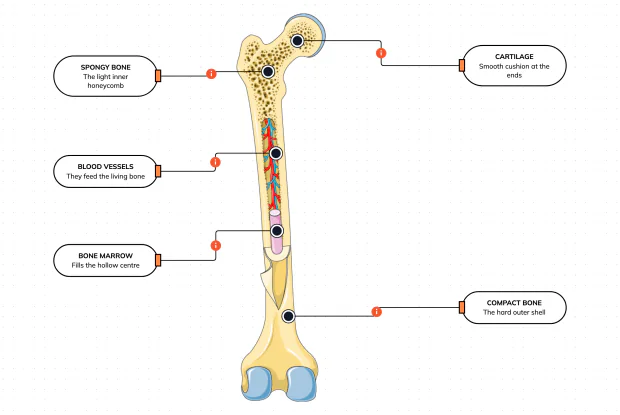
What Is a Bone Made Of?
Cut a bone open and it is nowhere near solid: a hard outer shell, a light honeycomb inside, a hollow centre full of marrow, blood vessels threading through, and a smooth cushion at each end. Learn what each part does — then label them yourself in an interactive playground.
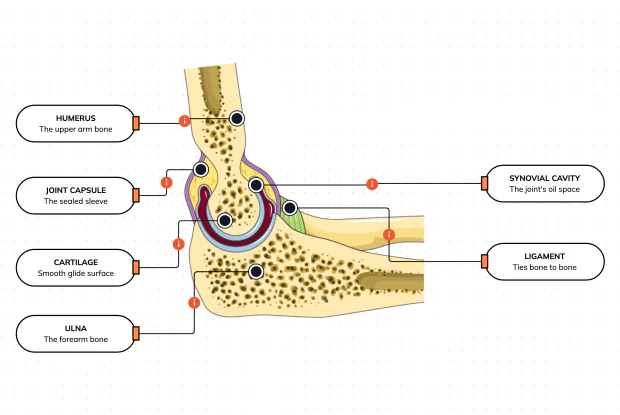
What Is Inside Your Elbow Joint?
A joint is where two bones meet and move — and it is far more than just the bones. Cut open the elbow and you find smooth cartilage caps, a sealed capsule of slippery fluid, and tough ligaments holding it all together. Learn what each part does, then label them yourself in an interactive playground.
What Makes Your Elbow Bend?
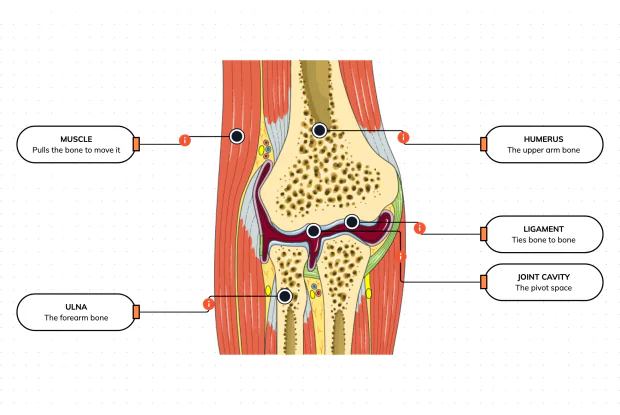
Bones and joints are just the hardware; nothing moves until a muscle pulls. Label the elbow to see the parts that turn a joint into movement — the muscle that pulls, the ligament that holds bone to bone, the two bones it links, and the space they pivot in — then build it yourself in an interactive playground.
What Holds Your Elbow Together?
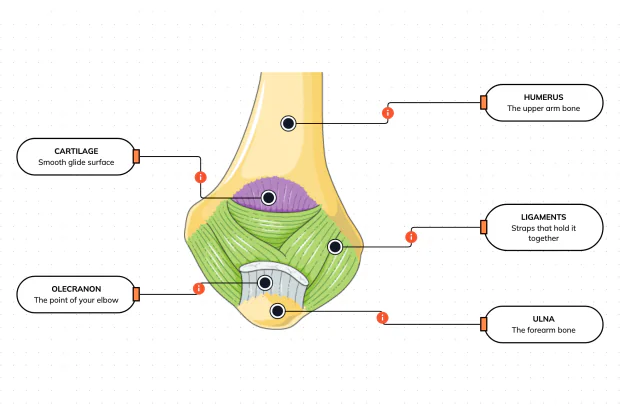
Your elbow is pulled on all day — by gravity, by every bag you carry, by every time you hang or push. So what stops the two bones from simply coming apart? Look at the back of the elbow and label the ligaments, the bony point, the cartilage and the two bones — and learn what holds the whole joint together.
What Are the Main Bones of the Skull?
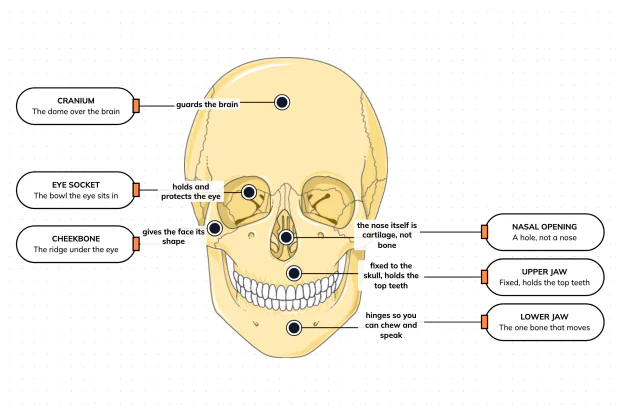
The skull looks like a single bone, but it is really about twenty-two locked together — with just one left free to move. Learn what each main part does, then label a skull yourself in an interactive playground.
What Are the Parts of Your Ear?
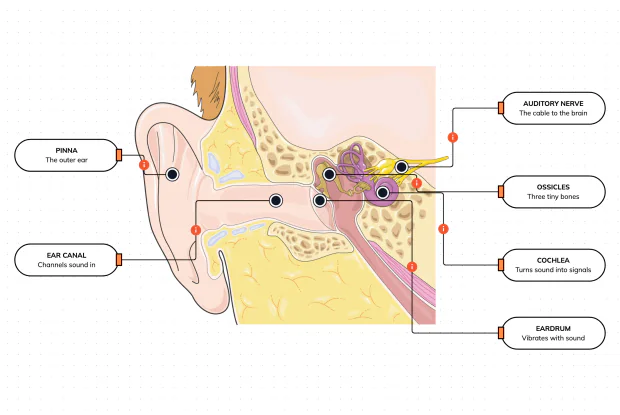
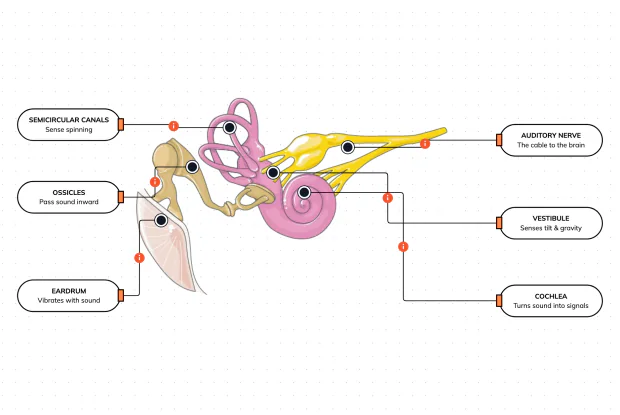
Hearing is a chain of parts passing a sound along, each handing it to the next. Label the pinna, ear canal, eardrum, ossicles, cochlea and auditory nerve, and follow a sound all the way from the air outside to a signal your brain can read — in an interactive playground.
How Does Your Ear Keep You Balanced?
Your ear does a second, hidden job: balance. Inside it sit fluid-filled loops that sense spinning and a chamber that senses tilt and gravity. Label the semicircular canals, vestibule, cochlea, ossicles, eardrum and nerve, and learn how one organ both hears and keeps you upright — in an interactive playground.
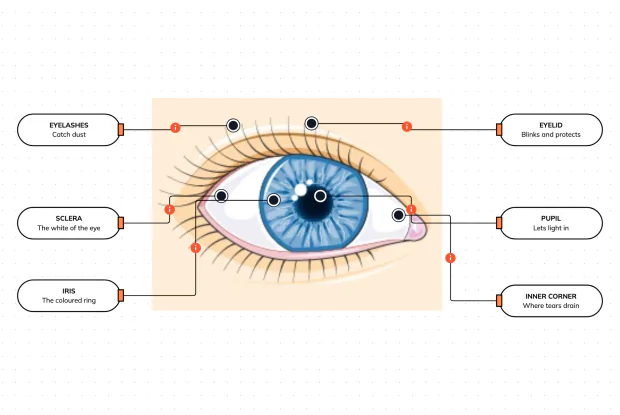
What Are the Parts of the Eye You Can See?
Before you look inside the eye, learn the parts you can already see in a mirror. Label the pupil, iris, sclera, eyelid, eyelashes and the tear-duct corner, and learn what each visible part does to let in light and protect the eye — in an interactive playground.
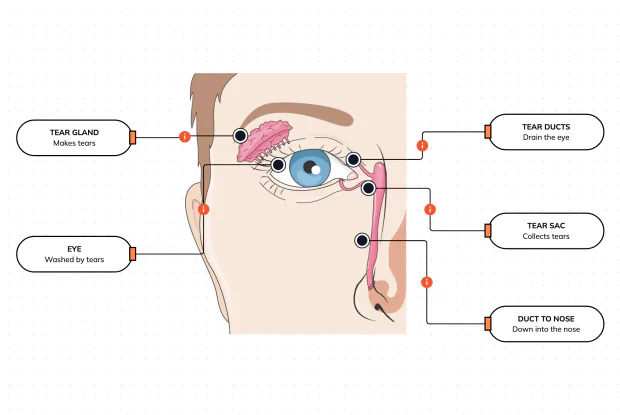
Where Do Your Tears Come From and Go?
Your eyes make and drain tears all day to stay clean and wet. Label the tear gland, the eye, the tear ducts, the tear sac and the duct to the nose, and follow a tear from where it is made to where it drains — in an interactive playground.
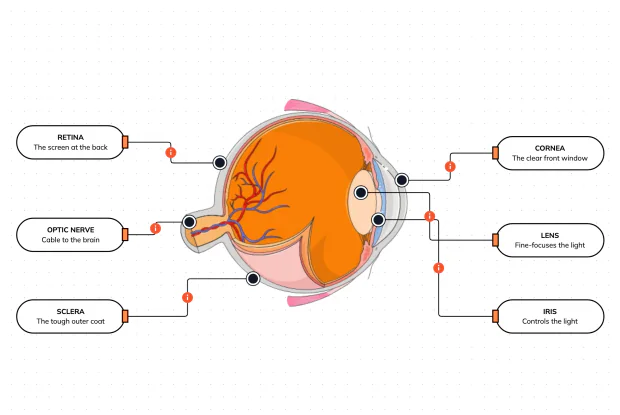
How Does Your Eye Turn Light Into a Picture?
Your eye works like a living camera. Cut it open and label the cornea, lens, iris, retina, optic nerve and sclera, and follow light as it is focused onto a screen at the back of the eye and sent to the brain — in an interactive playground.