What's at the Back of Your Knee?
Root Concept
Seen from behind, the knee is the femur meeting the tibia, wrapped in a sealed joint capsule that holds the joint together and keeps its fluid in. Muscles cross the back of the knee and pull on it through tendons — cords that tie muscle to bone — to bend the leg. The soft hollow behind the knee is the knee pit.
CodePLU Goal
Upgrading Human Mental Models
Learn how to think in Workflows
Concept Development By codeplu.com
The back of the knee, each part joined to the job it does — the two bones, the sealed capsule that holds them, and the muscle and tendon that bend the joint
What Is Hiding Behind Your Knee?
Reach behind your knee and press into the soft hollow there. Unlike the front, which is all hard kneecap and bone, the back of the knee is soft, tender and a little mysterious — there is no bone shielding it, and you can feel cords tighten under the skin when you bend your leg. This is the other side of the joint you already met from the front, and it tells the half of the story the front cannot show: how the whole joint is sealed shut, and how the muscles of your leg actually reach across it to make it move.
You are still looking at the same two bones — the femur (thigh bone) coming down from above and the tibia (shin bone) below — but from behind, the space where they meet is completely covered by a tough green sleeve. That is the joint capsule: a sealed bag that wraps right around the joint, holds the two bones together, and keeps the slippery lubricating fluid trapped inside. From the front you saw the ligaments and cushions inside the joint; from the back you see the wrapping that encloses the whole thing.
Crossing over that capsule are the muscles and their tendons. The big muscles of the thigh and calf do not sit on top of the joint — they pass behind it and grip the bones through pale, cord-like tendons, so that when a muscle pulls, the tendon tugs the bone and the knee bends. In the playground above you will label the two bones, the sealed capsule, a muscle and a tendon — and the label on each connection tells you the job that part does.
What Does Each Part at the Back of the Knee Do?
Which bones are you looking at from behind?
The same two you saw from the front: the femur and the tibia. The femur is the thigh bone, dropping down from the hip, and its lower end — with its two rounded knuckles — forms the top of the knee. The tibia is the shin bone, and its broad flat top forms the bottom of the knee and carries the weight on down toward the ankle. Seeing them from behind is useful because the back of the joint is where most of the muscles cross, so this is the view that shows how the leg's muscles actually reach the bones they move. The bones themselves have not changed — only your viewpoint has, from the front of the leg to the back.
What is the joint capsule?
The joint capsule is the tough, sealed sleeve of tissue that wraps right around the knee where the two bones meet — and from behind you can see it covering almost the whole joint. Think of it as a strong bag drawn tight around the ends of the femur and tibia. It does two jobs at once: it helps hold the bones together, adding to the ligaments, and it seals the joint shut so the slippery synovial fluid that lubricates the cartilage cannot leak away. Every movable joint in your body has one — you met it at the elbow too — but the knee's capsule is large and clearly visible from the back, which makes this the perfect place to see what 'sealing a joint' really looks like.
What is a tendon, and how is it different from a ligament?
A tendon is a tough cord that ties a muscle to a bone. When a muscle contracts, it cannot grab bone directly — it pulls on its tendon, and the tendon passes that pull on to the bone, so the bone moves. At the back of the knee you can see several muscles ending in pale, fan-shaped tendons that grip the bones. The easy way to remember the difference: a tendon ties muscle to bone (it moves the joint), while a ligament ties bone to bone (it holds the joint together). Both are strong bands and both can be injured, but they do opposite jobs — one is for pulling, the other for holding. The cords you can feel tighten behind your knee when you bend it are tendons.
Which muscles cross the back of the knee?
The back of the knee is a crossroads for the big muscles of the leg. Coming down from the thigh are the hamstrings — the muscles on the back of your thigh that bend the knee; you can feel their tendons as the taut cords on either side of the hollow when you bend your leg. Coming up from the calf is the top of the gastrocnemius, the main calf muscle, which actually begins above the knee. Because a muscle can only pull, these muscles bend the knee by pulling the shin backwards, working against the thigh muscles at the front that straighten it. The figure shows them cut across where they cross the joint, so you can see them gripping the bones through their tendons.
Why is the back of the knee so soft and tender?
The soft hollow behind your knee has a name — the popliteal fossa, or simply the 'knee pit' — and it feels different from the front for a good reason. There is no bone or kneecap shielding it; it is just skin over the capsule, tendons, and a bundle of important blood vessels and nerves running down to the lower leg. That is why the back of the knee is tender and why doctors feel there for a pulse. It is also why a swelling can appear there: if the joint capsule makes too much fluid, it can bulge backwards into this soft space as a lump called a Baker's cyst. The knee pit is soft simply because it is the one side of the joint that trades bony armour for a passage-way.
Real World Example
Why Can You Feel Cords Tighten Behind Your Knee?
The back of the knee is one of the few places where you can actually feel the machinery of a joint working under your own skin. Each thing you can feel there maps onto a part in the figure, and together they show how muscle, tendon and capsule cooperate:
The cords you can feel
Hamstring tendons
When you bend your knee against resistance, the two firm cords that stand out on either side of the hollow are tendons — the tendons of your hamstring muscles. The hamstrings sit on the back of your thigh, and to bend the knee they pull the shin bone backwards; but they cannot grip the bone directly, so each one narrows into a tough tendon that crosses the back of the knee and anchors to the lower leg. When the muscle tightens, the tendon goes taut, and that is the cord you feel. It is a live demonstration of the whole muscle–tendon–bone chain: the soft muscle up in the thigh, the cord-like tendon spanning the joint, and the bone it tugs to fold your leg.
The sealed bag that can swell
The joint capsule
The green sleeve wrapping the joint is the capsule, and normally you never notice it — it quietly holds the bones together and keeps the lubricating fluid sealed inside. But it can make itself known. If the knee is irritated or arthritic, the capsule may produce extra fluid, and because the back of the knee is soft and unprotected, that fluid can bulge backwards into the knee pit as a tense, sometimes painful lump behind the joint. Doctors call it a Baker's cyst, and it is simply the sealed capsule ballooning into the one direction where nothing hard is there to stop it. It is a vivid reminder that a joint really is a closed, fluid-filled bag — and that the back of the knee is the bag's soft spot.
Why the back has no armour
The knee pit (popliteal fossa)
The front of your knee is guarded by the kneecap and the hard ends of the bones, but the back is deliberately left open — and that is not a flaw. The hollow behind the knee, the popliteal fossa, is a protected passage-way: the main artery, vein and nerve to your lower leg all run through it, tucked into the soft gap behind the joint where bending the knee cannot pinch them shut. Trading bony armour for a clear channel is the sensible design, because those vessels and nerves must survive every squat and every step. It is why the back of the knee feels soft and tender, why you can find a pulse there, and why it is the natural place for a capsule swelling to appear. The knee pit is soft on purpose.
FAQs
Final Words
Turning the knee around fills in the half of the story the front cannot show. The same femur and tibia meet here, but from behind you see the whole joint sealed inside its capsule — the tough bag that holds the bones together and keeps the lubricating fluid in — and you see how the muscles of the leg actually reach the joint, gripping the bones through cord-like tendons to bend it. Front and back together give you the complete knee: bones and ligaments and cushions inside, capsule and muscles and tendons around.
You now know the difference that trips most beginners up — a tendon ties muscle to bone and moves the joint, a ligament ties bone to bone and holds it — and you know why the soft hollow behind your knee is soft on purpose. With the hip, the femur and both faces of the knee behind you, the leg is nearly complete; the last step down is the ankle and the bones of the foot that meet the ground.
Continue This Track
This concept is part 23 of The Human Body, Head to Toe.
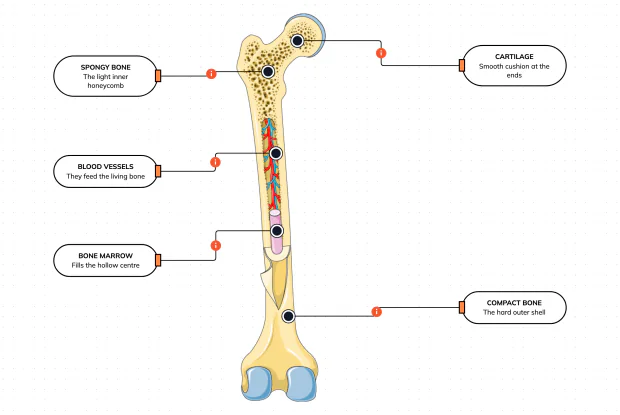
What Is a Bone Made Of?
Cut a bone open and it is nowhere near solid: a hard outer shell, a light honeycomb inside, a hollow centre full of marrow, blood vessels threading through, and a smooth cushion at each end. Learn what each part does — then label them yourself in an interactive playground.
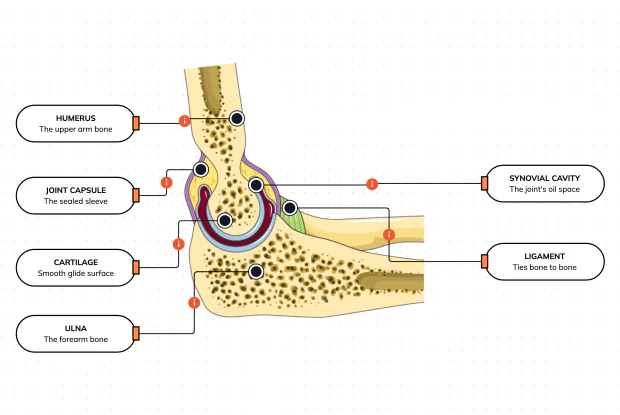
What Is Inside Your Elbow Joint?
A joint is where two bones meet and move — and it is far more than just the bones. Cut open the elbow and you find smooth cartilage caps, a sealed capsule of slippery fluid, and tough ligaments holding it all together. Learn what each part does, then label them yourself in an interactive playground.
What Makes Your Elbow Bend?
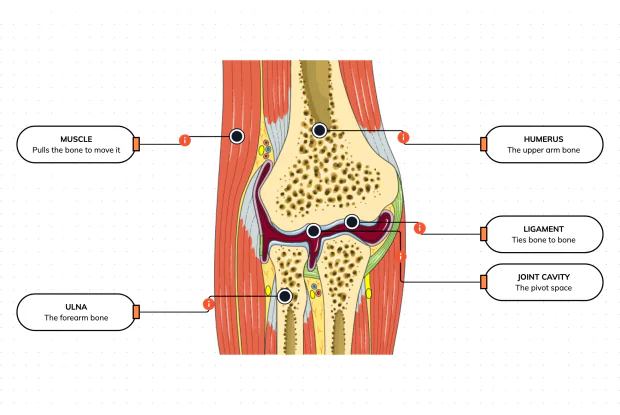
Bones and joints are just the hardware; nothing moves until a muscle pulls. Label the elbow to see the parts that turn a joint into movement — the muscle that pulls, the ligament that holds bone to bone, the two bones it links, and the space they pivot in — then build it yourself in an interactive playground.
What Holds Your Elbow Together?
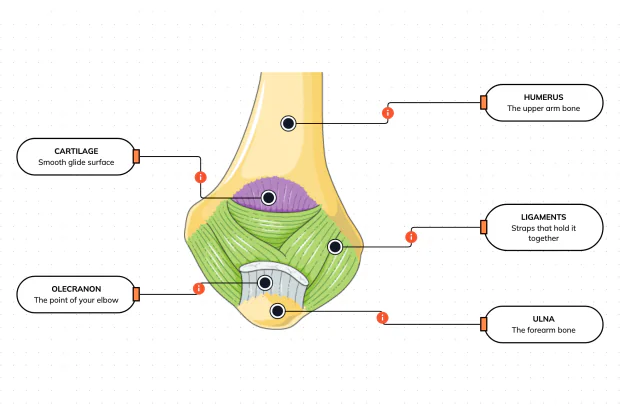
Your elbow is pulled on all day — by gravity, by every bag you carry, by every time you hang or push. So what stops the two bones from simply coming apart? Look at the back of the elbow and label the ligaments, the bony point, the cartilage and the two bones — and learn what holds the whole joint together.
What Are the Main Bones of the Skull?
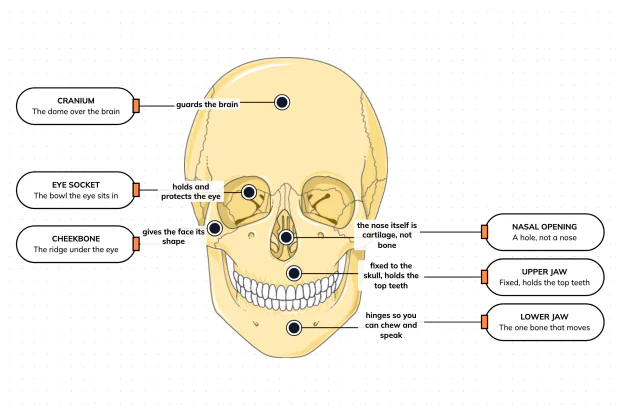
The skull looks like a single bone, but it is really about twenty-two locked together — with just one left free to move. Learn what each main part does, then label a skull yourself in an interactive playground.
What Are the Parts of Your Ear?
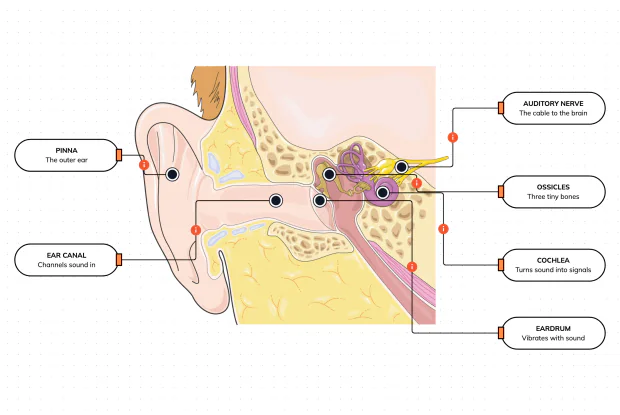
Hearing is a chain of parts passing a sound along, each handing it to the next. Label the pinna, ear canal, eardrum, ossicles, cochlea and auditory nerve, and follow a sound all the way from the air outside to a signal your brain can read — in an interactive playground.
How Does Your Ear Keep You Balanced?
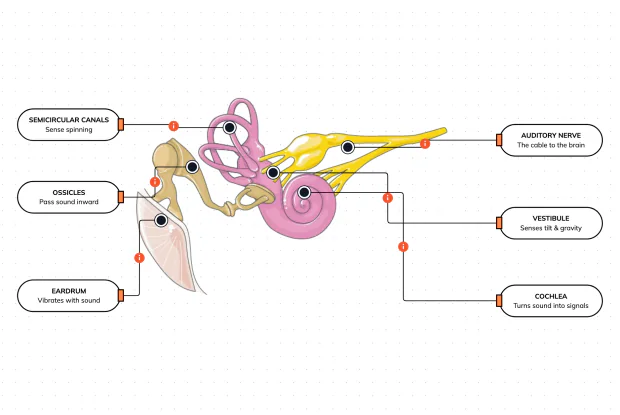
Your ear does a second, hidden job: balance. Inside it sit fluid-filled loops that sense spinning and a chamber that senses tilt and gravity. Label the semicircular canals, vestibule, cochlea, ossicles, eardrum and nerve, and learn how one organ both hears and keeps you upright — in an interactive playground.
What Are the Parts of the Eye You Can See?
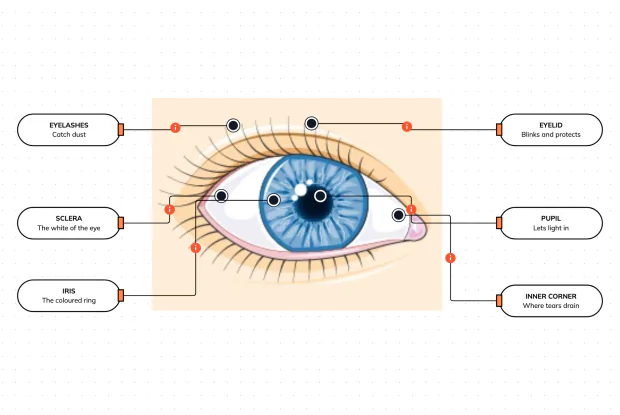
Before you look inside the eye, learn the parts you can already see in a mirror. Label the pupil, iris, sclera, eyelid, eyelashes and the tear-duct corner, and learn what each visible part does to let in light and protect the eye — in an interactive playground.
Where Do Your Tears Come From and Go?
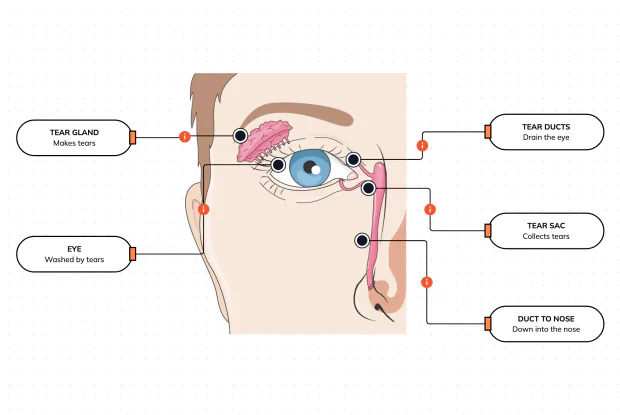
Your eyes make and drain tears all day to stay clean and wet. Label the tear gland, the eye, the tear ducts, the tear sac and the duct to the nose, and follow a tear from where it is made to where it drains — in an interactive playground.
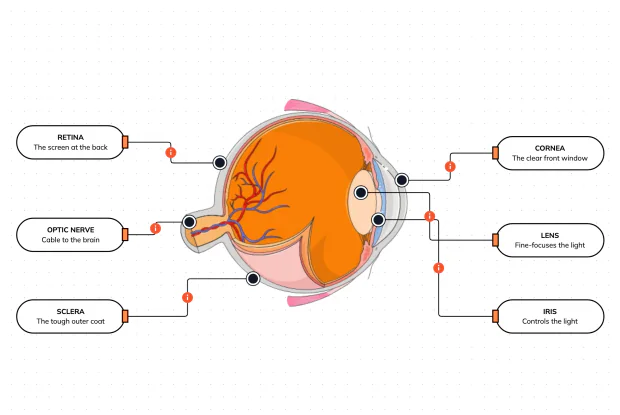
How Does Your Eye Turn Light Into a Picture?
Your eye works like a living camera. Cut it open and label the cornea, lens, iris, retina, optic nerve and sclera, and follow light as it is focused onto a screen at the back of the eye and sent to the brain — in an interactive playground.