How Is the Adrenal Gland Built?
Root Concept
An adrenal gland sits on top of each kidney and is built in parts: a tough outer capsule, an outer cortex that makes steroid hormones such as cortisol, and an inner medulla that makes adrenaline. An artery brings blood in, a central vein carries the hormone-rich blood out, and a nerve runs straight to the medulla to trigger adrenaline instantly.
CodePLU Goal
Upgrading Human Mental Models
Learn how to think in Workflows

Concept Development By codeplu.com
A cut through the adrenal gland, each part joined to its role — the capsule, the hormone-making cortex and medulla, and the artery, vein and nerve that serve them
Where Does the Sudden Rush of Adrenaline Come From?
When something frightens you — a near-miss on a bike, a sudden loud bang — your heart pounds, your breathing quickens and you feel a jolt of energy, all within a second. That jolt has a source: a small gland sitting on top of each of your kidneys, called the adrenal gland. It is only the size of a walnut, but it is one of the body's most powerful control centres.
Cut one open and you find it is built in parts. A tough outer skin, the capsule, wraps the whole gland. Inside, the outer region is the cortex, which makes a family of steroid hormones — including cortisol, the body's main stress and energy hormone. Deep in the middle is the medulla, a different core that makes adrenaline, the fast hormone behind that sudden jolt. In effect it is two glands in one: a slow, steady cortex and a fast-acting medulla.
Because its hormones must reach the whole body quickly, the adrenal gland is richly supplied with blood: an artery brings blood in from the outside, and a large central vein carries the hormone-loaded blood out. A nerve runs straight into the medulla, so that in an emergency the brain can trigger adrenaline in an instant. In the playground you will label the capsule, cortex, medulla, artery, central vein and nerve.
How Is the Adrenal Gland Built?
What is the adrenal gland?
You have two adrenal glands, one perched on top of each kidney like a small cap — which is where the name comes from ('ad-renal' means 'on the kidney'). Each is small, only a few centimetres across, but it makes hormones the body cannot do without. A hormone is a chemical messenger released into the blood to control something far away, and the adrenal glands make several of the most important ones. Wrapping each gland is a tough protective layer called the capsule. Under the capsule, the gland has two clearly different regions that do different jobs: an outer part called the cortex and an inner core called the medulla. Learning the adrenal gland really means learning these two parts and what each one makes.
Cortex outside, medulla inside
The outer region, the cortex, makes up most of the gland and produces a family of hormones called steroids. The best known is cortisol, which helps your body handle stress, control its energy, and stay awake and alert during the day. The cortex also makes hormones that control the balance of salt and water in your body. Deep in the middle, the medulla is smaller but famous: it makes adrenaline (also called epinephrine), the fast hormone that powers your 'fight or flight' response. The two parts even work on different timescales — the cortex works slowly and steadily, keeping you going hour by hour, while the medulla works in a flash, firing adrenaline the moment danger appears. One gland, two very different halves.
Wired and plumbed for speed
A hormone gland is only as good as its ability to get its hormones into the blood, and the adrenal gland is built for exactly that. An artery brings a rich supply of blood in through the outside of the gland, feeding all its cells. As the blood passes through, it picks up the hormones and drains into a large central vein, which carries the hormone-loaded blood straight out to the rest of the body. On top of this, a nerve runs directly into the medulla. This is the secret of how adrenaline can hit so fast: instead of waiting for a slow chemical signal, the brain sends an electrical message down the nerve to the medulla, which dumps adrenaline into the blood in under a second. The gland is both plumbed (artery and vein) and wired (nerve) for speed.
Real World Example
The Adrenal Gland in Action
The design of the adrenal gland explains several things you can feel or observe:
A sudden fright
The nerve fires the medulla for instant adrenaline
Imagine a dog leaps out barking as you walk past a fence. Almost before you have thought about it, your heart is racing and you have jumped back. That is the medulla at work. Your brain sensed danger and sent a signal straight down the nerve into the adrenal medulla, which instantly released adrenaline into the blood. The adrenaline sped your heart, opened your airways and pushed energy to your muscles, all to help you react. This is why the reaction feels so fast — the medulla is wired directly to the nervous system, skipping the slower chemical route. The 'adrenaline rush' is a real event happening in a walnut-sized gland on top of your kidney.
Waking up and getting through the day
The cortex releases cortisol, slowly and steadily
Not every stress is a sudden shock. Getting up in the morning, sitting an exam, or recovering from illness are slower challenges, and the cortex handles those with cortisol. Cortisol levels naturally rise in the early morning to help wake you and get your body ready for the day, then drift down again by night. It also climbs during longer periods of stress, helping release energy and keep you going. Unlike the medulla's instant burst, the cortex works gradually, adjusting your body over hours. So the same little gland covers both ends of stress: the split-second scare and the long, grinding day, using two different parts for the two different jobs.
Getting the hormones out fast
The central vein carries them into the bloodstream
A hormone made in the adrenal gland is useless until it reaches the organs it controls, and speed matters — especially for adrenaline. That is what the gland's rich blood supply is for. Blood arrives through the artery, flows through the hormone-making cells picking up cortisol and adrenaline, and drains into the large central vein at the base of the gland. From there it joins the body's main circulation and is carried everywhere within seconds. This is why the adrenal gland, though tiny, has such a generous blood supply: its whole purpose is to pour hormones into the blood and let the circulation rush them to the entire body almost instantly.
FAQs
Final Words
The adrenal gland is a small but powerful organ on top of each kidney, built in clear parts: a tough capsule wrapping an outer cortex that makes steroid hormones like cortisol, and an inner medulla that makes adrenaline. It is two glands in one — a slow, steady cortex and a fast-firing medulla — and it is richly supplied, with an artery bringing blood in, a central vein carrying hormone-loaded blood out, and a nerve running straight to the medulla for instant action.
That design is why one tiny gland can handle both the split-second scare and the long, demanding day. Next, we can zoom in even closer on the cortex, because it is not one layer but three, each stacked band making its own hormone — the fine detail behind the outer part of this remarkable little gland.
Continue This Track
This concept is part 43 of The Human Body, Head to Toe.
What Is a Bone Made Of?
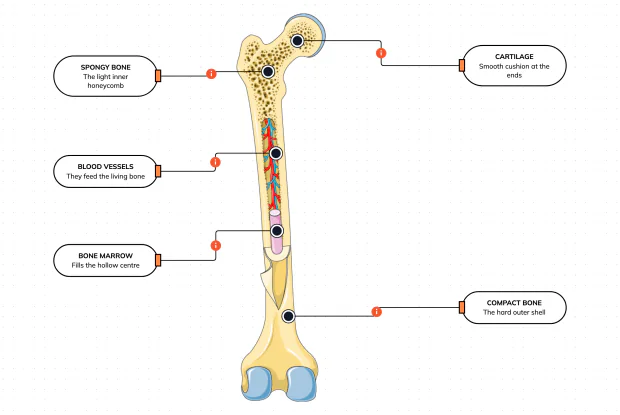
Cut a bone open and it is nowhere near solid: a hard outer shell, a light honeycomb inside, a hollow centre full of marrow, blood vessels threading through, and a smooth cushion at each end. Learn what each part does — then label them yourself in an interactive playground.
What Is Inside Your Elbow Joint?
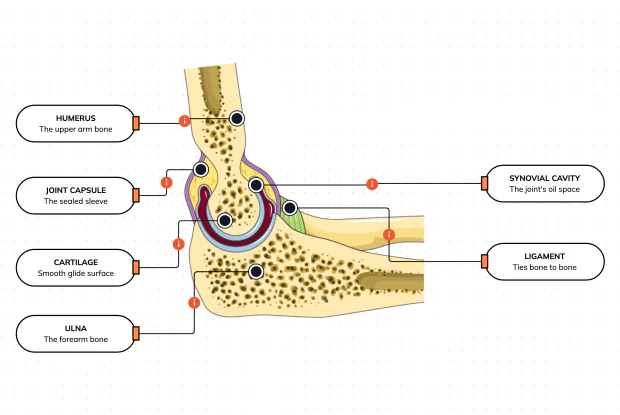
A joint is where two bones meet and move — and it is far more than just the bones. Cut open the elbow and you find smooth cartilage caps, a sealed capsule of slippery fluid, and tough ligaments holding it all together. Learn what each part does, then label them yourself in an interactive playground.
What Makes Your Elbow Bend?
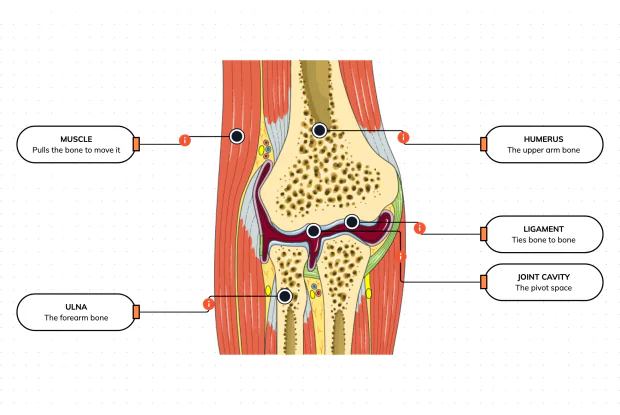
Bones and joints are just the hardware; nothing moves until a muscle pulls. Label the elbow to see the parts that turn a joint into movement — the muscle that pulls, the ligament that holds bone to bone, the two bones it links, and the space they pivot in — then build it yourself in an interactive playground.
What Holds Your Elbow Together?
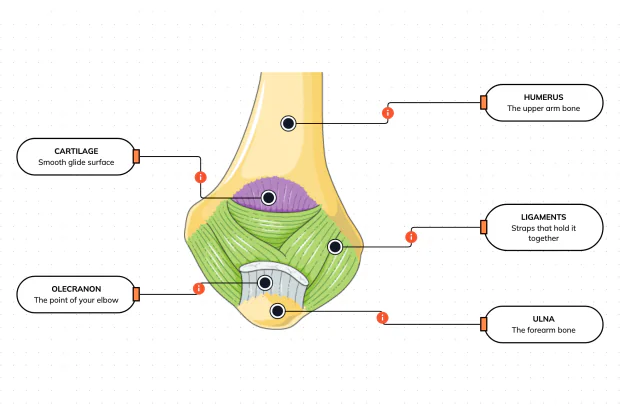
Your elbow is pulled on all day — by gravity, by every bag you carry, by every time you hang or push. So what stops the two bones from simply coming apart? Look at the back of the elbow and label the ligaments, the bony point, the cartilage and the two bones — and learn what holds the whole joint together.
What Are the Main Bones of the Skull?
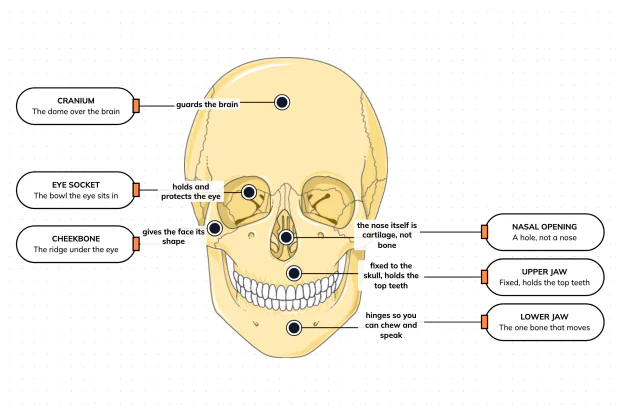
The skull looks like a single bone, but it is really about twenty-two locked together — with just one left free to move. Learn what each main part does, then label a skull yourself in an interactive playground.
What Are the Parts of Your Ear?
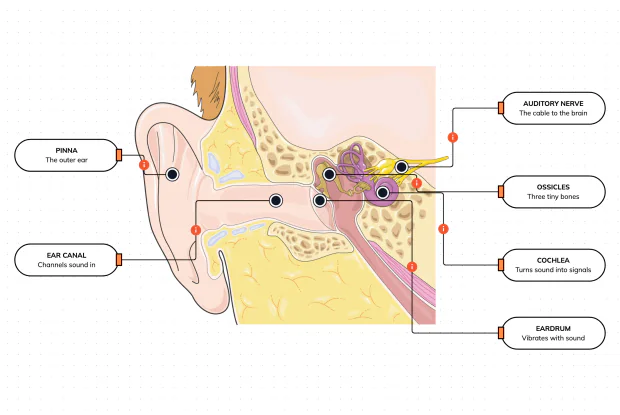
Hearing is a chain of parts passing a sound along, each handing it to the next. Label the pinna, ear canal, eardrum, ossicles, cochlea and auditory nerve, and follow a sound all the way from the air outside to a signal your brain can read — in an interactive playground.
How Does Your Ear Keep You Balanced?
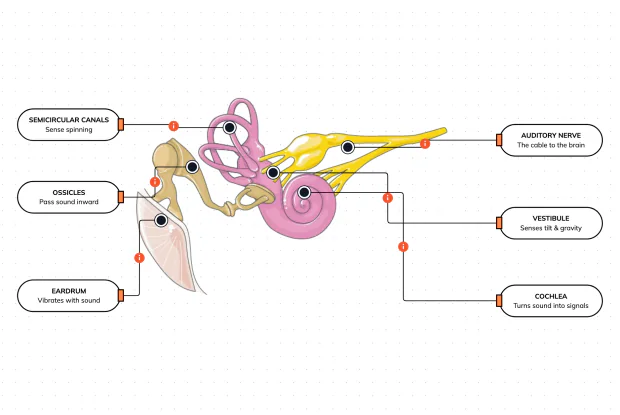
Your ear does a second, hidden job: balance. Inside it sit fluid-filled loops that sense spinning and a chamber that senses tilt and gravity. Label the semicircular canals, vestibule, cochlea, ossicles, eardrum and nerve, and learn how one organ both hears and keeps you upright — in an interactive playground.
What Are the Parts of the Eye You Can See?
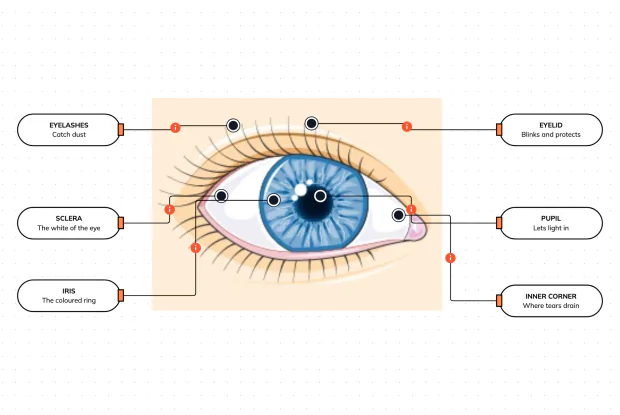
Before you look inside the eye, learn the parts you can already see in a mirror. Label the pupil, iris, sclera, eyelid, eyelashes and the tear-duct corner, and learn what each visible part does to let in light and protect the eye — in an interactive playground.
Where Do Your Tears Come From and Go?
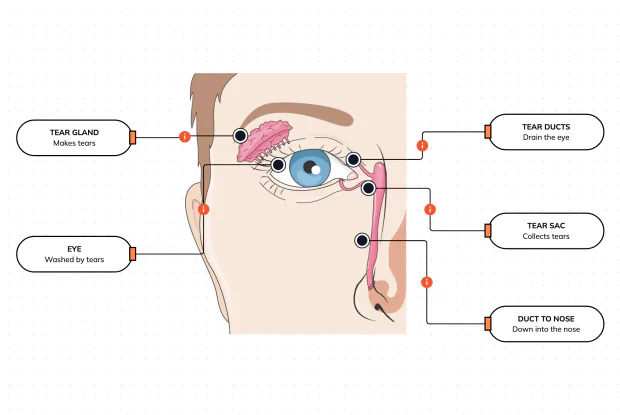
Your eyes make and drain tears all day to stay clean and wet. Label the tear gland, the eye, the tear ducts, the tear sac and the duct to the nose, and follow a tear from where it is made to where it drains — in an interactive playground.
How Does Your Eye Turn Light Into a Picture?
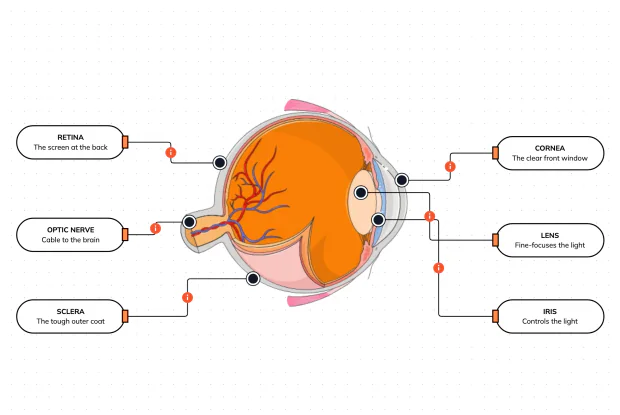
Your eye works like a living camera. Cut it open and label the cornea, lens, iris, retina, optic nerve and sclera, and follow light as it is focused onto a screen at the back of the eye and sent to the brain — in an interactive playground.