How Do You Turn a Rule Into a Formula?
Root Concept
A formula names the quantity you want, then says in letters exactly what to do to the quantities you already have.
CodePLU Goal
Upgrading Human Mental Models
Learn how to think in Workflows

Concept Development By codeplu.com
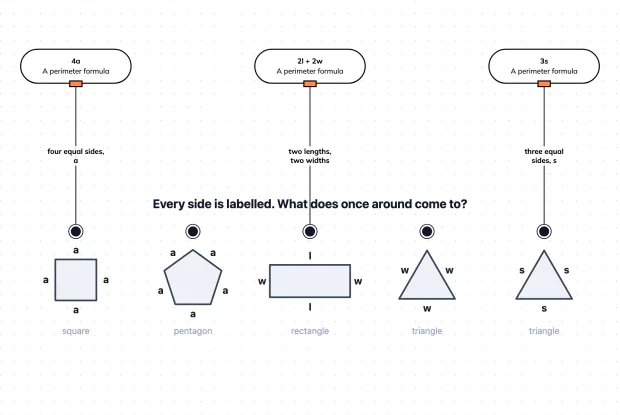
Work out once around for each shape, then match it to its formula
What Turns a Rule Into Something You Can Use?
You already know plenty of rules without calling them formulas. To find the perimeter of a square, add up its four sides. To work out a wage, multiply the hours by the rate. These are perfectly good rules and people use them all day. What they are not yet is usable by maths — you cannot rearrange an English sentence, and you cannot substitute into one.
A formula is the same rule with the quantities named by letters. The perimeter of a square becomes P = 4a, where a is the length of one side. Nothing has been added to the idea. What has changed is that every piece of it now has a name, so the rule can be applied to a side of seven centimetres or seven hundred without being rewritten, and later it can be turned around to find a side when you know the perimeter.
Building one is a three-step job: decide what you are trying to find, decide what you already know, and write down what you do to the second to get the first. In the playground below you get three formulas and five shapes with every side lettered. Work out what once around comes to for each shape, then match it to the formula that says so.
How Does a Sentence Become a Formula?
What are the three parts of a formula?
Every formula has a subject, an equals sign, and a recipe. The subject is the single quantity you are working out, and it sits alone on the left: P for perimeter, C for cost, A for area. The equals sign says the two sides are the same size, just as it does in any equation. The recipe on the right is built only from quantities you already know. So P = 4a reads as the perimeter is four lots of the side length, and every symbol in it has a job. A common slip is to write a formula with the subject buried in the middle, like 4a = P written when you meant to define P. It is not wrong, but putting the thing you want on its own, on the left, is what makes a formula easy to use at a glance.
How do you get from words to letters?
Write the rule as a plain sentence first, then translate it piece by piece. Take a rule for the cost of a taxi ride: the fare is twenty-five rupees plus fifteen rupees for every kilometre. Give each changing quantity a letter — F for the fare, k for the kilometres — and leave the fixed numbers as numbers. Now translate: is becomes the equals sign, plus stays as plus, and for every kilometre becomes multiply by k. You get F = 15k + 25. Do the translation in the order the sentence says it, and resist the urge to simplify while you are still translating. Getting a wrong formula tidy is much harder to spot than getting a right one untidy.
Why does it matter which letter you use?
Within one formula, a letter is a name, and the same name must mean the same thing throughout. If a stands for the side of a square, then a cannot also stand for the area two lines later. Between formulas you are free: the perimeter of an equilateral triangle is just as correctly written 3s as 3t, so long as you say what the letter stands for. That last part is the one people skip. A formula with no statement of what its letters mean is not finished, because the reader has to guess, and in the playground below two triangles look identical except for the letter on their sides — which is exactly why the letter has to be read, not assumed.
Real World Example
How Would You Build One From Scratch?
Watch the three steps happen on a job somebody might actually be doing in a garden:
Decide what you want
F, the length of fencing
The vegetable patch is a rectangle and it needs fencing all the way round. Before writing anything with letters, be exact about what is being found: not the area, not the cost, but the total length of fence needed to go once around the edge. Give it a name, F. This step sounds too obvious to bother with, and it is the one that most often goes wrong — perimeter and area get mixed up constantly, and a formula built for the wrong quantity will produce a confident, tidy, useless answer. Naming the target first also tells you what has to end up alone on the left-hand side.
Name what you know
l for length, w for width
The patch has two measurements that could change from garden to garden: how long it is and how wide. Call them l and w, and write down in words what they stand for, because in a month you will not remember. Everything else about the job is either fixed or irrelevant. Notice that you do not need actual numbers yet, and that is the point of building a formula rather than doing a sum: the same line will work for a patch two metres by three and for one twelve metres by five, so the gardener can change their mind about the size without starting the maths again.
Say what you do to them
F = 2l + 2w
Walk the edge in your head. Along the length, across the width, back along the other length, back across the other width. That is two lengths and two widths, so F = 2l + 2w. Test it on a case you can check by hand: a patch three metres by two gives six plus four, which is ten metres, and counting the four sides gives three, two, three, two, which is also ten. It agrees, so the formula is sound. You could also write it as F = 2(l + w), which says walk half the way round and double it, and is the same rule wearing different clothes.
FAQs
Final Words
A formula is a rule you can actually use: the quantity you want alone on the left, an equals sign, and a recipe built from quantities you already know. Building one is the same three steps every time — decide what you are finding, name what you know, and write down what you do to get from one to the other.
Two habits make the difference between a formula that works and one that quietly does not. Write what every letter stands for, and test the finished line against a case you can check by hand. Next comes the other half of the job: taking a formula somebody hands you and working out what it comes to for a particular number.
Continue This Track
This concept is part 3 of Your First Steps in Algebra.
Why Does Maths Use Letters Instead of Numbers?
Letters are not there to make maths harder. They are there because some rules have to cover every number at once, and you cannot write them all down. Build the rule for a growing pattern in an interactive playground.
What Is a Variable, and Why Use Letters?
A letter in maths is not a mystery or a code — it is a number you have not pinned down yet. Learn the three jobs letters do, and build a letter down into each in an interactive playground.
How Do You Turn a Rule Into a Formula?
A formula is a rule about a quantity, written with letters so it can be used rather than just read. Learn how to build one, and match formulas to the shapes they describe in an interactive playground.
What's the Difference Between an Expression and an Equation?
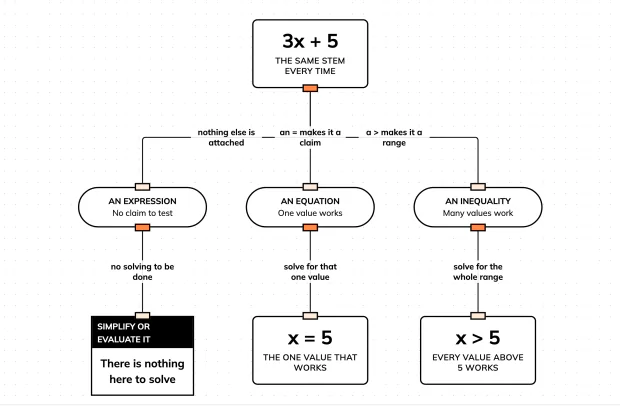
One can be simplified, one can be solved, and one gives you a range rather than an answer. Learn to tell them apart by building one stem into all three in an interactive playground.
How Do You Find the Value of an Expression?
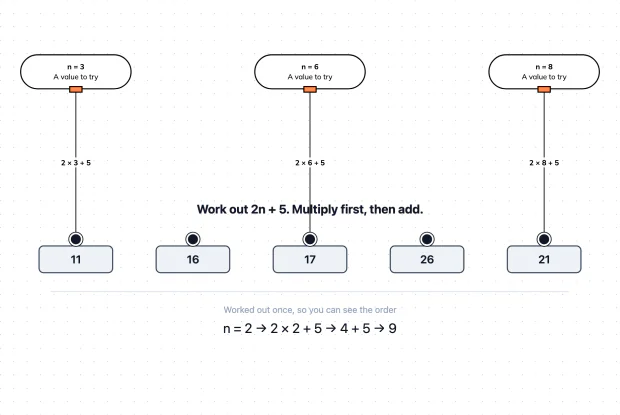
An expression only becomes a number once you choose what the letter stands for. Learn how to substitute a value safely, and work out an expression for several numbers in an interactive playground.
Why Must You Do the Same Thing to Both Sides?
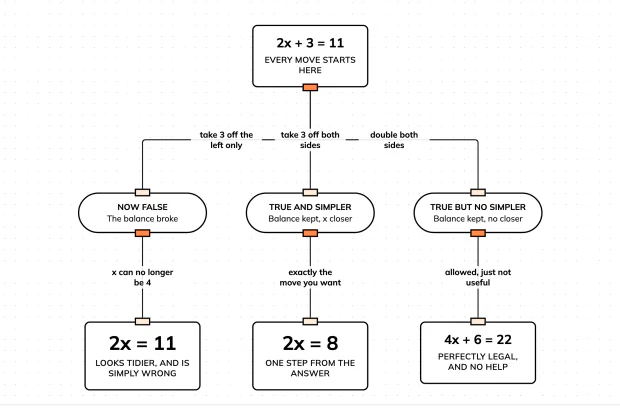
An equation is a claim that two sides are equal, so any change to one side alone makes it false. Learn which moves keep the balance and which ones actually help.
How Do You Solve for x, Step by Step?
Solving is undoing, in reverse order. Learn why the last thing done to x is the first thing you remove, and build the whole solution yourself.