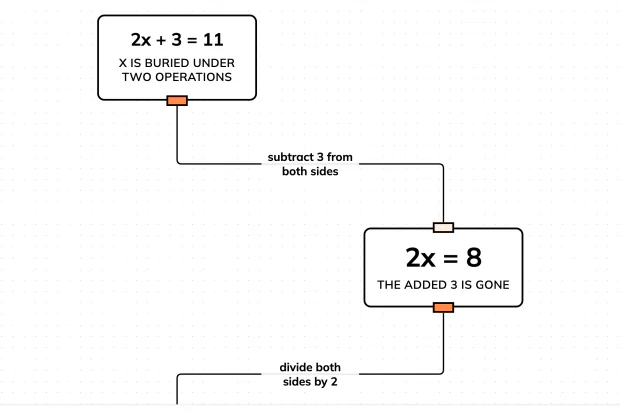
What's the Difference Between an Expression and an Equation?
Root Concept
An expression has no equals sign and can only be simplified or evaluated; an equation claims two things are equal and can therefore be solved.
CodePLU Goal
Upgrading Human Mental Models
Learn how to think in Workflows

Concept Development By codeplu.com
Two pans make a claim, one pan is only a value — match each line to its picture
Why Can You Solve One of These and Not the Other?
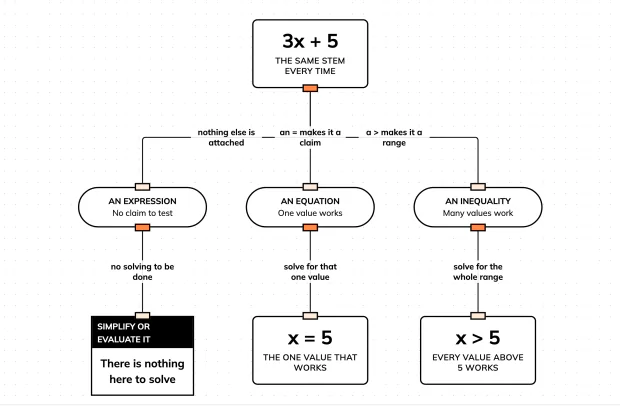
Put 3x + 5 and 3x + 5 = 20 side by side. They share every symbol except one, and that one symbol changes completely what you are holding. The first cannot be solved — there is no question in it. The second can, and the answer is x = 5.
The difference is that an equation makes a claim. The equals sign is not a full stop or an instruction to calculate; it is an assertion that the thing on the left and the thing on the right are the same size. That assertion is what you can interrogate: which value of x would make this true? An expression asserts nothing. It is a recipe sitting there, and the most you can do is tidy it up or work it out for a particular value.
Getting this distinction straight early saves a surprising amount of confusion, because the two things take different verbs. Expressions get simplified or evaluated. Equations get solved. Asking for the solution to an expression is like asking for the answer to a shopping list. In the playground below you will build 3x + 5 down through each symbol you could attach to it, and see what each one lets you do.
How Do You Tell Them Apart?
What is an expression, and what can you do with it?
An expression is a combination of numbers, letters and operations with no equals sign: 3x + 5, or 4a - 2b, or just 7. It is a description of a quantity rather than a statement about one. Two things are available to you. You can simplify it, which means writing it more compactly without changing its value — 3x + 2x becomes 5x. Or you can evaluate it, which means substituting a number and working it out: if x is 4, then 3x + 5 is 17. What you cannot do is solve it, because nothing has been claimed and so nothing can be true or false. Recognising expressions is also what makes simplifying safe: since there are no sides, there is no balance to preserve, and you are only ever rewriting the same quantity more neatly.
What does an equation actually claim?
An equation joins two expressions with an equals sign and asserts they have the same value: 3x + 5 = 20. That claim is either true or false depending on x, and solving means finding the values that make it true. Here x = 5 works, because 3 times 5 plus 5 is 20, and no other number does. This is where a very common misreading needs correcting. Many people read the equals sign as here comes the answer, because that is how it behaves on a calculator. In algebra it means these two sides balance, and that reading is what makes the whole subject work — it is why you are allowed to change both sides in step, and why doing something to only one side breaks the claim.
What about signs that are not equals?
Swap the equals sign for a greater-than sign and you get 3x + 5 > 20, which is an inequality. It still makes a claim, so it can still be solved, but the answer is a range rather than a single value: x > 5. Any number above 5 satisfies it, so there are infinitely many solutions. Inequalities matter more in real life than their small textbook footprint suggests — a budget is an inequality, a speed limit is an inequality, a pass mark is an inequality. Almost none of the practical constraints you meet are about hitting a number exactly. They handle much like equations, with one warning worth remembering for later: multiplying or dividing both sides by a negative number flips the direction of the sign.
Real World Example
Which of These Questions Can Actually Be Answered?
The distinction is not academic — it decides whether a question has an answer at all:
The expression: a rule with no question
3x + 2
A taxi charges 3 rupees a kilometre plus 2 rupees to get in. Write that as 3x + 2, where x is the number of kilometres, and you have an expression. It is a recipe for working out a fare, and that is all it is. It does not assert anything, so there is nothing about it that could be true or false and nothing to solve. Ask what it comes to for a seven kilometre trip and you get 23 rupees; ask for a two kilometre trip and you get 8. An expression answers how much, once you decide what x is. On the scales it is a single loaded pan with nothing opposite it to argue with.
The equation: a question with one answer
3x + 2 = 11
Now suppose the fare came to 11 rupees and you want to know how far you went. Writing 3x + 2 = 11 turns the recipe into a claim: it says this expression and the number 11 are the same size. That claim is either true or false depending on x, which is exactly what makes it something you can solve. Here it is true when x is 3 and false for every other value. On the scales it is two loaded pans that balance. The difference from the line above is one symbol, and that symbol is the whole of the difference between calculating and solving.
The inequality: a question with a range
3x + 2 < 11
Change the equals sign to a less-than sign and you get 3x + 2 < 11, which is still a claim, so it is still something you can solve. What changes is the shape of the answer. An equation like this one pins x to a single value; an inequality accepts a whole range of them, here every value below 3. That is worth meeting early, because it shows that the important split is not between equals signs and everything else. It is between something that merely has a value and something that makes a claim about a value, and both = and < are ways of making a claim.
FAQs
Final Words
One symbol decides everything. Without an equals sign you have an expression: a description of a quantity that you can simplify or evaluate, but never solve. With one you have an equation: a claim that two sides balance, which you can interrogate to find the values making it true. Swap in a greater-than sign and you get an inequality, still solvable but with a range as its answer.
The reading to carry forward is that equals means balance, not here comes the answer. That single shift is what makes the next concept make sense — once both sides must stay equal, the rule for changing an equation stops being arbitrary and becomes the only thing that could possibly work.
Continue This Track
This concept is part 4 of Your First Steps in Algebra.
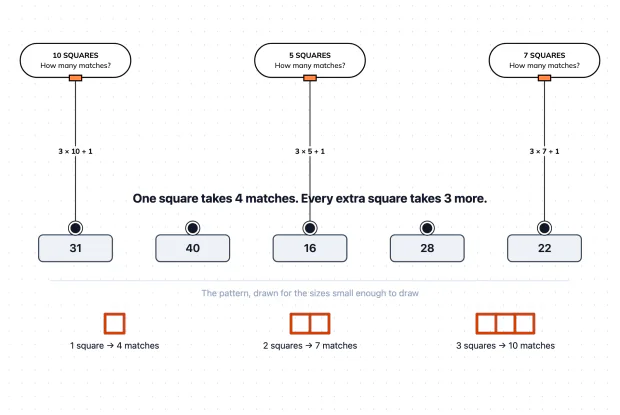
Why Does Maths Use Letters Instead of Numbers?
Letters are not there to make maths harder. They are there because some rules have to cover every number at once, and you cannot write them all down. Build the rule for a growing pattern in an interactive playground.
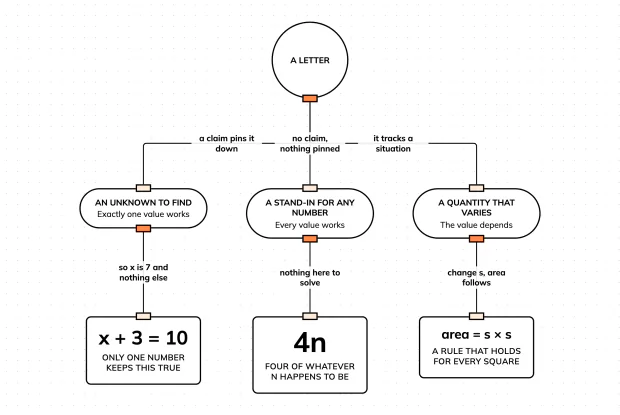
What Is a Variable, and Why Use Letters?
A letter in maths is not a mystery or a code — it is a number you have not pinned down yet. Learn the three jobs letters do, and build a letter down into each in an interactive playground.
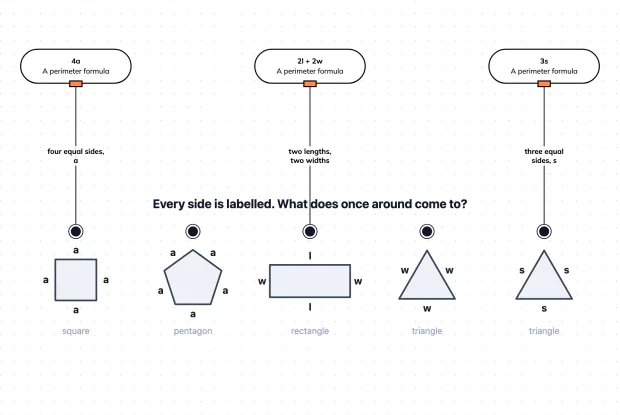
How Do You Turn a Rule Into a Formula?
A formula is a rule about a quantity, written with letters so it can be used rather than just read. Learn how to build one, and match formulas to the shapes they describe in an interactive playground.
What's the Difference Between an Expression and an Equation?
One can be simplified, one can be solved, and one gives you a range rather than an answer. Learn to tell them apart by building one stem into all three in an interactive playground.
How Do You Find the Value of an Expression?
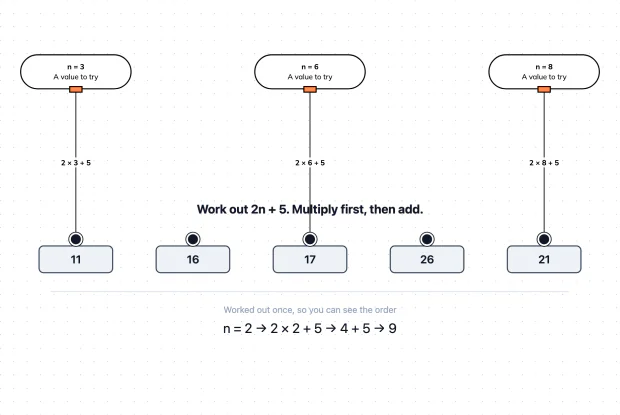
An expression only becomes a number once you choose what the letter stands for. Learn how to substitute a value safely, and work out an expression for several numbers in an interactive playground.
Why Must You Do the Same Thing to Both Sides?
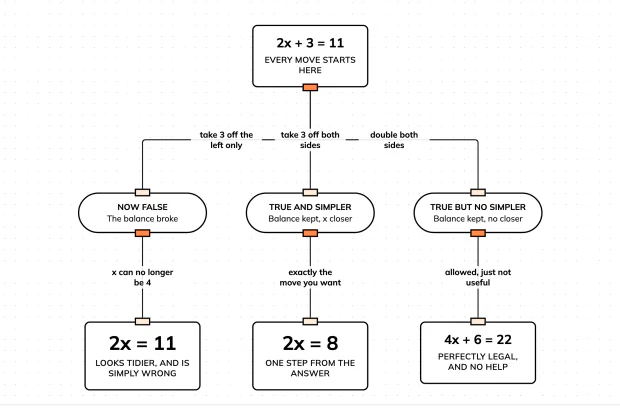
An equation is a claim that two sides are equal, so any change to one side alone makes it false. Learn which moves keep the balance and which ones actually help.
How Do You Solve for x, Step by Step?
Solving is undoing, in reverse order. Learn why the last thing done to x is the first thing you remove, and build the whole solution yourself.