How Do You Find the Value of an Expression?
Root Concept
Substituting means replacing the letter with a number, and then the usual rules of arithmetic decide the answer — multiplying before adding.
CodePLU Goal
Upgrading Human Mental Models
Learn how to think in Workflows

Concept Development By codeplu.com
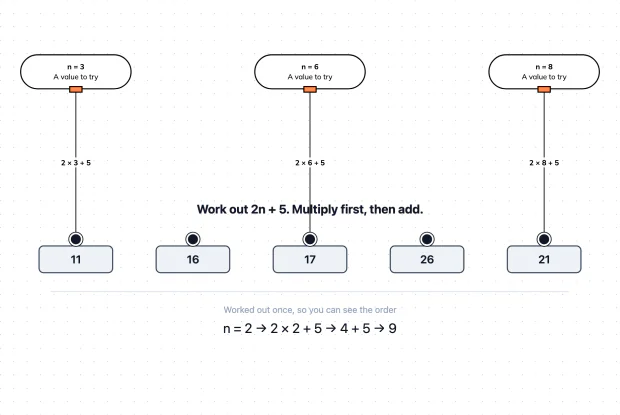
One expression, three values of n — multiply first, then add
What Turns an Expression Into a Number?
An expression like 2n + 5 is not a number. It is a set of instructions waiting for one: double whatever n is, then add five. Until somebody decides what n stands for, there is nothing to work out. The moment they do, the instructions can be followed and a single number comes out the other end.
Doing that is called substituting, and it is exactly what it sounds like — the letter goes out, a number comes in, and everything else about the expression stays where it was. Put n as 3 into 2n + 5 and you get two threes plus five, which is eleven. Put n as 8 and the same instructions give twenty-one. Same expression, different number in, different number out.
The step that catches people is not the swapping. It is what happens next, because once the number is in there you have an ordinary arithmetic sum, and ordinary arithmetic has rules about what gets done first. Multiplying comes before adding, and forgetting that is easily the most common way this goes wrong. In the playground below you will work out one expression for three different values, with two of the offered answers being exactly what you get if you add too early.
How Does Substituting Actually Work?
What does substituting a value actually mean?
It means writing the expression out again with a number where the letter used to be, and changing nothing else. For 2n + 5 with n as 6, you write 2 × 6 + 5. Notice that the hidden multiplication sign comes back the moment the letter leaves: 2n means two multiplied by n, so it becomes two multiplied by six, not twenty-six. Writing 26 by pushing the digits together is a real mistake that beginners make, and it comes from the shorthand that left the times sign out in the first place. Put the sign back in explicitly while you are learning. It costs one character and removes the whole class of error.
Which part do you work out first?
Multiplying and dividing happen before adding and subtracting. So in 2 × 6 + 5 you do the twelve first and then add five, giving seventeen. If you added first you would get 2 × 11, which is twenty-two, and that is a different and wrong answer. This is not a rule invented for algebra; it is the same order of operations that arithmetic has always used, and substituting simply hands you an ordinary sum that obeys it. Brackets override the order, which is why 2(n + 5) is a genuinely different expression from 2n + 5. The first says add then double, the second says double then add, and for n as 6 they give twenty-two and seventeen.
What if the same letter appears more than once?
Every copy of the letter gets the same number, because within one expression a letter is a single name for a single value. In 3a + a with a as 4, both letters become four: three fours is twelve, plus another four, which is sixteen. You cannot give one a the value four and another a the value five; that would be two different quantities sharing a name. The same applies to a letter squared: n² with n as 5 means five multiplied by five, which is twenty-five, not five multiplied by two. A useful habit when an expression has several letters in it is to write down what each one is before you start, so you are reading your own values rather than remembering them.
Real World Example
What Does Substituting Look Like Off the Page?
A teacher works out the cost of a coach trip. The formula stays put; only the number going in keeps changing:
The formula, before anyone knows the numbers
C = 250p + 4000
The coach costs four thousand rupees to hire whatever happens, and each child's entry ticket is two hundred and fifty rupees. Written as a formula that is C = 250p + 4000, where p is the number of children going and C is the total cost. At this point the teacher has no idea how many children will come, and that is precisely why the formula is worth writing. It is not an answer; it is an answer-making machine, and it will keep working every time the number changes. The four thousand sits outside the multiplication because it is charged once, not once per child.
The first guess
p = 30 gives 11,500 rupees
Thirty children put their names down, so the teacher substitutes thirty for p. That gives 250 × 30 + 4000. Multiply first: two hundred and fifty thirties is seven thousand five hundred. Then add the coach hire: eleven thousand five hundred rupees altogether. Had she added before multiplying she would have worked out 250 × 4030, which is over a million rupees and would have cancelled the trip on the spot. The order of operations is not pedantry here; it is the difference between a plausible number and an absurd one, which is also a useful way to catch the mistake.
The number changes twice more
p = 42, then p = 38
By Friday twelve more children have signed up, so p becomes forty-two: two hundred and fifty forty-twos is ten thousand five hundred, plus four thousand, giving fourteen thousand five hundred. Then four drop out with chickenpox and p becomes thirty-eight, which works out at thirteen thousand five hundred. Three answers in an afternoon, and the formula was written once. That is the whole payoff of keeping the rule in letters: the teacher never has to rethink how the cost is built up, only which number to put in today. Notice also that the four thousand never moved, because the coach costs the same whether thirty children go or forty-two — only the part attached to p responds to the change.
FAQs
Final Words
Finding the value of an expression is two steps that must happen in that order. Replace every copy of the letter with the number, putting the multiplication signs back as you go, and then work out the ordinary sum you are left with, multiplying and dividing before adding and subtracting.
Almost every wrong answer at this stage comes from the second step rather than the first. If a result looks surprising, redo it with the times signs written in and the brackets respected, and the error usually shows itself immediately. With substitution in hand, the next question is the reverse one: given the answer, what must the letter have been?
Continue This Track
This concept is part 5 of Your First Steps in Algebra.
Why Does Maths Use Letters Instead of Numbers?
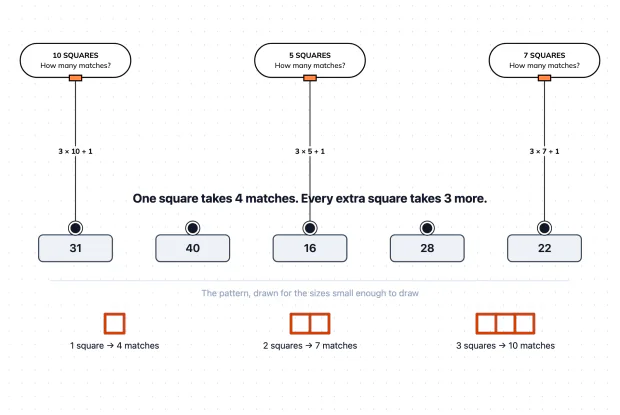
Letters are not there to make maths harder. They are there because some rules have to cover every number at once, and you cannot write them all down. Build the rule for a growing pattern in an interactive playground.
What Is a Variable, and Why Use Letters?
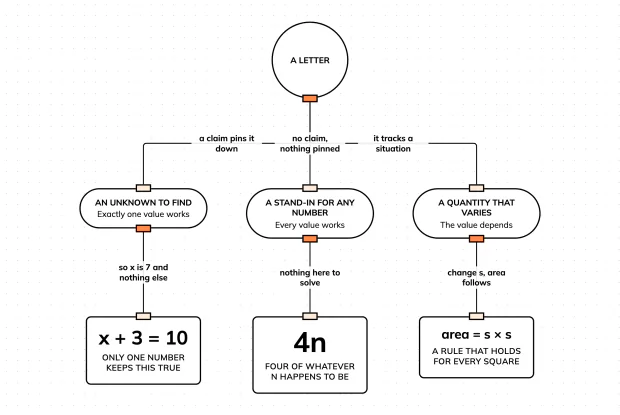
A letter in maths is not a mystery or a code — it is a number you have not pinned down yet. Learn the three jobs letters do, and build a letter down into each in an interactive playground.
How Do You Turn a Rule Into a Formula?
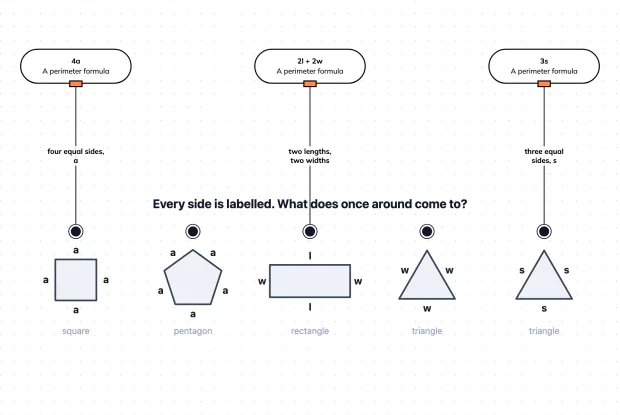
A formula is a rule about a quantity, written with letters so it can be used rather than just read. Learn how to build one, and match formulas to the shapes they describe in an interactive playground.
What's the Difference Between an Expression and an Equation?
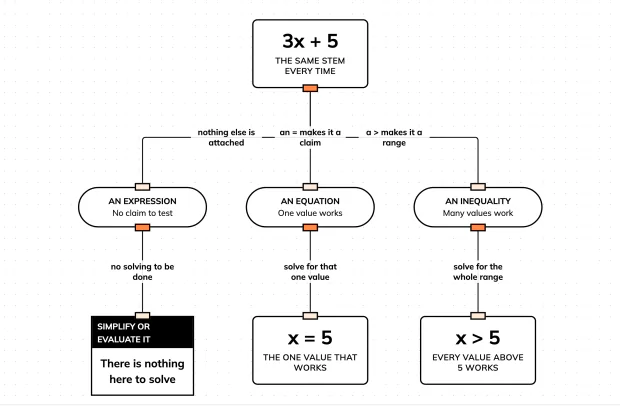
One can be simplified, one can be solved, and one gives you a range rather than an answer. Learn to tell them apart by building one stem into all three in an interactive playground.
How Do You Find the Value of an Expression?
An expression only becomes a number once you choose what the letter stands for. Learn how to substitute a value safely, and work out an expression for several numbers in an interactive playground.
Why Must You Do the Same Thing to Both Sides?
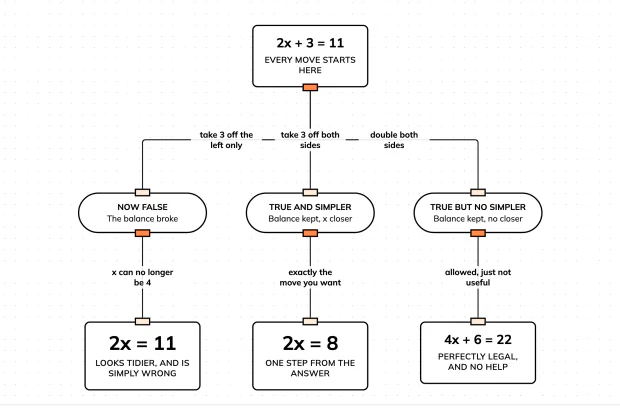
An equation is a claim that two sides are equal, so any change to one side alone makes it false. Learn which moves keep the balance and which ones actually help.
How Do You Solve for x, Step by Step?
Solving is undoing, in reverse order. Learn why the last thing done to x is the first thing you remove, and build the whole solution yourself.