How Do You Solve for x, Step by Step?
Root Concept
To isolate x, undo the operations around it in reverse order — remove what was added last, then undo the multiplication, then check by substituting back.
CodePLU Goal
Upgrading Human Mental Models
Learn how to think in Workflows

Concept Development By codeplu.com
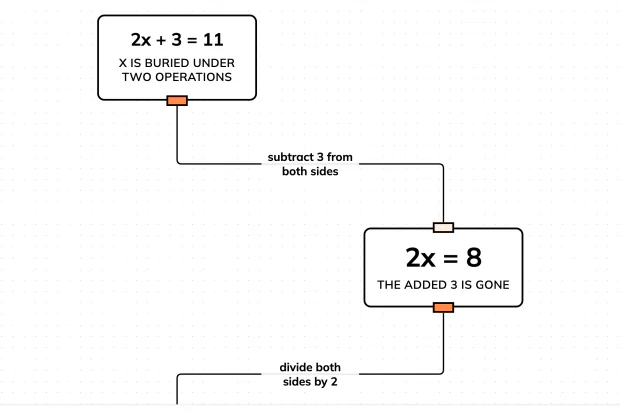
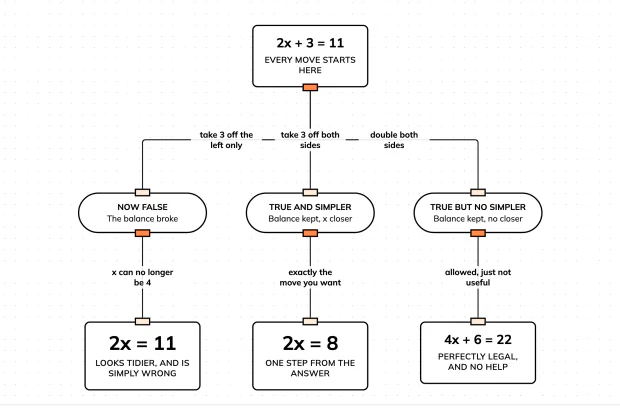
Two legal moves from 2x + 3 = 11 to x = 4 — match each stage to its scale
What Does Solving an Equation Actually Involve?
Solving for x has one goal and one method. The goal is to get x sitting alone on one side of the equals sign, because at that moment the equation is telling you what x is. The method is to undo whatever has been done to x — and to undo it in reverse order.
That reverse order is the part people skip, and it is the part that matters. In 2x + 3 = 11, two things have happened to x: it was multiplied by 2, and then 3 was added. Unwrapping a parcel does not start with the item inside; it starts with the last layer of paper that went on. Same here. The 3 was added last, so it comes off first.
Everything you remove has to come off both sides, for the reason established already: the equation is a claim of balance, and only identical changes keep it true. Then there is a final step that most people treat as optional and should not — substituting the answer back in. It costs a few seconds and it catches nearly every mistake. In the playground below you will connect the four stages of solving one equation, ending with that check.
How Does the Method Work?
Why undo in reverse order?
Look at what happened to x in 2x + 3. First it was multiplied by 2, then 3 was added. To get back to x you reverse that sequence: remove the 3, then undo the multiplication. Try it the other way and you can see why it fails. Divide 2x + 3 = 11 by 2 and you get x + 1.5 = 5.5, which is perfectly legal and simply not simpler — you have swapped whole numbers for decimals and still have two operations to undo. The order-of-operations idea from earlier is what generates the rule: because multiplication happens before addition when building the expression, addition must be undone before multiplication when taking it apart. Building goes one way, unbuilding goes the other, and that is true of far more than algebra.
What are inverse operations?
Every operation has an opposite that cancels it. Addition and subtraction undo each other; multiplication and division undo each other. So to remove an added 3 you subtract 3, and to undo a multiplication by 2 you divide by 2. That is the entire toolkit for equations at this level. Two details save trouble. First, apply the inverse to both sides every time — the balance rule has not gone away. Second, notice that the inverse depends on what was done to x, not on what looks awkward. In x - 5 = 2 the inverse is adding 5, even though adding feels like the wrong direction when you are trying to make something simpler. Read what was done, then do the opposite.
How do you handle x on both sides?
Equations like 5x = 2x + 9 look like a different problem and are not. The goal has not changed: get x alone. So gather the x terms on one side first by subtracting 2x from both sides, leaving 3x = 9, and then divide by 3 to get x = 3. The only new idea is that letters can be collected in the same way numbers can, because 5x minus 2x is 3x. Choose the side that avoids negatives where you can — subtracting the smaller x term keeps things tidier. And the check works exactly as before: 5 times 3 is 15, and 2 times 3 plus 9 is also 15, so both sides agree and the answer holds.
Why is checking not optional?
Substituting your answer back into the original equation is the only step that can tell you whether you are right, and it is the step people skip when short of time. Put x = 4 into 2x + 3: two fours are 8, plus 3 is 11, which matches the right-hand side exactly. If it had come out as 12, you would know immediately that something went wrong and could look for it. Note the word original — check against the equation you started with, not a line you rewrote, or you will simply confirm your own mistake. This habit is worth more than speed. In exams it converts near-misses into marks, and in real work it is the difference between a wrong number that gets noticed and one that does not.
Real World Example
How Many Guests Can the Budget Cover?
Most equations start life as an ordinary question, and solving is just the tidy way of answering it:
The question as anyone would ask it
Two boxes and 3 kg weigh 11 kg
A friend hands you two identical sealed boxes and says that together with a three kilogram weight they come to eleven kilograms on the scales. What does one box weigh? Nobody asks this using letters, and nobody needs to. You could get there by guessing: try three kilograms a box, that gives nine altogether, too light; try five, that gives thirteen, too heavy; try four and it lands exactly. Guessing works here because the numbers are small and friendly. The point of a method is that it keeps working when they are not, and when guessing would take all afternoon.
Writing it down
2x + 3 = 11
Call the weight of one box x. Two boxes come to 2x, the loose weight adds 3, and the whole lot balances against 11, so the sentence becomes 2x + 3 = 11. Notice the order in which x was built up: it was multiplied by two first, and then three was added. That order is the thing you will reverse in a moment, so it is worth reading it off deliberately rather than diving in. Writing the equation down is not a formality. It is the step that turns a word problem into something a method can be applied to.
Solving and checking
x = 4, and it checks out
Undo the last thing first. Three was added, so subtract three from both sides and the scales still balance: 2x = 8. Then x was doubled, so halve both sides: x = 4. One box weighs four kilograms. Now check it, which takes about five seconds and is the habit that saves you. Put 4 back into the original equation: two fours are eight, plus three is eleven, and eleven is what the right-hand side says. Both sides agree, so the answer is right. If they had not agreed, you would know immediately rather than after marking.
FAQs
Final Words
Solving is undoing in reverse order. Read what was done to x, then remove it in the opposite sequence — the thing added last comes off first — applying every inverse to both sides so the balance holds. Addition and subtraction undo each other, multiplication and division undo each other, and that is the whole toolkit at this level.
Then check, against the original equation, every time. That habit is what turns a method you can follow into one you can trust. With those four ideas — what a letter is, what an equation claims, why both sides must match, and how to unwrap x — you have the foundation the rest of algebra is built on.
Continue This Track
This concept is part 7 of Your First Steps in Algebra.
Why Does Maths Use Letters Instead of Numbers?
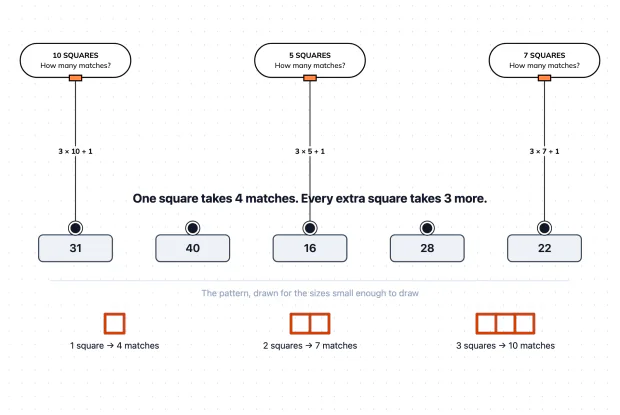
Letters are not there to make maths harder. They are there because some rules have to cover every number at once, and you cannot write them all down. Build the rule for a growing pattern in an interactive playground.
What Is a Variable, and Why Use Letters?
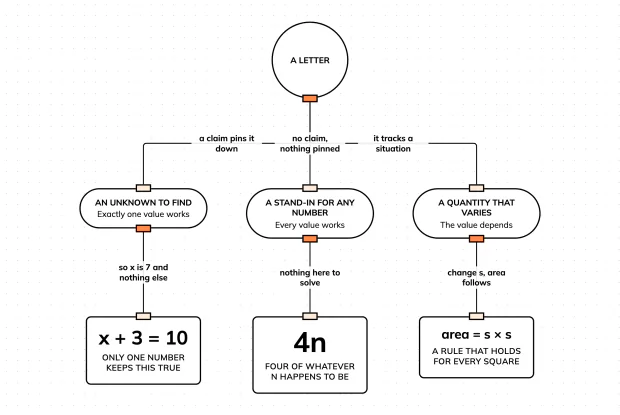
A letter in maths is not a mystery or a code — it is a number you have not pinned down yet. Learn the three jobs letters do, and build a letter down into each in an interactive playground.
How Do You Turn a Rule Into a Formula?
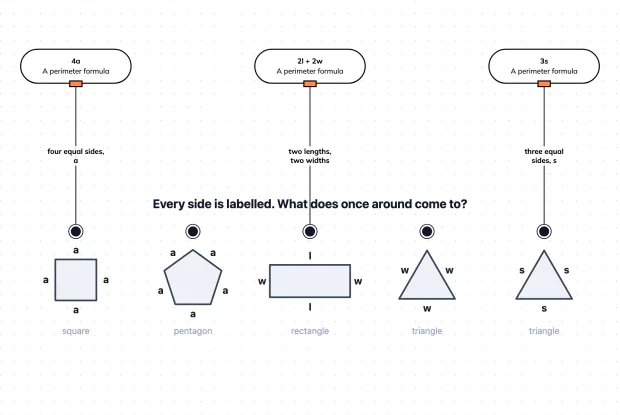
A formula is a rule about a quantity, written with letters so it can be used rather than just read. Learn how to build one, and match formulas to the shapes they describe in an interactive playground.
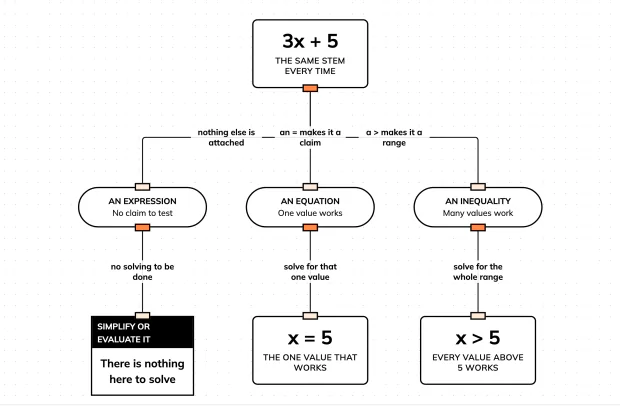
What's the Difference Between an Expression and an Equation?
One can be simplified, one can be solved, and one gives you a range rather than an answer. Learn to tell them apart by building one stem into all three in an interactive playground.
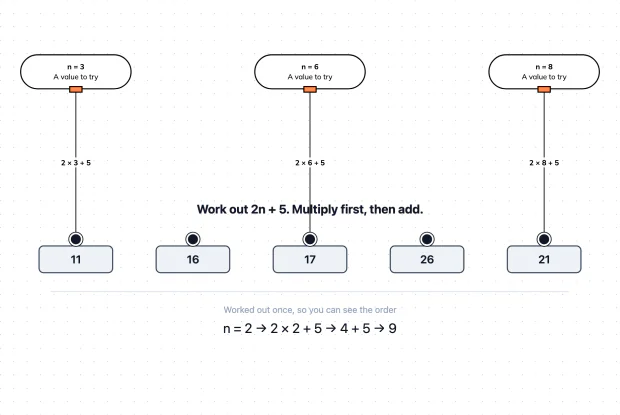
How Do You Find the Value of an Expression?
An expression only becomes a number once you choose what the letter stands for. Learn how to substitute a value safely, and work out an expression for several numbers in an interactive playground.
Why Must You Do the Same Thing to Both Sides?
An equation is a claim that two sides are equal, so any change to one side alone makes it false. Learn which moves keep the balance and which ones actually help.
How Do You Solve for x, Step by Step?
Solving is undoing, in reverse order. Learn why the last thing done to x is the first thing you remove, and build the whole solution yourself.