Why Must You Do the Same Thing to Both Sides?
Root Concept
An equation stays true only if both sides change identically — and some legal moves keep the balance without getting you any closer to an answer.
CodePLU Goal
Upgrading Human Mental Models
Learn how to think in Workflows

Concept Development By codeplu.com
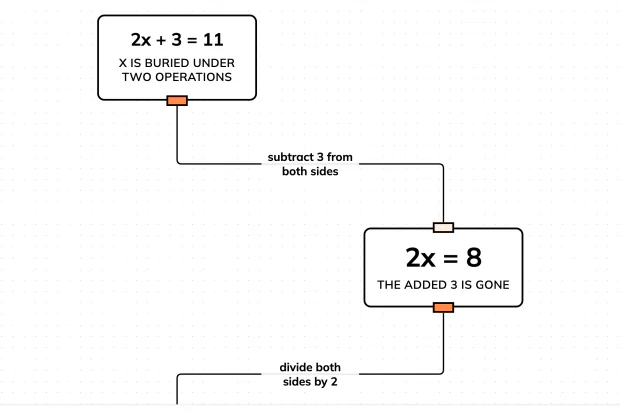
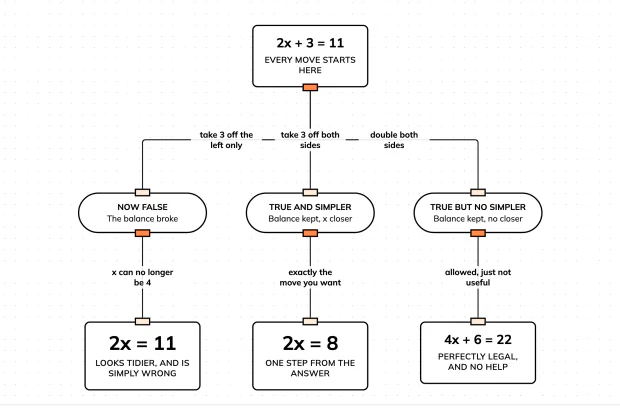
Three moves on 2x + 3 = 11 — connect each to the scale showing what it leaves behind
What Actually Breaks When You Change One Side?
Every rule about solving equations comes from a single idea: the equals sign says the two sides are the same size. Picture a pair of weighing scales that currently balance. If you take 3 off the left pan and nothing off the right, the scales tip. Nothing about your arithmetic was wrong — you simply destroyed the thing the equation was claiming.
That is the whole justification for do the same thing to both sides. It is not a rule invented to make homework harder; it is the only kind of change that leaves the claim intact. Take 3 off both pans and they still balance, so the new equation is just as true as the old one, and you have made the left side simpler in the process.
There is a second, less obvious point that most explanations skip, and it matters. Keeping the balance is not the same as making progress. Doubling both sides of an equation is completely legal and leaves you no closer to an answer than you were before. So solving is really two questions at once: is this move allowed, and does it actually help? In the playground below you get one equation, three moves, and five scales showing what various moves leave behind. Work out what each move does, then connect it to the scale that shows the result — two of those scales answer to no move at all.
What Keeps an Equation True?
Why does changing one side break the equation?
Start with 2x + 3 = 11, which is true when x is 4. Now take 3 off the left side only and you have 2x = 11. Is that still true when x is 4? Two times 4 is 8, not 11 — so no. The original claim has been replaced by a different, false one, and any answer you get from here is an answer to the wrong question. Notice what went wrong: the arithmetic was fine, the logic was not. This is the most common source of wrong answers in early algebra, and it usually happens in a rush rather than through misunderstanding. Writing each step out fully, both sides at once, is a slow-looking habit that saves far more time than it costs. The scales image is worth keeping in your head permanently: whatever you do, do it to both pans.
Which moves are allowed?
You can add the same amount to both sides, subtract the same amount from both sides, multiply both sides by the same number, or divide both sides by the same number. Each of these keeps the two sides equal, so the claim survives. One exception is worth knowing now rather than discovering later: you cannot divide both sides by zero, because dividing by zero is undefined. And when you multiply or divide, it has to apply to the entire side rather than one term of it. Doubling the left of x + 1 = 5 means writing 2x + 2, not 2x + 1 — a slip that catches people constantly. If you are ever unsure whether a step was legal, substitute a known solution back into both the old and new versions: if it satisfies both, the balance held.
Why isn't every legal move a useful one?
Multiply both sides of 2x + 3 = 11 by 2 and you get 4x + 6 = 22. Perfectly true, perfectly legal, and completely pointless — x is no easier to find than it was. This is the part that turns solving from a rule-following exercise into something with a direction. The goal is to end up with the letter alone on one side, so a useful move is one that removes something standing between you and that state. Subtracting 3 removes the added 3; dividing by 2 removes the multiplication. Both take you closer. Doubling adds clutter. So the question to ask at each step is not just may I do this, but what does this get rid of. That is the difference between knowing the rules and being able to solve.
Real World Example
How Do Scales Explain Every Step?
Balance is not a metaphor for what happens in an equation — it is a literal description, and doing it with objects makes each step obvious:
Setting up the scales
2 boxes + 3 weights = 11 weights
Put two identical sealed boxes on the left pan of a real pair of scales, and add three loose one-kilogram weights beside them. On the right pan, stack eleven one-kilogram weights. The pointer sits dead centre: the scales balance. That balance is the whole claim. It says the two boxes plus three kilograms weigh exactly the same as eleven kilograms, even though nobody has opened a box. Written in symbols that is 2x + 3 = 11, where x stands for the unknown weight of one box. Every step that follows is something you could physically do to these pans, which is why the algebra stops feeling like a set of arbitrary rules and starts feeling like moving objects around.
The move that keeps the balance
Take 3 off both pans
Lift three loose weights off the left pan, and three off the right pan as well. The pointer does not move. You removed equal amounts from equal sides, so the two pans still weigh the same and the claim survives intact. What is left is two boxes against eight weights, which is 2x = 8 — simpler than before and just as true. Now try it the wrong way. Take the three weights off the left pan only and the right pan drops immediately. Nothing you calculated was wrong; you simply threw away the thing the equation was asserting, and every answer after that point belongs to a different problem.
Finishing, and the pointless move
Halve both pans, or double them
Halve the contents of both pans: one box on the left against four weights on the right. The scales still balance, and now they are telling you something useful — a single box weighs four kilograms, so x = 4. Compare that with a different legal move. Double both pans at the very start and you get four boxes against twenty-two weights. The scales balance perfectly, the new equation is completely true, and you are no closer to knowing what one box weighs than when you began. Legal and useful are two separate tests, and the weights make the difference obvious in a way the symbols do not.
FAQs
Final Words
An equation is a claim that two sides weigh the same, so the only changes that preserve it are the ones applied identically to both. Add, subtract, multiply or divide both sides — never one — and never divide by zero. When a step feels arbitrary, picture the scales and it stops being arbitrary.
The extra idea worth keeping is that legal and useful are different tests. Doubling both sides is allowed and gets you nowhere. Solving means choosing, at each step, the legal move that removes something standing between you and the letter on its own — which is exactly what the next concept puts into practice.
Continue This Track
This concept is part 6 of Your First Steps in Algebra.
Why Does Maths Use Letters Instead of Numbers?
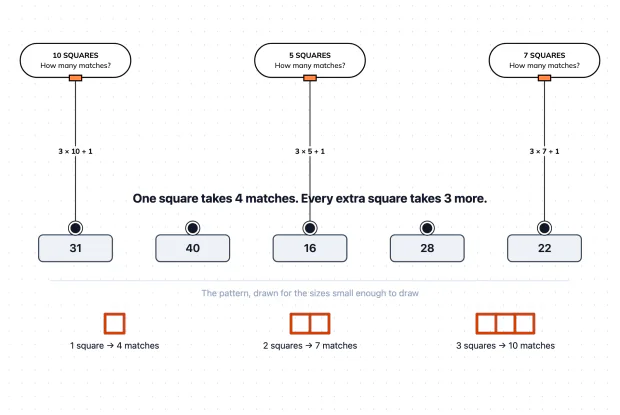
Letters are not there to make maths harder. They are there because some rules have to cover every number at once, and you cannot write them all down. Build the rule for a growing pattern in an interactive playground.
What Is a Variable, and Why Use Letters?
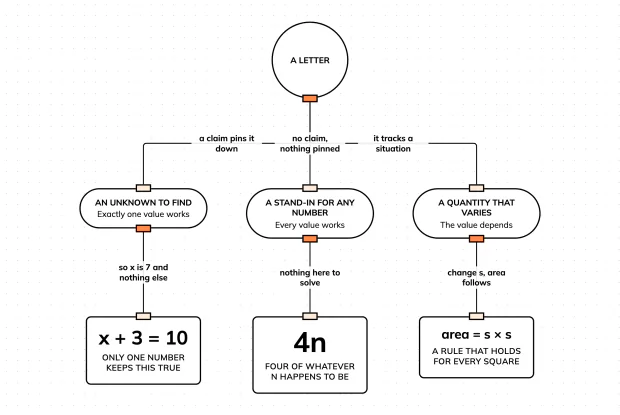
A letter in maths is not a mystery or a code — it is a number you have not pinned down yet. Learn the three jobs letters do, and build a letter down into each in an interactive playground.
How Do You Turn a Rule Into a Formula?
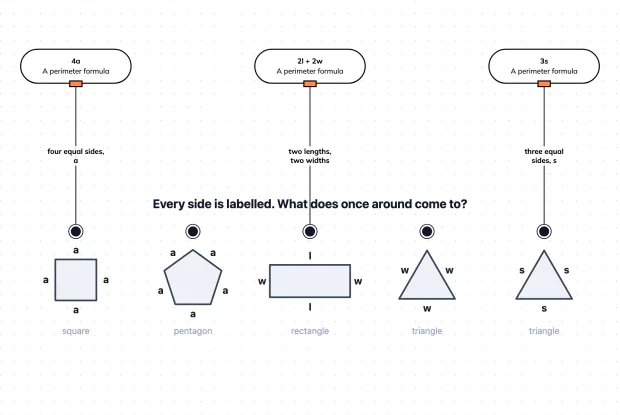
A formula is a rule about a quantity, written with letters so it can be used rather than just read. Learn how to build one, and match formulas to the shapes they describe in an interactive playground.
What's the Difference Between an Expression and an Equation?
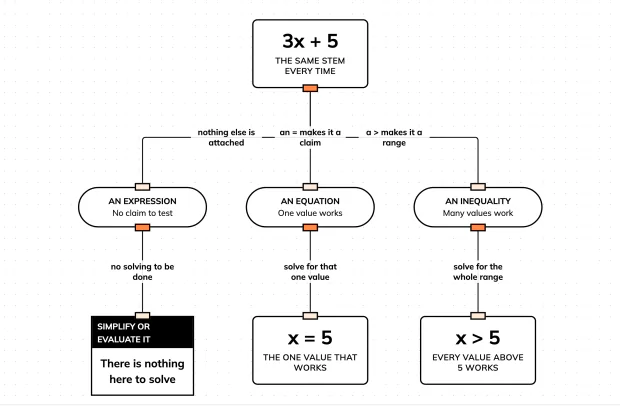
One can be simplified, one can be solved, and one gives you a range rather than an answer. Learn to tell them apart by building one stem into all three in an interactive playground.
How Do You Find the Value of an Expression?
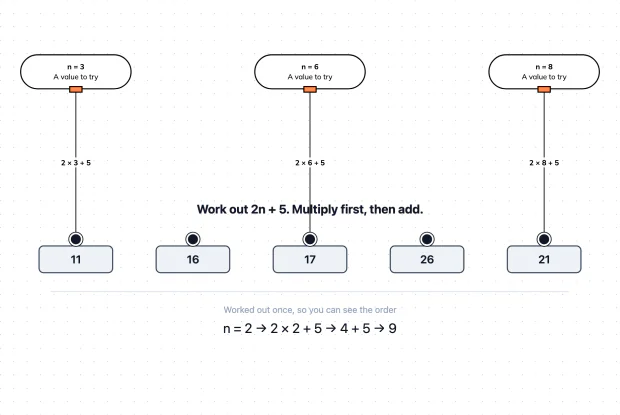
An expression only becomes a number once you choose what the letter stands for. Learn how to substitute a value safely, and work out an expression for several numbers in an interactive playground.
Why Must You Do the Same Thing to Both Sides?
An equation is a claim that two sides are equal, so any change to one side alone makes it false. Learn which moves keep the balance and which ones actually help.
How Do You Solve for x, Step by Step?
Solving is undoing, in reverse order. Learn why the last thing done to x is the first thing you remove, and build the whole solution yourself.