Why Does Maths Use Letters Instead of Numbers?
Root Concept
A letter is how you write a rule that has to work for every number, including the ones nobody is going to sit down and count.
CodePLU Goal
Upgrading Human Mental Models
Learn how to think in Workflows

Concept Development By codeplu.com
Find the rule from the small rows, then use it on rows too big to draw
What Can a Letter Do That a Number Cannot?
The first time a letter turns up in maths it usually looks like a trick. Numbers were doing fine, and now there is an x, and nobody quite explains what it is for. The honest answer is short: a letter is how you write a rule when the rule has to work for every number rather than one particular number.
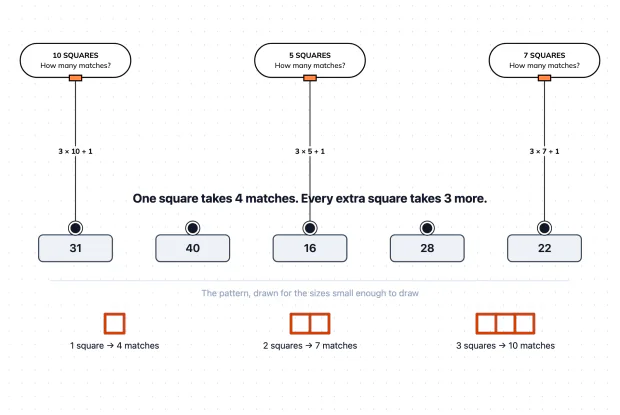
Think about laying out squares in a row with matchsticks. One square takes four matches. A second square next to it does not take another four, because the two squares share a side — it only takes three more. A third square takes three more again. You can keep going as long as you have matches, and at some point somebody is going to ask how many matches a row of fifty squares would take.
You could sit down and count. Nobody wants to, and for a hundred squares nobody sensibly would. What you want instead is one short line that answers the question for any number of squares at all, and to write that line you need something standing in the place where the number goes. That is the letter. In the playground below you will work out the counts for sizes far too big to draw, using nothing but the rule the small ones reveal.
What Is a Letter Really For?
Why can't you just write out the numbers?
For the matchstick squares you could write 4, 7, 10, 13, 16 and keep listing. The trouble is that the list never finishes, and it only answers questions you have already reached. If someone asks about fifty squares you have to extend the list all the way there, and if they ask about a thousand you are stuck. A list records answers; it does not explain them. Notice too that the list hides the very thing that makes the pattern predictable — the fact that each new square costs exactly three more matches. That regularity is the useful part, and it deserves to be written down somewhere you can use it rather than left for the reader to spot. A letter is what lets you write it down.
What does the letter actually replace?
Say it in words first: take three matches for every square, then add one extra. That sentence is already the rule, and it works for any size at all. The only clumsy part is the phrase for every square, which is standing in for a number nobody has chosen yet. Replace that phrase with a single letter — call it n — and the sentence becomes 3n + 1. Nothing has been made more mysterious. The letter is doing exactly the job the phrase was doing, in one character instead of sixteen. Many beginners assume the letter must be hiding a particular secret value that they are supposed to guess. Here it is not hiding anything: n is whatever size of row you happen to be asking about.
How do you find the rule in a pattern?
Look at what changes between one case and the next, rather than at the totals themselves. From four matches to seven is a jump of three; seven to ten is three again. A constant jump of three tells you the rule contains 3n. Then check one case you know: for a single square the rule so far gives three, but the real answer is four, so there is one extra match to account for, and the rule is 3n + 1. Test it against a case you have not used yet. Three squares should give nine plus one, which is ten, and ten is what the picture shows. Two things to be careful of: a rule that fits the first case by luck, and the common slip of writing 4n because one square took four matches.
Real World Example
Where Else Does One Letter Save You?
A letter earns its place whenever the same calculation has to be repeated for a number that keeps changing:
The cost of a taxi
fare = 15k + 25
A taxi charges twenty-five rupees to get in and fifteen rupees for each kilometre. Written out case by case that becomes an endless table: one kilometre is forty rupees, two is fifty-five, three is seventy, and so on for every trip anybody might take. Written with a letter it is fare = 15k + 25, where k is however many kilometres you travel. One short line now covers a two kilometre hop and a two hundred kilometre journey equally well. It also lets you run the question backwards, which a table cannot: if the meter reads one hundred and fifteen rupees, then 15k + 25 must be 115, and k works out at six kilometres.
Chairs around tables
seats = 4t + 2
Push rectangular tables end to end in a school hall and the seating follows a pattern very like the matchsticks. One table seats six people. Adding a second table does not add six more, because the two ends that now touch are no longer usable, so it adds four. Three tables seat fourteen, four seat eighteen. The rule is seats = 4t + 2, where t is the number of tables. When the hall has thirty tables pushed together, nobody is going to draw it; they will work out four thirties plus two and order a hundred and twenty-two chairs. The letter is what makes that a five-second job.
A recipe scaled up
flour = 120p grams
A pancake recipe uses a hundred and twenty grams of flour for every person. For four people that is four hundred and eighty grams, and most people can do that in their head. The moment you are cooking for a school event and the number of people is still being argued about, a fixed answer is no use at all. Writing flour = 120p, with p standing for however many people turn up, means the rule survives the argument. Whatever number is finally settled on gets multiplied by a hundred and twenty, and the same single line handles a family breakfast and a hall full of children.
FAQs
Final Words
A letter is not a harder kind of number. It is a placeholder that lets one line of maths answer a question for every value at once, instead of one value at a time. The matchstick squares show why that matters: counting works for three squares and is hopeless for three hundred, while 3n + 1 handles both without effort.
The habit worth taking from this is to look for what changes between cases and what stays the same. The constant jump becomes the number in front of the letter, and the leftover becomes what you add on. Next comes the question of what the letter is doing in a particular piece of maths, because it does not always do the same job.
Continue This Track
This concept is part 1 of Your First Steps in Algebra.
Why Does Maths Use Letters Instead of Numbers?
Letters are not there to make maths harder. They are there because some rules have to cover every number at once, and you cannot write them all down. Build the rule for a growing pattern in an interactive playground.
What Is a Variable, and Why Use Letters?
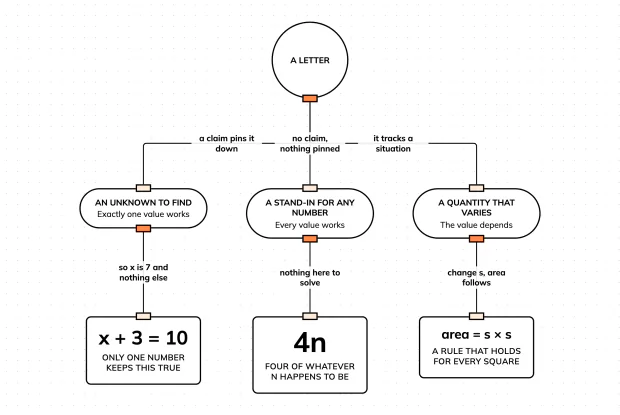
A letter in maths is not a mystery or a code — it is a number you have not pinned down yet. Learn the three jobs letters do, and build a letter down into each in an interactive playground.
How Do You Turn a Rule Into a Formula?
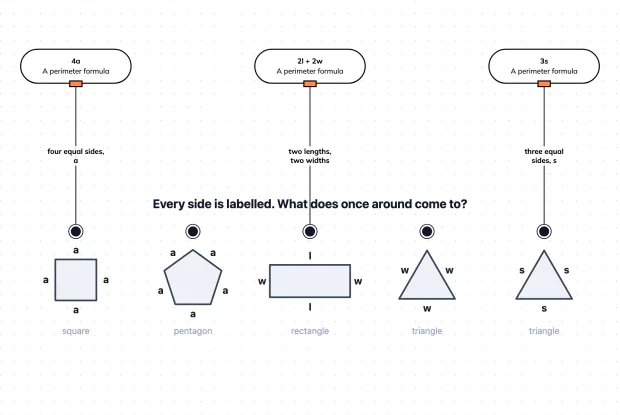
A formula is a rule about a quantity, written with letters so it can be used rather than just read. Learn how to build one, and match formulas to the shapes they describe in an interactive playground.
What's the Difference Between an Expression and an Equation?
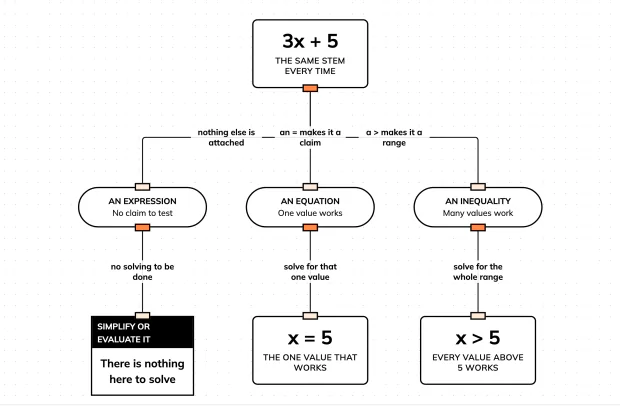
One can be simplified, one can be solved, and one gives you a range rather than an answer. Learn to tell them apart by building one stem into all three in an interactive playground.
How Do You Find the Value of an Expression?
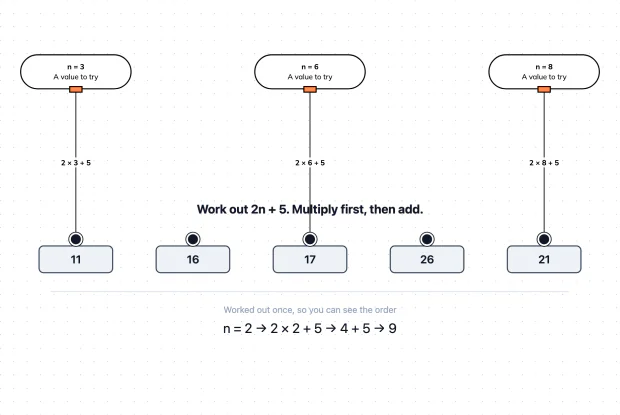
An expression only becomes a number once you choose what the letter stands for. Learn how to substitute a value safely, and work out an expression for several numbers in an interactive playground.
Why Must You Do the Same Thing to Both Sides?
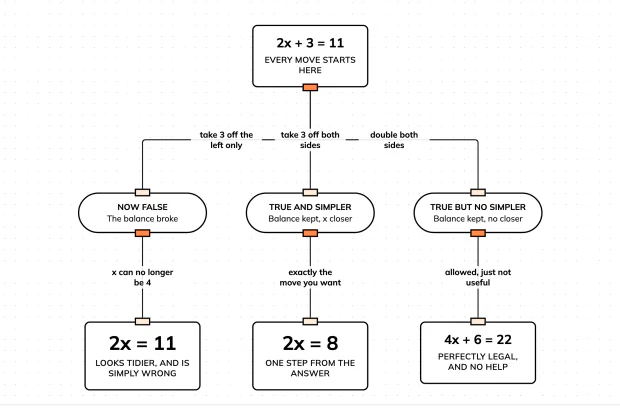
An equation is a claim that two sides are equal, so any change to one side alone makes it false. Learn which moves keep the balance and which ones actually help.
How Do You Solve for x, Step by Step?
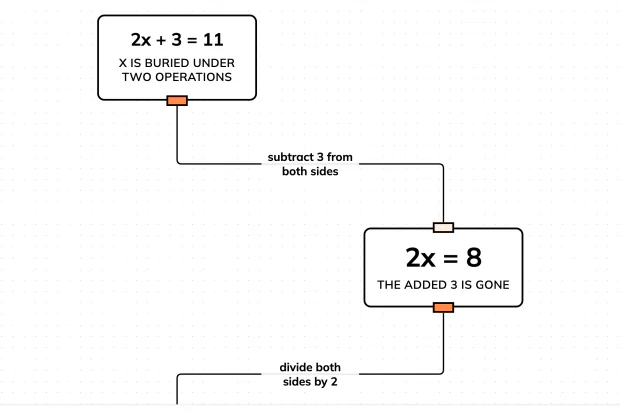
Solving is undoing, in reverse order. Learn why the last thing done to x is the first thing you remove, and build the whole solution yourself.