What Is an Angle, Actually?
Root Concept
An angle is the amount of turn between two rays that share an endpoint, measured in degrees — so it depends only on how far apart the arms point, never on how long they are drawn.
CodePLU Goal
Upgrading Human Mental Models
Learn how to think in Workflows

Concept Development By codeplu.com
What Is Being Measured When You Measure an Angle?
Stand facing a door and then turn to face a window. You have turned through an angle, and you did it without drawing anything. That is the idea underneath the whole topic: an angle is an amount of turning, and everything drawn on paper is a record of a turn that could have been made.
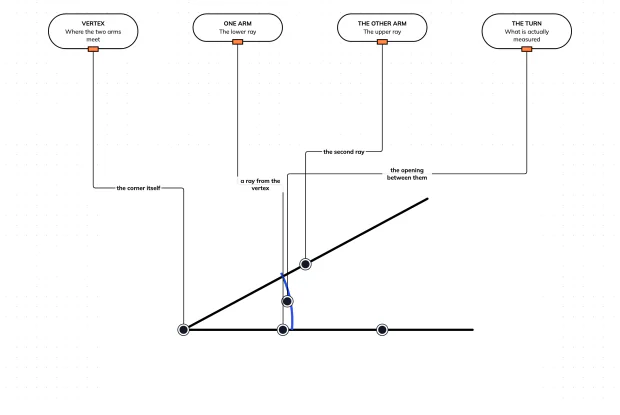
On paper an angle is made of two rays that share their endpoint. The shared point is called the vertex and the two rays are called the arms. But neither the vertex nor the arms are the angle — the angle is the opening between the arms, the amount you would have to turn one to land on the other.
That distinction explains the thing beginners most often get wrong. Drawing the arms longer does not make the angle bigger. Stretch the arms to twice the length and the turn between them has not changed at all, so the angle is identical. An angle has no length in it anywhere; it is measured in degrees, and a degree is a fraction of a full turn rather than a distance.
A Vertex, Two Arms, and the Turn Between Them
What are the parts of an angle called?
Three things have names. The vertex is the point where the two arms meet — the corner, and the only point that both arms share. The arms are the two rays running out from it, and being rays matters: they start at the vertex and carry on, which is what allows the arms to be drawn any length at all without affecting anything. The third part is the opening between them, which is what the angle actually is, and it is usually marked with a small curved arc. That arc is worth reading carefully, because it tells you which of the two possible openings is meant. Any two arms create two angles — the smaller one between them and the larger one going the other way round — and the arc is the drawing's way of saying which it is talking about. The angle in the practice below has its arc placed some distance from the vertex deliberately, because the opening is the same however near or far you choose to mark it.
Why does the length of the arms not matter?
Because the arms are rays, and a ray has no length to speak of — it carries on for ever, so the bit you draw is just the bit that fitted on the page. Two people drawing the same angle, one with two-centimetre arms and one with ten-centimetre arms, have drawn the same angle. This is genuinely counter-intuitive at first, because the bigger drawing looks bigger in every ordinary sense. The way to feel it is to go back to turning. Face the door, turn to the window: the amount you turned does not depend on how far away the door and the window are. A near door and a far door in the same direction take the same turn. Angle is about direction, and direction is not affected by distance. This is also why the arc marking the opening can be drawn at any radius — a bigger arc is a longer curve, but it spans the same turn.
What is a degree?
A degree is one three-hundred-and-sixtieth of a full turn. Turn all the way round and back to facing where you started and you have turned three hundred and sixty degrees; a quarter of that is ninety, which is the right angle. The number three hundred and sixty is not forced by anything in nature — it comes down to us from Babylonian astronomy, and it stuck because it divides evenly by an unusually large number of things: two, three, four, five, six, eight, nine, ten, twelve and more. That makes halves, thirds, quarters, fifths and sixths of a turn all come out as whole numbers of degrees, which is enormously convenient and is very likely why it beat the alternatives. Angles are measured with a protractor, a half-circle marked from zero to a hundred and eighty, lined up with its centre on the vertex and its baseline along one arm.
How do you name an angle?
Usually with three letters, and the middle one is always the vertex. So angle ABC means the angle at vertex B, between the ray going to A and the ray going to C. The convention exists because a single letter is not always enough: at a busy point several angles can share the same vertex, and saying angle B would be ambiguous about which pair of arms you meant. When there is only one angle at a point, people do shorten it to a single letter, and in a triangle you will often see the angles called simply A, B and C for that reason. You may also meet Greek letters — theta and alpha are common — used as a name for an unknown angle in the same way x is used for an unknown number. The small symbol ∠ is shorthand for the word angle, so ∠ABC reads as angle A B C.
Real World Example
Three Turns Somebody Had To Get Right
Angles matter wherever something is aimed, tilted or turned:
A ramp for wheelchairs
no steeper than about 5°
Accessibility rules limit how steeply a ramp may rise, and the limit is expressed as an angle rather than a height for a good reason: a ramp is hard to push up because of its steepness, not because of how tall it is. A gentle ramp can climb any height at all if you give it enough length. That is the practical face of the idea that angle is independent of distance — the same five degree slope is the same effort whether the ramp is two metres long or twenty, and the longer one simply arrives higher.
A satellite dish
aimed to within about 1°
A dish has to point at a satellite thirty-six thousand kilometres away, and the aiming tolerance is roughly a degree. What matters is purely the direction it faces — the size of the dish, the length of its mounting arm and the height of the building all have nothing to do with the angle it must be set to. Installers use a compass bearing and an elevation angle, two numbers that between them fix a direction in the sky, and neither of them is a distance. It is the clearest possible demonstration that an angle carries no length in it.
The hands of a clock
30° between each hour
The twelve hour marks divide a full turn into twelve equal parts, so consecutive hours are thirty degrees apart. At three o'clock the hands are ninety degrees apart, a right angle, and at six o'clock a hundred and eighty, a straight line. The hour hand is much shorter than the minute hand and this changes nothing whatsoever about the angle between them, which is the point made visible on every wall in the country — two arms of very different lengths, one angle.
FAQs
Final Words
An angle is an amount of turn. The vertex is where the arms meet and the arms are the two rays, but neither is the angle — the angle is the opening between them, and it is measured in degrees rather than in any unit of length.
So the length of the arms is irrelevant, every time. Stretch them, shorten them, draw the arc near the corner or far from it: the turn does not move. A clock makes the case on every wall, with one short hand and one long one holding a single angle between them.
With the vertex, the arms and the degree in place, sorting angles by size is the natural next step — and five names cover every angle there is.
Continue This Track
This concept is part 4 of The Building Blocks of Shape.
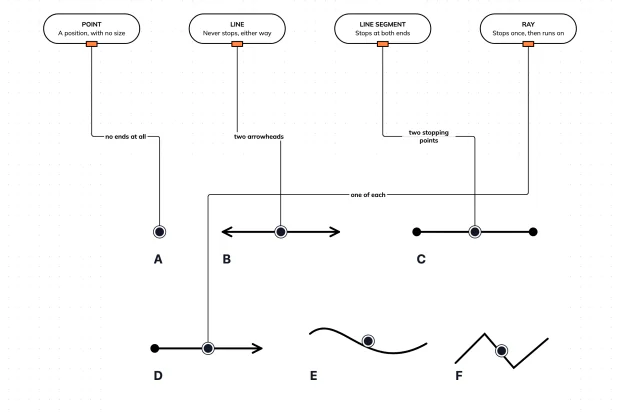
What Are a Point, a Line, a Segment and a Ray?
Every shape you will ever meet is built from four ideas, and they differ in nothing except whether they end. A point has no size, a line never stops, a segment stops twice and a ray stops once. Tell them apart on a real drawing in an interactive playground.
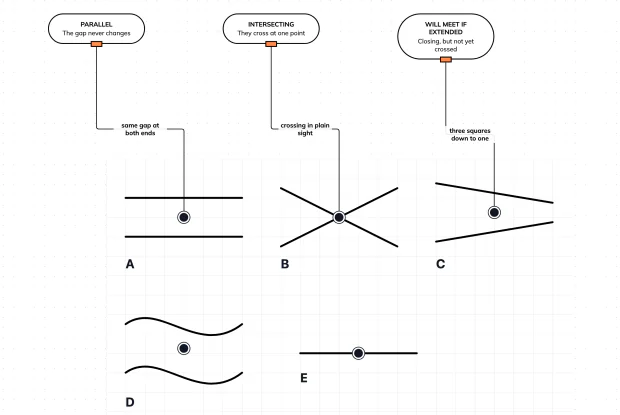
What Are Parallel and Intersecting Lines?
Two straight lines on a flat page either cross somewhere or never do — there is no third option. Parallel means the gap never changes, which is a claim you can check by measuring in two places rather than trusting your eye. Sort real pairs of lines in an interactive playground.
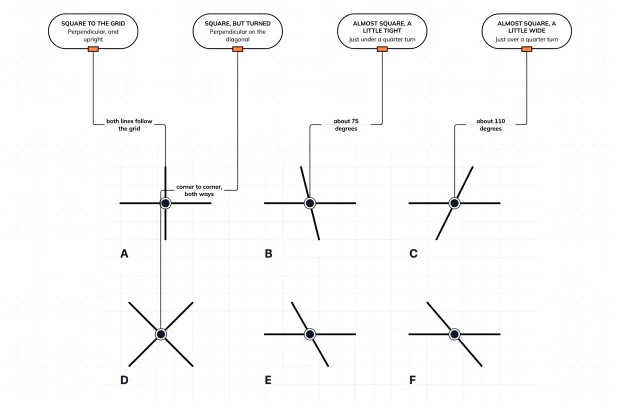
What Are Perpendicular Lines and Right Angles?
A right angle is a quarter turn, and two lines that cross at one are perpendicular. It is the one angle buildings, screens, paper and tiles are all built around, which is why a crossing that is nearly square is a problem rather than a near-enough. Pick the true right angles out of six crossings.
What Is an Angle, Actually?
An angle is not the corner and it is not the two lines — it is the amount of turning between them. That is why a long arm and a short arm can hold exactly the same angle, and why stretching a drawing changes nothing. Name the parts of a real angle in an interactive playground.
What Are the Types of Angles?
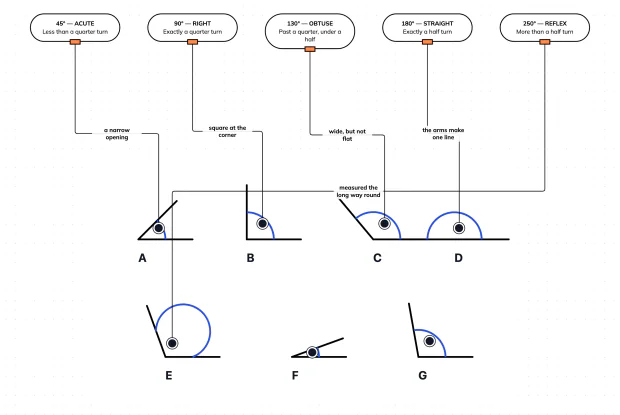
Every angle there is falls into one of five kinds, and the boundaries are set by two landmarks: the quarter turn and the half turn. Once those are fixed, acute, right, obtuse, straight and reflex sort themselves. Match five sizes to the angles that show them in an interactive playground.
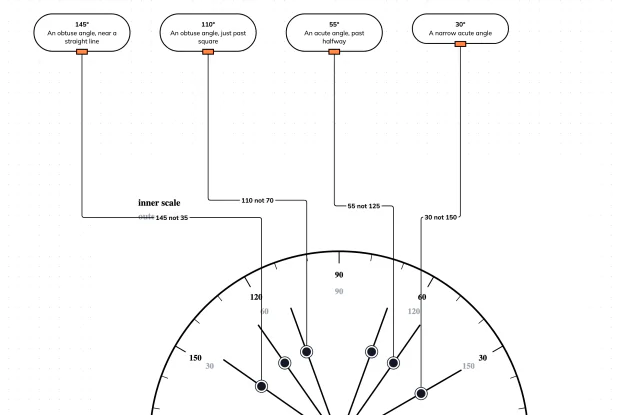
How Do You Measure an Angle with a Protractor?
A protractor has two scales running opposite ways, and picking the wrong one is the mistake everybody makes. Match four angles to the rays that make them in an interactive playground.