What Are a Point, a Line, a Segment and a Ray?
Root Concept
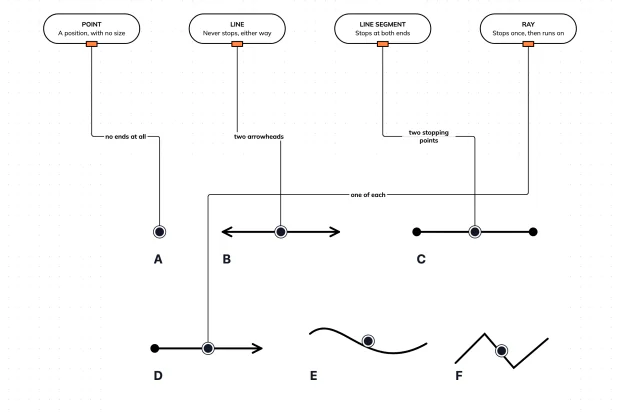
A point marks a position with no size; a line is straight and endless; a line segment is the part between two ends; a ray starts at one end and continues for ever — so the four differ only in how many ends they have.
CodePLU Goal
Upgrading Human Mental Models
Learn how to think in Workflows

Concept Development By codeplu.com
Why Start With Things You Cannot Actually Draw?
Geometry begins with four words, and all four describe something you cannot put on paper properly. A point has no width at all, so the dot you draw is already too big. A line goes on for ever in both directions, so the one you draw has been cut short at both ends by the edge of the page.
That sounds like a problem and it is actually the point. These are ideas rather than objects, and the drawings are reminders of them — which is why the marks at the ends matter so much. An arrowhead is not decoration. It is the drawing saying 'this carries on past where I stopped drawing it'.
Once you read the ends, the four separate cleanly. A point has no ends because it has no length. A line has none because it never finishes. A segment has two, because it is the piece between them. A ray has exactly one, which is why it is the odd and useful one: it starts somewhere definite and then goes on for ever.
Four Ideas, Told Apart by Their Ends
What exactly is a point?
A point marks a position and nothing else. It has no width, no height and no thickness — it is pure location, the answer to 'where' with no 'how big' attached. The dot you draw for one is a compromise: it must be visible, so it has to have some size, but the real point is the exact middle of that dot and nothing more. Points are usually named with a capital letter, so people speak of point A or point B, and that naming is what makes everything afterwards possible. A line segment is described by the two points at its ends. An angle is described by three points. A triangle by three. Without an agreed way to say 'this exact spot', none of the later definitions could be written down at all. It is worth getting comfortable with the idea that something can be real and useful while having no size.
How is a line different from a line segment?
A line is straight and endless. It carries on for ever in both directions, which is why it is drawn with an arrowhead at each end — the arrowheads are saying that the drawing ran out of paper, not that the line ran out. A line segment is a piece cut from a line: it has two definite ends, and those ends are points. So a segment has a length you can measure, and a line does not. That difference is the reason segments do almost all the work in practical geometry. The sides of a triangle are segments. The edges of a rectangle are segments. Anything you could measure with a ruler is a segment, because a ruler needs something to start at and something to stop at. Lines matter more when you are reasoning about directions and crossings, where where a thing ends is beside the point.
What is a ray, and where do you meet one?
A ray has one end and no other. It begins at a definite point — called its endpoint — and then continues for ever in one direction, so it is drawn with a dot at the start and an arrowhead at the finish. The everyday example is in the name. A beam of light from a torch starts at the bulb and travels outward until something stops it; while it is travelling, it has a beginning and no visible end. Rays matter more than they first appear, because an angle is made of two rays sharing an endpoint. That shared point becomes the angle's corner, and the two rays become its arms. So the next topic is built directly on this one: if a ray is not clear, an angle cannot be. Order matters when naming a ray, too — ray AB starts at A and goes through B, while ray BA starts at B and goes the other way.
Why must all four of these be straight?
Because straightness is what makes them measurable and predictable, and it is the quiet condition in all four definitions. A curve joining two points has a length, but there are infinitely many curves between the same two points and each has a different one. There is only ever one straight path, which is why a segment's length is a single definite number rather than a matter of which route you took. This is also the reason the two extra drawings in the playground below fit none of the four names. A curve is not a line, a segment or a ray, however neatly it is drawn, because it does not go the same direction all the way along. A zigzag fails for a related reason: it is made of several segments joined end to end, so it is a chain of four things rather than one thing. Every name here describes something with a single unchanging direction.
Real World Example
Three Places These Turn Up By Name
Each of these depends on knowing whether a thing stops, and where:
A torch beam in the dark
a ray
Switch on a torch in a dark field and the beam starts precisely at the bulb and carries on until something interrupts it. That is a ray in the most literal sense — one definite endpoint, one direction, and no end of its own. It is also a good illustration of why rays need an order in their name: the beam from the torch to the tree is a completely different thing from a beam that would run from the tree back to the torch, even though both lie along the same straight path. Direction is part of what a ray is, not an extra detail attached to it.
The edge of a table
a line segment
A table edge begins at one corner and stops at the next, which makes it a segment and gives it a length you can put a tape measure against. This is why nearly everything in carpentry, tiling and construction is segments rather than lines: real materials are cut to a size, and a size is exactly what having two ends gives you. When a builder talks about running a line across a room they are speaking loosely — what they mark is a segment, bounded by the two walls. The endless version would be no use, because it could not be cut, priced or carried.
A pin in a map
a point
A pin stuck into a map is standing in for a point: the position matters and the pin's own thickness is an accident of it being a physical object. Anyone who has argued about whether a route passes through a town has met the awkwardness directly — at the scale of the map the town is a dot, while on the ground it is several miles across. The mathematical idea of a point with no size is the clean version of what the pin is trying to be, and the reason coordinates can be exact even when the pin is not.
FAQs
Final Words
Four ideas, and they differ in one thing only: where they stop. A point has no ends because it has no length. A line has none because it never finishes. A segment has two. A ray has one, and that is what makes it the useful odd one out.
Read the marks and the names look after themselves. An arrowhead says the drawing stopped and the thing did not; a dot says the thing itself stops here. Nothing else on the page is doing any work.
Every definition after this leans on these. An angle is two rays sharing an endpoint. A polygon is segments joined end to end. Get the four straight now and the rest of geometry stops needing to be memorised.
Continue This Track
This concept is part 1 of The Building Blocks of Shape.
What Are a Point, a Line, a Segment and a Ray?
Every shape you will ever meet is built from four ideas, and they differ in nothing except whether they end. A point has no size, a line never stops, a segment stops twice and a ray stops once. Tell them apart on a real drawing in an interactive playground.
What Are Parallel and Intersecting Lines?
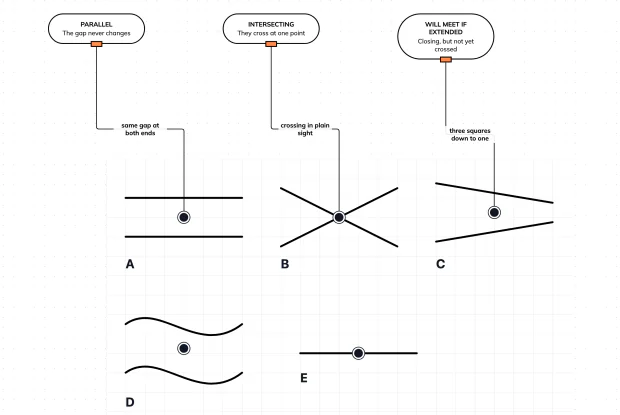
Two straight lines on a flat page either cross somewhere or never do — there is no third option. Parallel means the gap never changes, which is a claim you can check by measuring in two places rather than trusting your eye. Sort real pairs of lines in an interactive playground.
What Are Perpendicular Lines and Right Angles?
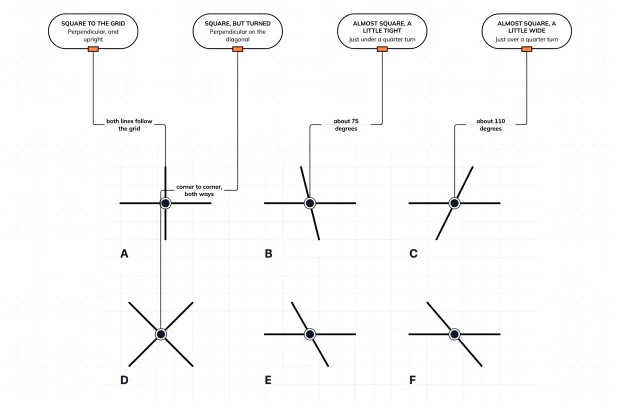
A right angle is a quarter turn, and two lines that cross at one are perpendicular. It is the one angle buildings, screens, paper and tiles are all built around, which is why a crossing that is nearly square is a problem rather than a near-enough. Pick the true right angles out of six crossings.
What Is an Angle, Actually?
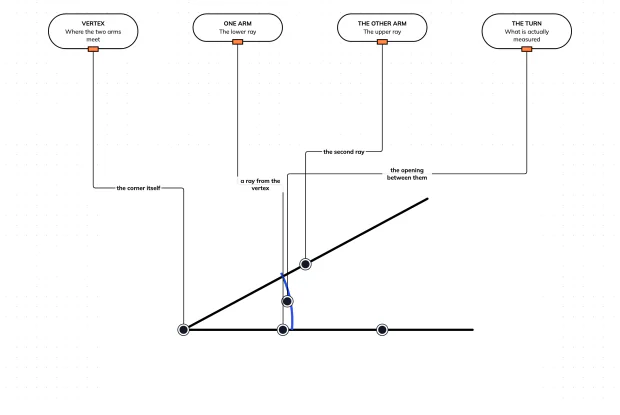
An angle is not the corner and it is not the two lines — it is the amount of turning between them. That is why a long arm and a short arm can hold exactly the same angle, and why stretching a drawing changes nothing. Name the parts of a real angle in an interactive playground.
What Are the Types of Angles?
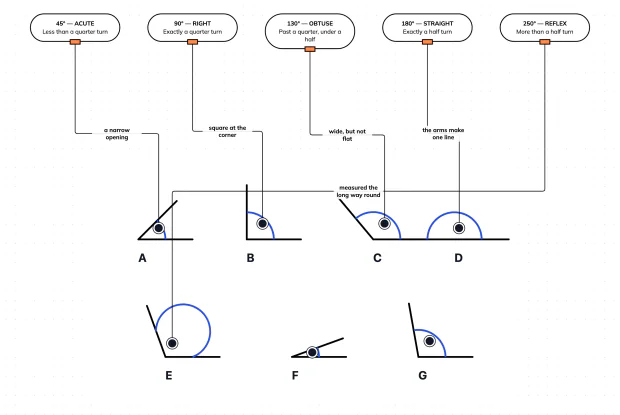
Every angle there is falls into one of five kinds, and the boundaries are set by two landmarks: the quarter turn and the half turn. Once those are fixed, acute, right, obtuse, straight and reflex sort themselves. Match five sizes to the angles that show them in an interactive playground.
How Do You Measure an Angle with a Protractor?
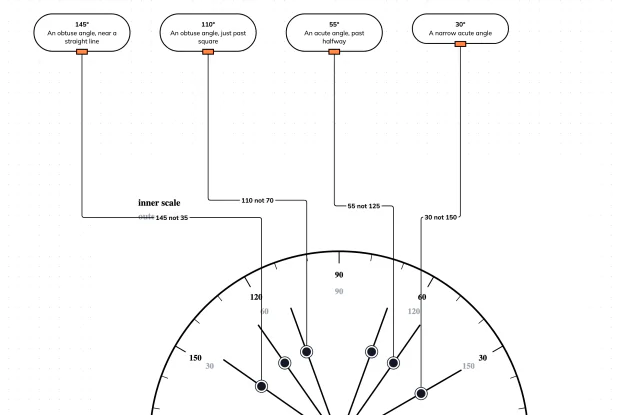
A protractor has two scales running opposite ways, and picking the wrong one is the mistake everybody makes. Match four angles to the rays that make them in an interactive playground.