How Do You Measure an Angle with a Protractor?
Root Concept
Read the protractor scale whose zero sits on the arm you are measuring from.
CodePLU Goal
Upgrading Human Mental Models
Learn how to think in Workflows

Concept Development By codeplu.com
Two scales, running opposite ways. The right one is whichever reads zero along the arm you started from.
The Instrument With Two Answers on It
The last tutorial sorted angles by size: acute below a quarter turn, right at exactly a quarter, obtuse between a quarter and a half, then straight and reflex. Naming which kind an angle is and putting an actual number on it are two different skills, though, and the second one needs an instrument. This is where the track stops reasoning and starts measuring.
A protractor is deceptively awkward for something so plain. The instrument itself is simple: a semicircle with the degrees marked round the curved edge and a centre point on the flat one. What catches people is that there are two sets of numbers, running in opposite directions, and only one of them is the answer. Read the wrong set and an angle of 55° comes out as 125°, which is wrong by a wide margin and still looks like a sensible reading.
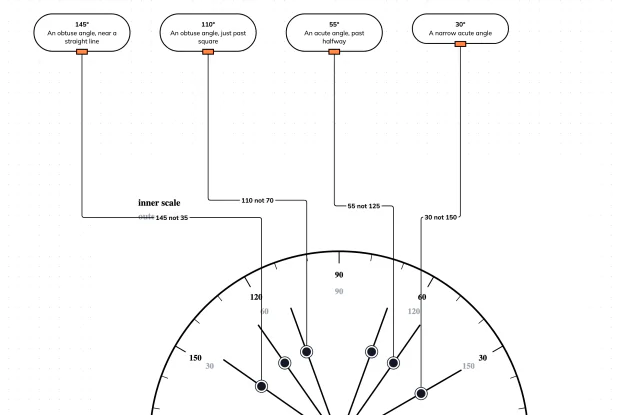
The fix is a habit rather than a trick, and it takes one extra second: before reading anything, check which scale has its zero sitting on the arm you are measuring from. That is the scale to use. In the playground below, two of the six rays are exactly the angles you get by reading the other scale.
Lining It Up, Reading It Off, and Checking It
What has to line up before you read anything?
Three things, and all three matter. The protractor's centre — usually a small hole or a cross on the flat edge — must sit exactly on the point of the angle, called the vertex. One arm of the angle must lie flat along the straight edge of the protractor. And the zero of a scale must sit on that same arm. Get the centre slightly off and every reading drifts; let the arm sit at a slight angle to the straight edge and the error is whatever that slant was. Most measuring mistakes are not misread numbers at all, they are a protractor that was never lined up properly in the first place.
Why are there two scales?
So that the protractor works whichever way round the angle sits. An angle might open to the left or to the right, and without two scales you would have to turn the protractor over, which is awkward and cannot be done at all with the common kind that has printing on one side. The inner scale here reads zero at the right end and 180 at the left; the outer one runs the other way. The pair always add to 180, so a ray reading 55 on one scale reads 125 on the other. That is why a misread is never slightly wrong — it is wrong by the amount the angle differs from 90°.
How do you choose the right scale?
Follow the arm you are measuring from out to the edge of the protractor and see which number it meets. If it meets a zero, that is your scale, and you read the other arm on the same set of numbers. In the playground the blue arm runs to the right, where the inner scale reads 0 and the outer reads 180, so every answer comes from the inner scale. Had the blue arm pointed left instead, the outer scale would be the one to use and every reading would change. Nothing about the protractor decides this — the arm you start from does, which is why the same ray can honestly read two different numbers depending on how it was set up.
What is the quickest check on a reading?
Look at the angle and decide whether it is acute or obtuse before you read any number. An acute angle is less than 90° and looks visibly narrower than a square corner; an obtuse one is more than 90° and looks visibly wider. If the angle is clearly narrow and your reading says 125°, you have read the wrong scale, and you know it without measuring again. This catches almost every scale error, because the two readings always sit on opposite sides of 90°. It costs nothing and it is the habit that separates careful work from lucky work. A right angle is the one case where both scales agree, since 90 and 180 − 90 are the same number.
Real World Example
Setting the Angle on a Mitre Saw
A mitre saw has the same two-scale problem as a protractor, with a more expensive consequence for getting it wrong.
Step 1
The saw reads from its own zero
A mitre saw swivels on a scale marked in degrees either side of a central zero, and that zero means a square cut straight across the timber. Set it to 45 and the blade crosses at 45° to the edge. The important detail is that the scale measures from the square position, not from the edge of the wood, so a joiner wanting a cut at 45° to the edge sets 45, while one working from a drawing that gives the angle the other way has to subtract from 90 first. It is exactly the protractor problem: the number means nothing until you know which line it is measured from.
Step 2
Two pieces, half the angle each
Two pieces of skirting board meeting at a corner each take half of the turn between the walls. A square corner is 90°, so each piece is cut at 45°. A bay window corner of 135° means two cuts of 67.5°. Joiners measure the actual wall angle with a sliding bevel and a protractor rather than trusting that a corner is square, because very few are. Reading that measurement off the wrong scale would turn a 40° corner into 140°, and the two pieces would meet at a gap wide enough to put a finger through.
Step 3
Check against what you can see
Before cutting, the joiner looks at the blade and asks whether the angle looks shallow or steep, exactly as you check acute against obtuse on a protractor. Timber cut at the wrong angle is scrap, and skirting comes in long expensive lengths, so the eye check is worth the two seconds every single time. The trade saying is to measure twice and cut once, and the second measurement is really a sanity check on which scale was read rather than a repeat of the same action. A joiner who has misread a scale rarely misreads it again in the same direction, so the second look catches it.
FAQs
Final Words
Measuring an angle is three alignments and one decision. The centre of the protractor goes on the vertex, one arm lies along the straight edge, and that arm must sit on a zero. The decision is which of the two scales to read, and the answer is always the one whose zero is on the arm you started from — not the inner one, not the outer one, but whichever that turns out to be.
The check costs nothing: decide whether the angle is acute or obtuse before you read the number, because the two possible readings always straddle 90°. With the protractor understood you can put a number on any angle in front of you, not just a name, and that is the last of the building blocks. Everything after this point in geometry assembles shapes out of the points, lines and angles this track has set out.
Continue This Track
This concept is part 6 of The Building Blocks of Shape.
What Are a Point, a Line, a Segment and a Ray?
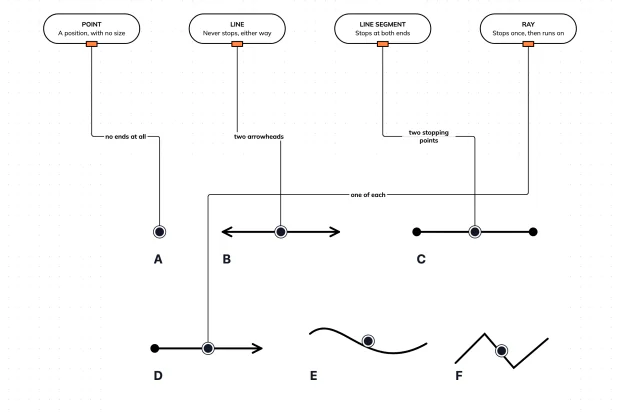
Every shape you will ever meet is built from four ideas, and they differ in nothing except whether they end. A point has no size, a line never stops, a segment stops twice and a ray stops once. Tell them apart on a real drawing in an interactive playground.
What Are Parallel and Intersecting Lines?
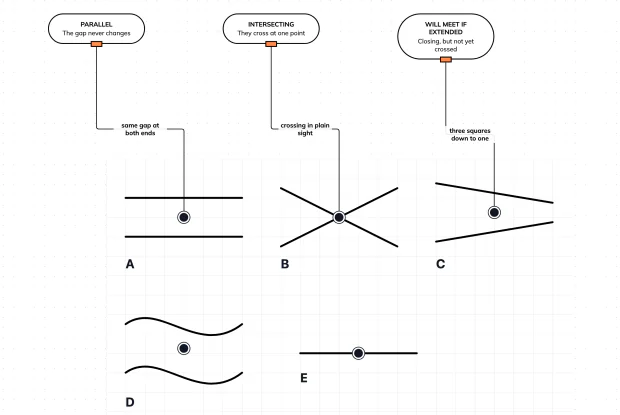
Two straight lines on a flat page either cross somewhere or never do — there is no third option. Parallel means the gap never changes, which is a claim you can check by measuring in two places rather than trusting your eye. Sort real pairs of lines in an interactive playground.
What Are Perpendicular Lines and Right Angles?
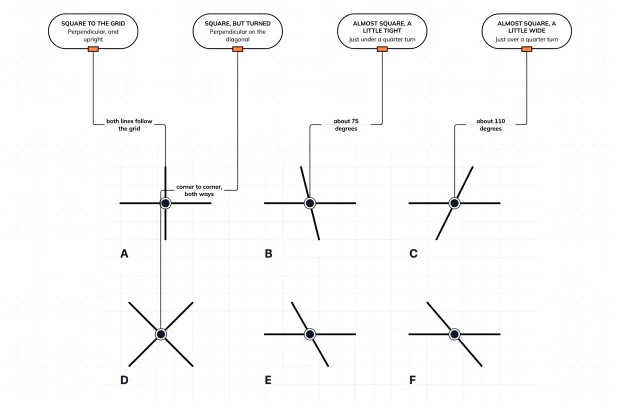
A right angle is a quarter turn, and two lines that cross at one are perpendicular. It is the one angle buildings, screens, paper and tiles are all built around, which is why a crossing that is nearly square is a problem rather than a near-enough. Pick the true right angles out of six crossings.
What Is an Angle, Actually?
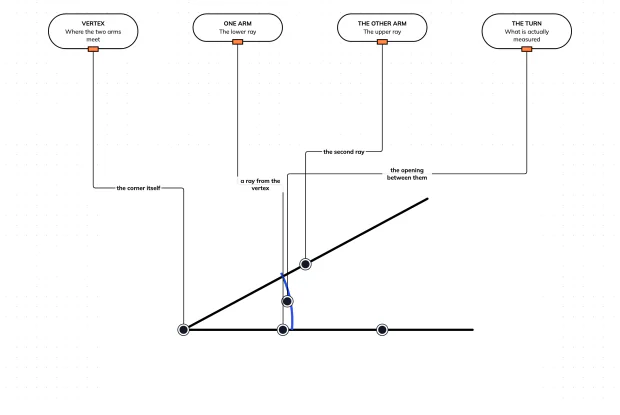
An angle is not the corner and it is not the two lines — it is the amount of turning between them. That is why a long arm and a short arm can hold exactly the same angle, and why stretching a drawing changes nothing. Name the parts of a real angle in an interactive playground.
What Are the Types of Angles?
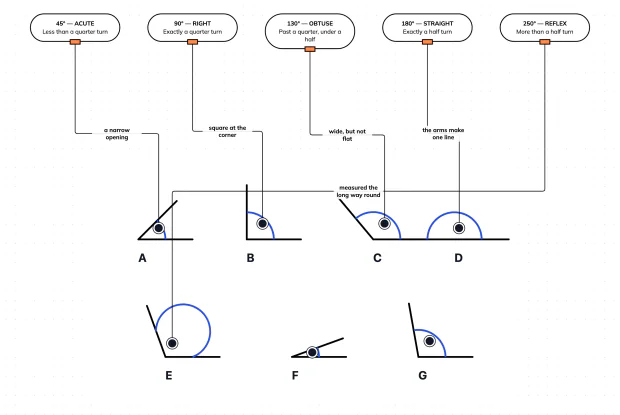
Every angle there is falls into one of five kinds, and the boundaries are set by two landmarks: the quarter turn and the half turn. Once those are fixed, acute, right, obtuse, straight and reflex sort themselves. Match five sizes to the angles that show them in an interactive playground.
How Do You Measure an Angle with a Protractor?
A protractor has two scales running opposite ways, and picking the wrong one is the mistake everybody makes. Match four angles to the rays that make them in an interactive playground.