The Building Blocks of Shape
Before any shape can be named, the things it is made of have to be pinned down — and they differ from one another in surprisingly little. A point, a line, a segment and a ray are separated by one question only: where do they stop? Two lines drawn on a page either meet or they never will, and the moment they meet at a square corner they earn a name of their own. An angle turns out not to be a shape at all but an amount of turning between two rays, which is why it is measured in degrees rather than centimetres — and once that lands, sorting angles into acute, right, obtuse, straight and reflex stops being vocabulary and becomes reading a size off a figure. The track then picks up a protractor, because naming an angle's kind and measuring it are different skills and the second needs an instrument — one with two scales running opposite ways, only one of which is the answer. Everything later in geometry is assembled from these ideas, so they are worth getting exactly right.
CodePLU Goal
Upgrading Human Mental Models
Learn how to think in Workflows
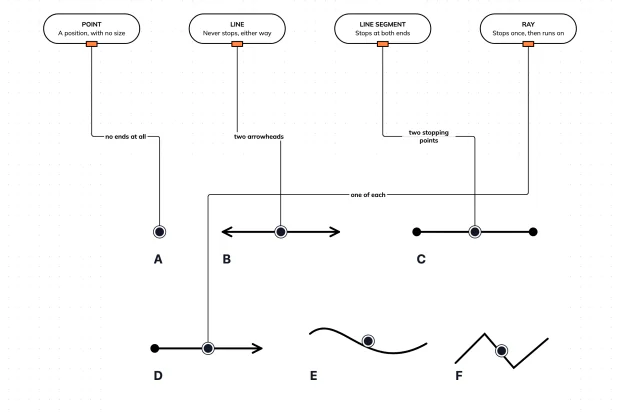
What Are a Point, a Line, a Segment and a Ray?
Every shape you will ever meet is built from four ideas, and they differ in nothing except whether they end. A point has no size, a line never stops, a segment stops twice and a ray stops once. Tell them apart on a real drawing in an interactive playground.
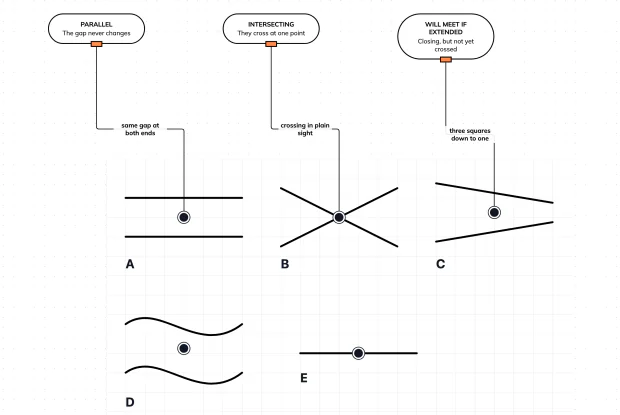
What Are Parallel and Intersecting Lines?
Two straight lines on a flat page either cross somewhere or never do — there is no third option. Parallel means the gap never changes, which is a claim you can check by measuring in two places rather than trusting your eye. Sort real pairs of lines in an interactive playground.
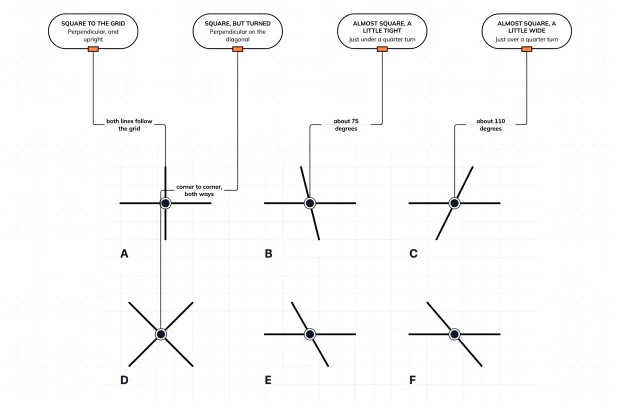
What Are Perpendicular Lines and Right Angles?
A right angle is a quarter turn, and two lines that cross at one are perpendicular. It is the one angle buildings, screens, paper and tiles are all built around, which is why a crossing that is nearly square is a problem rather than a near-enough. Pick the true right angles out of six crossings.
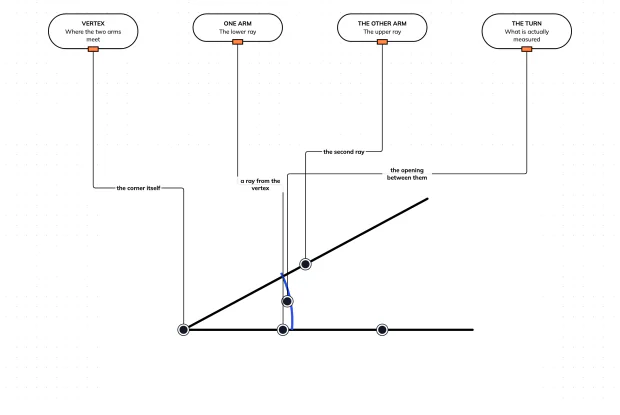
What Is an Angle, Actually?
An angle is not the corner and it is not the two lines — it is the amount of turning between them. That is why a long arm and a short arm can hold exactly the same angle, and why stretching a drawing changes nothing. Name the parts of a real angle in an interactive playground.
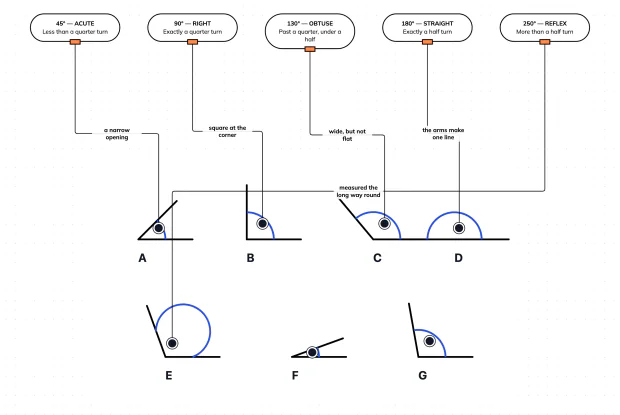
What Are the Types of Angles?
Every angle there is falls into one of five kinds, and the boundaries are set by two landmarks: the quarter turn and the half turn. Once those are fixed, acute, right, obtuse, straight and reflex sort themselves. Match five sizes to the angles that show them in an interactive playground.
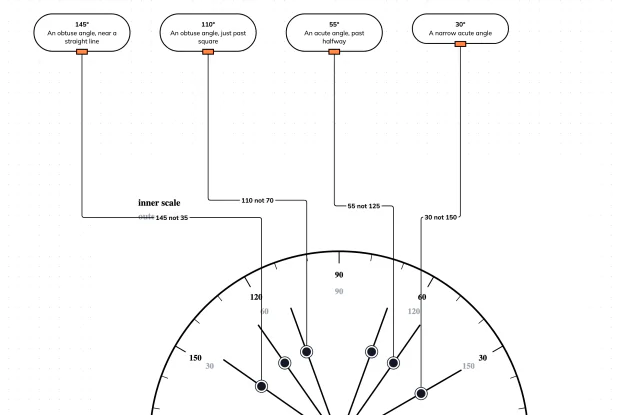
How Do You Measure an Angle with a Protractor?
A protractor has two scales running opposite ways, and picking the wrong one is the mistake everybody makes. Match four angles to the rays that make them in an interactive playground.