What Are the Types of Angles?
Root Concept
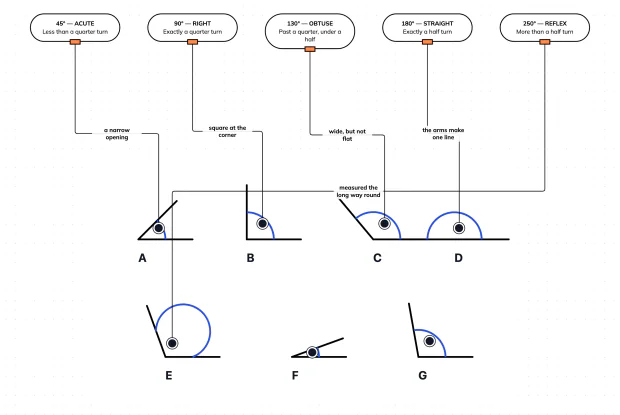
Angles are named by size against two landmarks: below 90° is acute, exactly 90° is right, between 90° and 180° is obtuse, exactly 180° is straight, and above 180° is reflex.
CodePLU Goal
Upgrading Human Mental Models
Learn how to think in Workflows

Concept Development By codeplu.com
Why Do Angles Need Five Different Names?
Angles come in every size from nothing at all up to a full turn, and it would be impractical to describe each one by its number every time. So they are grouped, and the grouping is not arbitrary — it is built around the two sizes that matter most, the quarter turn and the half turn.
The quarter turn is ninety degrees, the right angle, and it is the dividing line between narrow and wide. Anything smaller is acute. Anything larger, up to the half turn, is obtuse. The half turn itself is a hundred and eighty degrees, where the two arms have opened out into a single straight line, and that one is called straight for exactly that reason.
Past a hundred and eighty the angle is reflex, and reflex angles are the ones people find strangest — because you are now measuring the opening the long way round, on the outside. Five names, two landmarks, and every angle that exists falls into one of them.
Five Names, Two Landmarks
What are acute, right and obtuse angles?
An acute angle is any angle smaller than a right angle — under ninety degrees, a narrow opening. A right angle is exactly ninety, the quarter turn, and it is the reference the other two are defined against. An obtuse angle is bigger than a right angle but smaller than a straight one, so between ninety and a hundred and eighty degrees. The names carry their meanings if you know where to look: acute comes from a word meaning sharp or pointed, which is what a narrow angle looks like, and obtuse comes from one meaning blunt, which is what a wide one looks like. That is worth knowing because it is far easier to remember a picture than a pair of unfamiliar Latin words, and the mistake of swapping the two is by far the commonest in this topic. Sharp means small, blunt means wide.
What is a straight angle, and is it really an angle?
A straight angle is a hundred and eighty degrees — a half turn — and at that size the two arms point in exactly opposite directions, so together they form a single straight line. It does look odd to call a straight line an angle, and people often assume it must be a mistake. It is not. Think again about turning on the spot: face the door, then turn until you are facing directly away from it. You have turned through a definite amount, half a full turn, and the fact that the start and end directions lie along one line does not make that turn stop existing. The straight angle also does real work. It is why the angles on one side of a straight line always add to a hundred and eighty, which is the fact the proof about a triangle's angles rests on entirely.
What makes a reflex angle different?
A reflex angle is bigger than a straight angle — more than a hundred and eighty degrees and less than a full three hundred and sixty. The thing to understand is that a reflex angle is never alone. Any two arms create two angles at once: the opening on one side, and the opening on the other side going the long way round. Those two always add up to three hundred and sixty, because between them they cover the whole turn. So when a drawing shows a reflex angle, the arc is drawn round the outside, and that arc is the only thing telling you which of the two openings is meant. Without it you would naturally read the smaller one. This is why the arc matters more here than anywhere else, and why the reflex angle in the practice below has its arc sweeping round the outside of the arms rather than nestling in the corner.
How do you judge which type an angle is?
Compare it against the right angle rather than trying to read a number off it. The corner of a sheet of paper or a book is a right angle you can hold up against the drawing, and the question becomes narrower than that or wider than that, which the eye is genuinely good at. Comparing is easy where measuring is hard. Then use the straight line as the second landmark: if the arms have opened past a straight line, you are into reflex territory. This two-landmark method is also why the arms' length is such a trap here. A long-armed acute angle looks impressively large on the page and is still acute, because the opening has not changed. In the practice below every angle is drawn with arms of exactly the same length for precisely that reason — so the only thing left to compare is the thing that actually matters.
Real World Example
Three Angles You Could Point At Today
The five names are more useful than they look once you start noticing them:
A laptop screen, open for typing
about 100° — obtuse
Most people set a laptop screen a little past upright, at roughly a hundred degrees to the keyboard, which is an obtuse angle. It is a good example of why the band matters more than the number: nobody measures their laptop, but everybody can tell it is open past square and nowhere near flat. Push it right back until the screen lies flat in line with the keyboard and you would have a straight angle of a hundred and eighty. Close it until the two touch and the angle approaches zero. The whole range is available on one hinge.
The corner of a book
exactly 90° — right
Every sheet of paper and every book in the house has right angles at its corners, which makes them the most available measuring tool you own. Hold a book corner against any angle in a drawing and you can immediately say whether the drawing is narrower or wider, which is the entire skill of classifying angles by eye. This is also why paper is such a good teaching aid for the topic — the right angle is not an abstraction you have to imagine, it is a thing sitting on the desk that can be picked up and compared.
The reflex side of a clock at four o'clock
240° — reflex
At four o'clock the hands are a hundred and twenty degrees apart the short way round, which is obtuse. Go the other way, round the outside past twelve, and the same two hands span two hundred and forty degrees — a reflex angle. Both are correct, and they add to three hundred and sixty as every such pair must. It is the clearest everyday illustration that two arms always make two angles, and that a drawing has to say which one it means.
FAQs
Final Words
Five names and two landmarks. Below the quarter turn is acute, exactly a quarter is right, between a quarter and a half is obtuse, exactly a half is straight, and past a half is reflex. Every angle that exists lands in one of them.
Sharp means small and blunt means wide, which is the whole of acute versus obtuse and the pair most often swapped. And a straight line really is an angle — a half turn — which is why angles along a line add to 180.
Remember that two arms always make two angles, adding to a full turn between them. The arc on the drawing is the only thing that says which one is meant, and it matters most of all for the reflex one. Next comes putting a number on an angle rather than a name, which takes a protractor and one careful decision about which of its two scales to read.
Continue This Track
This concept is part 5 of The Building Blocks of Shape.
What Are a Point, a Line, a Segment and a Ray?
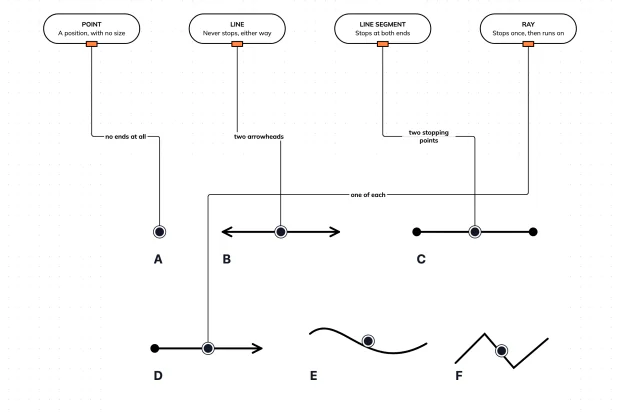
Every shape you will ever meet is built from four ideas, and they differ in nothing except whether they end. A point has no size, a line never stops, a segment stops twice and a ray stops once. Tell them apart on a real drawing in an interactive playground.
What Are Parallel and Intersecting Lines?
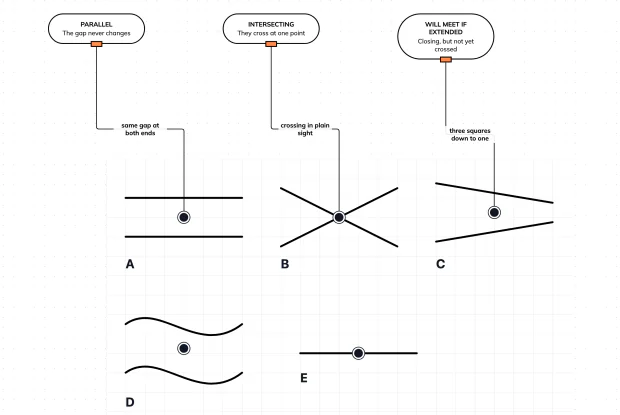
Two straight lines on a flat page either cross somewhere or never do — there is no third option. Parallel means the gap never changes, which is a claim you can check by measuring in two places rather than trusting your eye. Sort real pairs of lines in an interactive playground.
What Are Perpendicular Lines and Right Angles?
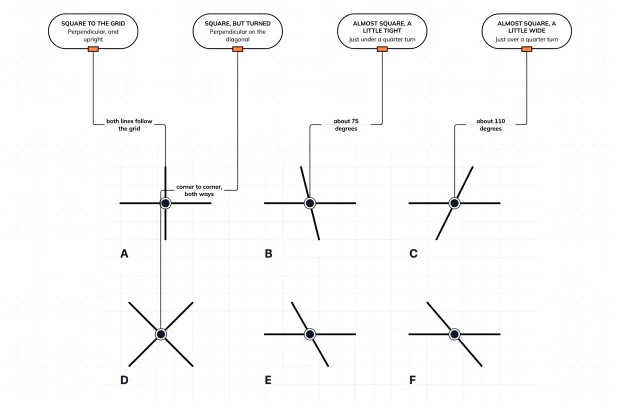
A right angle is a quarter turn, and two lines that cross at one are perpendicular. It is the one angle buildings, screens, paper and tiles are all built around, which is why a crossing that is nearly square is a problem rather than a near-enough. Pick the true right angles out of six crossings.
What Is an Angle, Actually?
An angle is not the corner and it is not the two lines — it is the amount of turning between them. That is why a long arm and a short arm can hold exactly the same angle, and why stretching a drawing changes nothing. Name the parts of a real angle in an interactive playground.
What Are the Types of Angles?
Every angle there is falls into one of five kinds, and the boundaries are set by two landmarks: the quarter turn and the half turn. Once those are fixed, acute, right, obtuse, straight and reflex sort themselves. Match five sizes to the angles that show them in an interactive playground.
How Do You Measure an Angle with a Protractor?
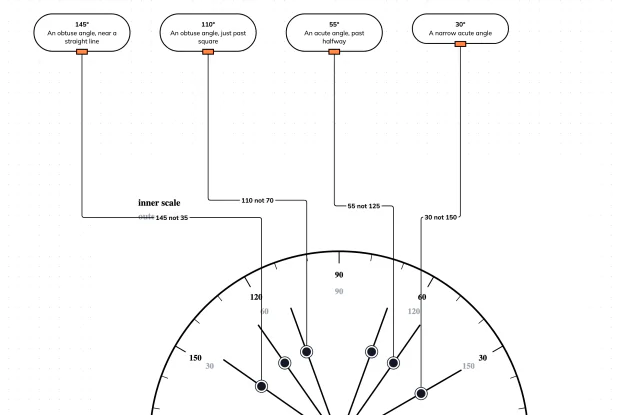
A protractor has two scales running opposite ways, and picking the wrong one is the mistake everybody makes. Match four angles to the rays that make them in an interactive playground.