What Are Parallel and Intersecting Lines?
Root Concept
Two straight lines on a flat surface either intersect at exactly one point or are parallel and never meet, and parallel is identified by the gap between them staying the same the whole way along.
CodePLU Goal
Upgrading Human Mental Models
Learn how to think in Workflows

Concept Development By codeplu.com
Why Do Two Straight Lines Have Only Two Options?
Draw two straight lines anywhere on a flat page and exactly one of two things is true. Either they cross at some point, or they never will no matter how far you extend them. There is no third possibility, and there is no way for two straight lines to cross twice — once they have met and carried on, they are separating for ever.
Lines that cross are called intersecting, and the place they cross is the point of intersection. Lines that never cross are called parallel, and the thing that makes them parallel is that the distance between them never changes. Not stays roughly similar — stays exactly the same, everywhere along their length.
That definition is more useful than it sounds, because it tells you how to check. Eyes are unreliable about this: two lines closing very slightly look convincingly parallel over a short stretch, and would meet somewhere off the page. Measure the gap in two different places instead, and the question stops being a matter of opinion.
Two Lines, One Question: Does the Gap Change?
What makes two lines parallel?
Two lines are parallel when the perpendicular distance between them is the same at every point along their length. The word perpendicular matters there — it means the gap measured straight across, at a right angle, rather than diagonally, because a diagonal measurement would change as you tilted it and would tell you nothing. So parallel is not really a statement about the lines meeting at all. It is a statement about a distance staying constant, and the never-meeting part follows from it: if the gap is always five squares, the lines cannot possibly touch, because touching would need the gap to become zero. This also explains something that surprises people: parallel lines do not have to be horizontal or vertical. Two lines running diagonally across the page are parallel if their gap holds, and a pair of horizontal lines whose gap widens is not parallel at all.
Why can two straight lines never cross twice?
Because two points already decide a straight line completely. Choose any two points on a page and there is exactly one straight line that passes through both — you can check this with a ruler, and you will never find a second. Now suppose two lines crossed at two different places. Both lines would then pass through both of those points, and since only one straight line can do that, the two lines would have to be the same line. So two genuinely different straight lines meet at most once. This is why intersecting lines have a single point of intersection rather than a region or a list of points, and it is a good early example of a proof by contradiction: you assume the thing you doubt, follow it honestly, and arrive somewhere impossible.
How do you tell a near-miss from a real parallel?
By measuring twice, in two places well apart. This is the whole practical skill in the topic, because the eye is genuinely bad at it. Two lines that close by a single square across the width of a page look parallel to almost everybody, and they are not — extended far enough they will certainly meet. The check is quick on a grid: count the squares between the lines at the far left, then count again at the far right. Identical numbers mean parallel. Different numbers mean they are closing or spreading, and closing lines will eventually cross somewhere beyond the paper. Measure at the two ends rather than two places near each other, because a small change spread over a long distance is exactly what a short sample will hide. That is the mistake the playground below is built to catch.
Where do these show up in real life?
Parallel lines are everywhere something needs to keep a constant distance. Railway tracks are the classic case and a good one, because the constant gap is not decorative — it is what allows a train with a fixed axle width to stay on them. Ruled lines on paper, the opposite edges of a door, shelves on a wall and lane markings on a road all rely on the same property. Intersecting lines matter wherever two paths have to share a spot: a crossroads, a pair of scissors, the hands of a clock as they pass. And there is a lovely visual trick hiding in the definition. Railway tracks appear to converge in the distance, and photographs of them seem to show the gap closing — but that is perspective, not geometry. On the ground the gap is unchanged, which is precisely why the train does not derail a mile down the line.
Real World Example
Three Gaps That Have To Hold
In each of these, someone measured the gap in more than one place for a reason:
Railway track
1.435 m, everywhere
Standard gauge track holds its rails one point four three five metres apart along the entire length of the line, and the tolerance for error is a few millimetres. This is parallel in its most demanding form: a train's wheels are on a rigid axle, so a gap that widened by even a little would let the wheels drop between the rails. Track crews measure it repeatedly rather than sighting along the line, precisely because the eye cannot detect a slow drift. The rails appear to meet in the distance in every photograph ever taken of them, which is perspective playing a trick and not the geometry changing.
Ruled lines on a page
8 mm apart
The lines on a sheet of ruled paper are parallel so that every line of handwriting gets the same room as every other. If the gap narrowed down the page the writing would be forced to shrink, and anyone who has written on hand-drawn lines knows exactly how that feels. It is also a good place to see that parallel does not mean equal length — the lines are all the same length here by convention, but two parallel lines can be any lengths at all. Parallel is a claim about the distance between them and nothing else.
A crossroads
one point of intersection
Two roads meeting at a junction are intersecting lines, and the single point where they cross is what every traffic light, give-way marking and roundabout in the world exists to manage. The fact that two straight roads can only cross once is the reason a junction is a place rather than a stretch. Roads that run alongside without meeting need no signals at all, which is the practical difference between the two cases: intersecting lines create a conflict to resolve, parallel ones never do.
FAQs
Final Words
Two straight lines on a flat page have only two options: they cross once, or they never cross. Nothing else is available to them, and no pair of different straight lines can cross twice.
Parallel is a claim about a distance rather than about meeting. The gap, measured straight across, stays the same everywhere — and because it does, the lines cannot ever touch. Direction and length have nothing to do with it.
So check by measuring twice, at the two ends. Lines closing by a single square across a page look parallel to almost anyone, and will still meet somewhere past the edge of it.
Continue This Track
This concept is part 2 of The Building Blocks of Shape.
What Are a Point, a Line, a Segment and a Ray?
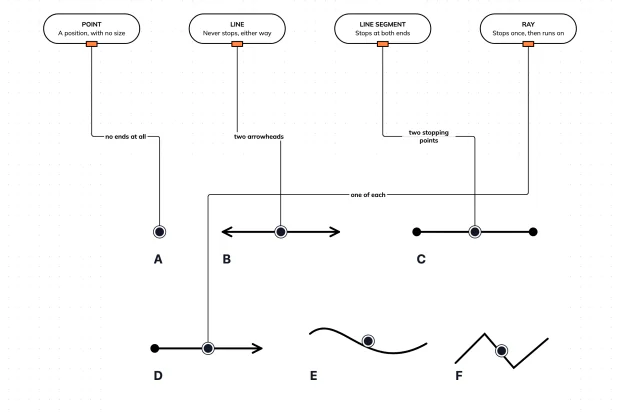
Every shape you will ever meet is built from four ideas, and they differ in nothing except whether they end. A point has no size, a line never stops, a segment stops twice and a ray stops once. Tell them apart on a real drawing in an interactive playground.
What Are Parallel and Intersecting Lines?
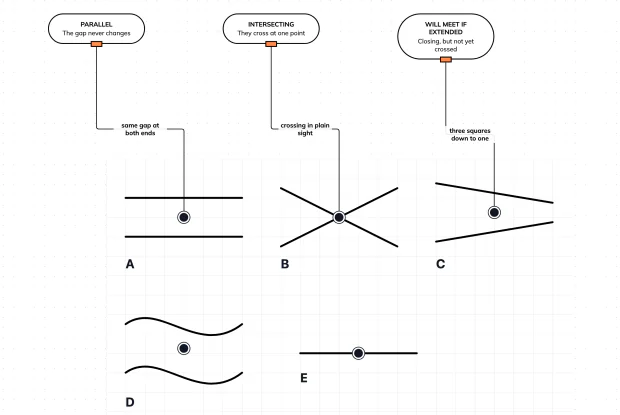
Two straight lines on a flat page either cross somewhere or never do — there is no third option. Parallel means the gap never changes, which is a claim you can check by measuring in two places rather than trusting your eye. Sort real pairs of lines in an interactive playground.
What Are Perpendicular Lines and Right Angles?
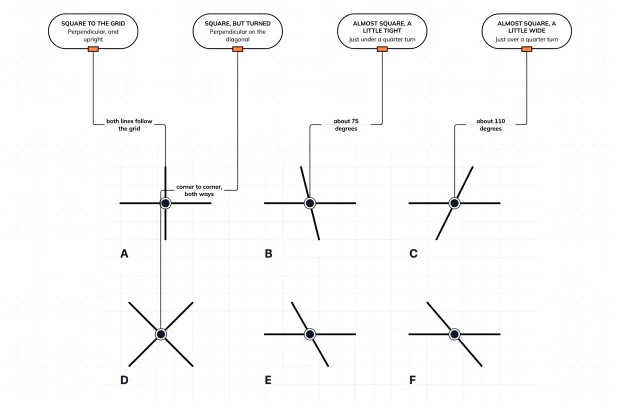
A right angle is a quarter turn, and two lines that cross at one are perpendicular. It is the one angle buildings, screens, paper and tiles are all built around, which is why a crossing that is nearly square is a problem rather than a near-enough. Pick the true right angles out of six crossings.
What Is an Angle, Actually?
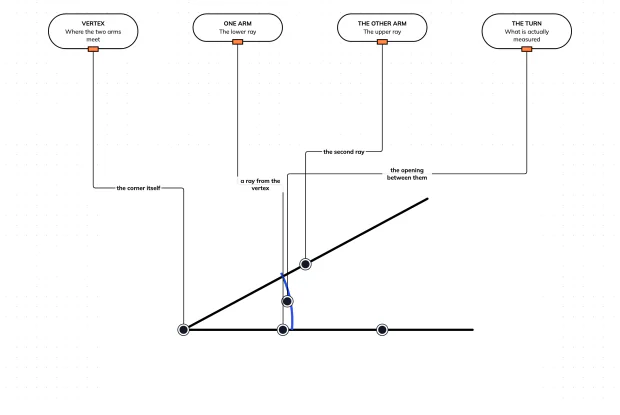
An angle is not the corner and it is not the two lines — it is the amount of turning between them. That is why a long arm and a short arm can hold exactly the same angle, and why stretching a drawing changes nothing. Name the parts of a real angle in an interactive playground.
What Are the Types of Angles?
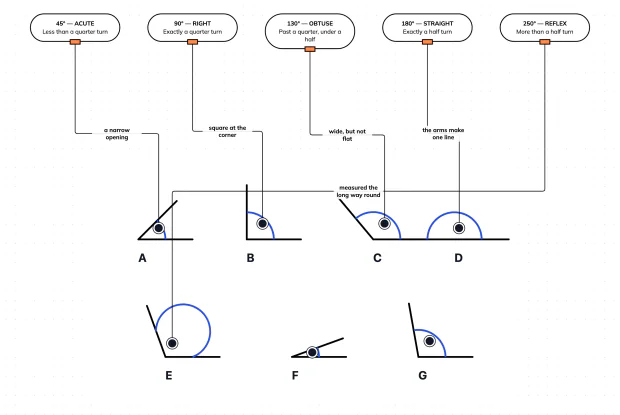
Every angle there is falls into one of five kinds, and the boundaries are set by two landmarks: the quarter turn and the half turn. Once those are fixed, acute, right, obtuse, straight and reflex sort themselves. Match five sizes to the angles that show them in an interactive playground.
How Do You Measure an Angle with a Protractor?
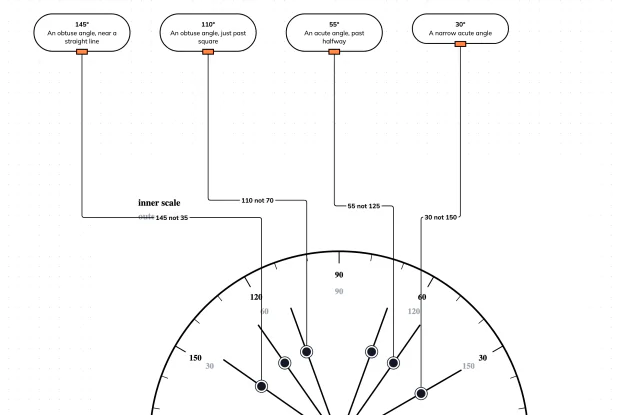
A protractor has two scales running opposite ways, and picking the wrong one is the mistake everybody makes. Match four angles to the rays that make them in an interactive playground.