What Are Perpendicular Lines and Right Angles?
Root Concept
A right angle is exactly a quarter of a full turn, ninety degrees, and two lines crossing at a right angle are perpendicular — a condition that must be checked against something square rather than judged by eye.
CodePLU Goal
Upgrading Human Mental Models
Learn how to think in Workflows

Concept Development By codeplu.com
Why Is One Particular Angle Worth Its Own Name?
Turn all the way round and you have made a full turn. Cut that turn into four equal parts and each one is a right angle — a quarter turn, ninety degrees. Two lines that cross at that exact angle are called perpendicular, and no other angle in geometry gets anything like the attention this one does.
There is a reason for the special treatment. Almost everything people build is built square. Walls meet floors at right angles, paper has square corners, screens and tiles and bricks and windows are rectangles. So the right angle is not one option among many — it is the angle the constructed world is assembled from, which is why it has its own name, its own symbol and its own tools.
And because it is built rather than natural, it has to be checked. Almost square is not square, and a corner a few degrees out will show as a gap at the far end of a long wall. That is why the practice below gives you a grid to test against rather than asking you to judge ninety degrees by looking, which nobody can do reliably.
A Quarter Turn, and Nothing Less
What exactly is a right angle?
A right angle is one quarter of a complete turn. If you stand facing north and turn to face east, you have turned through a right angle; do it four times and you are facing north again, which is what makes a full turn four right angles. Measured in degrees a full turn is three hundred and sixty, so a right angle is ninety of them. The number three hundred and sixty is inherited rather than natural — the Babylonians chose it, and it survives because it divides neatly by so many numbers, including four. What matters here is the quarter, not the ninety: the quarter is the idea and the ninety is the unit it happens to be counted in. A right angle is marked on a drawing with a small square in the corner rather than a curved arc, and that square is doing real work — it declares the angle exact rather than approximate.
What does perpendicular mean?
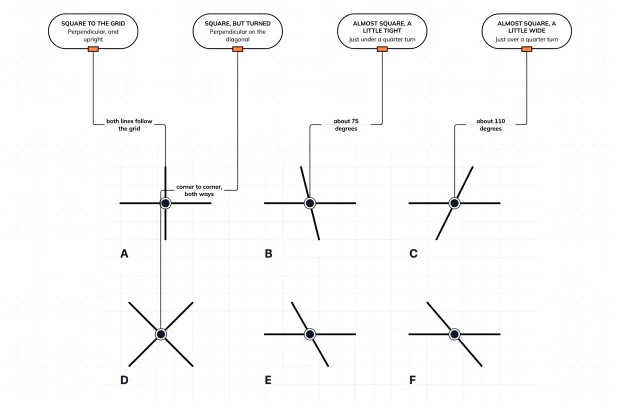
Two lines are perpendicular when they cross at a right angle. That is the whole definition, and it applies to segments and rays just as much as to endless lines. One thing worth noticing is that when two lines cross, four angles are formed around the crossing point — and if one of them is a right angle then all four must be, because they make up a full turn between them and four equal quarters is the only way that works. So perpendicular is not a claim about one corner of the crossing; it is a claim about all of it. Another point that catches people out is that perpendicular has nothing to do with being upright. A pair of lines crossing at forty-five degrees to the page is perpendicular if the angle between the two of them is ninety. Turning the paper does not change any angle on it, and the crossing in the practice below marked 'square, but turned' is exactly that case.
Why can you not judge a right angle by eye?
Because the eye is far better at comparing than at measuring. Shown two angles side by side, most people can say which is larger. Shown one angle alone and asked whether it is exactly ninety degrees, almost nobody can tell the difference between ninety and eighty-five. That gap between comparing and measuring is why builders carry a set square and a spirit level instead of trusting their judgement, and it is why the figure in the practice below deliberately has no right-angle markers drawn on it. Marking the square corners would hand over the answer. A grid does something better: it gives you a known square to compare against, so a crossing is perpendicular when both lines run along the grid — or, for the turned case, when both run corner to corner through the grid squares. That is checking, not guessing, and checking is the actual skill.
Why does almost square cause real problems?
Because a small error at a corner becomes a large one at a distance. A wall set one degree off square drifts by about two centimetres over every metre it runs, so a five metre wall finishes ten centimetres out of position — a gap you could put your hand into. The same applies to a picture frame whose corners are slightly off: the four sides will not close, and the last joint has to be forced or filled. This is why the trades have so many tools dedicated to this one angle. A try square checks a corner, a spirit level checks against gravity, and the three-four-five method checks a large right angle using nothing but a tape measure, since a triangle with sides of three, four and five units always has a right angle between the shorter two. Every one of them exists because almost is not a usable standard when errors accumulate.
Real World Example
Three Corners That Had To Be Exact
The right angle is the angle the built world is assembled from, and each of these shows why:
A doorway in a wall
90° at all four corners
A door frame has to be square or the door will not close properly — it will bind at the top on one side and show a gap at the bottom on the other. Fitters check with a try square at each corner and often by measuring the two diagonals, which are equal in a rectangle and unequal the moment one corner goes out. That diagonal trick is a neat piece of geometry doing practical work: it tests all four corners at once without measuring a single angle, because only a true rectangle has matching diagonals.
Marking out a building's foundations
3-4-5 with a tape measure
Builders setting out foundations need right angles far larger than any set square, so they use a triangle instead. Measure three metres along one line, four along the other, and adjust until the distance between those two marks is exactly five — the corner is then square, guaranteed. It works because of the relationship between the sides of a right-angled triangle, and it has been used for this exact purpose for thousands of years. It needs no tool but a tape, which is why it survives on sites where a spirit level would be useless.
A shelf on a wall
perpendicular to the wall
A shelf must meet its wall at a right angle or objects will slide. Tilt it a couple of degrees downward and anything round begins to roll; tilt it the other way and the shelf looks wrong even to someone who could not say why. This one is interesting because there are two different rights angles in play: the shelf must be perpendicular to the wall, and it should also be level with respect to gravity. On a wall that is itself out of true those two demands disagree, and the fitter has to decide which one the eye will notice.
FAQs
Final Words
A right angle is a quarter turn and nothing less, and two lines crossing at one are perpendicular. Because the four angles round a crossing make a full turn, getting one of them right forces the other three.
It is not about being upright. The angle between the two lines is what decides it, so a crossing on the diagonal is every bit as perpendicular as an upright one — turning the page changes no angle drawn on it.
And it has to be checked rather than judged. Nobody can see the difference between ninety degrees and eighty-five, which is why the trades carry squares and levels, and why a wall one degree out finishes ten centimetres wrong across a room.
Continue This Track
This concept is part 3 of The Building Blocks of Shape.
What Are a Point, a Line, a Segment and a Ray?
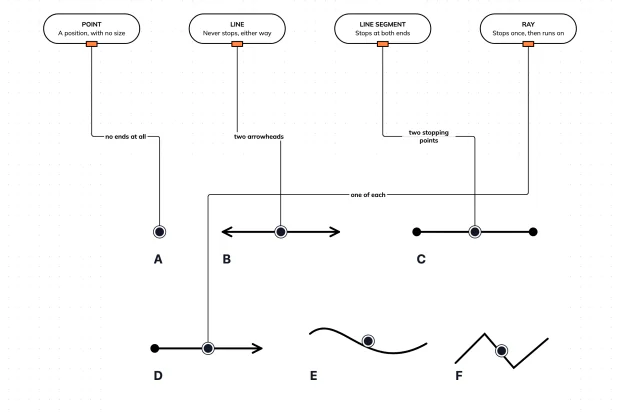
Every shape you will ever meet is built from four ideas, and they differ in nothing except whether they end. A point has no size, a line never stops, a segment stops twice and a ray stops once. Tell them apart on a real drawing in an interactive playground.
What Are Parallel and Intersecting Lines?
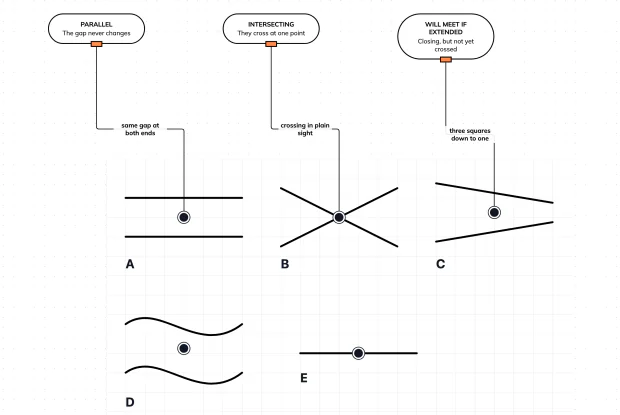
Two straight lines on a flat page either cross somewhere or never do — there is no third option. Parallel means the gap never changes, which is a claim you can check by measuring in two places rather than trusting your eye. Sort real pairs of lines in an interactive playground.
What Are Perpendicular Lines and Right Angles?
A right angle is a quarter turn, and two lines that cross at one are perpendicular. It is the one angle buildings, screens, paper and tiles are all built around, which is why a crossing that is nearly square is a problem rather than a near-enough. Pick the true right angles out of six crossings.
What Is an Angle, Actually?
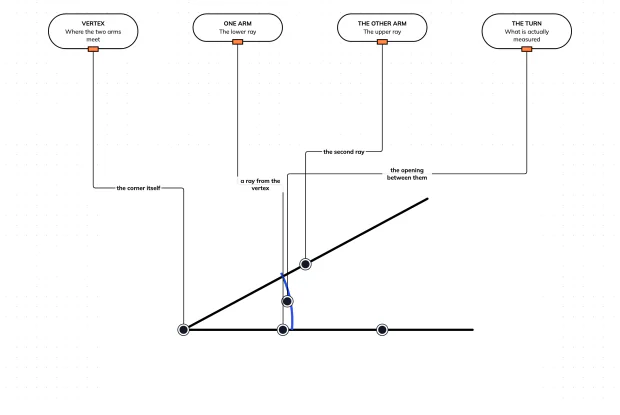
An angle is not the corner and it is not the two lines — it is the amount of turning between them. That is why a long arm and a short arm can hold exactly the same angle, and why stretching a drawing changes nothing. Name the parts of a real angle in an interactive playground.
What Are the Types of Angles?
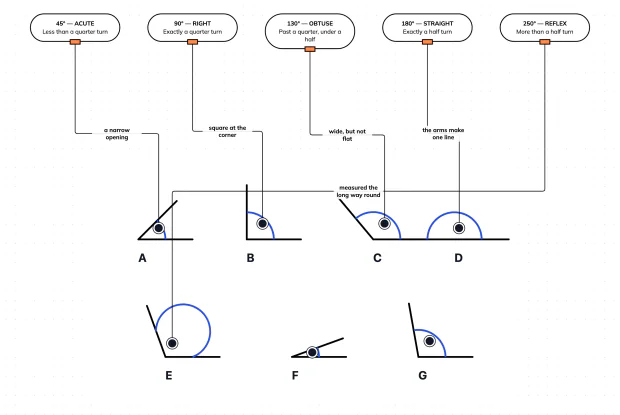
Every angle there is falls into one of five kinds, and the boundaries are set by two landmarks: the quarter turn and the half turn. Once those are fixed, acute, right, obtuse, straight and reflex sort themselves. Match five sizes to the angles that show them in an interactive playground.
How Do You Measure an Angle with a Protractor?
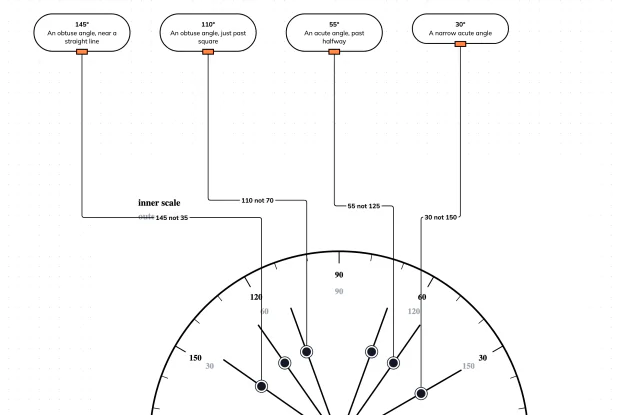
A protractor has two scales running opposite ways, and picking the wrong one is the mistake everybody makes. Match four angles to the rays that make them in an interactive playground.